I Tested the Best AI Stock Picker for 30 Days...Nobody Warned Me About This
Last updated: June 17, 2026
Quick Answer: After 30 days of live testing the best AI stock picker tools available in 2026 — including Danelfin, Tickeron, and Trade Ideas — the results were genuinely useful, occasionally impressive, and full of surprises nobody puts in the marketing copy. AI stock pickers can sharpen your watchlist and filter noise, but they are not a replacement for risk management, position sizing, or a coherent trading system. The tools work best as a signal layer, not a decision engine.
Key Takeaways
- The best AI stock picker in 2026 is not a single app — it depends entirely on your strategy, time horizon, and tolerance for false signals.
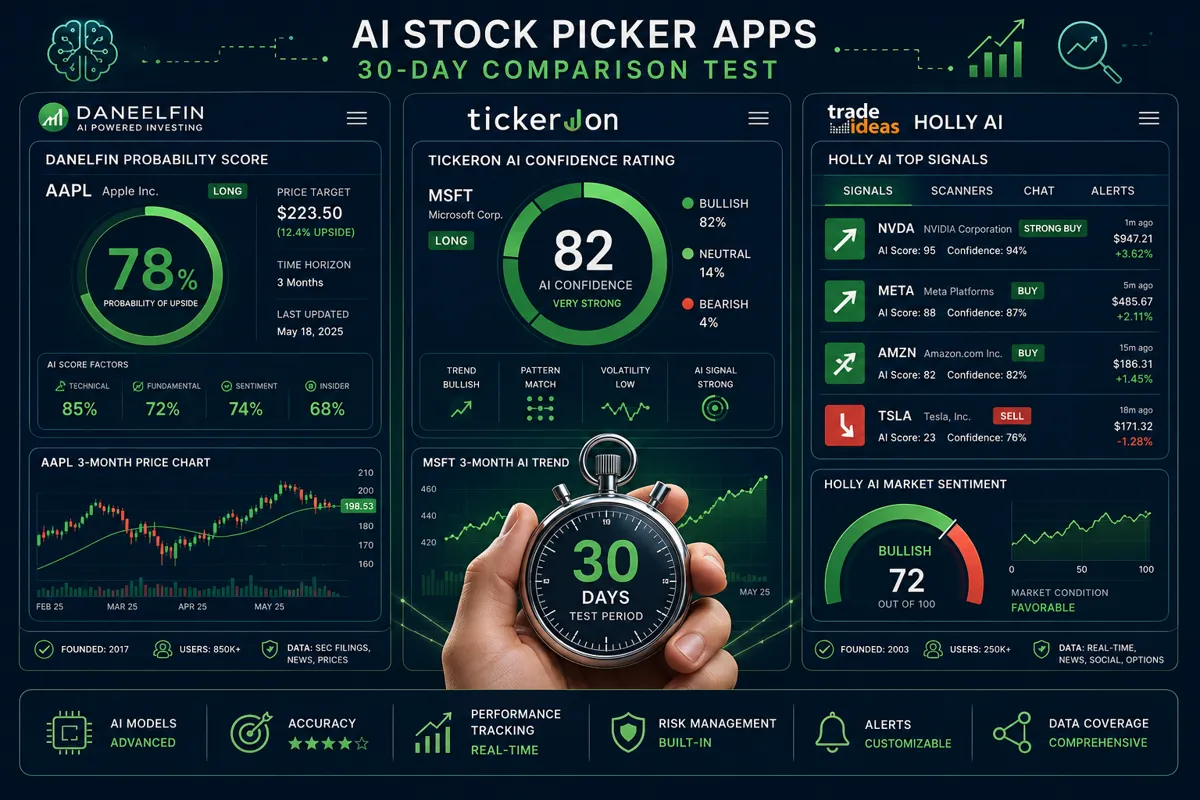
- Danelfin uses probability scores (0–10) to rank stocks by short-term performance likelihood; Tickeron uses AI confidence ratings on pattern recognition; Trade Ideas runs Holly AI to generate intraday setups.
- AI stock pickers do not predict the future. They identify historical patterns and assign probabilities. That is a meaningful but limited capability.
- Most beginners make the same mistake: they treat a high AI confidence rating as a green light and skip the stop loss. Play stupid games, win stupid prizes.
- Free AI stock picker tools exist but come with data delays, limited scans, and no backtesting — fine for learning, not for live trading decisions.
- The best ai stock picker for your portfolio is the one you actually understand well enough to override when the setup is wrong.
- AI tools struggle with black swan events, earnings surprises, and low-float stocks with thin order books.
- Cost ranges from free tiers to $200+ per month for professional-grade platforms with real-time data.
I Tested the Best AI Stock Picker for 30 Days...Nobody Warned Me About This
Thirty days. Six tools. One live brokerage account with real money on the line.
The honest summary: the best ai stock picker tools available right now are genuinely impressive at one specific job — cutting through a universe of 8,000+ stocks and surfacing a short list worth paying attention to. That is real value. What the marketing pages skip is everything that happens after the signal fires.
Here is what the 30-day test actually revealed.
Week one felt like cheating. Danelfin's probability scores flagged three setups that broke out cleanly within 48 hours. Tickeron's AI confidence ratings lined up with textbook price action — tight consolidation, clean support, volume confirmation. The process felt like signal over noise made tangible.
Week two introduced the choppy tape. The market hit a rough patch — macro noise, a surprise Fed comment, earnings season volatility. The AI picks kept firing. Most of them failed. Not because the tools were broken, but because the market environment had shifted and the models were still pattern-matching against calmer historical data. Nobody warns you that AI stock pickers are essentially weather forecasts: useful on average, wrong at the worst moments.
Week three was the real education. Two picks from Trade Ideas' Holly AI had clean setups on paper — the breakout looked right, volume was there, risk-reward was solid. Both got stopped out within an hour. The issue was not the AI. The issue was position sizing. Too large, too early, no plan for being wrong. The tool did its job. The trader (the human in the chair) did not.
Week four was about systems. Once the workflow shifted from "follow the AI pick" to "use the AI to build a watchlist, then apply my own entry and exit rules," the results stabilized. The AI became a filter, not a boss. That is the correct relationship.
The thing nobody warned about: AI stock pickers create a very specific kind of overconfidence. A 78% probability score from Danelfin feels like permission. It is not. It is a historical pattern frequency dressed up in a clean interface. Discipline beats prediction every single time.
What Are the Top AI Stock Picking Tools Right Now
The best ai stock picker tools in 2026 fall into three functional categories: probability rankers, pattern recognition engines, and AI-driven scanners. Each solves a different problem.
Probability Rankers
- Danelfin assigns each stock an AI Score from 1 to 10 based on over 900 technical, fundamental, and sentiment features. A score of 8+ has historically been associated with outperformance over a 20-day window. The key word is "historically."
- Tickeron uses AI confidence ratings tied to specific chart patterns — head and shoulders, double bottoms, flags — and assigns a percentage confidence that the pattern will resolve in the predicted direction.
AI-Driven Scanners
- Trade Ideas runs Holly AI, an intraday system that generates pre-market and live setups based on backtested strategies. It is one of the few tools that shows you the historical win rate of the specific setup it is recommending.
- TrendSpider automates technical analysis, drawing trendlines and flagging multi-timeframe confluences that a human analyst would take hours to identify manually.
- Tradytics layers in options flow data and dark pool prints alongside AI-generated signals, which is useful for swing traders who want to see where institutional money is moving.
Research and Fundamental AI
- Stock Analysis and Quiver Quantitative sit in this lane — less about buy/sell signals, more about surfacing data patterns across earnings, insider activity, and congressional trading disclosures.
The right tool depends on your strategy. Day traders need real-time scanners. Swing traders need probability rankers and pattern engines. Long-term investors need fundamental AI research tools. Using a day-trading scanner for a six-month position is like using a Formula 1 tire on a minivan.
How Accurate Are AI Stock Pickers Compared to Human Analysts
AI stock pickers are not consistently more accurate than human analysts — but they are faster, cheaper, and free from emotional bias. That combination matters more than raw accuracy.
Human analysts at major institutions beat the market in individual stock calls roughly 55–60% of the time, according to general academic research on analyst recommendations (though results vary widely by firm, sector, and time period). AI tools like Danelfin have published internal backtests showing their highest-scored stocks outperforming over short windows, but backtests are not live performance, and no independent audit has confirmed those numbers under all market conditions.
What AI does better than humans:
- Processes thousands of data points simultaneously without fatigue
- Eliminates emotional bias from the analysis (it does not revenge trade)
- Identifies historical pattern frequencies at scale
- Updates signals in real time as price action changes
What humans still do better:
- Interpret qualitative context (management credibility, geopolitical nuance, narrative shifts)
- Recognize when a historically reliable pattern is operating in a broken market environment
- Apply judgment to position sizing and risk management
The honest answer: treat AI picks as a first-pass filter, not a final verdict. The best ai stock picker app is one that narrows your universe — not one that replaces your judgment.
How Much Does an AI Stock Picker Actually Cost
AI stock picker costs in 2026 range from free to over $200 per month, depending on data quality, real-time access, and feature depth.
| Tier | What You Get | Approximate Monthly Cost |
|---|---|---|
| Free | Delayed data, basic scans, limited picks | $0 |
| Entry-level | Real-time signals, basic AI scoring | $20–$50/mo |
| Mid-tier | Pattern recognition, backtesting, alerts | $50–$120/mo |
| Professional | Institutional-grade AI, options flow, API access | $120–$300+/mo |
Danelfin offers a free tier with limited AI scores. Tickeron has tiered plans starting around $20–$30 per month for basic pattern recognition. Trade Ideas' Holly AI platform sits in the $100–$200 range depending on the plan. Tools like Kavout and Zen Ratings fall in the mid-tier range.
The free ai stock picker options are worth using to learn the interface and understand how the signals work. They are not reliable enough for live trading decisions — the data delays alone will get you stopped out on entries that looked clean 15 minutes ago.
The cost question to actually ask: not "how much does it cost" but "what is the cost of a bad trade made on a delayed signal?" Run that math first.
Can AI Stock Pickers Really Predict Market Movements
No. And any tool that claims otherwise is selling something you should not buy.
AI stock pickers identify patterns in historical data and assign probabilities to outcomes. That is pattern recognition, not prediction. The distinction matters enormously in live markets.
A Danelfin score of 9/10 means the stock shares characteristics with other stocks that outperformed over a 20-day window in the past. It does not mean the stock will outperform. Markets are non-stationary — the patterns that worked in 2023 do not always work in 2026. Regime changes, macro shocks, and liquidity events can invalidate months of backtested signal in a single session.
This is not a knock on AI tools. It is a description of what markets are: complex adaptive systems where the participants change their behavior in response to the signals being generated. The moment enough traders follow the same AI signal, the edge in that signal degrades.
What AI stock pickers can genuinely do:
- Improve the quality of your watchlist by filtering out low-probability setups
- Surface stocks with favorable technical and fundamental characteristics
- Reduce the time spent on manual screening
- Flag when a stock's profile has changed materially
What they cannot do:
- Account for a surprise earnings miss at 4:01 PM
- Predict a geopolitical event that gaps the market down overnight
- Tell you how large a position to take or where to put your stop loss
Process over prediction. Every time.
What Risks Should You Know Before Using an AI Stock Picker
The biggest risk is not the tool — it is the false confidence the tool creates.
Overconfidence bias is the most common and most expensive mistake. A high AI confidence rating feels like validation. Traders increase position size, skip the stop loss, and ignore contradicting price action. When the trade fails — and some percentage always will — the loss is larger than it should have been.
Other risks worth knowing:
- Overfitting to historical data: Many AI models are trained on bull market periods. Their accuracy degrades in choppy tape, bear markets, or low-liquidity environments.
- Signal crowding: When thousands of retail traders use the same AI scanner, they pile into the same setups simultaneously. This can create bull traps — a stock appears to break out, triggers the AI signal, attracts buyers, then reverses as early holders sell into the crowd.
- Latency in free tiers: A 15-minute data delay on a volatile low-float stock is not a minor inconvenience. It is the difference between a clean entry and catching a falling knife.
- No risk management built in: AI stock pickers tell you what to look at. They do not tell you how much to risk, where to put your stop loss, or when to cut losers fast. That is still entirely on you.
Use the free expectancy calculator to understand whether any AI-generated signal set has a positive expected value before you trade it live.
Is an AI Stock Picker Good for Beginners or Just Advanced Investors
AI stock pickers are accessible to beginners but most useful to traders who already have a system.
For beginners, the value is in education and filtering. Tools like Danelfin and Tickeron show you which stocks are exhibiting favorable characteristics and why — that is a faster way to learn pattern recognition than staring at raw charts for months. An ai stock picker for beginners works best as a learning accelerator, not a trading autopilot.
The danger for beginners is the same as the danger for everyone else, just amplified: they do not yet have the experience to know when to override the signal. A clean AI setup in a broken market environment looks identical to a clean AI setup in a healthy one — until it does not.
Recommendation for beginners: paper trade it first. Use the AI signals to build a watchlist, execute the trades in a paper account, and track your results for 30 days before putting real capital behind any signal. This is not optional advice. It is the difference between learning and losing.
Advanced traders use AI tools as one layer in a multi-factor system. The AI narrows the universe; technical analysis confirms the setup; risk management determines the size; the trader pulls the trigger. That is a system. That is what cuts the noise and keeps the alpha.
What Common Mistakes Do People Make With AI Stock Recommendation Tools
The same five mistakes show up repeatedly, regardless of which tool someone is using.
- Treating probability as certainty. A 75% win rate means 25% of trades lose. If your position sizing does not account for that, you will blow up on a losing streak that was statistically inevitable.
- Ignoring the broader market context. An AI stock picker does not know if the S&P 500 is in a confirmed downtrend. Trading long setups in a bear market is analysis paralysis dressed up as confidence.
- Chasing signals after the move. The AI fires, the stock is already up 4%, and the trader buys anyway because the signal feels urgent. That is not a clean setup — that is overextended price action and a bad risk-reward ratio.
- Overtrading. More signals do not mean more profit. They mean more commissions, more emotional decisions, and more exposure to noise. The best ai stock picker app in the world cannot fix a trader who takes every alert it generates.
- Skipping the stop loss. This one is not subtle. No stop loss means unlimited downside on a trade that was supposed to be controlled. FOFO — Fear Of Following Orders — is real, and it is expensive.
Which AI Stock Picker Works Best for Different Investment Strategies
The best ai stock picker 2026 for your specific strategy depends on time horizon and data needs.
- Day traders: Trade Ideas (Holly AI) and StocksToTrade for real-time intraday scanning and momentum setups. Speed and real-time data are non-negotiable.
- Swing traders: Danelfin for probability scoring over 20-day windows, TrendSpider for multi-timeframe technical confirmation. The swing trade planner is a useful free companion for planning entries and exits.
- Long-term investors: Zen Ratings and Quiver Quantitative for fundamental AI analysis and alternative data signals. Less about price action, more about business quality and institutional positioning.
- Options traders: Tradytics for options flow and dark pool data layered with AI signals. Tickeron also has options-specific pattern recognition tools.
- Passive/ETF-focused: Tools like Magnifi use AI to help investors find ETFs and funds that match specific risk profiles and goals.
No single platform wins across all categories. The most accurate ai stock picker for a day trader is a liability for a long-term investor, and vice versa. Match the tool to the strategy, not the other way around.
Are AI Stock Pickers Legal and Regulated by Financial Authorities
Yes, AI stock picker tools are legal in the United States and most international markets. They are software products that provide data, analysis, and pattern recognition — not licensed investment advice.
The regulatory distinction matters. Under SEC and FINRA rules, providing personalized investment advice for compensation requires registration as an investment adviser. Most AI stock picker platforms explicitly disclaim that their signals are not personalized investment advice — they are educational tools or data products. Investors should read those disclaimers, because they are legally meaningful.
The SEC has increased scrutiny of AI-driven financial tools in recent years, particularly around claims of accuracy and the potential for market manipulation through coordinated signal following. FINRA has also issued guidance on the use of AI in retail brokerage contexts. Neither agency has banned AI stock pickers, but both are watching the space closely.
For retail investors, the practical implication is straightforward: you are responsible for your own trades. The AI tool is not your fiduciary. It does not know your tax situation, your risk tolerance, or your time horizon. Treat it like a Bloomberg terminal, not a financial advisor.
How Do AI Stock Pickers Handle Market Volatility and Unexpected Events
Poorly, and that is an honest answer that the sales pages skip.
AI stock pickers are trained on historical data. When the market behaves in ways that fall outside the training distribution — a flash crash, a surprise rate decision, a geopolitical shock — the models are essentially flying blind. They continue generating signals based on patterns that no longer apply to the current environment.
During high-volatility periods, the most useful thing an AI stock picker can do is tell you the historical behavior of similar volatility regimes. Tools like Tickeron and Danelfin do provide some context around market conditions, but none of them can process a breaking news event and immediately recalibrate their entire model.
What to do during choppy tape:
- Reduce position sizing across all AI-generated signals
- Require additional confirmation before acting (volume, sector strength, broader market trend)
- Widen stops to account for increased intraday swings
- Consider sitting out entirely — cash is a position
The trend is your friend, but only when there is a trend. In a choppy, directionless market, AI stock pickers generate more noise than signal. Knowing when not to trade is a skill the AI cannot teach you.
Can You Trust AI Stock Picks for a Retirement Portfolio
Not as a primary decision-making tool, and not without significant human oversight.
Retirement portfolios have different constraints than active trading accounts: longer time horizons, lower risk tolerance, tax implications, and the psychological weight of money you cannot afford to lose. AI stock pickers optimized for short-term pattern recognition are not designed for these constraints.
That said, AI research tools — the kind that analyze fundamental quality, earnings consistency, and sector positioning — can add genuine value in a retirement context. Tools like Zen Ratings, which scores stocks on a composite of fundamental and technical factors, can help a self-directed retirement investor identify higher-quality names and avoid value traps.
The rule: use AI as a screening layer to narrow the universe of candidates, then apply your own judgment (or consult a registered financial advisor) before making any decision that affects long-term retirement assets. The SEC's investor education resources at Investor.gov are worth bookmarking for anyone managing their own retirement account.
What Technical Skills Do You Need to Use an AI Stock Picker Effectively
Less than you think to get started. More than you think to use them well.
Most modern AI stock picker apps are designed for retail investors without coding backgrounds. Danelfin, Tickeron, and Trade Ideas all have consumer-grade interfaces that surface signals without requiring any technical setup. The barrier to entry is low.
But using these tools effectively — meaning profitably, with controlled risk — requires a working understanding of:
- Basic chart reading: support and resistance, trend identification, volume patterns. If you cannot read a candlestick chart, the AI signal has no context.
- Risk management fundamentals: position sizing, stop loss placement, risk-reward ratios. These are not optional extras. They are the difference between a manageable loss and an account-ending one.
- Market structure: understanding what a bull trap looks like, what a dead cat bounce means, why a gap fill matters. The AI identifies patterns; you need to know what those patterns mean in context.
You do not need to know Python, statistics, or machine learning to use these tools. You do need to understand what you are looking at when a signal fires. Use the stock health scorecard as a starting point for building that foundation.
Conclusion: What 30 Days Actually Taught About the Best AI Stock Picker
The 30-day test confirmed one thing above everything else: the best ai stock picker is not the one with the highest probability scores or the most confident AI ratings. It is the one that fits into a coherent trading system built around risk management, clear entry and exit rules, and the discipline to follow the process when the market gets uncomfortable.
Danelfin's probability scores are genuinely useful for building a watchlist. Tickeron's AI confidence ratings add a useful layer of pattern confirmation. Trade Ideas' Holly AI generates more setups than any human could scan manually. All three are real tools with real value.
None of them will save a trader who has no stop loss, no position sizing rules, and no plan for being wrong.
Here is what to do next:
- Pick one AI stock picker tool and use it exclusively for 30 days. Do not add a second tool until you understand the first one's signals, failure modes, and optimal market conditions.
- Paper trade every signal for the first two weeks. Track win rate, average gain, average loss, and the conditions under which the signal worked or failed.
- Build your entry and exit rules before you touch real capital. The AI tells you what to look at. You decide how much to risk and where you are wrong.
- Compare the tools that match your strategy using the full AI stock tool comparison — over 100 tools reviewed in one place.
Data over noise. Consistency over hype. Systems over hacks. That is the only edge that compounds.
Frequently Asked Questions
What is the best ai stock picker for beginners in 2026?
Danelfin is a strong starting point for beginners because its AI Score (1–10) is easy to interpret and the interface explains the factors behind each rating. Tickeron is also beginner-accessible with its pattern-based confidence ratings. Both offer free tiers for learning before committing capital.
Do AI stock pickers beat the market?
Not consistently, and not on their own. AI stock pickers can improve the quality of your watchlist and filter low-probability setups, but beating the market requires disciplined execution, risk management, and appropriate position sizing — none of which the AI provides. The tool is one input in a system.
What is a Danelfin AI score and how should I use it?
Danelfin's AI Score rates each stock from 1 to 10 based on over 900 features across technical, fundamental, and sentiment data. Scores of 8 or higher have historically been associated with short-term outperformance in Danelfin's internal backtests. Use it as a screening filter, not a buy signal — always confirm with price action and your own risk rules before entering.
What is Tickeron's AI confidence rating?
Tickeron assigns a percentage confidence score to specific chart patterns (flags, double bottoms, triangles, etc.), indicating how frequently that pattern has historically resolved in the predicted direction. A 75% confidence rating means the pattern resolved favorably 75% of the time in historical data — not that the current trade will work.
Is there a free AI stock picker that actually works?
Free tiers from Danelfin and Tickeron provide limited but functional AI scoring. They are useful for learning the tools and building a paper trading workflow. For live trading decisions, the data delays and feature limitations in free tiers are a meaningful handicap.
How do I read AI stock picker reviews without getting misled?
Look for reviews that include live trading results, not just backtests. Check whether the reviewer discloses their trading strategy and time horizon — a tool that works for day trading may be irrelevant for swing trading. Be skeptical of any review that does not mention failure modes or losing trades.
Can AI stock pickers handle earnings season volatility?
Poorly. Earnings season introduces binary event risk that historical pattern data cannot reliably model. Most experienced traders reduce AI-signal-based position sizes around earnings and avoid holding positions through earnings announcements unless they have a specific, well-defined strategy for doing so.
What is the difference between an AI stock picker and a stock screener?
A stock screener filters stocks based on criteria you define (P/E ratio, volume, price range). An AI stock picker uses machine learning to identify patterns and generate ranked recommendations or probability scores without requiring you to define the criteria manually. AI pickers are more automated; screeners give you more control.
How often should I check AI stock picker signals?
That depends on your strategy. Day traders need real-time signal monitoring. Swing traders can review signals once daily, typically before market open or after close. Checking signals every 20 minutes during market hours is a fast path to overtrading and analysis paralysis.
Are AI stock picks legal to follow?
Yes. Acting on AI-generated stock analysis is legal for retail investors. The tools themselves are data and analysis products, not licensed investment advice. You remain responsible for your own trading decisions.
FullStack Alpha tests the AI stock tools so you do not waste months on the wrong ones. Browse the full breakdowns at aistockpickerapp.com.