Danelfin Cost: Every 2026 Plan and the Free Tier Catch
Last updated: October 28, 2026
Ten reports a month. That's the number that decides whether 
Quick answer: Danelfin cost by plan in one table
Danelfin costs $0 for the capped free tier, $22 a month billed yearly for Plus, $59 a month billed yearly for Pro, and $134 a month billed yearly for Elite (checked October 2026). Danelfin's own pricing page says yearly billing runs 25% below monthly and the two-year plan 40% below, and every paid plan offers a 14-day free trial plus a 30-day money-back guarantee.
Danelfin cost figures above come from Danelfin's own pricing page (checked October 2026). The monthly column is derived from the yearly savings Danelfin states for each plan ($84, $240 and $540 a year). Confirm before you check out, because this company ships changes often and pricing pages move.
A few things worth fixing in your head right now:
- The free plan is a sampler, not a service. It's perpetual, needs no credit card, and shows you exactly enough to want more.
- Plus is the real entry point. Unlimited reports and unlimited rankings are what make the tool usable as a daily workflow.
- Pro buys a spreadsheet, basically. CSV export, suggested trading parameters, and the full signal set. That matters if you build your own models.
- Elite is for people running serious capital or an API-adjacent process. It bundles API access at 10,000 calls a month. Most retail readers don't need it.
- Annual is the default smart choice at 25% off, and the 30-day guarantee makes the risk small.
Want the full scored verdict instead of just the price tag? Our editorial Danelfin scorecard rates it on transparency, evidence and community feedback, and the Danelfin directory listing keeps the plan details in one place.
How much does Danelfin cost per month and per year?
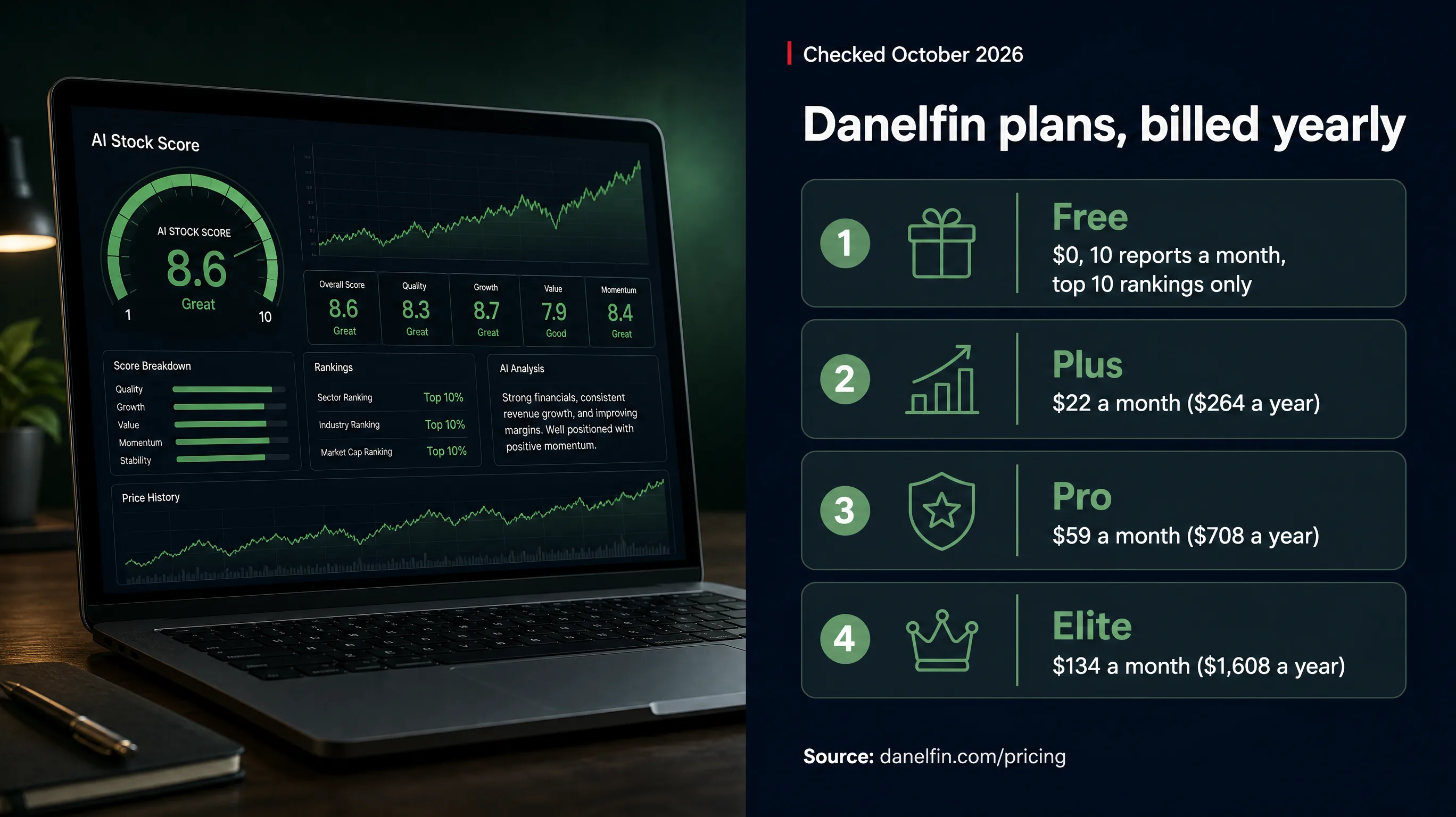
Danelfin runs four tiers. Free at $0, Plus at $22/month on annual billing ($264/year) or $29/month paid monthly, Pro at $59/month annual ($708/year) or $79/month monthly, and Elite at $134/month annual ($1,608/year) (checked October 2026). Annual saves 25%, and a two-year commitment pushes that to 40%.
What the monthly-to-annual gap actually costs you
Plus billed monthly is $29. Plus billed annually works out to $22 a month, a stated saving of $84 over the year. Pro's gap is wider: $79 monthly versus $59 annual equivalent, a $240 difference. That's not pocket change for a trader with a $5,000 account. The yearly Plus price alone is about 5% of that whole account, paid to a research vendor, before you place a single trade.
Run the math the way you'd run position sizing. If a tool costs 5% of your capital annually, it has to add 5% of edge just to break even on the subscription. On a $50,000 account, Pro at $708 is 1.4%. On a $5,000 account, it's 14%. Same product, completely different decision.
The danelfin pricing question isn't "is it expensive." It's "expensive relative to what you're trading."
What you get as you move up
- Plus adds unlimited stock and ETF reports, unlimited rankings, automatic portfolio sync with broker accounts, three portfolios at 25 securities each, all AI Score alpha signals, unlimited AI price forecasts, and the top 25 long trade ideas and screener results.
- Pro adds suggested trading parameters (stop loss and take profit), CSV export, 10 portfolios holding up to 50 securities, the full fundamental, technical and sentiment signal breakdowns, and unlimited screener results and long trade ideas.
- Elite adds unlimited short trade ideas, Danelfin's API Expert tier at 10,000 calls a month, unlimited portfolios, historical daily AI Scores since 2017 in CSV on request, and priority support. Danelfin also sells standalone API plans on a separate pricing page.
If the API piece is what draws you to Elite, our guide to how much a trading bot really costs shows what the automation side of that budget looks like.
The trial and refund terms
Paid plans come with a 14-day free trial and a 30-day money-back guarantee that runs from the date a new subscription is created. That combination is unusually generous for this category, and it changes how you should approach the decision. You don't need to agonize. You need a test plan.
Decision rule: take the 14-day trial, run your actual watchlist through it, and write down whether the AI Score changed a single decision you made. If it didn't, cancel inside the window. The paper-trade-first rule applies to tools too, not just setups.
Common mistake: buying Pro on day one because the feature list is longer. CSV export is useless if you weren't already exporting data to a spreadsheet model. Buy the plan that matches the process you already have, not the process you imagine having.
Is there a free version of Danelfin, and what does it hide?
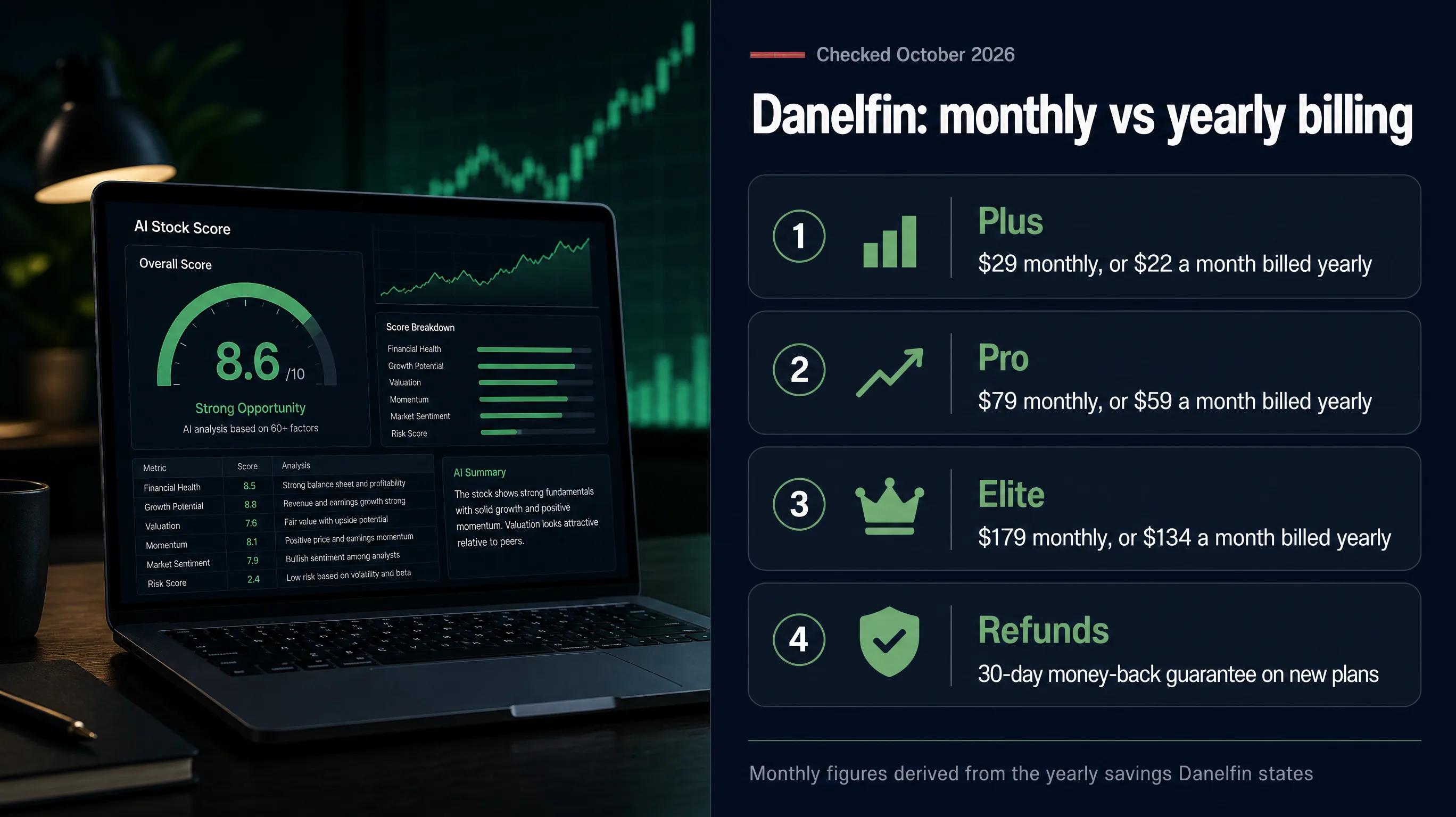
Yes. Danelfin free is a perpetual $0 plan with no credit card required, and it's genuinely usable for a narrow job: checking the AI Score on a handful of names you already follow. What it hides is breadth. You get the top 10 stocks in the daily rankings, 10 stock or ETF reports per month, one portfolio capped at five holdings, partial score explanations, the top two long trade ideas, and the top two screener results.
The report quota is the real constraint
Those 10 reports cover the core analysis: buy/hold/sell signal, technical, fundamental, sentiment, low-risk and historical score views. One report per ticker. If you're comparing six semiconductor names and four of their suppliers, you're done for the month in about twenty minutes.
Most people don't notice this until they hit the wall mid-research, which is precisely when the upgrade button looks most attractive. That's not a scandal. It's product design. But you should see it coming, because the real danelfin cost of the free plan is measured in reports, not dollars.
The ranking cap is the quieter one
Free users see only the top 10 securities in stock, ETF and sector rankings. Paid users get unlimited ranking access. The practical effect: free shows you Danelfin's strongest names, but it can't support comparison or systematic screening. You can't ask "which 40 mid-cap industrials score above 7?" because you can't see past position ten.
Here's what most people miss about danelfin free: it tells you what Danelfin likes, but not why, and not what it dislikes. Knowing a stock scores a 9 is a fraction of the value. Knowing which of your current holdings score a 3 is the part that saves money.
Explanations are deliberately partial
Free accounts see only the top AI Score alpha signals. Pro and Elite expose the full technical, fundamental and sentiment signal sets. So the free plan surfaces the ranking but withholds the reasoning, which is the opposite of what a thinking investor wants. If you can't see why a stock scores well, you're outsourcing judgment to a number. That's how people end up catching a falling knife with a 9 next to its name.
Who the free tier genuinely works for
- You hold 5 or fewer positions and want a monthly sanity check.
- You're testing whether a quantitative score fits your process at all.
- You already use a separate screener and only need a second opinion on finalists.
If you're screening weekly or managing more than ten names, free will frustrate you inside a month. For broader no-cost options, our roundup of free AI stock screeners covers tools without a report meter running in the background, and our breakdown of what free AI trading bot tiers actually include shows the same capped-sampler pattern on the automation side.
Which Danelfin plan is worth it?
For most self-directed investors, Plus at $22/month annual is the danelfin cost worth paying. It removes both hard caps (reports and rankings), which is where the free plan actually breaks, and it leaves the heavier Pro and Elite features for people who build spreadsheet models or manage larger books.
Match the plan to your behavior, not your ambition
- Stay free if you check in monthly, hold under five positions, and use Danelfin as a second opinion. Zero dollars for a sanity check is good value.
- Buy Plus if you maintain a watchlist of 15 to 25 names, rebalance a few times a year, and want the ranking and forecast data without exporting anything. This is the sweet spot for the danelfin plans lineup.
- Buy Pro if you export to Excel or Sheets, run multiple portfolios, or want the full signal decomposition behind every score. CSV export and trading parameters are the two features that justify the $444 annual step up from Plus.
- Buy Elite if you're running a larger account where the subscription is under 0.5% of capital and you'll use the API calls or unlimited portfolios consistently.
The cost-as-percentage test
Before you pick, do one calculation. Divide the annual danelfin cost by your account size.
Under 1% and the subscription is a rounding error. Over 3% and the tool needs to be carrying real weight in your decision-making. Over 10% and you're funding a research subscription with money that should be your risk capital. Play stupid games, win stupid prizes.
Is danelfin worth it? Only if you'd act on the output. A score you read and ignore costs $264 a year to feel informed.
The mistake that wastes the trial
People sign up for the 14-day trial and spend it browsing. Browsing isn't testing. Run this instead:
- List the 10 positions you currently hold.
- Pull the AI Score and full signal breakdown on each.
- Note every holding scoring below 4 and ask why you own it.
- Pull the top 20 ranked names in two sectors you understand.
- Write down one decision you'd make differently because of the data.
If step 5 is blank after two weeks, cancel. The 30-day guarantee gives you an extra cushion even after that. Our broader comparison of the top AI trading tools of 2026 covers where else that same $264 could go.
Does the Danelfin AI Score actually work?
Danelfin publishes more evidence than almost anyone in this category, and that transparency is part of what you're paying for. The company reports a backtested +456% cumulative return on its Best Stocks strategy from March 29, 2017 through September 3, 2026, against +228% for the S&P 500, including estimated transaction costs of 0.15% per trade. These are Danelfin's own figures, published on its blog on October 16, 2026, and the company explicitly labels the result as backtested rather than live. That label matters.
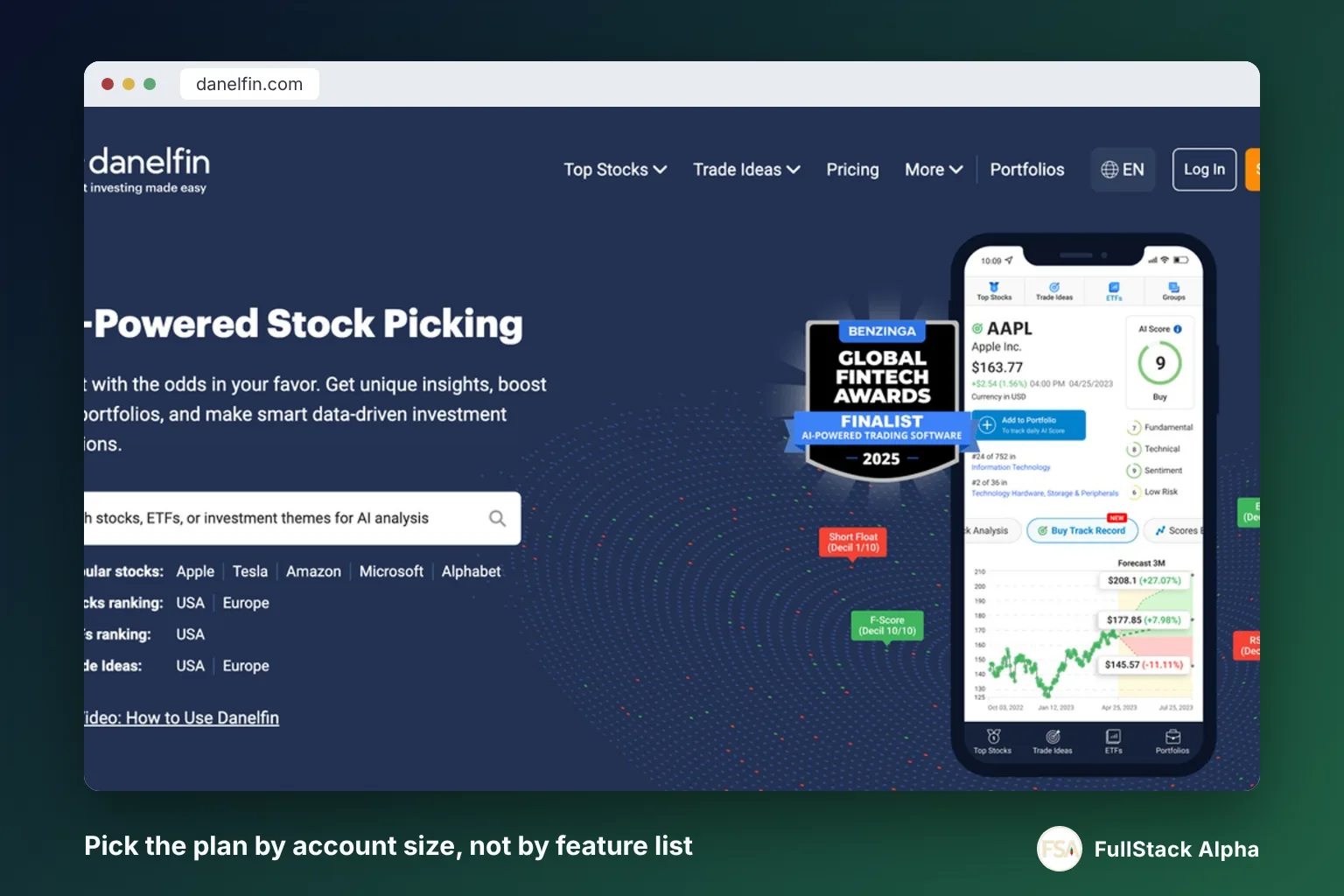
What's genuinely strong about the evidence
On September 30, 2026, Danelfin published an update titled "A Stronger 10," aimed at making its top AI Score of 10 more consistent. The company explains its methodology changes in public posts rather than hiding behind the word "proprietary."
That matters. Most "proprietary AI" vendors won't tell you whether their model is a neural network or a public API with a dashboard bolted on. Danelfin at least shows its work, which gives you something to check rather than something to take on faith.
What to hold at arm's length
A high hit rate on top-scored stocks sounds strong until you factor in that in a rising market, a coin flip does better than you'd think. The reference point matters. A backtest including 0.15% per trade in costs is more honest than most, but backtests are still constructed with hindsight on the universe, the rebalancing schedule, and the strategy rules.
A score is an input, not a signal. An AI Score of 10 on an overextended stock that's already run 40% is still a bad entry. The model ranks probability; it doesn't tell you about your entry, your stop loss, or your position sizing. That's your job, and no subscription covers it.
Recent product changes worth pricing in
Danelfin has shipped quickly through late 2026, according to its own feature announcements:
- October 28, 2026: a natural-language stock screener, pitched as "just ask for the stocks you want," adding a conversational layer to stock selection.
- October 8, 2026: portfolio forecasting plus combined US/European portfolios, pushing the platform from single-stock scoring toward portfolio-level analysis.
- September 4, 2026: portfolio sync extended to Europe, Australia and India. That feature only matters to Plus-and-above users, since free accounts don't get automatic sync.
- August 5, 2026: a Danelfin mobile app.
Shipping velocity is a reasonable thing to pay for. A tool that shipped four notable updates in three months is worth more than one that's been static since 2023. For a deeper look at the rating methodology itself, see our breakdown of whether the Danelfin AI Score can actually beat the market.
Danelfin vs Kavout on price and features
Both sell AI-driven stock ranking. Danelfin publishes its methodology and performance updates in public; 
How to choose between them
- Pick Danelfin if you want to see the reasoning. The full technical, fundamental and sentiment signal breakdown on Pro tells you what's driving the number. If you're the kind of investor who won't act on a score without understanding it, this is the tiebreaker.
- Pick Kavout if you prefer a chat-style research workflow, a lower entry price, and don't need the signal decomposition. Our Kavout scorecard covers how it holds up.
- Pick neither if you don't yet have a written set of entry and exit rules. A score plugged into no system is just weather.
Our side-by-side Kavout vs Danelfin comparison lines up the features, the head-to-head comparing Danelfin vs Zen Ratings vs Kavout goes deeper on the scoring differences, and the full Kavout review covers its pricing tiers on their own terms.
The danelfin vs kavout verdict: Danelfin wins on transparency by a clear margin, and Kavout wins on entry price. Neither wins on community evidence, because almost nobody is publicly discussing either one at scale.
The edge case nobody mentions
If you trade non-US equities, check coverage before you pay. Danelfin added combined US/European portfolios in October 2026 and portfolio sync across Europe, Australia and India in September, which is real progress. But US-listed coverage is still the deepest part of the product. Paying the annual danelfin cost for a portfolio the tool only partly covers is an expensive way to learn that lesson.
What are the most common Danelfin complaints?
The loudest complaint isn't about accuracy or price. It's about how little public discussion exists. There simply isn't enough unsolicited user conversation to corroborate the company's own numbers.
The thin-evidence problem
Reddit threads, independent reviews and long-term user write-ups are sparse compared to bigger names in the category. That's not proof of a bad product. It's an absence of proof either way, and when the danelfin cost runs $264 to $708 a year, absence of proof is a real cost. You're relying heavily on vendor-published statistics.
When a vendor is the main source of evidence about the vendor, discount accordingly. Even when the vendor is unusually transparent, as Danelfin is.
The recurring practical gripes
Here are the friction points we'd flag before you pay:
- The free tier feels too tight. Ten reports and a top-10 ranking cap frustrate people who expected a broader trial. Fair complaint, though the 14-day paid trial solves it if you use it properly.
- Backtest versus live gap. Investors want live, audited track records, not simulated ones. Danelfin's labeling is honest, but the request is legitimate.
- Price steps are steep. The jump from $264 to $708 a year, Plus to Pro, is a big leap for features that mainly serve spreadsheet users.
- Mobile is new. Danelfin only announced its mobile app in August 2026, so it has far less track record than the web platform. Chart-heavy research still feels better on a laptop.
- Scores change. The AI Score updates daily, which can feel like whiplash if you expected a stable rating. That's a feature of a daily model, not a bug, but it catches people off guard.
The complaint that's actually the user's fault
"The score was 9 and the stock dropped." A probability model says a name is more likely to outperform, not that it will. If you bought with no stop loss and no position sizing plan because a number said 9, the tool didn't fail you. Your process did.
Danelfin, like every tool we cover, gets at least two real drawbacks on the record: thin public corroboration, and a free tier too restrictive to evaluate the product honestly. Both are genuine. Neither is disqualifying.
Here's a quick danelfin cost calculator to run the numbers against your own account before you decide.
FAQ
How much does Danelfin cost in 2026? Free is $0 forever with a 10-report monthly cap. Plus is $22/month billed yearly ($264/year) or $29/month monthly. Pro is $59/month billed yearly ($708/year) or $79/month monthly. Elite is $134/month billed yearly ($1,608/year). Annual saves 25% versus monthly, and two-year billing saves 40% (checked October 2026).
How many stocks can you analyze with Danelfin free? Ten per month. The free tier allows 10 stock or ETF reports monthly, covering the buy/hold/sell signal plus technical, fundamental, sentiment, low-risk and historical score views. You also see only the top 10 names in any ranking, and one portfolio limited to five holdings.
Can you cancel Danelfin anytime? Yes. Danelfin says you can cancel from the Subscriptions and Billing section, and you keep paid features until the end of the billing period. Paid plans include a 14-day free trial and a 30-day money-back guarantee from the date a new subscription starts. Always confirm current terms at checkout.
Is Danelfin good for beginner investors? It's accessible but incomplete on its own. The 1-to-10 AI Score is easy to read, which is the appeal and the trap. Beginners need position sizing and stop loss rules before they need a score. Start on the free tier, pair it with a trading journal, and only pay once you have written rules.
How accurate are Danelfin's AI predictions? Danelfin's own backtest shows its Best Stocks strategy at +456% from March 2017 to September 2026 versus +228% for the S&P 500, after estimated costs of 0.15% per trade. Those are vendor-published, backtested figures, not independently audited live results.
Does Danelfin work on mobile? Yes. Danelfin announced a mobile app on August 5, 2026, and portfolio sync now covers brokers in the US, Europe, Australia and India. Chart-heavy research still feels better on a laptop. Portfolio sync requires a Plus plan or higher.
What are the best free alternatives to Danelfin?


Is Danelfin's free tier a loss leader? Yes, and openly so. No credit card is required and the plan never expires, but the 10-report cap, top-10 ranking limit and partial score explanations show you the product's quality while making daily use impractical. That's a legitimate funnel, not a trick, as long as you know the caps before you start.
The practical next step
The danelfin cost structure is honest, its methodology disclosure is among the best in this category, and its public user evidence is thin. All three are true. It's a good tool with a real gap.
Do this before you pay anything:
- Open the free account. No card, no risk.
- Spend your 10 reports on positions you already own, not on names you're curious about. Judging a tool on your own book is the only test that counts.
- Run the cost calculator above against your account size. Under 1%, upgrade without much thought. Over 10%, stay free.
- If you upgrade, start the 14-day Plus trial and write down one decision it changed. No decision changed, no subscription.
A score tells you what a model thinks. Your rules tell you what to do about it. Build the second part first. Process over prediction.
References
- Danelfin Plans and Pricing. danelfin.com.
- Danelfin Best Stocks Strategy: +456% Since 2017 vs. +228% for the S&P 500. blog.danelfin.com.
- Danelfin API Access Plans. danelfin.com.
- Danelfin New Features. blog.danelfin.com.
- Kavout Pricing Plans. kavout.com.
Still deciding whether an AI stock score belongs in your process? Danelfin is one of dozens of prediction tools we track, with free tiers and pricing side by side. Compare them → AI stock prediction tools
This is education, not financial advice.
Your market edge starts with the right tool. Stay alpha.
Some links on this page may be affiliate links. Rankings are never influenced by them.