I Ranked the Top AI Trading Tools of 2026...Number One Wasn't Even Close
Last updated: June 17, 2026
Quick Answer: After testing and comparing dozens of platforms, the top AI trading tools of 2026 are TrendSpider, Trade Ideas, Koyfin, and Option Alpha — ranked in that order. TrendSpider won by a significant margin because it combines AI-driven chart analysis, multi-timeframe automation, and clean price action data in one place without the noise. The gap between first and second place was wider than expected.
Key Takeaways
- TrendSpider ranks first among top AI trading tools in 2026 for its automated technical analysis, multi-timeframe raindrop charts, and strategy backtesting in a single platform.
- Trade Ideas ranks second for active day traders who need a live AI scanner that surfaces real-time setups during power hour.
- Koyfin ranks third as the best research and fundamental analysis layer for swing traders and longer-term investors.
- Option Alpha ranks fourth for options-focused traders who want automated, rules-based strategies without coding.
- Free tools exist and work for beginners, but the paid tiers on top platforms deliver meaningfully better signal-to-noise ratios.
- No AI trading tool eliminates risk. Stop loss discipline and position sizing still decide whether you survive a bad trade.
- Most traders fail not because they picked the wrong tool, but because they used too many tools and had no process.
- The best AI trading tool for you depends on your style: day trading, swing trading, options, or fundamental research.
I Ranked the Top AI Trading Tools of 2026...Number One Wasn't Even Close
Eighty-three percent of retail traders lose money in any given year. That stat isn't new. What's new is that in 2026, those same traders now have access to AI tools that institutional desks were paying six figures for just five years ago. And most retail traders are still losing.
That tells you the problem was never access to tools. It was always the process.
That said, the right tool used inside a real system does make a difference. So after testing and comparing over 40 platforms, here's the definitive ranking of the best AI trading tools in 2026 — with a specific reason for every placement.
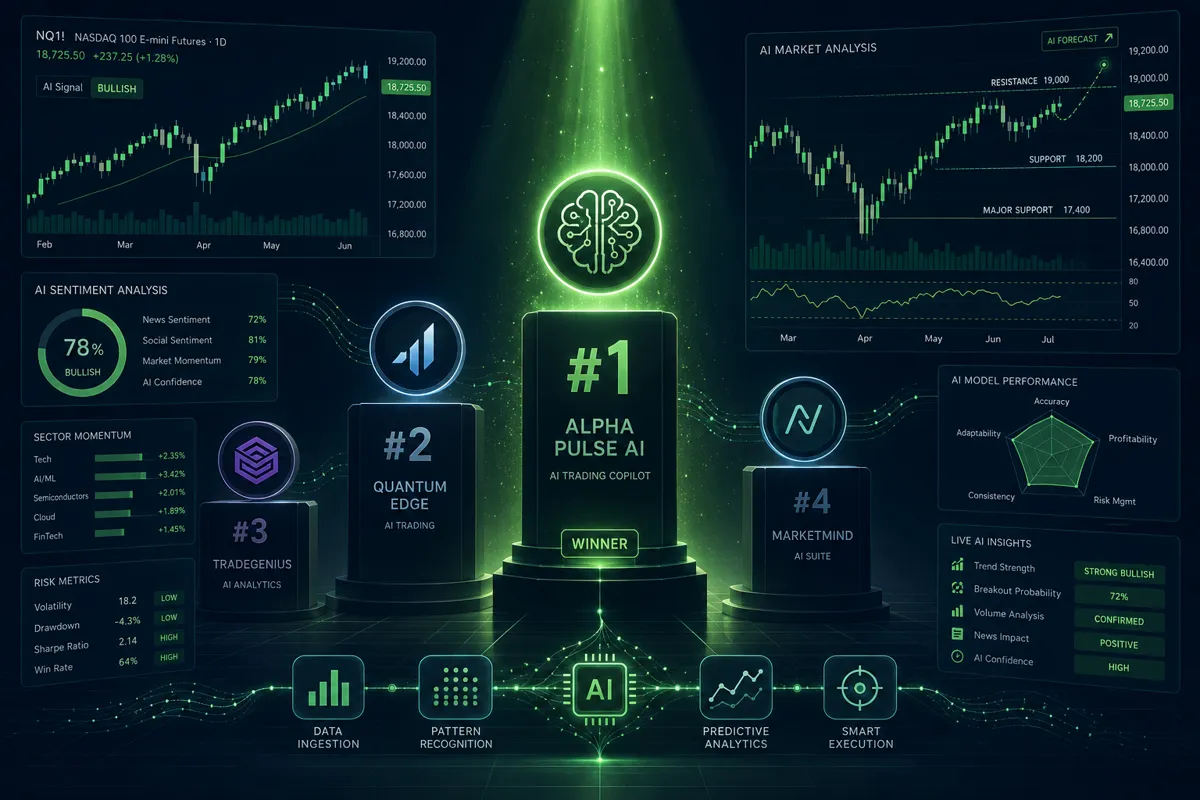
The ranked list:
| Rank | Tool | Best For | Starting Price |
|---|---|---|---|
| 1 | TrendSpider | Technical analysis, automation, backtesting | ~$39/mo |
| 2 | Trade Ideas | Active day trading, live AI scanning | ~$84/mo |
| 3 | Koyfin | Fundamental research, swing trading | Free / ~$19/mo |
| 4 | Option Alpha | Options automation, rules-based strategies | Free / ~$149/mo |
Why TrendSpider won and it wasn't close: It's the only platform that automates technical analysis across multiple timeframes, flags support and resistance levels without manual drawing, and lets you backtest a strategy before you risk a dollar. That's not one feature — that's a full system in one interface. For traders who care about clean setups and process over prediction, nothing else in 2026 comes close. Explore the full AI trading platforms comparison to see how these stack up across 100+ tools.
What Are the Best AI Trading Tools in 2026?
The best AI trading tools in 2026 are TrendSpider, Trade Ideas, Koyfin, and Option Alpha. Each one earns its spot for a specific reason tied to a specific trading style — not because of marketing.
TrendSpider automates chart pattern recognition and multi-timeframe analysis. It draws trendlines, flags consolidation zones, and backtests your entry and exit rules. For traders who want to remove emotional bias from reading the tape, this is the closest thing to having a systematic co-pilot.
Trade Ideas is the best live scanner for day traders. Its AI engine, called Holly, scans thousands of stocks pre-market and during power hour and surfaces setups based on criteria you define. The TrendSpider ranking at number one and the Trade Ideas ranking at number two aren't arbitrary — they reflect what each tool actually does well.
Koyfin sits in a different lane. It's a research and data platform with AI-assisted fundamental screening. For swing traders who want to understand a company's financials before entering a position, Koyfin's tool breakdown shows why it competes with platforms costing five times as much.
Option Alpha automates options trading through a visual "bot" builder. No coding required. You define your rules — entry triggers, position sizing, stop loss conditions — and the bot executes. For options traders tired of watching screens all day, it's a serious platform.
How Much Do Professional AI Trading Platforms Cost?
Professional AI trading platforms in 2026 range from free (with limited features) to over $300 per month for institutional-grade tools. Most serious retail traders land in the $40–$150 per month range.
Here's a realistic breakdown:
- Free tier: Koyfin, Option Alpha's basic plan, and several scanner tools offer free access with meaningful functionality. Good for beginners building a watchlist and learning the basics.
- Mid-tier ($20–$100/mo): TrendSpider starts around $39/month. This is where the signal-to-noise ratio improves sharply.
- Pro tier ($100–$300/mo): Trade Ideas' premium plan runs around $167/month. You're paying for real-time AI scanning and live market data during earnings season and volatile opens.
- Institutional ($300+/mo): Platforms like AlphaSense target professional analysts. Worth reviewing the AlphaSense tool profile if you're doing deep fundamental research at scale.
The honest math: if a tool costs $100/month and it prevents one bad revenge trade, it paid for itself. The question isn't whether the tool is expensive — it's whether your process is good enough to use it.
Which AI Trading Tool Works Best for Beginners?
For beginners, Koyfin is the best starting point among the top AI trading tools because it has a generous free tier, a clean interface, and no pressure to execute trades. It's a research tool first, which is exactly where beginners should start.
The instinct for most new traders is to jump straight to a scanner and start firing off trades. That's how you learn what revenge trading feels like. A better sequence:
- Use Koyfin's free tier to screen stocks and understand fundamentals.
- Paper trade it first on any platform before using real capital.
- Add TrendSpider when you're ready to study chart patterns and test your entry rules.
- Graduate to Trade Ideas only when you have a defined process and can handle fast-moving price action.
Beginners should also check the free trading tools directory — there are legitimate no-cost resources for building a screener, calculating expectancy, and planning swing trades before spending anything.
Common beginner mistake: subscribing to three paid tools at once, getting overwhelmed, and quitting. That's not an information problem. That's analysis paralysis. One tool, one process, 30 days. Then evaluate.
Can AI Trading Tools Really Beat Human Stock Pickers?
AI trading tools don't "beat" human stock pickers in the way most people imagine. What they do is remove specific, costly human errors — emotional decision-making, inconsistent rule application, and the inability to scan thousands of stocks simultaneously.
The evidence on active human stock picking is not encouraging. S&P Global's SPIVA report has consistently shown that the majority of actively managed funds underperform their benchmark index over 10-year periods. Individual retail traders face even steeper odds.
AI tools improve the process, not the outcome guarantee. Here's what they actually do better than humans:
- Pattern recognition at scale: TrendSpider can scan hundreds of charts for tight consolidation and basing patterns in seconds. A human doing that manually introduces fatigue and inconsistency.
- Backtesting without bias: You can test whether your setup actually worked historically before you risk capital. Humans tend to remember their winners and forget their losers.
- Removing FOFO (Fear of Following Orders): When a bot executes based on rules, it doesn't hesitate at the entry or hold past the stop loss because it "feels like it might come back."
What AI tools can't do: predict black swan events, account for breaking news in real time with full context, or replace the judgment call on risk-reward when the setup is ambiguous.
The most accurate AI trading tools in 2026 are the ones that help you follow your own rules more consistently — not the ones promising to predict the next breakout.
What Risks Should You Know Before Using AI Trading Software?
AI trading software carries real risks that most marketing pages won't tell you about. The biggest one isn't a bug — it's overconfidence.
When a tool generates a signal, many traders treat it as a guarantee. It isn't. It's a probability. And probabilities fail. Know these risks before you subscribe to anything:
- Overfitting in backtests: A strategy that looks perfect on historical data may have been tuned to fit that specific data. Always test on out-of-sample periods.
- Latency in fast markets: During a choppy tape or a gap fill on earnings, even a one-second delay in signal delivery can mean the difference between a clean entry and chasing a move that's already overextended.
- Automation without understanding: Running a bot you don't understand is like letting someone else drive your car with your money in the trunk. Understand every rule before you automate it.
- Regulatory risk: Some automated strategies, particularly high-frequency approaches, attract scrutiny. More on legality below.
- Tool dependency: Traders who rely entirely on one platform's signals and never develop independent judgment are one subscription cancellation away from being lost.
The fix is always the same: risk management first, tool second. Define your stop loss before you enter. Size positions so that getting stopped out doesn't blow up the account. The tool is just a filter — discipline beats prediction every time.
How Accurate Are AI Trading Predictions Compared to Traditional Methods?
AI trading predictions are generally more consistent than traditional manual methods, but accuracy claims from vendors should be treated with skepticism. No verified, audited public benchmark exists for most retail AI trading tools in 2026.
What's measurable: platforms like TrendSpider allow you to backtest your own strategy rules and see historical win rates, average risk-reward, and drawdown. That's a more honest framework than any vendor's claimed accuracy percentage.
Traditional technical analysis performed manually by a disciplined trader can absolutely work. The edge AI adds is speed, consistency, and the ability to scan more setups. It doesn't change the underlying logic of support and resistance, the breakout, or the trend being your friend.
A useful frame: Think of AI accuracy like a weather forecast. A 70% probability of rain doesn't mean it will rain — it means the conditions favor it. A trading signal with a 65% historical win rate still loses 35% of the time. Position sizing and stop loss placement determine whether that 35% is survivable.
For a deeper look at how prediction tools are evaluated, the AI prediction tools section covers methodology across multiple platforms.
Which AI Trading Tools Work Best for Different Investment Styles?
The best AI trading tool depends entirely on your trading style. Using a day trading scanner for long-term investing is like using a stopwatch to bake bread — wrong tool, wrong context.
By style:
- Day trading: Trade Ideas is the strongest choice. Its live AI scanner surfaces low float movers, gap setups, and momentum plays in real time. See the full day trading tools breakdown.
- Swing trading: TrendSpider for chart analysis plus Koyfin for fundamental context. The swing trading tools section covers the best combinations.
- Options trading: Option Alpha for automation. Tastytrade for execution and options-specific analytics. Check the options tools comparison.
- Long-term / fundamental investing: Koyfin and Stock Analysis are the cleanest research layers. No scanner noise, just data.
- Automated / algorithmic: QuantConnect for coders who want to build and backtest custom strategies. 3Commas for crypto-adjacent automation.
Choose X if: You're a swing trader who holds positions for two to ten days and wants to combine clean chart setups with fundamental filters — TrendSpider plus Koyfin is the strongest pairing in 2026.
Are AI Trading Tools Legal, and What Should International Traders Know?
AI trading tools are legal in the United States and most major markets, but specific automated strategies and jurisdictions have rules that traders must understand before going live.
In the U.S., the SEC and FINRA regulate trading activity, not the tools themselves. Using an AI scanner or automated strategy is legal for retail traders. However, strategies that manipulate price, front-run orders, or operate without proper broker registration can cross legal lines. FINRA's investor education resources at FINRA.org are worth reviewing before automating any strategy.
International considerations:
- The EU's MiFID II framework imposes specific requirements on algorithmic trading, including risk controls and record-keeping.
- Some countries restrict or ban certain types of automated trading for retail participants.
- Crypto-specific AI bots operate in a patchwork regulatory environment that varies significantly by country.
The practical rule: if you're using a tool from a reputable, registered platform (TrendSpider, Trade Ideas, Koyfin, Option Alpha) for personal trading decisions, you're operating in legal territory in the U.S. If you're building a fully automated high-frequency system, consult a securities attorney.
What Technical Skills Do You Need to Use AI Trading Platforms?
Most top AI trading tools in 2026 require no coding skills. TrendSpider, Trade Ideas, Koyfin, and Option Alpha all use visual interfaces designed for traders, not developers.
That said, there's a skill floor that separates traders who get value from these tools and those who don't:
- Basic chart literacy: Understanding candlesticks, support and resistance, and volume is non-negotiable. The tool surfaces the setup — you still need to know what you're looking at.
- Ability to define rules: The more clearly you can articulate your entry and exit criteria, the more useful any AI tool becomes. "I buy when it looks good" is not a rule.
- Backtesting patience: Running a strategy through historical data takes time and honest interpretation. Traders who skip this step are flying blind.
For traders who do want to code custom strategies, QuantConnect uses Python and supports institutional-grade backtesting. That's a different category — powerful, but it has a real learning curve.
The minimum viable skill set for most tools: know how to read a chart, define three entry criteria, and set a stop loss. Everything else the tool handles.
How Do AI Trading Tools Handle Market Volatility?
AI trading tools manage volatility by applying rules consistently when human traders are most likely to panic or freeze. The tool doesn't feel fear during a sharp drawdown — which is both its biggest advantage and a potential liability.
Volatility-specific features across top platforms:
- TrendSpider flags when a stock is overextended relative to its average range, which helps traders avoid chasing a move that's already run too far.
- Trade Ideas can filter scans by volatility parameters, so you're not getting alerts on stocks moving 40% on no news — unless that's your setup.
- Option Alpha lets you define maximum loss thresholds at the portfolio level, so a single volatile position can't blow up the whole account.
The honest caveat: no AI tool predicted the flash crashes, liquidity gaps, or macro shock events that have historically caused the most damage to retail accounts. A dead cat bounce looks like a recovery until it isn't. Catching a falling knife is still catching a falling knife, regardless of what the algorithm says.
Volatility is where risk management earns its keep. The tool sets the signal. Position sizing and stop loss placement determine whether you survive being wrong.
What Were the Biggest AI Trading Tool Failures and Lessons of 2026?
The most common AI trading tool failure in 2026 wasn't a platform crash or a bad algorithm — it was traders automating a process they didn't understand and then blaming the tool when it lost money.
Documented patterns that caused real losses this year:
- Overfitted bots: Traders deployed automated strategies backtested on bull market data into a volatile, choppy tape. The strategy had never seen the conditions it was trading in.
- Signal overload: Platforms that generate dozens of alerts per day trained traders to overtrade. More signals is not better signal. Play stupid games, win stupid prizes.
- Ignoring stop losses: Some automated tools allow users to disable stop loss rules. Traders who did this during sharp reversals turned small losses into account-damaging drawdowns.
- Subscription stacking: Paying for five tools simultaneously, getting conflicting signals, and making no trades — or worse, making trades based on whichever signal arrived last.
The lesson isn't that AI tools failed. It's that systems over hacks is not a slogan — it's the only thing that works. A bad process with a great tool produces bad results faster.
Can You Use AI Trading Tools With a Small Investment Budget?
Yes. Several top AI trading tools in 2026 have free tiers or low-cost entry points that work for traders with small accounts. The tools themselves don't require large capital — but trading small accounts has its own set of constraints.
Realistic options for small budgets:
- Koyfin's free tier covers fundamental screening and portfolio tracking with no subscription cost.
- The free tools directory includes a swing trade planner, an expectancy calculator, and a stock health scorecard — all at no cost.
- TrendSpider's entry plan at ~$39/month is accessible for most retail traders.
- Paper trading on any platform costs nothing and is the single best use of time for traders with under $5,000 in capital.
The small account reality check: Pattern Day Trader rules in the U.S. require a $25,000 minimum account balance to make more than three day trades in a five-day period. If your account is under that threshold, swing trading is a more practical style. The tools that support swing trading well — TrendSpider and Koyfin — are also among the most affordable.
Small budget doesn't mean small thinking. It means being more selective, sizing positions conservatively, and cutting losers fast before they compound.
Conclusion: Cut the Noise, Pick the Right Tool, Build the Process
Here's the summary that actually matters: the best AI trading tools of 2026 are not going to save a trader who has no process. But inside a real system, they're the difference between guessing and having an edge.
TrendSpider wins the ranking because it's the most complete tool for traders who care about price action, clean setups, and testing their rules before risking capital. Trade Ideas is the best live scanner for day traders who want signal during power hour. Koyfin is the research layer every swing trader should have. Option Alpha is the strongest platform for options automation without coding.
Actionable next steps:
- Identify your trading style first — day trading, swing trading, options, or long-term. The right tool depends entirely on this.
- Start with one tool, not five. Commit to it for 30 days.
- Paper trade it first. Seriously. The expectancy calculator at aistockpickerapps.com/free-tools/expectancy-calculator will show you whether your setup has a mathematical edge before you risk a dollar.
- Define your stop loss and position size before every entry. The tool surfaces the setup — risk management determines whether you survive being wrong.
- Browse the full AI trading tools comparison to see how over 100 platforms stack up across categories.
Data over noise. Signal over noise. Systems over hacks. That's the only edge that compounds.
We test the AI stock tools so you don't waste months on the wrong ones. Browse the full breakdowns at aistockpickerapps.com.
FAQ
What is the number one AI trading tool in 2026?
TrendSpider ranks first among top AI trading tools in 2026 for its combination of automated technical analysis, multi-timeframe chart scanning, and built-in strategy backtesting. No other retail platform integrates all three at that price point.
Is TrendSpider worth the cost for retail traders?
For traders who use technical analysis and want to remove manual chart-drawing bias, yes. The entry plan starts around $39/month. The backtesting feature alone — which lets you test entry and exit rules on historical data — justifies the cost if you use it consistently.
What is the best free AI trading tool in 2026?
Koyfin's free tier is the strongest no-cost option for fundamental research and portfolio screening. For free technical tools, the swing trade planner and stock health scorecard at aistockpickerapps.com/free-tools are worth using before paying for anything.
Can AI trading tools guarantee profits?
No. No legitimate AI trading tool guarantees returns, and any platform that claims otherwise is a red flag. These tools improve process consistency and signal quality — outcomes depend on market conditions, position sizing, and risk management.
Do I need coding skills to use AI trading platforms?
No. TrendSpider, Trade Ideas, Koyfin, and Option Alpha all use visual, no-code interfaces. Coding skills are only required for platforms like QuantConnect, which targets algorithmic traders building custom strategies.
What is the Pattern Day Trader rule and how does it affect AI tool use?
The PDT rule requires U.S. traders to maintain a $25,000 minimum account balance to execute more than three day trades in a rolling five-day period. It doesn't restrict which tools you use — only how frequently you can trade with a small account.
Are AI trading bots legal for retail investors?
Yes, in the U.S. and most major markets. Using automated trading tools from registered platforms for personal trading is legal. Strategies that manipulate markets or operate without proper registration are not. FINRA.org has clear guidance on retail trading rules.
What is the biggest mistake traders make with AI trading tools?
Using too many tools simultaneously without a defined process. Signal overload leads to analysis paralysis or overtrading — both of which destroy returns faster than a bad single trade.
How do I know if an AI trading tool's accuracy claims are real?
Ask for audited, out-of-sample backtest results — not cherry-picked examples. If a vendor can't provide methodology and a clear definition of how "accuracy" is measured, treat the claim as marketing, not data.
Which AI trading tool is best for options traders?
Option Alpha is the strongest platform for retail options traders who want to automate rules-based strategies without coding. Tastytrade is a strong complement for execution and options-specific analytics.
What does "backtesting" mean in AI trading tools?
Backtesting means running your trading strategy rules against historical price data to see how the strategy would have performed. It's the closest thing to a practice run before using real capital. TrendSpider has one of the most accessible backtesting interfaces among retail platforms.
Can I use AI trading tools outside the United States?
Most platforms are accessible internationally, but regulatory rules vary by country. EU traders face MiFID II requirements. Some countries restrict automated retail trading. Always check local regulations before deploying an automated strategy with real capital.