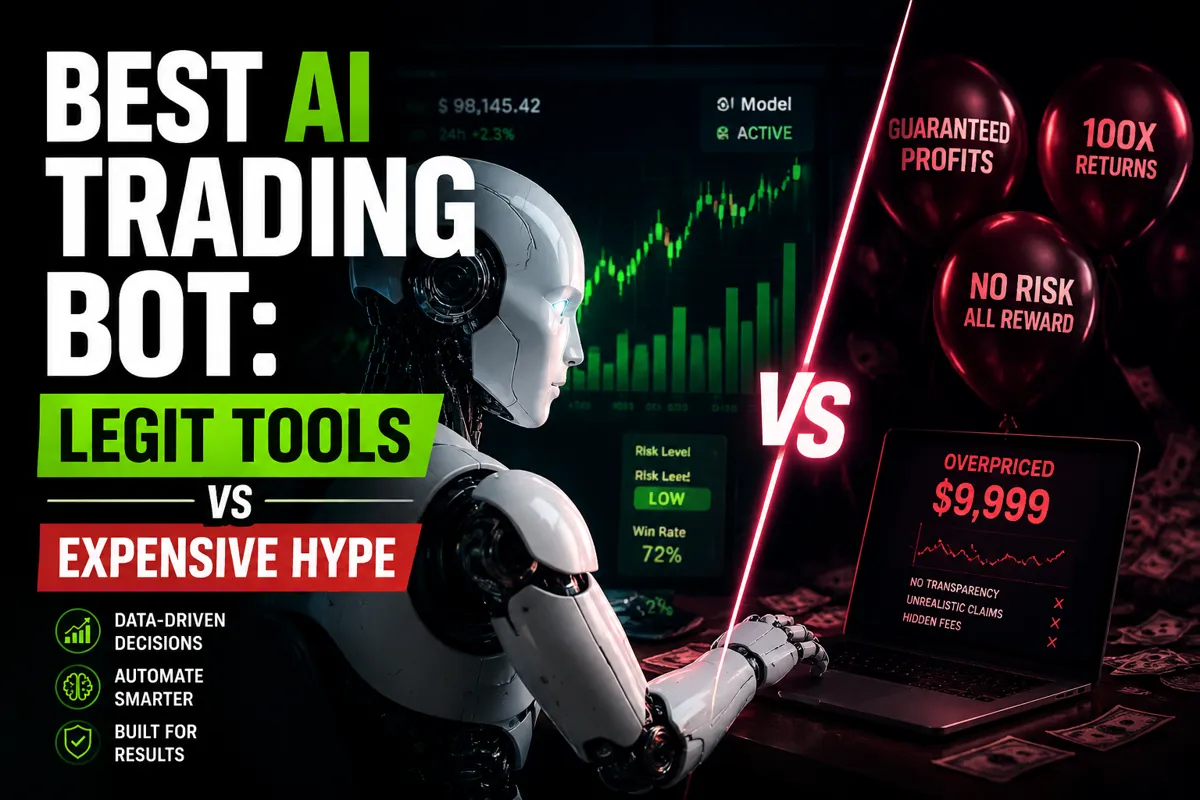
Best AI Trading Bot: Legit Tools vs Expensive Hype
{"cover":"Professional landscape format (1536x1024) hero image with bold text overlay: 'Best AI Trading Bot: Legit Tools vs Expensive Hype' in extra large 72pt white bold sans-serif font with dark drop shadow, centered upper-third composition. Background shows a split-scene: left half features a sleek Bloomberg-style trading terminal with green candlestick charts and AI neural network overlays in navy blue and forest green; right half shows a chaotic montage of flashy ads, neon dollar signs, and fake guru imagery fading into static. Color palette: navy blue #0A1128, plaid green #5FA777, soft white #F8FAFC. High contrast, magazine cover editorial quality, fintech aesthetic.","content":["Landscape format (1536x1024) editorial illustration showing a transparent AI robot brain overlaid on a live stock market chart with support and resistance levels marked, candlestick price action visible, neural network nodes connecting data points to trade signals. Color scheme: navy blue background, green circuit lines, white chart labels. Clean fintech aesthetic, no clutter, professional depth-of-field blur on background data streams. Concept: how AI trading bots process market data into actionable signals.","Landscape format (1536x1024) side-by-side comparison infographic showing two trading dashboards: left panel labeled 'Legit AI Bot' with clean backtesting results, transparent performance metrics, and a modest upward equity curve; right panel labeled 'Expensive Hype' with exaggerated profit claims, red warning badges, and fake testimonial overlays. Navy blue and forest green palette with plaid red warning accents. Bold sans-serif labels, editorial quality, data-driven visual storytelling.","Landscape format (1536x1024) overhead flat-lay photograph of a trader's desk with multiple monitors showing TradingView charts, a notebook with handwritten risk-reward calculations, a coffee cup, and a tablet displaying an AI bot interface with backtesting results. Warm desk lamp lighting, navy and green color grading, shallow depth of field on the AI screen. Text overlay in corner: 'AI Bot vs Manual Trading' in small 24pt white sans-serif. Professional editorial quality, real trader workspace aesthetic.","Landscape format (1536x1024) clean infographic-style image showing a vertical pricing ladder from free to premium AI trading bots, with icons representing features at each tier: free tier shows basic signals, mid-tier shows backtesting and alerts, premium tier shows live execution and portfolio management. Forest green gradient background, white and soft white text labels, plaid green accent bars for each tier. Bold sans-serif typography, no clutter, fintech product comparison aesthetic, editorial quality.","Landscape format (1536x1024) dramatic close-up of a red warning stamp reading 'SCAM ALERT' overlaid on a blurred screenshot of a fake AI trading bot website promising guaranteed returns, with a magnifying glass in the foreground revealing hidden fine print. Color palette: plaid red #A63D40 dominant, navy blue background, white magnifying glass highlight. High contrast, investigative journalism aesthetic, editorial quality. Secondary visual element: a checklist with green checkmarks for legitimate bot features partially visible in the lower right corner."]
Last updated: June 30, 2026
Quick Answer: The best AI trading bot for retail traders in 2026 depends entirely on your strategy, market (stocks vs. crypto), and tolerance for complexity. Legitimate tools like Trade Ideas, TrendSpider, and Tickeron offer verified, transparent performance. Most "AI bots" selling guaranteed returns are expensive noise. No bot eliminates risk — the ones worth your money reduce guesswork and enforce discipline.
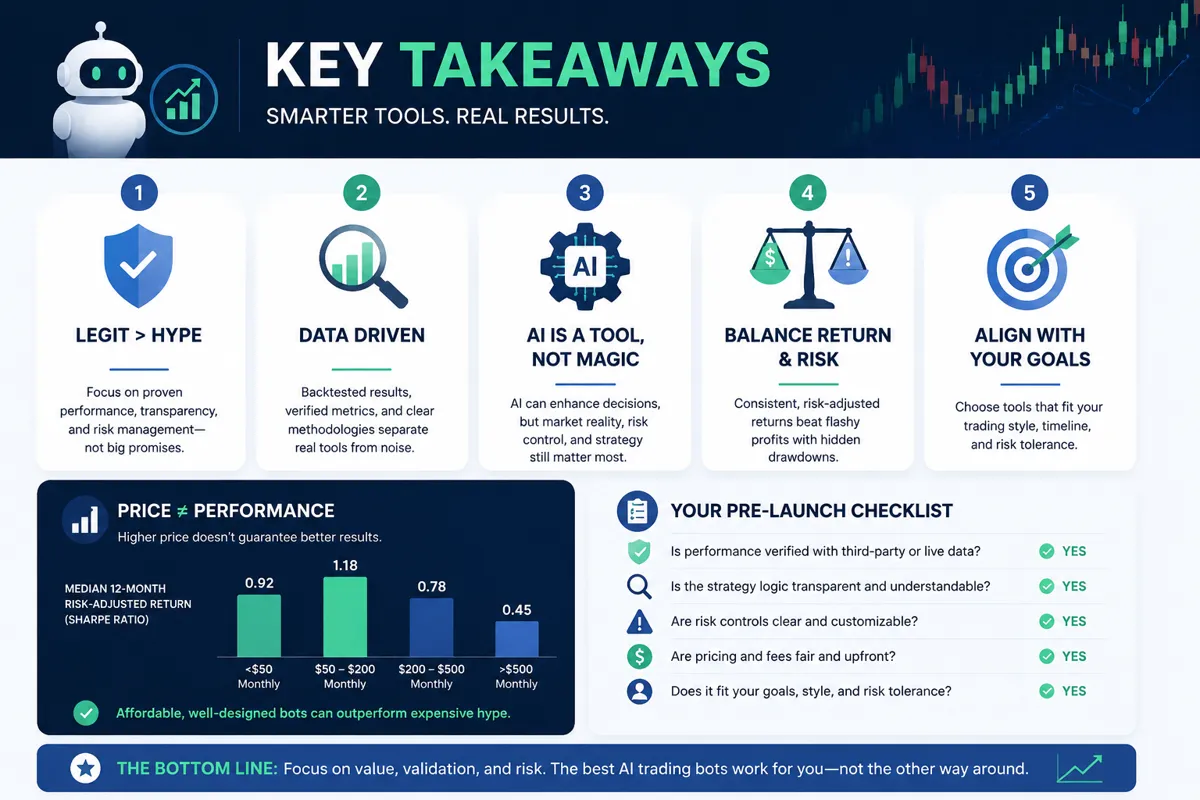
Key Takeaways
- No AI trading bot can guarantee profits. Any platform claiming otherwise is a red flag, not a feature.
- The best AI trading bot for most retail traders is one with transparent backtesting, a clear risk-reward framework, and broker integration — not the flashiest dashboard.
- Legitimate bots cost between $0 (free tiers) and $250+/month for professional-grade tools. Price alone doesn't signal quality.
- Coding skills are not required for most modern AI bots — platforms like Composer and TrendSpider are built for non-coders.
- Backtesting (testing a strategy against historical data) is the single most important feature to look for. No backtest = no trust.
- AI bots for crypto and stocks operate differently. Crypto bots run 24/7; stock bots are constrained by market hours and SEC regulations.
- The biggest mistake traders make with bots is over-optimizing for past data — a trap called curve-fitting — then deploying live capital without paper trading first.
- Scam bots share a predictable playbook: unverified returns, no regulatory disclosure, and pressure to act fast.
- Systems over hacks. A mediocre bot with strict position sizing beats a "genius" bot with no risk management every time.
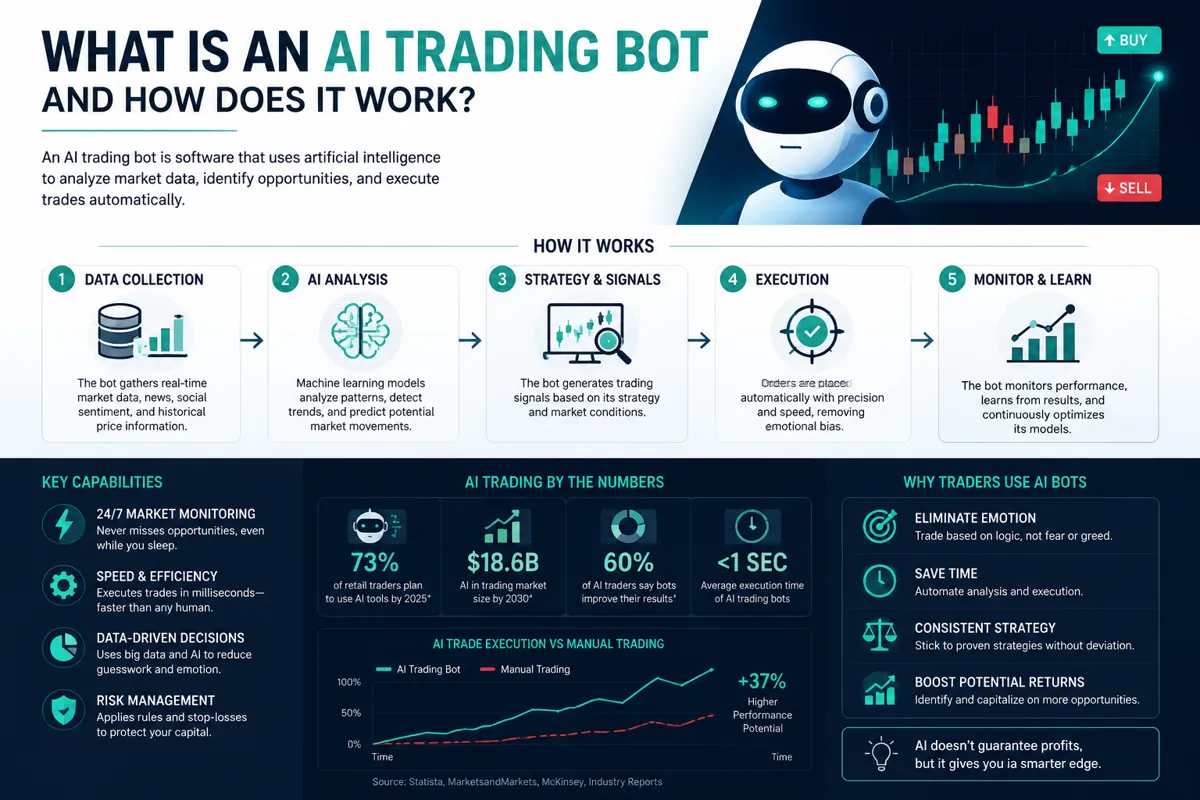
What Is an AI Trading Bot and How Does It Work?
An AI trading bot is software that executes trades — or generates trade signals — based on algorithms trained on market data, price action, and sometimes alternative data like news sentiment or earnings transcripts. It removes the emotional variable from execution, which is either its greatest strength or its most dangerous illusion, depending on how you use it.
Here's the basic mechanics:
- The bot ingests data (price, volume, indicators, news, options flow).
- It runs that data through a rules-based or machine-learning model.
- It either fires a trade automatically or surfaces a signal for you to act on.
- It logs the outcome and, in smarter systems, adjusts weighting over time.
The "AI" label gets slapped on everything from a simple moving average crossover script to a genuine neural network trained on millions of data points. Most retail-facing products sit closer to the former. That's not automatically bad — a clean, rules-based system beats a discretionary mess — but know what you're actually buying.
The practical takeaway: Ask any bot vendor one question before spending a dollar — "Where can I see the verified, out-of-sample performance data?" If they pivot to testimonials, you have your answer.
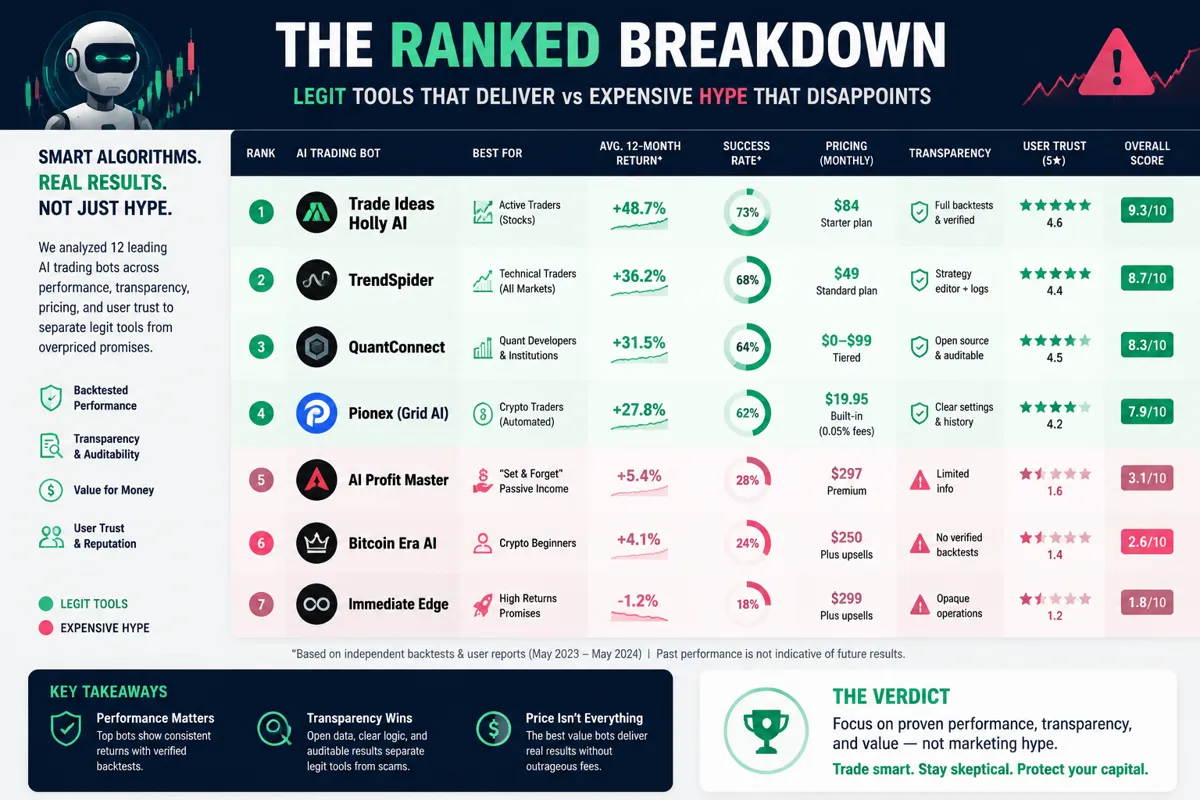
Best AI Trading Bot: Legit Tools vs Expensive Hype — The Ranked Breakdown
This is where most comparison articles go soft. They list ten tools, give everyone four stars, and call it a day. That's not helpful. Here's an honest ai trading bot value ranking based on transparency, features that matter, and real-world usability for retail traders.
Tier 1 — Professional-grade, verified track records:
- Trade Ideas (Holly AI): The gold standard for day trading bots. Holly AI runs thousands of simulated strategies overnight and surfaces the highest-probability setups for the next session. Audited performance data, deep scanner integration, and a clean setup for active traders. Not cheap (~$167–$228/month), but it's a working tool, not a pitch deck. Check the full Trade Ideas breakdown before committing.
- Tickeron: Offers an audited AI robot marketplace where you can see actual historical performance per robot — not cherry-picked screenshots. Widest selection of AI robots for retail traders, with risk ratings attached. Transparent enough to trust as a starting point.
- TrendSpider: The best no-code automated strategy builder for technical traders. Transparent backtest results, multi-timeframe analysis, and dynamic price alerts. If your edge lives in price action and support and resistance levels, TrendSpider's toolkit is worth the monthly fee.
Tier 2 — Solid, specific use cases:
- Composer: Portfolio-level bot with no-code, broker-connected execution (works with Alpaca). Better for systematic investors building rules-based allocation strategies than for active day traders chasing the breakout.
- QuantConnect: Institutional-grade algo bot for serious retail traders who want full control. Open-source, Python-based, and genuinely powerful. The learning curve is steep, but the ceiling is high. If you're willing to put in the work, nothing at this price point (free to start) comes close.
- 3Commas: Popular for crypto automation. Solid DCA and grid bot functionality, reasonable pricing, and a large community. Not a stock market tool — keep it in its lane.
Tier 3 — Useful signal tools, not full bots:
Tools like Tickeron's AI signals, Blackbox Stocks, and Tradytics generate signals and alerts rather than executing trades. They're valuable for traders who want AI-assisted analysis without handing over execution. Lower risk, lower automation.
The practical takeaway: Match the tool to your strategy. A day trader needs Holly AI or TrendSpider. A crypto compounder needs 3Commas. A quant-curious retail trader needs QuantConnect. Using the wrong tier is how you waste six months and $1,200.
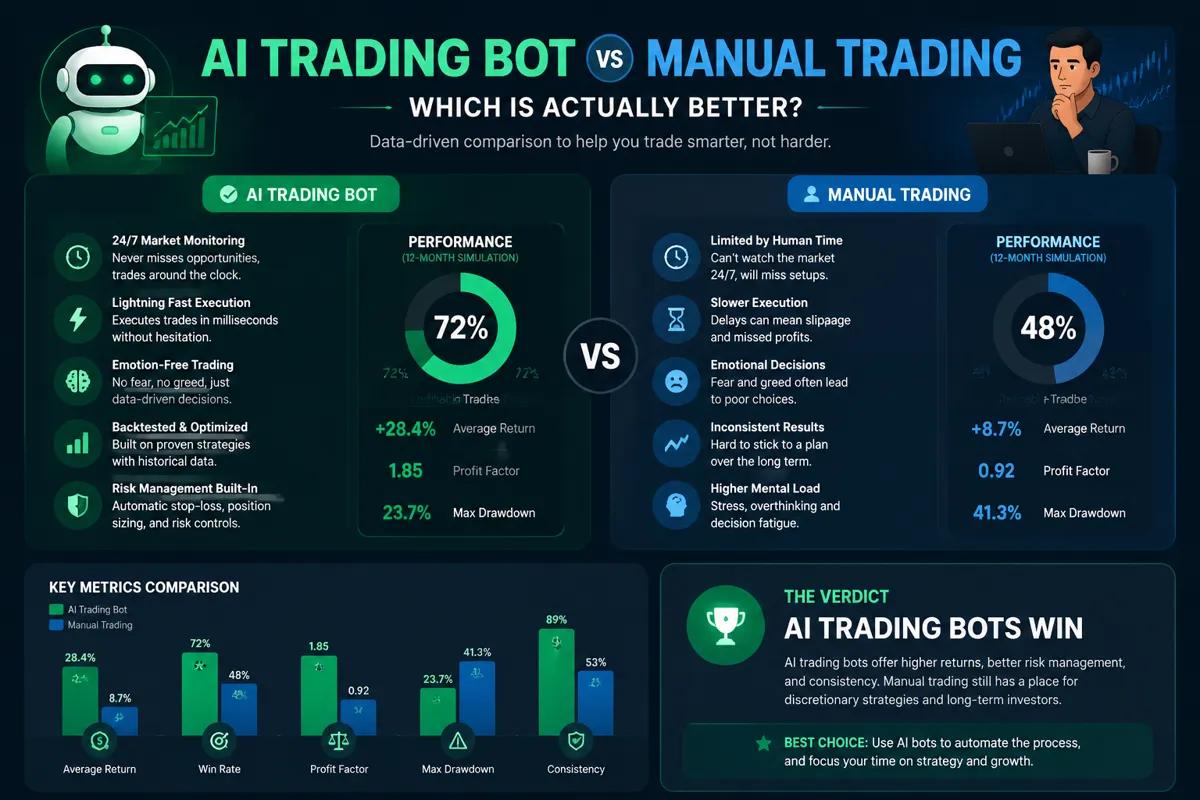
AI Trading Bot vs Manual Trading: Which Is Actually Better?
Neither is universally better. The honest answer is that AI bots win on consistency and speed; manual trading wins on adaptability and context.
Bots don't revenge trade. They don't panic-sell during power hour because their portfolio is down 3%. They execute the same stop loss logic at 9:32 AM that they would at 3:58 PM. That emotional neutrality is genuinely valuable — most retail traders blow up not because their analysis is wrong, but because their execution is undisciplined.
Manual trading wins when the tape is choppy and the rules don't fit the environment. A bot trained on trending markets will get chopped to pieces in a sideways, low-volume grind. A skilled trader reads that and steps aside. The bot keeps firing.
The smart play in 2026: Use bots for execution discipline and signal filtering. Use human judgment for context — earnings season behavior, macro shifts, and recognizing when the setup just isn't clean. Think of the bot as a co-pilot, not an autopilot.
How Much Does a Good AI Trading Bot Cost?
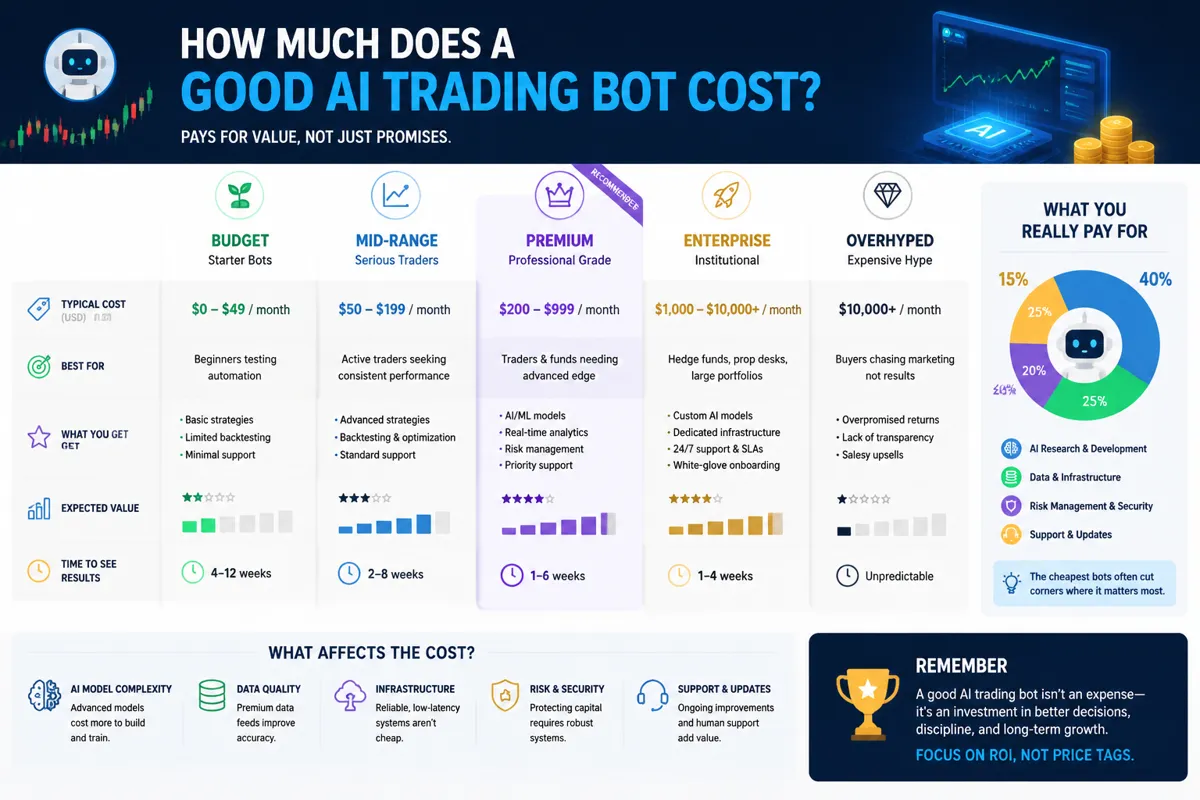
Legitimate AI trading bots range from free to $300+/month for retail-facing platforms. Here's what you actually get at each price tier:
| Price Tier | What You Get | Example Tools |
|---|---|---|
| Free | Basic signals, limited backtesting, paper trading | QuantConnect (free tier), TradingView free plan |
| $20–$50/month | Decent scanner + alert automation | Webull premium, basic Tickeron |
| $50–$150/month | Strategy automation, backtesting, broker integration | TrendSpider, Composer, 3Commas |
| $150–$300/month | Professional AI signals, audited bots, full automation | Trade Ideas, Tickeron premium |
| $300+/month | Institutional tools adapted for retail | QuantConnect cloud compute, enterprise tiers |
Red flag pricing: Any "bot" sold as a one-time fee of $997–$4,997 with "lifetime access" and a countdown timer. That's a sales funnel, not a trading tool. Play stupid games, win stupid prizes.
The best free AI trading bot for beginners is QuantConnect's free tier for algo learning, or TradingView's free plan for manual signal testing. Neither automates execution at the free level, but both let you paper trade it first before risking real capital.
How to Spot an AI Trading Bot Scam
Most AI trading bot scams share the same DNA. Once you see the pattern, you can't unsee it.
The scam playbook:
- Guaranteed returns or "consistent 30% monthly profits" — the SEC has been clear: no investment strategy can guarantee returns, and any claim otherwise is a securities violation.
- No verifiable backtest data. Screenshots of a Robinhood account are not audited performance.
- Pressure to act fast — "only 12 spots left" or a countdown timer on the sales page.
- No regulatory disclosure, no company address, no named team.
- Requires you to deposit funds with an unregulated broker they recommend.
- Testimonials with no last names, stock photos, or suspiciously round numbers ("I made $47,000 in 3 weeks").
The legitimate bot checklist:
- Transparent, downloadable backtest results with out-of-sample data
- Named team with verifiable credentials or a registered company
- Clear pricing with no hidden "activation fees"
- Integration with regulated brokers (Fidelity, Alpaca, Tastytrade, Interactive Brokers)
- Active user community with real, searchable feedback
For a deeper look at which tools pass this test, the AI trading platforms comparison covers 100+ tools with independent ratings.
Can AI Trading Bots Guarantee Profits?
No. Full stop. Any bot, platform, or person claiming guaranteed profits from automated trading is either lying or doesn't understand how markets work — and neither option is someone you want managing your money.
Markets are non-stationary. The pattern that worked in 2022's bear market may destroy capital in 2026's environment. Even the best AI trading bot is a probabilistic tool, not a money printer. What a legitimate bot can do is improve your win rate, enforce risk management, and remove emotional decision-making from the equation.
The honest math: If a bot wins 55% of trades with a 1.5:1 risk-reward ratio and you size positions correctly, that's a viable edge over time. That's not a guarantee — it's a statistical expectation. Discipline beats prediction. The system is the edge, not the bot.
AI Trading Bot for Crypto vs Stock Market: Key Differences
Crypto bots and stock market bots are built for fundamentally different environments. Using the wrong tool in the wrong market is like wearing running shoes to a swim meet.
Crypto bots:
- Run 24/7 — markets never close
- Grid bots and DCA (dollar-cost averaging) bots work well in volatile, range-bound crypto markets
- Less regulatory oversight means more platforms, more scams, and more risk
- Best tools: 3Commas, Wundertrading, Pionex
Stock market bots:
- Constrained by market hours (9:30 AM–4:00 PM ET), pre-market, and after-hours windows
- Must integrate with SEC-regulated brokers
- More data richness (earnings, options flow, institutional activity) to train on
- Best tools: Trade Ideas, TrendSpider, Tickeron, QuantConnect
For retail traders focused on equities, the swing trading tools directory covers the best AI-assisted platforms for stock-specific strategies.
Do I Need Coding Skills to Use an AI Trading Bot?
No coding required for most modern retail-facing AI bots. Platforms like Composer, TrendSpider, and Trade Ideas are built specifically for traders who think in strategies, not Python syntax.
- No-code options: Composer (drag-and-drop portfolio logic), TrendSpider (visual strategy builder), Trade Ideas (pre-built Holly AI strategies)
- Low-code options: 3Commas (simple condition-based triggers), Tickeron (template-based robots)
- Code-required: QuantConnect (Python/C#), custom MetaStock scripts, Alpaca API integrations
Choose based on your goal: If you want to run someone else's verified strategy, no-code is fine. If you want to build and own your edge from scratch, learning the basics of Python with QuantConnect is worth the investment. The QuantConnect tool breakdown covers what the learning curve actually looks like.
What Is AI Trading Bot Backtesting and Why Does It Matter?
Backtesting means running a trading strategy against historical price data to see how it would have performed. It's the closest thing to a test drive before you put real money on the line.
Without backtesting, you're deploying capital on a hunch. With it, you at least know whether your logic has ever worked — and under what conditions it broke down.
What good backtesting looks like:
- Out-of-sample testing (tested on data the model wasn't trained on)
- Realistic transaction costs included (slippage, commissions)
- Multiple market environments tested (bull, bear, choppy tape)
- Max drawdown clearly disclosed — not just win rate
The trap to avoid: Curve-fitting. That's when a strategy is so perfectly tuned to past data that it looks flawless historically but falls apart in live markets. If a backtest shows a 90%+ win rate with no drawdown, that's a curve-fit, not an edge. Use the free expectancy calculator to stress-test any bot's claimed numbers before you trust them.
Best AI Trading Bot for Beginners: Where to Actually Start
The best AI trading bot for beginners is one that teaches you how to think, not just what to click. That wasn't in our bingo card when AI bots first launched — most were built for quants, not retail traders learning the ropes.
The beginner path:
- Start with TradingView's free plan — learn to read price action and set basic alerts before automating anything.
- Paper trade a simple strategy for 30 days. No real capital. Just log every entry and exit.
- Use the free stock screener recipe builder to define your setup criteria before trusting any bot to find it for you.
- Once you have a documented edge, explore Composer or TrendSpider to automate the execution.
- Start with small position sizing. Risk management is the only thing standing between a learning experience and a blown account.
The mistake most beginners make: Skipping steps 1–3 and going straight to a $200/month bot they don't understand. Analysis paralysis is bad; blind automation is worse. Cut the noise, keep the alpha — and that starts with knowing what signal you're actually chasing.
Common Mistakes People Make With AI Trading Bots
Even legitimate tools get misused. Here's where retail traders consistently go wrong:
- Over-optimizing the backtest. Tweaking parameters until the historical results look perfect, then deploying live. The market doesn't care about your backtest.
- No position sizing rules. A bot that wins 60% of trades will still blow up an account if position sizing is reckless. Risk-reward and position sizing are non-negotiable.
- Ignoring drawdown limits. Set a maximum drawdown threshold — say, 15% — and pause the bot if it hits that level. No bot runs well in every market condition.
- Overtrading. More signals is not better. A bot firing 40 trades a day in a choppy tape is generating commissions, not alpha.
- Trusting the bot blindly during earnings season. Earnings create gap-fill scenarios and volatility spikes that break most standard bot logic. Reduce position sizing or pause automated execution around major earnings events.
- Not paper trading it first. Every new bot gets 30 days of paper trading before live capital. No exceptions.
Conclusion: Cut the Noise, Pick the Right Bot
The best AI trading bot in 2026 isn't the one with the slickest landing page or the boldest profit claims. It's the one that fits your strategy, shows you its work through transparent backtesting, and enforces the risk management discipline that most retail traders skip.
Here's the action plan:
- Define your strategy first. Day trading, swing trading, crypto automation, or portfolio-level rules? The answer determines the tool.
- Demand verified performance data. No backtest, no trust. Out-of-sample results only.
- Paper trade before going live. Thirty days minimum. Log every signal.
- Set a drawdown limit and stick to it. The bot doesn't know when to stop. You do.
- Start with one tool, not six. Tool overload is just analysis paralysis with a subscription fee.
The signal is out there. The noise is louder. Systems over hacks, process over prediction — that's the only edge that compounds.
We test the AI stock tools so you don't waste months on the wrong ones. Browse the full AI trading bots directory at aistockpickerapps.com.
FAQ
What is the best AI trading bot for retail traders in 2026?
Trade Ideas (Holly AI) leads for active day traders. TrendSpider is the top pick for technical swing traders. Tickeron offers the most transparent AI robot marketplace. The best choice depends on your strategy and market.
Can an AI trading bot make me money consistently?
No bot guarantees consistent profits. A well-configured bot with solid risk management can improve execution discipline and signal quality, but market conditions change and no algorithm works in every environment.
How much should I pay for a legitimate AI trading bot?
Expect $50–$250/month for a credible retail-facing tool with real backtesting. Anything sold as a one-time fee over $500 with "lifetime access" and a countdown timer is almost always a sales funnel.
Do AI trading bots work for crypto?
Yes, but use crypto-specific platforms like 3Commas or Wundertrading. Stock market bots are not built for 24/7 crypto markets and will underperform in that environment.
What is backtesting and why does it matter?
Backtesting runs a strategy against historical data to measure how it would have performed. It's the minimum standard of evidence for any bot. Always look for out-of-sample results, not just in-sample optimization.
How do I know if an AI trading bot is a scam?
Key red flags: guaranteed return claims, no verifiable backtest data, pressure tactics, no named team or registered company, and requirements to deposit with an unregulated broker.
Do I need coding skills to use an AI trading bot?
No. Platforms like Composer, TrendSpider, and Trade Ideas are fully no-code. QuantConnect requires Python but offers the most flexibility for traders who want to build custom strategies.
What is the best free AI trading bot?
QuantConnect's free tier is the strongest free option for algo development. TradingView's free plan is the best starting point for signal testing and manual strategy building before automating.
Should I use a bot during earnings season?
Use caution. Earnings create volatility spikes and gap-fill scenarios that break most standard bot logic. Reduce position sizing or pause automated execution around major earnings announcements.
What is the biggest mistake traders make with AI bots?
Deploying live capital without paper trading first, and skipping position sizing rules. A bot with no risk management attached is just a faster way to lose money.
How do AI trading bots for stocks differ from crypto bots?
Stock bots operate within market hours (9:30 AM–4:00 PM ET) and must connect to SEC-regulated brokers. Crypto bots run 24/7 on unregulated exchanges. The data inputs, strategy logic, and risk profiles are fundamentally different.
What features actually matter in an AI trading bot?
Transparent backtesting with out-of-sample data, broker integration with a regulated platform, customizable stop loss and position sizing rules, and a clear drawdown limit. Everything else is optional.