Agentic Trading Is Making Some Traders Rich...7 Brokers Ranked

On October 27, 2026, 
Agentic trading means an AI agent such as 

Both things can be true. Here's what the plumbing actually does, who approves the order at each broker, and where the risk hides.
What Is Agentic Trading, and How Is It Different From a Bot?
Three things get confused constantly. They're not the same animal.
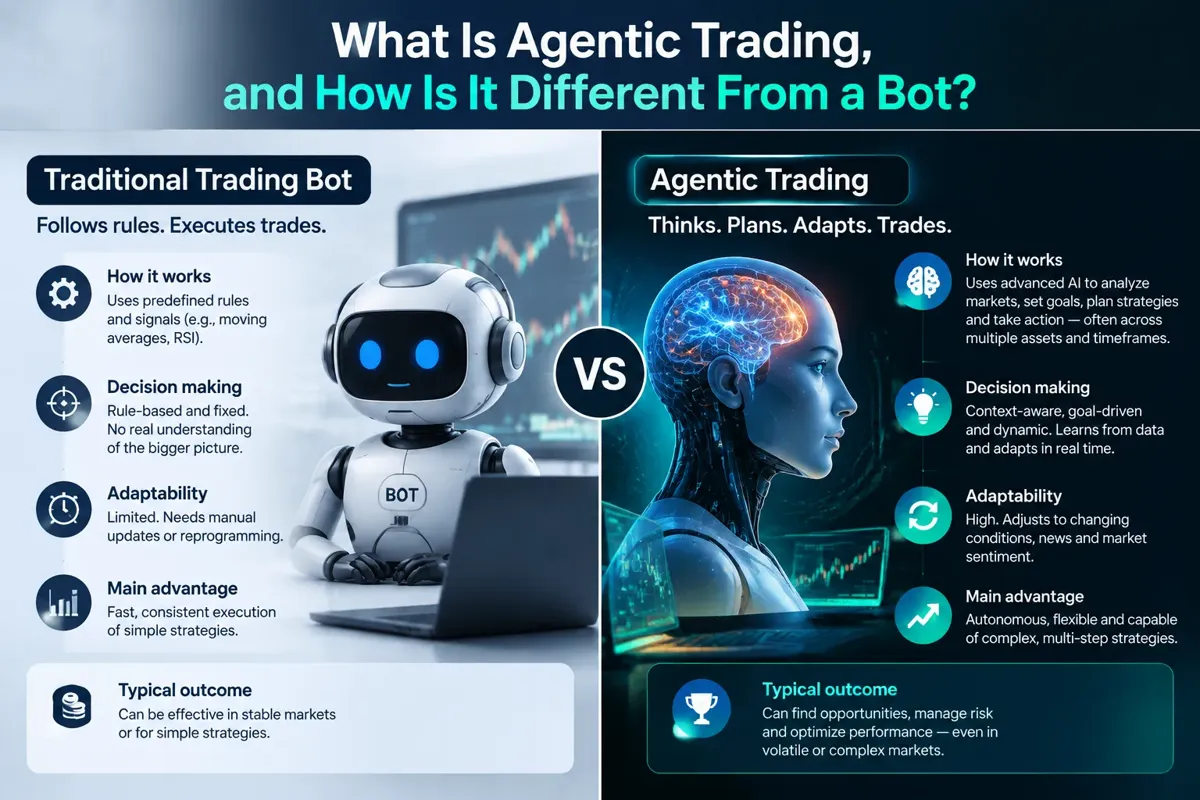
A trading bot follows rules you wrote. If RSI drops below 30, buy. It has no judgment. It will happily buy a falling knife into a bankruptcy filing because the indicator said so.
A robo-advisor allocates a long-term portfolio and rebalances. It isn't trading. It's a thermostat.
AI agent trading sits between them. A large language model reads filings, news, chart data, and your account positions, forms a view, then submits an order through a broker connection. The difference between this and algorithmic trading is reasoning versus rules. An algo executes a predetermined plan. An agent decides what the plan should be, then executes it.
The connection layer most brokers use is called MCP, Model Context Protocol. Think of it as a standard plug. Your broker publishes a set of tools the AI can call, like "get quote," "check buying power," "place order." The AI calls them. No coding required on your end, which answers the obvious question: yes, you can let an AI trade without writing a line of code. That's the whole point of the standard.
The uncomfortable part: an agent with order permissions is a discretionary trader you've never interviewed.
Jefferies analysts expect these tools to increase overall market volumes as adoption spreads. More volume isn't the same as more profit for the person clicking approve.
Who's Actually Making Money With Agentic Trading?
Here are the receipts that exist publicly. Read them as other traders' reported experiences, not as a forecast of yours.
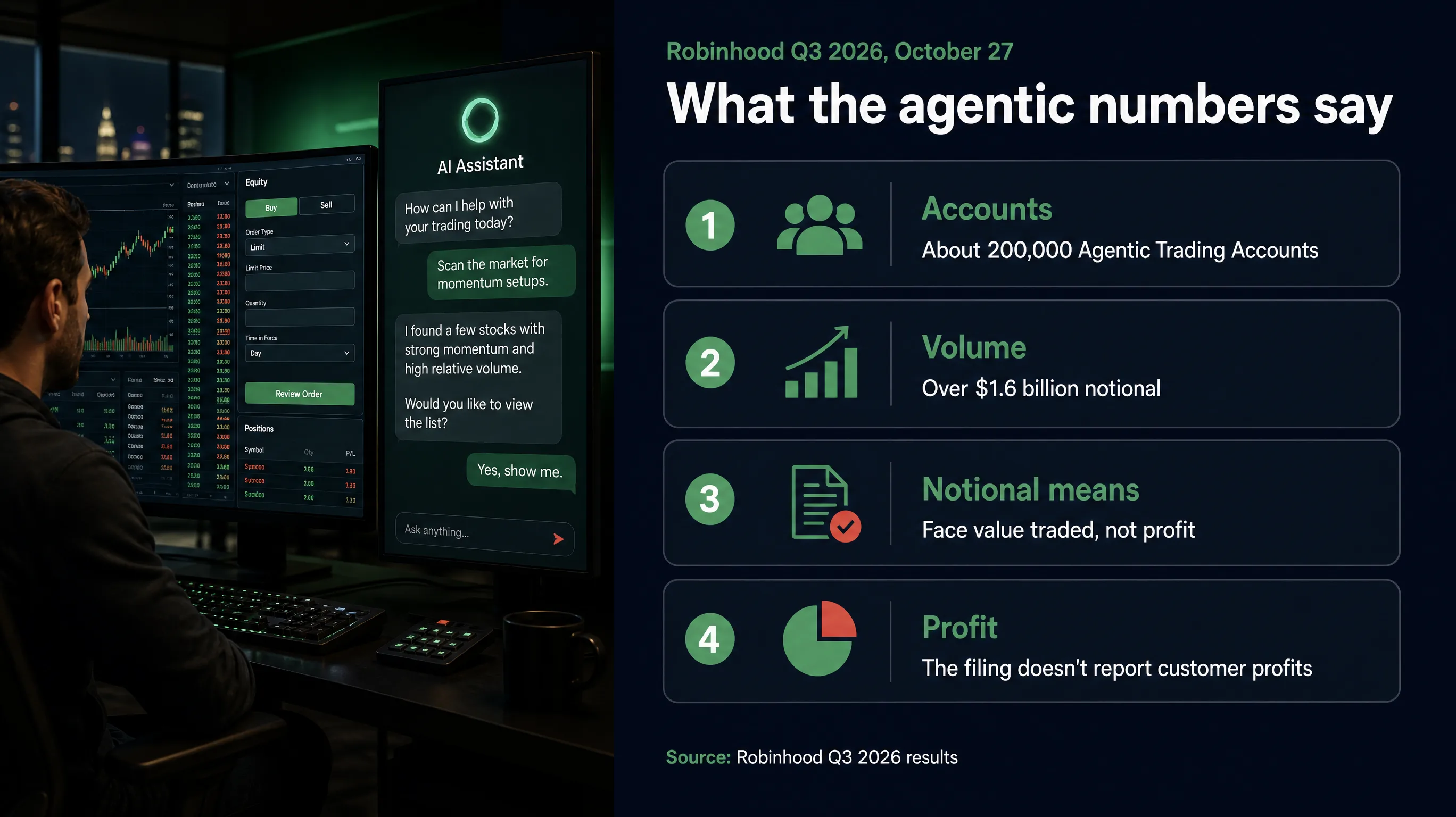
Robinhood's own filing. The Q3 2026 release dated October 27, 2026 reports about 200,000 Agentic Trading Accounts and over $1.6 billion in notional volume. Notional volume is the face value of what got traded, not profit. A trader who buys and sells the same $5,000 position forty times generates $200,000 in notional and might be down money. The filing doesn't say anyone made anything.
A single iron condor. @PSInvestor on X documented Claude running a one-contract NFLX iron condor for a $27 gain on $66 at risk. That's a 41% return on the capital at risk and roughly the cost of a sandwich. It's a real, documented, verifiable trade. It is also a sample size of one.
A month-long test. 
Reddit. A post on r/ai_trading from a trader who built an AI-assisted automatic swing trading setup is one of the more detailed write-ups out there. The agentic trading Reddit threads skew the way Reddit always does: heavy on build logs, light on audited P&L. Treat the enthusiasm with the same suspicion you'd apply to any Discord.
Notice what's missing across all four. Nobody has posted a twelve-month, drawdown-included, tax-adjusted track record. Because the category is barely a year old.
Nobody got rich yet. Some people got curious, and a few got $27.
The Counterweight Nobody Is Posting About
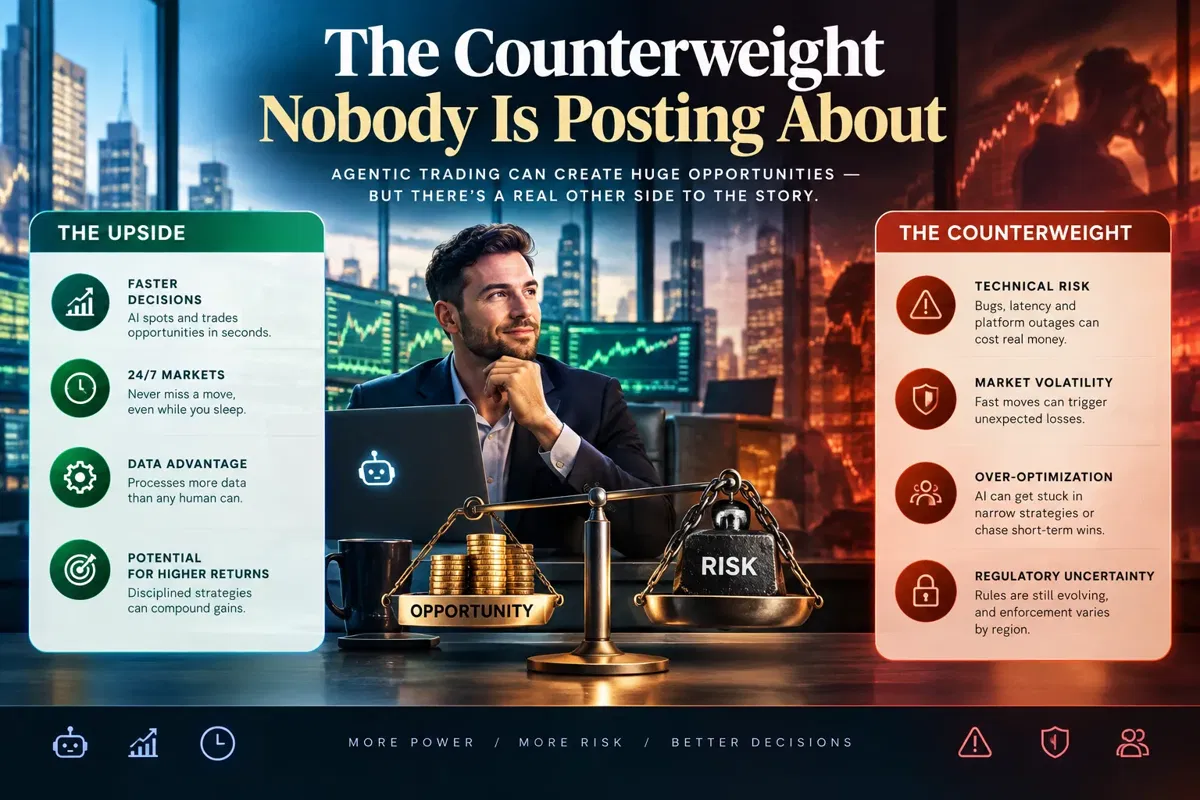
On October 22, 2026, Axios reported that major US banks were detecting unauthorized AI agents operating inside customer accounts. Not rogue agents going haywire. Agents that the account holder didn't knowingly authorize.
That's the real risk surface. You're not just betting that the model picks well. You're betting that the credential chain between your chat window and your broker holds. Mindful Markets has tracked how regulators are already splitting the field between autonomous and pre-approved agent models for exactly this reason.
Which Brokers Offer Agentic Trading in 2026?
Seven US brokers run first-party connections between AI agents and live accounts. The ranking below is ordered by how much control you keep, because that's the variable that decides whether this is a tool or a liability.
The single most useful question to ask any agentic trading platform: who presses submit?
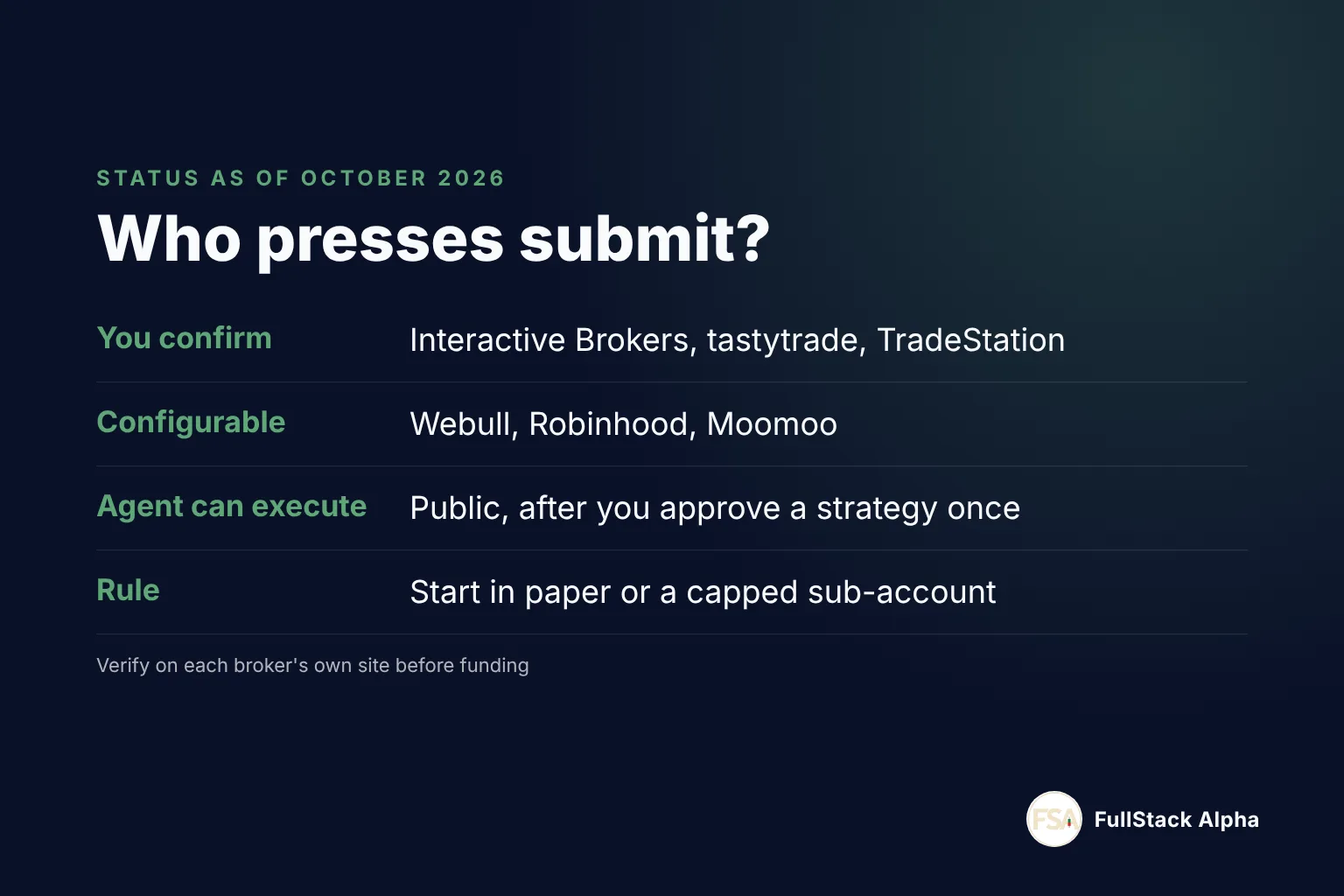
Who Presses Submit? AI Agent Control Map
Seven US brokers, ranked by how much control stays with you. Status as of October 2026, verify on each broker's own site before funding.
Green = you submit. Light green = you choose. Red = the agent can execute alone. FullStack Alpha · educational only, not investment advice.
 1. Interactive Brokers: The Capital Jail Cell Approach
Interactive Brokers launched Autonomous Trading in late October 2026, and it's the most conservative design in the group, which is exactly why it ranks first.
Clients authorize a connected AI platform to scan more than 75,000 listed stocks, options, and ETFs worldwide and submit supported orders from a dedicated AI Partition. That partition is the whole idea. You move cash into it from your main account. The agent can touch that money and nothing else. Funding is capped at the lesser of 10% of account equity or $25,000, with a $1,000 minimum.
So Interactive Brokers autonomous trading answers the "how much money do you need" question cleanly: a thousand dollars to start, and the broker will not let you hand over the farm even if you want to.
There's a gating requirement too. Before autonomous execution switches on, you have to complete at least ten manually approved trades of $100 or more across two weeks. Translation: prove you've been watching before the training wheels come off. Supported orders are market, limit, stop, and stop-limit on eligible stocks and equity options. Margin, short selling, fractional shares, penny stocks, and Canadian stocks are excluded.
StockBrokers.com ranked IBKR first among the seven brokers it tested, citing the separation of AI-generated instructions from final execution, no extra AI connection fee, and no special minimum beyond normal account rules.
The drawback, and it's real: IBKR's interface has never been friendly. If Robinhood is a smartphone, IBKR is a Linux install. Expect a learning curve. If you're comparing it against other global platforms, the Interactive Brokers vs Saxo breakdown covers the non-AI side of the account.
 2. Webull: The Caps Nobody Else Bothered to Build
Webull went the other direction from IBKR. Instead of walling off capital, it wrapped the orders.
Webull offers native connectors for ChatGPT, Claude, and Grok. The guardrails are per-order dollar caps, per-order share caps, and a symbol whitelist. That last one matters more than it sounds. A whitelist means the agent can only trade names you've pre-approved. If your agent develops a sudden conviction about a $0.40 low float shell company with a pump campaign behind it, it can't act on it, because the ticker isn't on the list.
The Webull MCP integration is genuinely one of the better-executed ones for traders who want speed without surrendering the whole account. Caps are set once and enforced per order, which is more granular than "here's a pile of money, be careful."
Where it falls short: caps control size, not frequency. An agent can stay inside a $500 per-order cap and still run forty trades a day, racking up slippage and short-term capital gains. If you're running anything high-turnover, read how taxes work with day trading before the agent builds you a surprise.
3. Robinhood: The Most Adopted, Not the Most Careful
Robinhood launched agentic accounts in May 2026 and announced Robinhood Agents at its HOOD Summit on September 29, 2026. The agents research markets, analyze holdings, build strategies, and place trades inside a separate self-directed agentic account.
By late September, Robinhood said agents were calling its tools nearly 30 million times a day. The company has not disclosed how many of those calls became executed trades. A tool call is an agent asking for a quote. It is not a trade, and conflating the two is how a stat becomes marketing.
In the agentic trading Robinhood setup, the approvals system is the strongest part. With approvals on, the agent cannot submit an order without your confirmation, delivered as a push alert. You can also turn approvals off and let it run unsupervised.
Here's the design gap: no per-order dollar caps. Approvals on means you babysit every trade. Approvals off means there's no size ceiling between the agent and your funded balance. Webull gives you a middle setting. Robinhood doesn't.
Robinhood also launched Agent Apps, letting agents pull from specialized providers including Nasdaq and 

Best for beginners? It's the easiest to set up by a wide margin, and 200,000 accounts says people agree. Easiest is not the same as safest. Keep approvals on.
 4. tastytrade: The 60-Second Dry Run
tastytrade built the most interesting safety mechanism of the seven, and almost nobody talks about it.
The agent can't place an order directly. It proposes one, and tastytrade returns a dry-run token, valid for about 60 seconds, showing exactly what would execute and what it would cost in buying power. The order only fills if that token gets confirmed inside the window. Buying power on the agentic side is capped around $50,000.
Why this is smart: the dry run makes the agent's intent legible before money moves. Most agentic failures aren't evil robots. They're an agent misreading an options chain and building a position with a risk profile the trader never intended. A 60-second preview catches exactly that.
tastytrade is options-first, which suits traders already running spreads and defined-risk structures. The NFLX iron condor receipt mentioned earlier is the kind of trade this platform is built around. If options are your lane, the AI options trading tools roundup covers what pairs well with it.
The friction is the feature, and also the complaint. Sixty seconds is not enough time to think, and if you're away from your phone the token expires. Some traders find that annoying. That annoyance is the guardrail doing its job.
 5. Moomoo: Paper Trading by Default, Which Is the Correct Default
Moomoo's agentic setup defaults to paper trading. You have to deliberately switch it to live.
That one decision puts Moomoo above two brokers with more polished apps, because the most common mistake with trading agents is going live before you understand what the agent actually does. Paper trade it first isn't advice here. It's the factory setting.
Run your agent on simulated money for 30 sessions. Log every trade. Watch what it does during a choppy tape with no clear direction, because that's where agents get shredded. A model that looks brilliant in a trending market often overtrades sideways price action into a thousand small losses. A trading journal template makes that visible in a way a broker statement won't.
The honest limitation: once you flip to live, Moomoo's controls are configurable rather than hard-capped, so the protection is mostly front-loaded into the default. The discipline has to come from you after that.
 6. Public: Strategy Approved Once, Trades Not Reversible
Public's Agentic Brokerage works differently from everything above. You confirm a strategy once. The agent then executes against that strategy, and those trades cannot be reversed.
That's a legitimate design for someone who wants genuine delegation. It's also the place where the gap between "I approved a strategy" and "I approved these forty trades" gets expensive. You're consenting to a direction, not a destination.
What happens when an agent makes bad trades under this model? The trades stand. You eat them. There's no undo button in any brokerage, agentic or otherwise, and Public is the broker where that fact bites hardest because there's no per-order checkpoint to catch the drift.
Use it only if you can write your strategy constraints with real precision: max position size, allowed sectors, max concurrent positions, hard stop loss on every entry. Vague instructions to a capable agent produce confident nonsense. If you can't articulate your edge in one sentence, you shouldn't be delegating it.
Who shouldn't touch this: anyone who hasn't already traded the strategy manually for a quarter.
 7. TradeStation: Confirmation on Every Order, Access by Request
TradeStation ranks last on this list, and not because the product is bad. It's because access is by request and the per-order confirmation requirement makes it functionally a copilot rather than an autonomous trader.
Every order needs confirmation. That's the strictest setting of the seven. For a platform built around serious charting and strategy automation, requiring a human keystroke on every fill removes most of the speed advantage people want from an ai trading agent in the first place.
TradeStation's real strength has always been its native strategy automation, which predates the agentic wave by two decades. If you want rules-based execution, the existing tools already do it better and faster than an LLM asking permission. The agentic layer is useful for research and position review, less so for execution.
It's worth saying the broader industry is heading this direction anyway. 

How Does Agentic Trading Actually Work, Step by Step?
The mechanics are simpler than the marketing suggests.
One. You connect. Inside your broker's settings, you authorize an AI platform. The broker issues scoped credentials. Not your password, a limited permission set.
Two. You set limits. Order caps, symbol whitelists, partition funding, approval requirements. Do this before you fund anything. Most people do it after their first scare.
Three. The agent gathers context. It calls broker tools for quotes, positions, buying power, and sometimes third-party data feeds. This is the 30-million-calls-a-day number Robinhood cited.
Four. The agent proposes or places. Depending on your broker and settings, you get a push alert, a dry-run token, or a filled order.
Five. The order routes to an exchange. Same plumbing as a manual trade. Same spread, same slippage, same settlement.
Fees are mostly ordinary. The brokers listed here don't charge a separate AI connection fee for the base integration, though options contract fees, data subscriptions, and margin rates apply as normal. The AI model itself may cost you, as most capable agents run on paid API tiers. If you're setting up the connection side, the broker with API walkthrough covers the technical part.
Free alternatives exist. Moomoo's paper mode costs nothing. Several free AI trading bots will run a strategy without a subscription. Start there before you pay for anything.
Is Agentic Trading Safe? The Five-Item Checklist
Letting an AI trade is regulated in the sense that the brokers are. They're SIPC members, FINRA-registered, and subject to the same rules as any other brokerage. SIPC covers custody failure, meaning the broker going under. It does not cover your agent buying a bad stock. Nothing covers that.
Run this checklist before you fund a live agentic account:
Read-only first. Connect with read permissions only for two weeks. Let the agent analyze and recommend. Watch whether its reasoning holds up against what price actually did.
Order caps on. If your broker supports per-order dollar and share limits, set them below your comfort threshold. Not at it. Below it.
Separate funded account. Never connect an agent to your main portfolio. IBKR enforces this with the AI Partition. Robinhood uses a separate account. If your broker doesn't force separation, create it yourself by funding sparingly.
Approval per trade. Keep it on until the agent has a record you've personally reviewed. Thirty trades minimum.
Kill switch. Know exactly how to revoke access before you grant it. Every broker on this list lets you sever the connection. Find that button first. The Axios report about unauthorized agents in bank accounts is the reason this item isn't optional.
The agent is the trader. You are the risk manager. Those are different jobs and you only get to quit one of them.
Does Agentic Trading Make Money?
So, is agentic trading good for your P&L? Honest answer: unknown, and anyone claiming otherwise is selling something.
What exists is four public receipts, three of them under $30, covering a few weeks each in a market that mostly went up. $1.6 billion in notional volume across 200,000 accounts works out to roughly $8,000 of trading activity per account. That's turnover, not profit, and it tells you most of these accounts are small and experimental.
The structural problem is familiar. Around 70% of day traders lose money. Handing the same decisions to a faster, more confident decision-maker does not obviously fix that. It can make it worse, because an agent removes the hesitation that sometimes saves you. Revenge trading is a human failure. Overtrading is now available at machine speed.
The pattern worth watching: traders reporting the best experiences are running small defined-risk positions with hard caps and daily review. The ones reporting disasters turned approvals off and checked back a week later.
How long until profits? Nobody has a twelve-month sample. Plan for six months of learning what your agent actually does before you judge it on P&L. Our analysis of whether AI trading bots actually make money walked through the comparable numbers on the previous generation of tools, and the honest result there was humbling.
Agentic Trading vs AI Stock Pickers: Which Fits You?
An AI stock picker hands you a list. You decide. An agent decides and acts.
Pickers suit swing traders and anyone with a day job. You get a watchlist, you check the setup against support and resistance, you size the position, you set the stop. The AI compressed four hours of screening into four minutes. You still own the decision.
Agents suit people who've already got a written system and want execution speed. The agent isn't adding judgment. It's adding reaction time on a process you already validated.
Who should not hand trading to an agent: anyone without a written system, anyone trading money they need within three years, anyone who can't explain in one sentence why their strategy makes money, and anyone who hasn't paper traded the approach first. That covers most people reading this, and that's fine. The AI swing trading tools category gets you most of the benefit with none of the autonomous execution risk. For narrowing the field, the AI stock tool finder filters by what you actually need.
Systems over hacks. An agent amplifies whatever process you already have, including the bad one.
FAQ
How can agentic AI be used in trading? Agentic AI trading covers research, portfolio analysis, strategy drafting, and order execution. The research and analysis uses are low-risk and genuinely useful today. Execution is the part that needs guardrails.
Which AI agent trading platform is the best? Interactive Brokers, based on how the architecture is built. It separates AI instructions from final execution, caps partition funding at the lesser of 10% of equity or $25,000, and charges no extra AI connection fee. Robinhood is easier to start with. Those are different questions.
Can ChatGPT or Claude place trades for me? Yes, through a broker connection. Webull supports ChatGPT, Claude, and Grok natively. The models can't reach your account without you explicitly authorizing the link, and most brokers let you require confirmation on every order.
Does AI trading really make you money? The documented public results are small and short: a $27 options gain, a $25.94 month on $1,000. No audited long-term records exist for retail agentic accounts because the category launched in 2026. Treat every result as another trader's reported experience.
Is agentic trading safe for beginners? Safe-ish with approvals on, a separate funded account, and order caps. Dangerous with approvals off. Moomoo's paper-trading default is the right starting point regardless of which broker you end up using.
Which AI trading bot is legit? Judge by transparency, not by marketing. If a tool won't show you its method or its live results, treat the "proprietary AI" claim as a wrapper around a public model. Our breakdown of legit AI trading bots versus expensive hype covers the tells.
What do traders on Reddit say about AI agent trading? Mixed and early. Build logs outnumber verified P&L reports. The useful threads are on r/ai_trading and r/algotrading, where people post their actual configs. The hype threads are everywhere else.
The One Thing to Do This Week
Connect an agent in read-only mode to an account you've already been trading manually. Ask it to analyze your last twenty positions and tell you what it would have done differently. Don't give it order permissions. Don't fund anything new.
Two weeks of that will tell you more about whether this fits your process than any ranking, including this one. If the agent's reasoning consistently beats yours, you've learned something. If it confidently recommends things you know are wrong, you just saved yourself a funded account.
Picked your broker? The next decision is what the agent runs on. The FullStack Alpha directory lists 200+ AI stock tools by category and price, including the brokers ranked above. Compare brokers with built-in AI tools
References
- Jefferies Sees AI Trading Tools Boosting Market Volumes. investing.com.
- Ai In Trading 2026: Autonomous Or Pre Approved Agents Split As Regulators Step Up. mindfulmarkets.ai.
- Bull Of The Day: Robinhood Markets Inc (HOOD). zacks.com.
For educational purposes only. Not investment advice. Results shown are other traders' reported experiences.
This is education, not financial advice.
Your market edge starts with the right tool. Stay alpha.
Some links on this page may be affiliate links. Rankings are never influenced by them.