Top Monthly Dividend ETF Picks: 7 Compared on Yield

The top monthly dividend ETF for most income investors is JPMorgan Equity Premium Income (JEPI), because it pays every month at a 0.35% expense ratio without leaning on the kind of yield that quietly eats your principal.
Quick answer
If you want monthly cash from one fund and you'd like to keep your capital roughly intact, JEPI is the default top monthly dividend ETF. If you want a bigger check and you can stomach a growth-heavy portfolio with a capped upside, QQQI from NEOS pays more and charges 0.68% to do it. If your priority is cost, SPDR Portfolio High Yield Bond (SPHY) runs about 0.05% a year, roughly $5 per $10,000, and still pays monthly. The mistake almost nobody avoids on the first try is treating a distribution rate as a return. It isn't. A 13% payout on a fund that loses 9% of its net asset value is a 4% year with extra paperwork.
Top monthly dividend ETF picks: key takeaways
- JEPI charges 0.35% (about $35 a year per $10,000 invested) and is the largest monthly-paying equity income ETF in the US, with roughly $40 billion in assets as of mid-2026.
- QQQI charges 0.68% (about $68 per $10,000) and has distributed cash every month since it launched in January 2024. Its issuer-reported distribution rate has generally run in the low-to-mid teens.
- SPHY charges about 0.05%, the cheapest monthly payer on this list, and pays interest from high yield corporate bonds rather than option premium.
- SPHD holds roughly 50 stocks screened from the S&P 500 for high dividend yield and low volatility, pays monthly, and writes zero options.
- PFF holds several hundred preferred securities at about 0.46%, and it moves with interest rates more than with the stock market.
- The sustainability test takes 30 seconds: distribution rate minus the trailing 12-month change in net asset value. If that number is deeply negative year after year, the fund is handing you your own money back.
- Distribution rates are not fixed. Every fund here can and does change the monthly amount. Check the issuer page before you buy, because the numbers in any article, including this one, are a snapshot.
How did we pick each top monthly dividend ETF?
Four filters, applied in order: pays monthly, charges a fee you can defend, has a distribution history long enough to judge, and holds assets deep enough that you can actually get out.
Here's what each one means in practice.
1. Monthly distributions, confirmed by history. Plenty of funds say "monthly" in the marketing and then skip. Every pick here has a published record of consecutive monthly payments. A fund launched last quarter with one payment behind it is a prospectus, not a track record.
2. Expense ratio under 0.70%. Fees compound against you with the same patience your dividends compound for you. At 0.68% you're paying $68 a year per $10,000, every year, whether the fund has a good month or a terrible one. Anything north of 0.70% needs a very specific reason to exist.
3. Assets over roughly $1 billion. Size is not quality, but it does buy you tighter bid-ask spreads and a lower chance of the fund closing and forcing a taxable exit you didn't plan.
4. A yield you can trace to a source. Option premium, bond coupons, preferred dividends, or common stock dividends. If you can't name where the cash comes from, you can't judge whether it survives a bad tape. This is the filter that knocks out most of the double-digit yielders retirees get pitched.
What we deliberately excluded: single-stock covered call funds, leveraged income products, and anything with a distribution rate above 20%. Those aren't income tools. They're volatility harvesting with a dividend costume on, and the people buying them for retirement cash flow usually find out the hard way.
Yields and asset figures in this guide are approximate as of mid-2026 and change constantly. Treat them as a starting point and verify on the issuer's fund page. The SEC's investor education site has a plain-English primer on how fund distributions and fees actually work if you want the mechanics from the regulator rather than the marketing department.
Top monthly dividend ETF picks at a glance
No single top monthly dividend ETF wins every column, so read the income engine before you read the yield.
Seven funds, three different engines. Four of them generate income by selling options (QQQI, JEPI, JEPQ, DIVO). One pays you from ordinary stock dividends (SPHD). Two pay you from credit (PFF, SPHY). Match the engine to what you're afraid of, not to the biggest number.
| ETF | Strategy | Trailing yield (approx., mid-2026) | Expense ratio | Assets (approx.) | Distribution history | Best for | Price (annual fee per $10,000) |
|---|---|---|---|---|---|---|---|
| NEOS Nasdaq-100 High Income (QQQI) | Active Nasdaq-100 with index call overlay | ~13% to 15% | 0.68% | ~$3B to $4B | Monthly since Jan 2024 | Highest payout with growth exposure | ~$68 |
| JPMorgan Equity Premium Income (JEPI) | Low-volatility US equity plus option-linked notes | ~7% to 8% | 0.35% | ~$40B | Monthly since 2020 | Core monthly income holding | ~$35 |
| JPMorgan Nasdaq Equity Premium Income (JEPQ) | Nasdaq-100 equity plus option-linked notes | ~9% to 11% | 0.35% | ~$28B | Monthly since May 2022 | Tech-tilted income at a low fee | ~$35 |
| Amplify DIVO ETF (DIVO) | Active quality dividend stocks, tactical calls | ~4.5% to 5% | 0.56% | ~$4B | Monthly since 2016 | Dividend growth with modest overlay | ~$56 |
| Invesco S&P 500 High Dividend Low Vol (SPHD) | ~50 high-yield, low-volatility S&P 500 stocks | ~3.5% to 4% | 0.30% | ~$3B | Monthly since 2012 | Pure dividends, no option cap | ~$30 |
| iShares Preferred and Income Securities (PFF) | US preferred stock and hybrid securities | ~6% to 6.5% | 0.46% | ~$14B | Monthly, long history | Rate-driven income, low equity beta | ~$46 |
| SPDR Portfolio High Yield Bond (SPHY) | Broad US high yield corporate bonds | ~6.5% to 7% | 0.05% | ~$9B | Monthly, long history | Cheapest monthly cash flow | ~$5 |
The last column is the honest price of ownership. Share prices move every day and tell you nothing about value. The fee is the only number you pay with certainty.
1. NEOS Nasdaq-100 High Income ETF (QQQI)
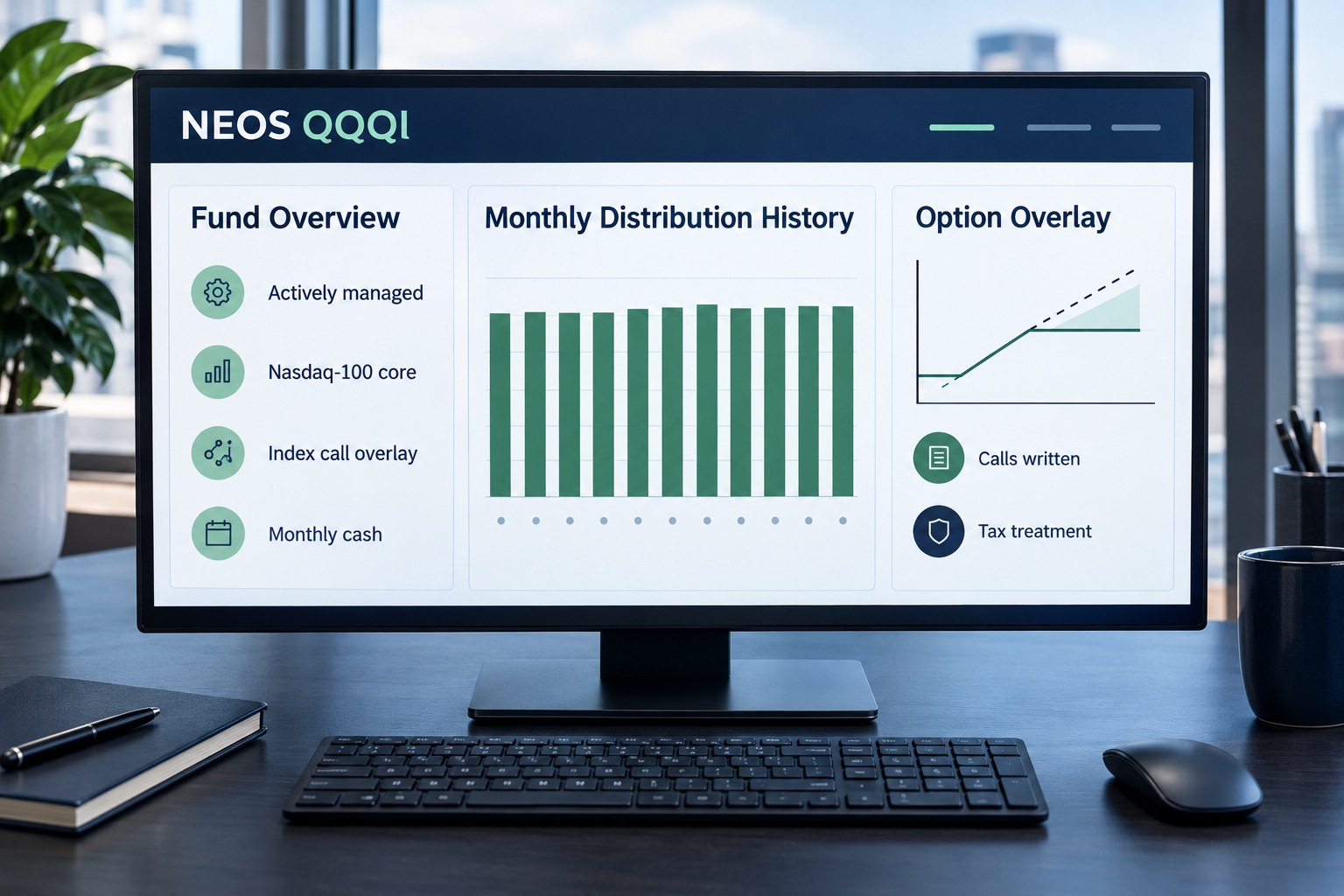
QQQI is the top monthly dividend ETF on this list by distribution rate, and its 0.68% fee is the price of that bigger check.
Best for: investors who want the largest monthly check and accept that the upside is capped.
QQQI holds a core portfolio of Nasdaq-100 large-cap growth names and writes call options against that exposure to generate cash. A call option is a contract that gives the buyer the right to purchase at a set price. Selling one collects premium today and gives up gains above that strike. That's the trade: current income in exchange for the top slice of a rally.
What separates it from older covered call funds is the option design. NEOS writes index options rather than single-stock options, which fall under Section 1256 of the tax code and carry a blended long-term and short-term treatment. The fund also characterizes a meaningful share of its distributions as return of capital, meaning part of the cash isn't taxed as income the year you receive it. Return of capital lowers your cost basis, so the tax shows up later as a bigger capital gain. It's deferral, not forgiveness, and in a taxable brokerage account deferral has real value.
Pros
- Highest distribution rate on this list, generally in the low-to-mid teens
- Index options give Section 1256 tax treatment plus return of capital characterization
- Actively managed overlay, so coverage can flex with volatility
- Monthly cash every month since January 2024
Cons
- 0.68% is the most expensive fee here, roughly double JEPI
- Nasdaq-100 concentration means a handful of mega-cap tech names drive the whole thing
- Capped upside in strong rallies, which is the cost of the payout
- Short history, so it hasn't been tested through a full bear market
Key features: active management, Nasdaq-100 core, index call overlay, monthly distributions, tax-aware structure.
Skip it if a 25% drawdown in your income sleeve would change your behavior. Growth stocks fall harder, and option premium does not rescue you from that.
2. JPMorgan Equity Premium Income ETF (JEPI)
If you only buy one top monthly dividend ETF, make it this one: 0.35%, roughly $40 billion in assets, and monthly cash since 2020.
Best for: the core monthly income position in a retiree's portfolio.
JEPI owns a defensively screened basket of US large-cap stocks chosen for lower volatility and reasonable valuation, then adds income through equity linked notes that replicate selling S&P 500 calls. An equity linked note is a bank-issued instrument whose payoff is tied to an index and an option position. It introduces a small amount of counterparty risk, which JPMorgan manages by spreading notes across issuers and keeping maturities short.
The result is a fund that usually falls less than the S&P 500 in bad stretches and lags it in great ones, while paying every month. At roughly $40 billion, it's the most liquid vehicle in this category, and at 0.35% it's priced like an index product even though the option sleeve is actively run.
Pros
- 0.35% expense ratio, the cheapest active option-income fund here
- Lower volatility than the S&P 500 thanks to the defensive stock screen
- Deep liquidity and penny-wide spreads at roughly $40 billion in assets
- Monthly distributions since 2020, including through the 2022 drawdown
Cons
- Distributions are taxed largely as ordinary income, so it's best held in an IRA
- Equity linked notes add counterparty risk a plain covered call fund avoids
- Meaningful lag versus the S&P 500 in strong up years
- Monthly amount swings with volatility, so budgeting on a fixed figure is a mistake
Key features: roughly 100 to 140 low-volatility holdings, ELN option sleeve, monthly payout, 0.35% fee.
Decision rule: if you need one monthly payer in a tax-advantaged account and you don't want to think about it again for five years, this is the one.
3. JPMorgan Nasdaq Equity Premium Income ETF (JEPQ)
Think of JEPQ as JEPI with a louder engine: same 0.35% fee, more Nasdaq, more volatility.
Best for: investors who want JEPI's low fee with a bigger payout and more tech.
Same machinery as JEPI, different engine room. JEPQ screens Nasdaq-100 stocks instead of the broad market and writes options on the Nasdaq-100. Higher index volatility means fatter option premium, which is why its distribution rate typically runs several points above JEPI's while the fee stays at 0.35%.
That extra yield isn't free. You're taking concentrated exposure to the same dozen mega-cap technology names that dominate every growth index, and when that group corrects, JEPQ corrects with it. Option premium cushions maybe a few percentage points of a serious drawdown. It doesn't neutralize one.
Pros
- Distribution rate typically several points above JEPI at the same 0.35% fee
- Roughly $28 billion in assets with excellent liquidity
- Monthly cash since May 2022, including its first full bear market
- Actively screened Nasdaq holdings rather than a straight index clone
Cons
- High single-name and sector concentration in mega-cap tech
- Ordinary income tax treatment on most distributions
- Deeper drawdowns than JEPI when growth sells off
- Same ELN counterparty consideration
Key features: Nasdaq-100 equity screen, ELN option overlay, monthly payout, 0.35% fee.
Common mistake: owning JEPQ alongside QQQ and calling it diversification. You own the same 15 companies twice, once with a cap on the upside.
4. Amplify DIVO ETF (DIVO)
DIVO is the top monthly dividend ETF here for investors who care more about total return than the size of this month's check.
Best for: investors who want dividend growth first and monthly income second.
DIVO is the most conservative option-income fund here, and the yield reflects that. It holds a concentrated book of roughly 20 to 25 large-cap companies with strong dividend records, then writes covered calls tactically on individual positions rather than blanketing the whole portfolio. That means it keeps more of the upside than a fully covered fund, at the cost of a smaller check.
The manager, Capital Wealth Planning, has been running this approach since the fund launched in 2016, and it's paid monthly throughout. Its distribution rate in the 4.5% to 5% range looks unimpressive next to a mid-teens covered call fund until you compare total returns across a market cycle. DIVO gives up far less growth.
Pros
- Tactical, partial call writing preserves more upside than full-coverage funds
- Roughly 20 to 25 quality dividend payers, actively selected
- Monthly distributions since 2016, the longest option-income record here
- Qualified dividends make up a larger share of the payout than in ELN-based funds
Cons
- 0.56% fee is high relative to the yield you receive
- Lowest distribution rate among the four option-income picks
- Concentration in 20-odd names means a single blowup matters
- Not enough current income if you're drawing 5% or more annually
Key features: active stock selection, tactical covered calls, monthly payout, 0.56% fee.
Choose DIVO if you're 55 and building toward income rather than spending it now.
5. Invesco S&P 500 High Dividend Low Volatility ETF (SPHD)
SPHD is proof that a monthly payer doesn't need options to work.
Best for: investors who want monthly dividends with zero option machinery.
SPHD does something refreshingly simple. It screens the S&P 500 for the highest dividend yielders, keeps the 50 with the lowest realized volatility, weights them by yield, and pays you monthly. No options, no notes, no tax characterization puzzle. Just dividends from utilities, consumer staples, real estate, and financials, showing up twelve times a year at 0.30%.
The trade-off is a yield in the high 3s rather than double digits, plus a value and defensive tilt that can lag badly when growth leads. SPHD had a rough stretch through the 2023 to 2025 mega-cap run for exactly that reason. The yield-weighting screen can also drift toward companies whose yields are high because the share price fell, which is a different risk from the one the marketing describes.
Pros
- 0.30% expense ratio with no option overlay to understand
- Monthly distributions since 2012, the longest equity record on this list
- Qualified dividend tax treatment on most of the payout
- Genuine upside participation, since nothing caps the gains
Cons
- Lowest yield here at roughly 3.5% to 4%
- Heavy tilt toward utilities, staples, and real estate
- Yield weighting can pull in declining businesses
- Lags hard when mega-cap growth leads the market
Key features: 50 holdings, dividend-yield weighting, low-volatility screen, monthly payout.
Edge case worth knowing: because SPHD pays qualified dividends, it works fine in a taxable account, unlike most option-income funds. That matters more than a percentage point of yield for a lot of investors.
6. iShares Preferred and Income Securities ETF (PFF)
PFF adds a different engine to an income sleeve: preferred dividends that move with rates, not with the stock market.
Best for: diversifying equity risk with income that tracks interest rates instead of stocks.
PFF holds several hundred US preferred securities, which are hybrid instruments that sit between bonds and common stock. Preferreds pay a fixed dividend, rank ahead of common shareholders, and typically have no maturity date. That last feature makes them long-duration, so PFF's price is sensitive to rate moves. When yields rose sharply in 2022, PFF fell hard alongside long bonds.
Issuer concentration is the other thing to understand. Banks and insurers are the dominant preferred issuers, so PFF carries real financial-sector credit exposure. In a banking stress event, it behaves less like a bond fund and more like a levered bet on bank balance sheets. The March 2023 regional bank episode made that point clearly.
Pros
- Roughly 6% to 6.5% income with low correlation to option-income funds
- Large and liquid at roughly $14 billion
- Long monthly distribution history through multiple rate cycles
- Higher claim priority than common stock in a capital structure
Cons
- Long duration means meaningful price losses when rates rise
- Heavy financial-sector concentration by construction
- 0.46% is pricey for what is essentially a fixed-income sleeve
- Many preferreds are callable, which caps price appreciation when rates fall
Key features: several hundred preferred holdings, financials-heavy, monthly distributions, 0.46% fee.
Own PFF if your monthly income is already concentrated in covered call equity funds and you want a second, unrelated source of cash.
7. SPDR Portfolio High Yield Bond ETF (SPHY)
On cost alone, SPHY is the top monthly dividend ETF in this comparison at about 0.05% a year.
Best for: the cheapest monthly cash flow in the group.
SPHY tracks a broad index of below-investment-grade US corporate bonds and charges about 0.05%, roughly $5 a year per $10,000. That's not a typo. It's an eighth of what PFF costs and a fourteenth of QQQI, for a payout in the 6.5% to 7% range that comes from contractual coupon payments rather than option premium.
High yield means credit risk. These are companies rated below BBB, and in a recession, defaults rise and prices fall. High yield lost roughly 11% in 2022 and more than 26% in 2008. What it doesn't do is depend on volatility staying elevated or on a manager rolling options correctly. Bonds pay coupons because a contract says so, which is a meaningfully different reliability profile.
Pros
- About 0.05% expense ratio, cheapest monthly payer here by a wide margin
- Income comes from contractual coupons, not option premium
- Broad diversification across hundreds of corporate issuers
- Long monthly distribution history
Cons
- Credit risk is real and shows up exactly when stocks fall
- Interest income is taxed at ordinary rates, so it belongs in an IRA
- No upside participation beyond coupon and price recovery
- Correlates with equities during credit stress, which limits its diversification value
Key features: broad US high yield corporate index, monthly distributions, roughly $9 billion in assets, 0.05% fee.
If you're paying 0.60% or more for a high yield bond fund, look at what you're actually getting for the extra 55 basis points. Usually it's a logo.
Top monthly dividend ETF income math, side by side
Fee drag and gross monthly income on a $100,000 position, using the approximate mid-2026 distribution rates above. These are illustrations of arithmetic, not forecasts, and nothing here is a promise about future payouts.
| ETF | Annual fee cost on $100,000 | Approx. gross monthly income on $100,000 | Income engine | Tax home |
|---|---|---|---|---|
| QQQI | $680 | ~$1,080 to $1,250 | Index option premium | Taxable or IRA |
| JEPI | $350 | ~$580 to $670 | ELN option premium plus dividends | IRA preferred |
| JEPQ | $350 | ~$750 to $920 | ELN option premium plus dividends | IRA preferred |
| DIVO | $560 | ~$375 to $415 | Dividends plus tactical calls | Taxable friendly |
| SPHD | $300 | ~$290 to $335 | Common stock dividends | Taxable friendly |
| PFF | $460 | ~$500 to $540 | Preferred dividends | IRA preferred |
| SPHY | $50 | ~$540 to $585 | Bond coupons | IRA preferred |
Notice that SPHY delivers roughly the same monthly cash as PFF for one ninth of the fee, and nearly as much as JEPI with none of the equity drawdown risk. That's the kind of comparison a yield-ranked list hides from you.
Income planner
Monthly Dividend Income Planner
How much do you need invested for a monthly check, or what will your money pay, after fees and taxes?
What should you look for in a top monthly dividend ETF?
Five checks, in this order. Yield is fourth, and that's on purpose.
1. Where does the cash come from? Option premium, bond coupons, preferred dividends, or common dividends. Each behaves differently in a crisis. Option premium shrinks when volatility collapses. Bond coupons stop when companies default. Common dividends get cut when earnings fall. Know which risk you signed up for.
2. Distribution rate minus NAV change. Pull the fund's 12-month distribution rate, then pull the 12-month change in net asset value per share. Net asset value is the per-share value of the fund's holdings. If a fund paid 14% and its NAV dropped 12%, your actual gain was about 2%, and the check was mostly your own capital coming back with a fresh cost basis. Run this on every high-yield fund before you buy. It takes less time than reading the fact sheet.
3. Fee against the alternative. A 0.68% fee is fine if the fund does something nothing cheaper does. It's indefensible if a 0.35% fund delivers 80% of the outcome. QQQI earns its price through the index-option tax structure. Plenty of competitors charging the same do not.
4. Yield, finally. And read the label. SEC yield is a standardized 30-day calculation. Distribution rate annualizes the most recent payment and can be inflated by one unusual month. Funds market the flattering one. Check both.
5. Tax location. Most option-income and bond distributions are ordinary income, taxed at your marginal rate. Holding JEPQ or SPHY in a taxable account when you have IRA room available is a self-inflicted wound. SPHD and DIVO, with their qualified dividends, are the better taxable-account candidates.
The common mistake, said plainly: sorting a screener by yield descending and buying the top row. That column is a ranking of risk, not of quality. If you want help building filters that measure sustainability rather than headline payout, our breakdown of AI ETF screeners for beginners walks through the specific ones worth setting up.
How does a top monthly dividend ETF compare to other income options?
Monthly dividend ETFs aren't the only route to a monthly check. Here's the honest comparison against the three alternatives people actually consider.
Covered call ETFs as a category. Every option-income fund here is a covered call fund in some form, but the category runs much wider, including single-stock funds and weekly-payer products with distribution rates above 30%. Those are volatility trades wearing income branding. They suit tactical traders sizing small positions, not retirees funding groceries. We went deeper on the trade-offs in our comparison of the best covered call ETFs for income. The short version: coverage ratio and option tenor matter more than the advertised yield.
Individual monthly dividend stocks. Realty Income, Main Street Capital, and STAG Industrial all pay monthly, and buying them directly means no expense ratio at all. That's a genuine advantage. The cost is single-name risk and the work of monitoring payout coverage yourself. Suits investors with $250,000 or more who want 10 to 15 positions and enjoy reading filings. Anyone with a smaller account, or no interest in quarterly earnings calls, is better served by a fund.
Bond ETFs. SPHY is on this list, but the broader bond universe includes investment-grade corporates, Treasuries, and municipals, most paying monthly at fees between 0.03% and 0.20%. Bonds beat equity income funds on reliability of payment and lose on inflation protection and growth. Suits investors over 70, or anyone whose sequence-of-returns risk is high, meaning a bad market in the first few years of drawdown does lasting damage.
The actual answer for most people is a blend. One option-income equity fund for the bulk of the payout, one credit fund for cash that doesn't depend on volatility, and one traditional dividend fund for qualified tax treatment and real upside. JEPI plus SPHY plus SPHD is a defensible three-fund monthly income sleeve at a blended fee near 0.23%. Before you commit real capital, run the allocation through a risk lens. Our piece on what AI portfolio analysis catches that you miss covers the overlap problem most income investors never spot.
Top 5 features to demand in a monthly dividend ETF
- A traceable income source. Option premium, bond coupons, preferred dividends or common dividends. If you can't name it, you can't judge whether it survives a bad tape.
- A real monthly track record. A published history of consecutive monthly payments, not one quarter of marketing.
- A fee you can defend. Under 0.70%, and only above a cheaper fund if it does something the cheaper fund can't.
- A payout that passes the NAV test. Distribution rate minus the 12-month NAV change should not be deeply negative year after year.
- Enough size to exit cleanly. Assets over roughly $1 billion buy tighter spreads and a lower chance of a forced, taxable closure.
Top monthly dividend ETF FAQ
Which monthly dividend ETF has the highest yield?
Among the seven here, QQQI has the highest distribution rate, generally in the low-to-mid teens as of mid-2026. Higher-yielding monthly ETFs exist, including single-stock covered call funds paying over 30%, but those have shown significant net asset value erosion and are not built for capital preservation.
Are monthly dividend ETFs good for retirement income?
Yes, if you pick for sustainability rather than headline yield. Monthly payments match monthly expenses, which reduces the need to sell shares at bad prices. Hold the ordinary-income payers like JEPI, JEPQ, PFF, and SPHY inside an IRA where possible, and check each fund's distribution rate against its NAV trend annually.
Do covered call ETFs lose value over time?
Some do. A covered call fund caps its upside, so in a sustained bull market its net asset value typically grows slower than the underlying index, and funds that pay out more than they earn will see NAV decline. The test is distribution rate versus 12-month NAV change. Persistently negative means the payout is partly return of your own capital.
What is the cheapest monthly dividend ETF?
SPDR Portfolio High Yield Bond ETF (SPHY) at roughly 0.05%, which works out to about $5 per year on a $10,000 position. Among equity monthly payers, SPHD at 0.30% and JEPI and JEPQ at 0.35% are the low-cost options.
How is return of capital taxed on monthly dividend ETFs?
Return of capital is not taxed in the year you receive it. It reduces your cost basis, so you pay capital gains tax on a larger gain when you eventually sell. Funds using index options, including QQQI, often characterize a portion of distributions this way, which defers tax rather than eliminating it. Confirm the actual split on your Form 1099-DIV each year.
Can I live on monthly dividend ETF income alone?
Only with enough capital. At a 7% distribution rate, $500,000 generates roughly $2,900 a month before tax. At a 4% rate you'd need closer to $875,000 for the same figure. Distribution amounts also vary month to month, so build a cash buffer of three to six months of expenses instead of assuming a flat payment.
Should I hold more than one monthly dividend ETF?
Usually yes, because a single fund concentrates you in one income engine. Pairing an option-income equity fund with a credit fund, for example JEPI with SPHY, gives you two unrelated cash sources. Owning JEPQ and QQQI together does not diversify you, since both depend on the same Nasdaq-100 exposure.
When do these ETFs actually pay out?
Most declare late in the month with payment in the first days of the following month, but the exact ex-dividend and payment dates differ by fund and change monthly. Check each issuer's distribution calendar rather than assuming a fixed date, especially if you're timing purchases around an ex-dividend date.
What is the top monthly dividend ETF for retirees?
JEPI for most retirees. It charges 0.35%, has paid monthly since 2020, and usually falls less than the S&P 500 in bad stretches. Hold it in an IRA, since most of its distributions are taxed as ordinary income.
What is the top monthly dividend ETF for a taxable account?
SPHD, because most of its payout is qualified dividends and it charges 0.30%. DIVO is the other taxable-account candidate for the same reason.
Is the highest-yielding fund always the top monthly dividend ETF?
No. A distribution rate is not a return. Subtract the 12-month change in net asset value from the distribution rate, and if that number stays deeply negative, the fund is paying you with your own capital.
Which ETF is best for monthly income?
JEPI for most income investors. It pays monthly at a 0.35% expense ratio with lower volatility than the S&P 500. If cost matters most, SPHY pays monthly for about 0.05% a year.
How do I make $1000 a month in dividends?
You need enough capital, not a higher yield. At a 7% distribution rate that takes roughly $171,000, and at 4% roughly $300,000, before tax. Payouts vary month to month, so keep a cash buffer instead of counting on a flat check.
What are the top 5 dividend paying ETFs?
From this list, five funds cover the main income engines: JEPI and QQQI for option income, SPHD for plain stock dividends, PFF for preferreds and SPHY for high yield bonds. Pick by income source and fee, not by the biggest yield.
Final verdict: the top monthly dividend ETF for each investor
JEPI is the top monthly dividend ETF for most income investors and retirees who want one fund at 0.35% with lower volatility than the S&P 500. Hold it in an IRA.
QQQI is for investors who want the biggest check available from a credible issuer, accept Nasdaq-100 concentration, and value the index-option tax structure enough to pay 0.68%.
JEPQ suits the investor who wants a higher payout than JEPI without paying a higher fee, and who already understands what mega-cap tech concentration does in a drawdown.
DIVO fits investors still five or ten years from drawing income, who want dividend growth and real upside participation with a modest payout on top.
SPHD is the taxable-account choice, with qualified dividends, no option cap, and a 0.30% fee.
PFF earns a place as a second, unrelated income source for portfolios already loaded with covered call equity funds.
SPHY is the cheapest monthly cash on this list at about 0.05%, and the right answer if you want coupon income rather than option premium.
Your next step takes ten minutes. Pull up the fund page for whichever two you're considering, find the 12-month distribution rate and the 12-month NAV change, and subtract. Do that before you place a single order, and you'll have filtered out the funds that pay you with your own money. Cut the noise, keep the alpha.
One fund examined seven ways here. There are 200+ more AI stock and ETF tools catalogued in the FullStack Alpha directory, filterable by category, price and what they actually do.
Browse the directory → aistockpickerapps.com
This article may contain affiliate links; we may earn a commission at no extra cost to you.