Best Covered Call ETF for Income: 7 Funds Compared
Last updated: August 31, 2026
The best covered call ETF for income is not the one with the highest number on the distribution page. It is the one whose share price is still standing after years of paying you.
That distinction matters more than most income investors realize. A fund can print a 12% yield while bleeding principal. You collect the coupon, the NAV slides, and after five years you have received your own money back in smaller installments. That is not income. That is a slow liquidation with good marketing.
This comparison covers seven funds: JEPI, JEPQ, QYLD, XYLD, RYLD, DIVO, and SPYI. Each is measured against the same standard: distribution yield versus total return, and whether the share price has held up while the distributions were paid.
Key Takeaways
- The best covered call ETF for income depends on whether you measure yield alone or yield plus NAV trend.
- QYLD has delivered roughly 12% annual distributions since inception but its NAV has declined approximately 35% over a decade while the Nasdaq 100 tripled, according to 247 Wall St.
- SPYI reported an 11.9% distribution yield and 18.9% total return over the prior 12 months with share price up approximately 8.2% year-to-date as of July 2026, per Seeking Alpha research.
- Return of capital (ROC) is legal and disclosed on the SEC 19a-1 notice, but it means part of every distribution is your own principal coming back to you.
- Covered call ETFs cap upside in rising markets and do not protect against declines. That is a structural feature, not a flaw to be fixed.
- Distributions are not guaranteed and can be cut at any time.
- Tax character matters: JEPI and JEPQ distributions are largely ordinary income; SPYI uses Section 1256 contracts, which receive a blended 60/40 long-term/short-term capital gains treatment under IRS rules.
- For a taxable account, distribution character can cost more in taxes than the yield difference between funds.
How Does a Covered Call ETF Actually Generate Income?
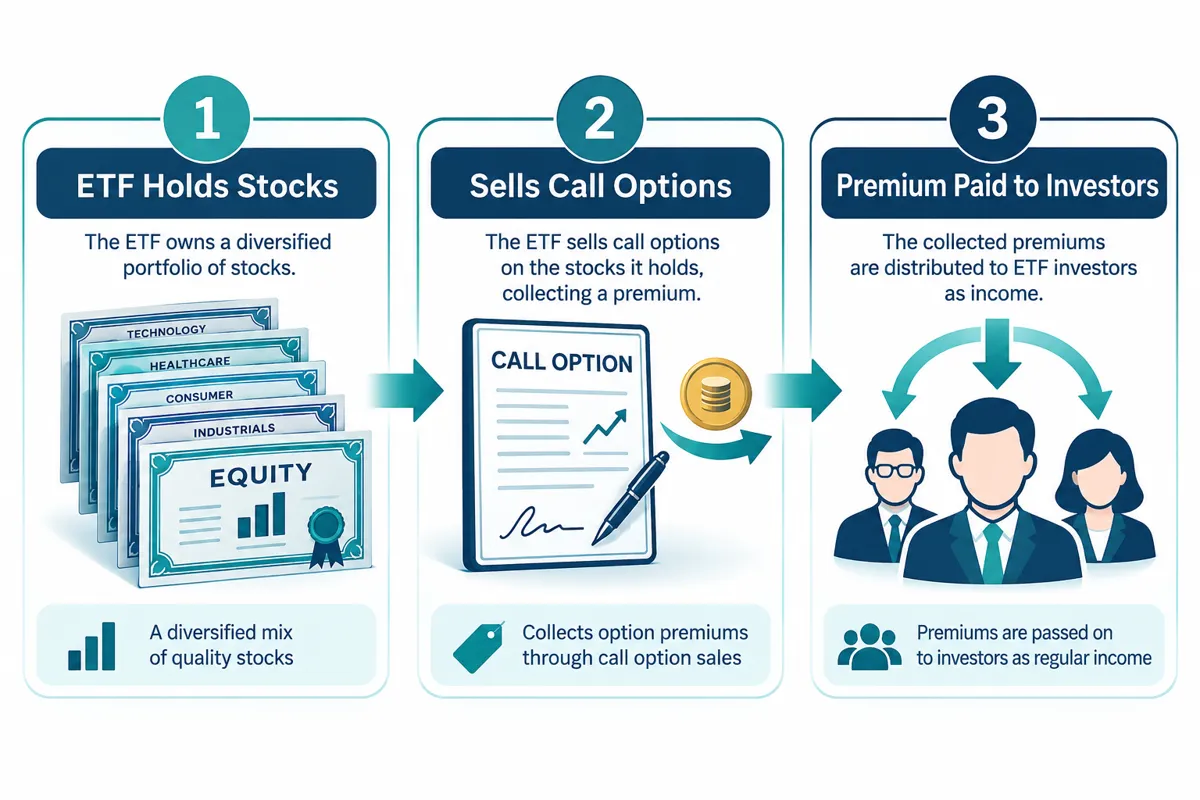
A covered call ETF holds a portfolio of stocks or tracks an index, then sells call options against those holdings to collect option premiums. Those premiums are passed to shareholders as monthly or quarterly distributions. The fund does not need to sell stocks to pay you. The income comes from the option market.
Writing Calls Against the Index, Explained Simply
Selling a call option means agreeing to sell a stock at a fixed price (the strike) by a set date. The buyer pays a premium upfront for that right. If the stock stays below the strike, the option expires worthless and the seller keeps the premium. That premium is the income.
A covered call ETF does this at scale. Global X, for example, runs QYLD by selling at-the-money monthly calls on the Nasdaq 100. At-the-money means the strike is right at the current index level, which maximizes premium collected but also maximizes upside given away.
The mechanics are straightforward. The risk is in what you give up.
Why the Distribution Is Not the Same as Return
Distribution yield measures cash paid out divided by share price. Total return measures cash paid out plus or minus share price change. These two numbers can diverge dramatically over time.
A fund paying 12% annually while its NAV falls 8% per year has a net real return of roughly 4%, before taxes. A fund paying 7% with a flat NAV has a better outcome. Yahoo Finance has noted that NAV erosion is a persistent structural issue across the covered call ETF category, not an exception.
If you want to understand how to screen for this pattern before buying, the AI ETF screeners compared guide walks through tools that surface NAV trend data alongside yield.
What Is a Covered Call ETF Doing in a Rising Market?
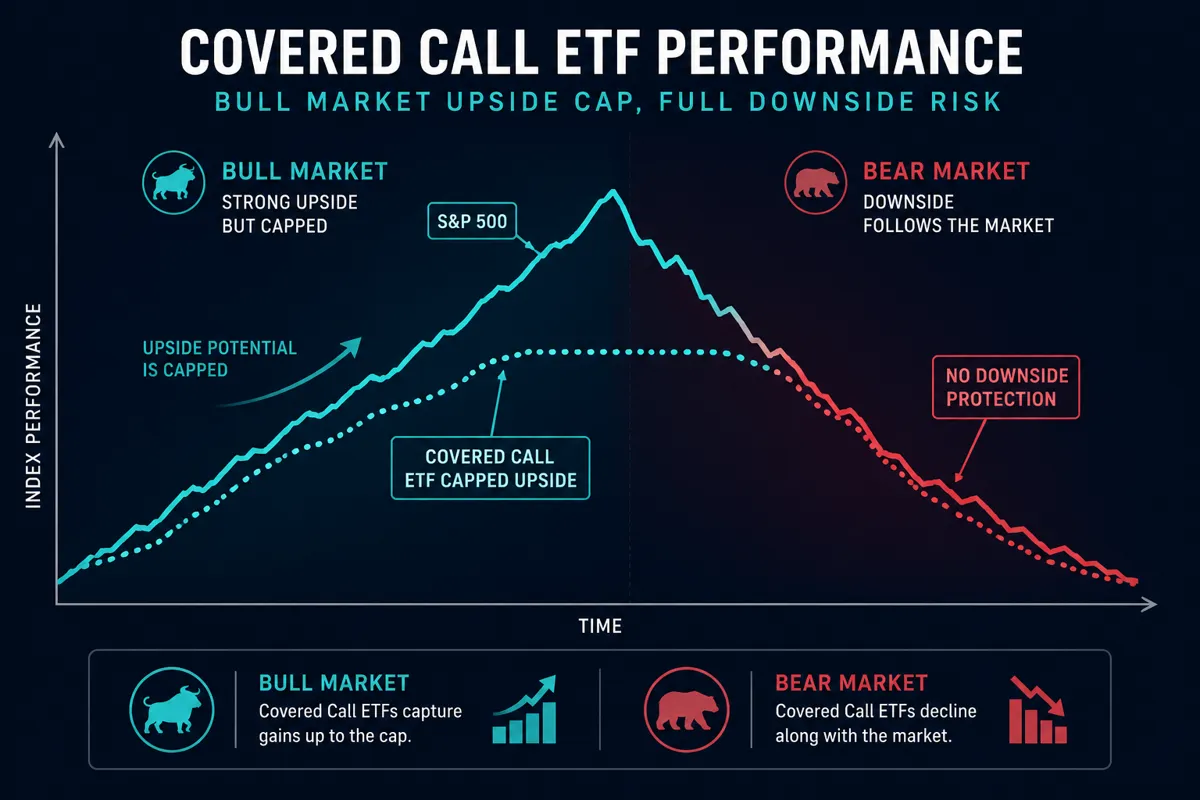
In a bull market, a covered call ETF caps its own upside. If the Nasdaq 100 rises 25% in a year, a fund selling at-the-money calls each month will capture only a fraction of that gain because the index repeatedly blows through the strike prices. The premium collected does not compensate for the appreciation forfeited.
This is not a flaw. It is the trade. You get income now in exchange for growth later. The question is whether that trade makes sense for your specific situation.
The 7 Funds Compared: Which Is the Best Covered Call ETF for Income?
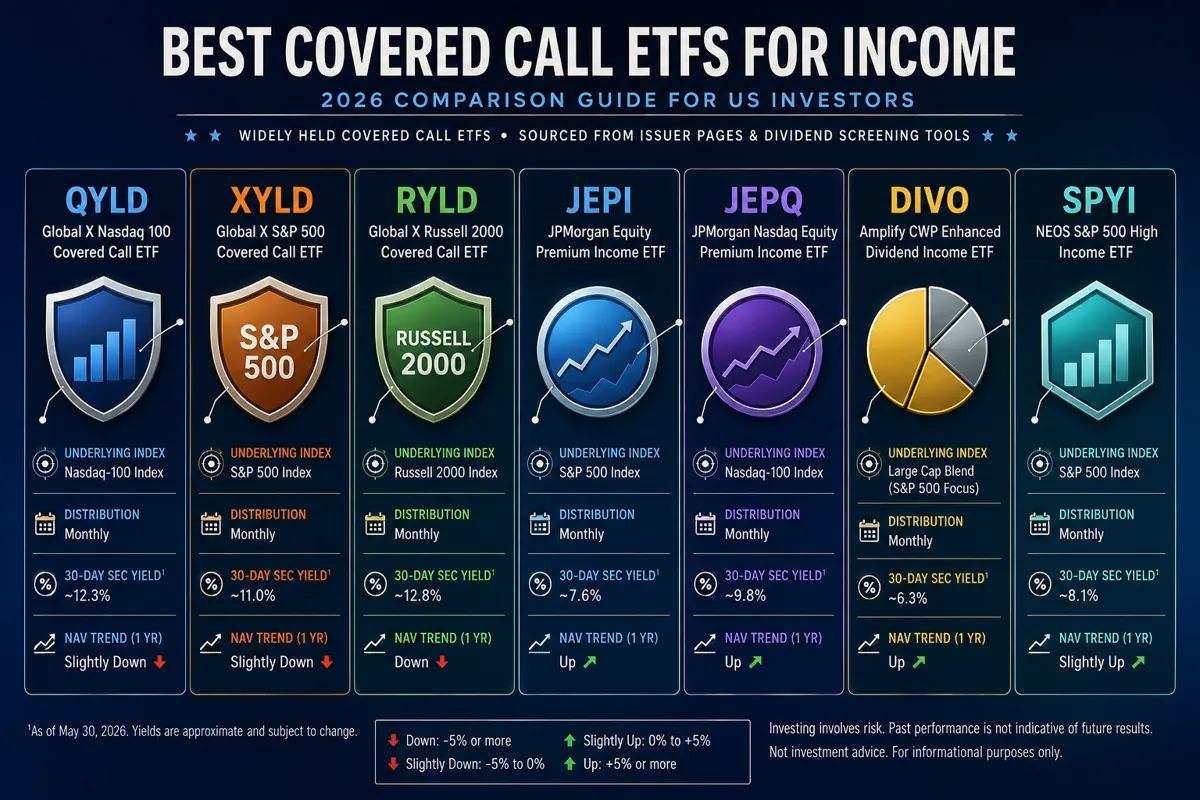
These seven funds represent the most widely held covered call ETFs available to US investors in 2026. Data is sourced from issuer pages, Dividend Vision's August 2026 screen, and ETF Valuer. Verify current figures on the issuer's fund page before acting.
1. JEPI: The Large Cap Income Standard
JPMorgan Equity Premium Income ETF (JEPI) is managed by JPMorgan Asset Management and launched in May 2020. It holds a defensive selection of S&P 500 stocks and sells equity-linked notes (ELNs) tied to S&P 500 index options rather than writing calls directly on individual holdings.
As of August 2026, JEPI carries a distribution yield of approximately 7.61% and assets under management of roughly $46.2 billion, making it the largest fund in this category by AUM, per Dividend Vision. The expense ratio is 0.35%.
The NAV trend has been relatively stable compared to pure index-writing peers. Because JEPI writes out-of-the-money options through ELNs rather than at-the-money calls, it retains more upside participation. The distribution is largely ordinary income, which matters in a taxable account.
JEPI is the closest thing to an income standard in this category. Lower yield, better NAV behavior.
2. JEPQ: The Nasdaq Version
JPMorgan Nasdaq Equity Premium Income ETF (JEPQ) applies the same JPMorgan active management approach to the Nasdaq 100 rather than the S&P 500. It launched in May 2022 and reported a distribution yield of approximately 13.97% with AUM near $41.9 billion as of August 2026, per Dividend Vision.
The expense ratio is 0.35%. Because the Nasdaq 100 carries higher option premiums than the S&P 500 (more volatility means more expensive options), JEPQ collects more premium income and pays a higher distribution. The tradeoff is that it also gives up more upside in a Nasdaq bull run.
JEPQ distributions are largely ordinary income. For income active investors who want Nasdaq equity exposure with a JPMorgan active management overlay, JEPQ is the logical pairing to JEPI. The NAV has shown more volatility than JEPI given the underlying index, but has not exhibited the structural long-term erosion seen in QYLD.
3. QYLD: The Highest Headline Yield
Global X Nasdaq 100 Covered Call ETF (QYLD) is the fund that most income investors find first and many regret later. It launched in December 2013 and writes at-the-money monthly calls on the Nasdaq 100, collecting the maximum possible premium each cycle.
The distribution yield sits near 11.70% with AUM of approximately $8.3 billion as of August 2026, per Dividend Vision. The expense ratio is 0.60%.
The structural problem is documented: QYLD's NAV has declined approximately 35% over a decade while the Nasdaq 100 tripled, per 247 Wall St. At-the-money call writing means the fund captures almost none of the index's capital appreciation. Distributions have included significant return of capital components over its history, meaning part of what you receive is your own principal.
QYLD is the textbook case for why the best covered call ETF for income cannot be selected on yield alone.
4. XYLD: The S&P 500 Equivalent
Global X S&P 500 Covered Call ETF (XYLD) applies the same at-the-money call writing strategy as QYLD but against the S&P 500 rather than the Nasdaq 100. It launched in June 2013 and carries a distribution yield near 10% with an expense ratio of 0.60%, per ETF Valuer.
Because the S&P 500 is less volatile than the Nasdaq 100, XYLD collects less premium and pays a lower distribution than QYLD. It has exhibited similar NAV erosion patterns over time, though somewhat less severe given the index composition. The fund is useful as a comparison benchmark for the at-the-money writing strategy applied to a broader, less growth-heavy index.
XYLD is better than QYLD on NAV behavior but still trails JEPI on total return over most multi-year periods, per Days to Expiry.
5. RYLD: Small Cap Exposure
Global X Russell 2000 Covered Call ETF (RYLD) brings covered call income generation to small cap equity exposure. It launched in April 2019 and writes at-the-money monthly calls on the Russell 2000 index.
RYLD reported a monthly yield near 11.9% and a 12-month total return of approximately 20.5% as of July 2026, per Seeking Alpha. The expense ratio is 0.60%. However, that same analysis flagged structural NAV erosion as a persistent concern and rated the fund a hold, noting that at-the-money call writing caps the small cap upside that would otherwise compensate investors for the higher risk of holding small cap equity.
RYLD makes sense only if you specifically want small cap income exposure and accept that the Russell 2000's higher volatility cuts both ways: more premium collected, but also more NAV risk in a downturn.
6. DIVO: The Selective Writing Approach
Amplify CWP Enhanced Dividend Income ETF (DIVO) takes a different approach. Rather than writing calls on an entire index, it holds a concentrated portfolio of high-quality dividend-paying large cap stocks and writes covered calls selectively on individual positions, typically on names that have run up and where the manager wants to harvest premium without giving up long-term compounders.
The distribution yield is lower, typically in the 4-5% range, with an expense ratio of 0.55%, per ETF Valuer. The NAV trend has been meaningfully better than QYLD or XYLD because the selective writing approach preserves more equity upside.
DIVO is the best covered call ETF for long-term investors who want income without sacrificing all of their capital appreciation. The yield is not headline-grabbing. The total return picture is.
7. SPYI: The Newer Tax-Aware Option
NEOS S&P 500 High Income ETF (SPYI) launched in August 2022 and uses a different structural approach: it buys S&P 500 exposure and sells out-of-the-money call spreads using Section 1256 contracts. Under IRS rules, Section 1256 contracts receive a 60/40 blended tax treatment, with 60% of gains taxed at long-term capital gains rates regardless of holding period.
SPYI reported an 11.9% distribution yield and 18.9% total return over the prior 12 months, with share price up approximately 8.2% year-to-date as of July 2026, per Seeking Alpha analysis. AUM stands near $11.4 billion with an expense ratio of 0.68%, per Dividend Vision.
The fund has never missed a monthly payment since inception. More importantly, its NAV has not shown the structural erosion of the at-the-money writing peers. For taxable account holders, the Section 1256 tax treatment is a genuine structural advantage over JEPI or QYLD distributions, which are largely ordinary income.
Comparison Table: Seven Covered Call ETFs Side by Side
| Fund | Dist. Yield | Expense Ratio | Underlying Index | NAV Trend | Best Suited For |
|---|---|---|---|---|---|
| JEPI | 7.61% | 0.35% | S&P 500 (active) | Stable | Conservative income, IRA |
| JEPQ | 13.97% | 0.35% | Nasdaq 100 (active) | Mostly stable | Higher income, Nasdaq exposure |
| QYLD | 11.70% | 0.60% | Nasdaq 100 | Eroding | Short-term income only |
| XYLD | ~10% | 0.60% | S&P 500 | Gradual erosion | S&P income, short-medium term |
| RYLD | ~11.9% | 0.60% | Russell 2000 | Structural erosion | Small cap income, tactical |
| DIVO | 4-5% | 0.55% | Large cap dividend stocks | Positive | Long-term total return + income |
| SPYI | 11.72% | 0.68% | S&P 500 (Section 1256) | Rising | Taxable accounts, high income |
Sources: Dividend Vision August 2026, ETF Valuer, Days to Expiry. Verify current figures on each fund's issuer page.
Which Best Covered Call ETFs Have No NAV Erosion?
The short answer: DIVO and SPYI have shown the best NAV preservation among the seven funds reviewed here. JEPI and JEPQ have been relatively stable. QYLD, XYLD, and RYLD have all shown meaningful NAV erosion over multi-year periods, with QYLD the most severe case on record.
Reading Share Price Against Distributions Paid
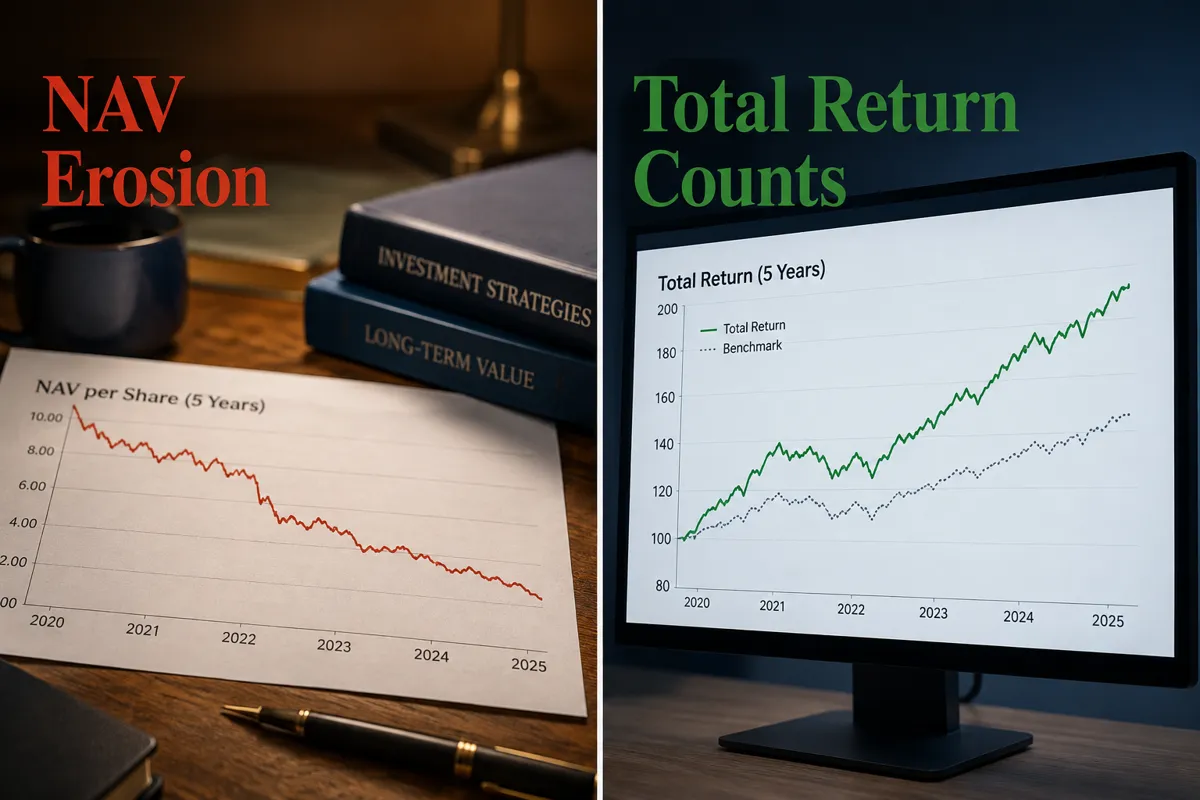
The only honest way to evaluate a covered call ETF is to add up every distribution paid since inception and compare that total to the current share price versus the starting share price. If the share price has fallen by more than the distributions paid, the fund has destroyed capital in real terms.
QYLD's NAV decline of approximately 35% over a decade, documented by 247 Wall St, is the clearest example. An investor who bought at inception and reinvested distributions would have a different outcome than one who spent the distributions. But an investor who spent the distributions and watched the principal erode has a real problem.
Yahoo Finance has noted that NAV erosion is a category-wide concern, not isolated to one issuer. The structural reason is that at-the-money call writing gives away all capital appreciation above the strike, so in a rising market the fund cannot rebuild NAV through price appreciation.
Return of Capital and the 19a-1 Notice
Return of capital (ROC) is legal. It is disclosed on the fund's SEC 19a-1 notice, which issuers are required to send when a distribution includes a return of capital component. What it means in practice is that part of the cash you receive is your own principal coming back to you, not income generated by the portfolio.
ROC is not inherently bad. It reduces your cost basis, which defers taxes. But if the NAV is declining and distributions include ROC, the fund is paying you your own money while your investment shrinks. That is the combination to watch for. You can find a deeper breakdown of how to spot this pattern using an ETF screener in this guide to funds paying you your own money.
Why a 12 Percent Yield Can Still Lose You Money
Play stupid games, win stupid prizes. Chasing a 12% yield without checking the NAV trend is the oldest mistake in income investing. The math is simple: a 12% annual distribution on a fund whose NAV falls 10% per year leaves you with a 2% net return, before taxes, on a shrinking principal base.
WTOP's June 2026 analysis of high-yield covered call ETFs noted that headline yield is the most misleading single metric in this category. Total return, measured as price change plus distributions reinvested, is the only number that tells the full story.
Best Covered Call ETF for Taxable Account or Roth IRA?
Tax character is the deciding factor when choosing between funds for different account types. The best covered call ETF for income in a Roth IRA is not necessarily the best covered call ETF for a taxable account, because the tax treatment of distributions differs materially across these seven funds.
Best Covered Call ETF for Roth IRA and Tax-Deferred Space
In a Roth IRA, distributions are tax-free on withdrawal, so the tax character of distributions does not matter during the accumulation phase. This makes high-yield funds like JEPQ or QYLD more attractive in a Roth IRA than in a taxable account, because the ordinary income character of their distributions is sheltered.
JEPI is also a strong candidate for a Roth IRA or traditional IRA. Its active management approach, lower volatility profile, and stable NAV make it a sensible long-term income holding in tax-deferred space. For a traditional IRA, distributions are taxed as ordinary income on withdrawal regardless of character, so the tax advantage of SPYI's Section 1256 structure is less relevant.
Best Covered Call ETF for Taxable Account and Distribution Character
For a taxable account, SPYI's Section 1256 structure is a genuine structural edge. Under IRS rules, 60% of Section 1256 gains are taxed at long-term capital gains rates and 40% at short-term rates, regardless of holding period. For an investor in a high tax bracket, this blended rate is significantly lower than the ordinary income rate applied to JEPI or JEPQ distributions.
DIVO's distributions include qualified dividends from its underlying equity holdings, which also receive preferential tax treatment compared to ordinary income. For a taxable brokerage account focused on after-tax income, SPYI and DIVO are the two funds with the most favorable distribution character among the seven reviewed here.
QYLD and XYLD distributions are largely ordinary income with ROC components. The ROC reduces cost basis and defers taxes, but the ordinary income portion is taxed at the investor's marginal rate each year.
Best Covered Call ETF for IRA Versus Brokerage Account
The practical rule: put high-yield ordinary income funds (JEPQ, QYLD, XYLD, RYLD) in a Roth IRA or traditional IRA where the tax character is sheltered. Put tax-efficient funds (SPYI, DIVO) in a taxable brokerage account where the lower tax rate on their distributions provides a real annual advantage.
JEPI works well in either account type. Its lower yield means less ordinary income drag in a taxable account, and its NAV stability makes it a reasonable long-term IRA holding.
Is a Covered Call ETF Right for Long-Term Holding?
For most long-term investors, a covered call ETF is a trade-off, not a free lunch. You get income now and give up growth later. Whether that trade makes sense depends on your time horizon, your income need, and your tolerance for watching an index run past you.
Best Covered Call ETF for Long-Term Investors
DIVO is the best covered call ETF for long-term investors among the seven reviewed here. Its selective writing approach preserves more equity upside, its NAV has trended positively, and its dividend income from underlying holdings adds a layer of return that pure index-writing funds do not have.
SPYI is the second-best long-term option if you need a higher income level and are holding in a taxable account. Its NAV has risen since inception, it has never missed a monthly payment, and the Section 1256 tax treatment reduces the annual tax drag compared to ordinary income peers.
JEPI is the conservative long-term choice for investors who prioritize capital preservation over maximum income. Its 7.61% yield with a stable NAV and JPMorgan's active management overlay makes it the most widely held fund in this category for a reason.
What You Give Up in a Bull Market
This is the part that does not appear on the fund's marketing page. In the 2023 to 2025 Nasdaq bull run, JEPQ and QYLD both significantly underperformed a simple QQQ position on total return. QYLD's at-the-money writing captured almost none of the index appreciation. JEPQ's out-of-the-money writing captured more, but still trailed QQQ by a wide margin.
Investing Engineer's analysis of covered call ETF performance in bull markets found that the income advantage is frequently more than offset by the upside cap in strong trending markets. The covered call strategy earns its keep in flat or mildly declining markets where premium income compensates for the lack of price appreciation.
When Writing Your Own Calls Beats the Fund
If you hold individual stocks or a standard equity ETF, writing your own covered calls gives you control over strike selection, expiration, and timing. You decide how much upside to give up and when. A fund like QYLD writes at-the-money calls every month regardless of market conditions, which is mechanically simple but strategically rigid.
For investors comfortable with options mechanics, writing calls against QQQ, SPY, or individual positions can produce similar income with more flexibility. The best AI options trading tools page covers platforms that help with strike selection and premium analysis if you want to explore that route.

FullStack Alpha tool
Yield vs NAV Reality Check
“I have owned QYLD since 2020. When the etf drops, it drops hard. When it grows (if it grows) it is very slow. You are sacrificing growth for income.”
r/dividends · the dark side of covered call ETFs, 129-upvote thread
A high distribution yield can be your own capital handed back to you. Enter the yield and what the share price actually did to see the total return underneath the headline number.
Simplified: distributions are treated as collected, not reinvested. Check the fund's own return-of-capital percentage on its website before drawing conclusions.
Frequently Asked Questions
What is the best covered call ETF for income?
The best covered call ETF for income depends on whether you prioritize yield, total return, or tax efficiency. SPYI and DIVO have shown the best combination of income and NAV preservation. JEPI is the most conservative choice with stable NAV. JEPQ offers higher yield with Nasdaq equity exposure. QYLD offers the highest headline yield but has the worst long-term NAV record of the seven funds reviewed here.
Which covered call ETFs have no NAV erosion?
Among the seven funds reviewed, DIVO and SPYI have shown the best NAV preservation. JEPI and JEPQ have been relatively stable. QYLD, XYLD, and RYLD have all exhibited meaningful NAV erosion over multi-year periods, with QYLD declining approximately 35% over a decade per 247 Wall St. Verify current NAV trends on each fund's issuer page.
Is JEPI or QYLD better for income?
JEPI is better for income on a total return basis. QYLD pays a higher headline distribution but its NAV has declined significantly over time, reducing the investor's principal base. JEPI's lower yield comes with a more stable share price and JPMorgan's active management overlay. On a five-year total return basis, JEPI has outperformed QYLD in most measured periods, per Days to Expiry.
Are covered call ETFs good for a Roth IRA?
Covered call ETFs can work well in a Roth IRA because the ordinary income character of most distributions is sheltered from taxes. JEPQ and JEPI are common Roth IRA choices. QYLD's high yield is more attractive in a Roth IRA than in a taxable account where the ordinary income tax drag reduces net returns. The NAV erosion risk still applies regardless of account type.
How are covered call ETF distributions taxed?
Most covered call ETF distributions (JEPI, JEPQ, QYLD, XYLD, RYLD) are taxed as ordinary income at the investor's marginal rate. SPYI uses Section 1256 contracts, giving its distributions a blended 60/40 long-term/short-term capital gains treatment under IRS rules, which is typically more favorable. DIVO distributions include qualified dividends from underlying holdings. Return of capital components reduce cost basis and defer taxes but do not eliminate them.
Do covered call ETFs lose value over time?
Some do. QYLD has declined approximately 35% in NAV over a decade while the Nasdaq 100 tripled, per 247 Wall St. XYLD and RYLD have shown similar patterns. DIVO and SPYI have maintained or grown their NAV. The at-the-money call writing strategy used by Global X funds structurally prevents capital appreciation, which is the primary driver of long-term NAV erosion.
What is the expense ratio on a covered call ETF?
Expense ratios among the seven funds reviewed range from 0.35% (JEPI, JEPQ) to 0.68% (SPYI), with QYLD, XYLD, and RYLD at 0.60% and DIVO at 0.55%. The JPMorgan funds are the lowest-cost options in this group. For income active UCITS ETF investors in Europe, comparable structures exist but expense ratios and distribution treatment differ by domicile.
Should you hold a covered call ETF long term?
It depends on the fund. DIVO and SPYI are the most defensible long-term holdings among the seven reviewed, given their NAV preservation and income generation. JEPI is a reasonable long-term conservative income position. QYLD, XYLD, and RYLD are structurally challenged for long-term holding because their at-the-money writing prevents NAV recovery in bull markets. Distributions are not guaranteed and can be cut.
Are covered calls a good way to generate income?
Covered calls generate real income through option premiums, but the income comes at the cost of capped upside. In flat or sideways markets, covered calls outperform simple equity holding. In strong bull markets, they lag significantly. The strategy works best as a complement to a broader portfolio rather than a standalone income source, and only when the NAV is not eroding faster than the distributions are paid.
What is the best ETF for income growth?
For income combined with NAV growth, DIVO and SPYI are the strongest performers among covered call ETFs reviewed here. DIVO's selective writing approach and dividend equity base have produced both income and capital appreciation. SPYI's rising NAV alongside its 11.9% distribution yield is the most compelling income-plus-growth combination in this category as of mid-2026. Neither guarantees future performance.
Which ETF is best for covered calls?
JEPI is the most widely held covered call ETF with $46.2 billion in AUM and the most stable NAV record among large funds in this category, per Dividend Vision. SPYI is the strongest performer on total return over the past 12 months. DIVO is the best choice for long-term capital preservation with income. The right answer depends on whether you are optimizing for yield, total return, tax efficiency, or NAV stability.
Which ETF gives monthly income?
All seven funds reviewed here pay monthly distributions: JEPI, JEPQ, QYLD, XYLD, RYLD, DIVO, and SPYI. Monthly payment is a standard feature of covered call ETFs. The distribution amount varies month to month based on option premiums collected, which fluctuate with market volatility. Higher volatility generally means higher premiums and larger distributions. Distributions are not guaranteed and can be reduced or suspended.
Final Verdict: Judge the Fund on Total Return, Not the Yield
The best covered call ETF for income in 2026 is not the one with the biggest number on the distribution page. It is the one whose NAV is still intact after years of paying you.
By that standard, SPYI and DIVO are the two funds that have earned the right to be in a serious income portfolio. SPYI delivers double-digit income with a rising NAV and a tax structure that is genuinely better for taxable accounts. DIVO delivers lower but sustainable income with the best long-term NAV record in the group.
JEPI is the conservative anchor. Lower yield, stable NAV, $46.2 billion in assets, and JPMorgan's active management track record. It is not exciting. That is the point.
JEPQ is the right call if you want Nasdaq equity premium income and can accept higher volatility. Its NAV has held better than QYLD despite the same underlying index.
QYLD, XYLD, and RYLD are the cautionary tales. The yield is real. The NAV erosion is also real. If you hold these for income and spend the distributions, you are drawing down principal. That is not a strategy. That is a slow liquidation.
The process is simple: check the distribution yield, then check the five-year NAV chart, then check the total return. If the total return does not beat a simple savings account after fees and taxes, the fund is not doing the job. Signal over noise. Data over noise. Systems over hacks.
Two tools that help with this kind of screening: the AI ETF screeners compared guide and the best AI stock tools for 2026 breakdown.
Seven funds compared. 200+ AI stock tools catalogued in the FullStack Alpha directory, filterable by category and use case. Compare the full field at aistockpickerapps.com.
Affiliate disclosure: FullStack Alpha may earn a commission on purchases made through links in this article. This does not affect editorial independence or fund rankings.
References
QDTE Market Dynamic Has Now Changed Rating Downgrade - https://seekingalpha.com/article/4933995-qdte-market-dynamic-has-now-changed-rating-downgrade
Covered Call ETFs - https://www.dividendvision.com/best/covered-call-etfs
RYLD The Rally Is Hiding The Structural Flaws - https://seekingalpha.com/article/4921386-ryld-the-rally-is-hiding-the-structural-flaws
7 High Yield Covered Call ETFs Income Investors Will Love - https://wtop.com/news/2026/06/7-high-yield-covered-call-etfs-income-investors-will-love-2/
Covered Call ETFs - https://www.etfvaluer.com/best/covered-call-etfs
Best Covered Call ETFs - https://www.daystoexpiry.com/blog/best-covered-call-etfs
QYLD's 12 Percent Yield Has Quietly Eroded NAV By 35 Percent Over A Decade While The Nasdaq Tripled - https://247wallst.com/investing/2026/05/27/qylds-12-percent-yield-has-quietly-eroded-nav-by-35-percent-over-a-decade-while-the-nasdaq-tripled/
10 Best Covered Call ETFs - https://investingengineer.com/10-best-covered-call-etfs/
Every Covered Call ETF Erodes - https://finance.yahoo.com/markets/options/articles/every-covered-call-etf-erodes-222514392.html
Covered Call ETF List - https://www.bestetf.net/list/covered-call/