Streetbeat vs Wealthfront: Which AI Investing App Fits You

Last updated: October 28, 2026
One of these companies reported about $55.2 billion in investment advisory assets at the end of September 2026. The other disclosed $4.87 million in client assets at the end of 2025. That single gap tells you most of what you need to know about streetbeat vs wealthfront before you ever open either app. 

Quick answer: which app fits which investor, with costs
Choose Wealthfront if you want a hands-off portfolio managed for you at a known price. Choose Streetbeat if you want an AI layer that talks to you about your holdings and you're fine being an early adopter with a small balance.
The streetbeat vs wealthfront call comes down to one question: do you want a manager or a conversation partner?
Here's the short version of the cost and fit picture, verified against each company's own disclosures as of October 2026:
Alpaca Securities LLC, member FINRA/SIPC.
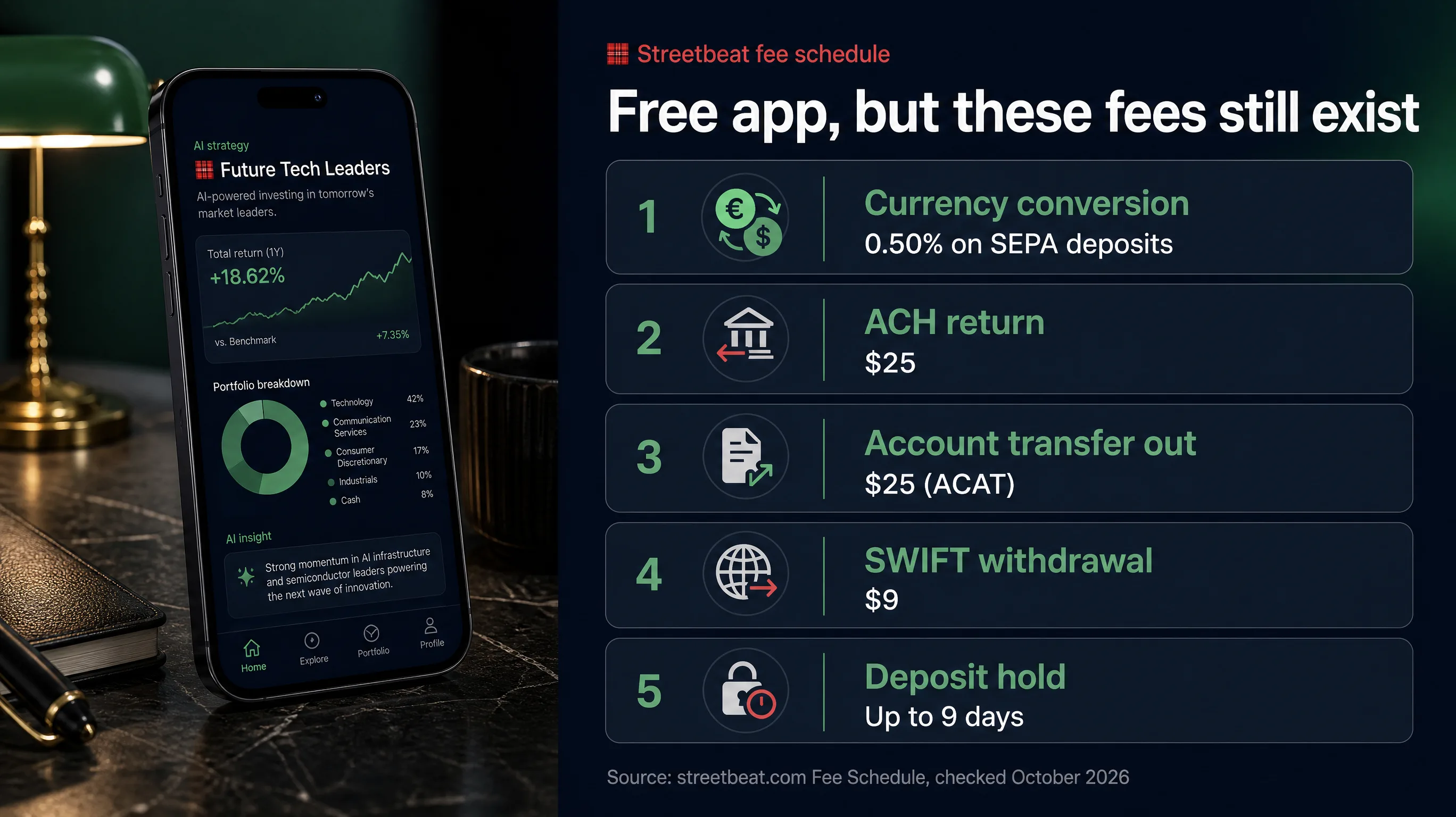
- The catch on both sides: free isn't free, and 0.25% isn't the whole bill. ETF expense ratios apply either way. Streetbeat's published fee schedule lists a 0.50% conversion fee on SEPA currency exchanges, a $25 ACH-return fee, a $25 ACAT transfer-out fee, and a $9 international SWIFT withdrawal fee (checked October 2026).
A rough decision rule before we get into the detail:
That's the headline. Now the mechanics, because the mechanics are where people get hurt.
Streetbeat vs Wealthfront: what is the core difference?
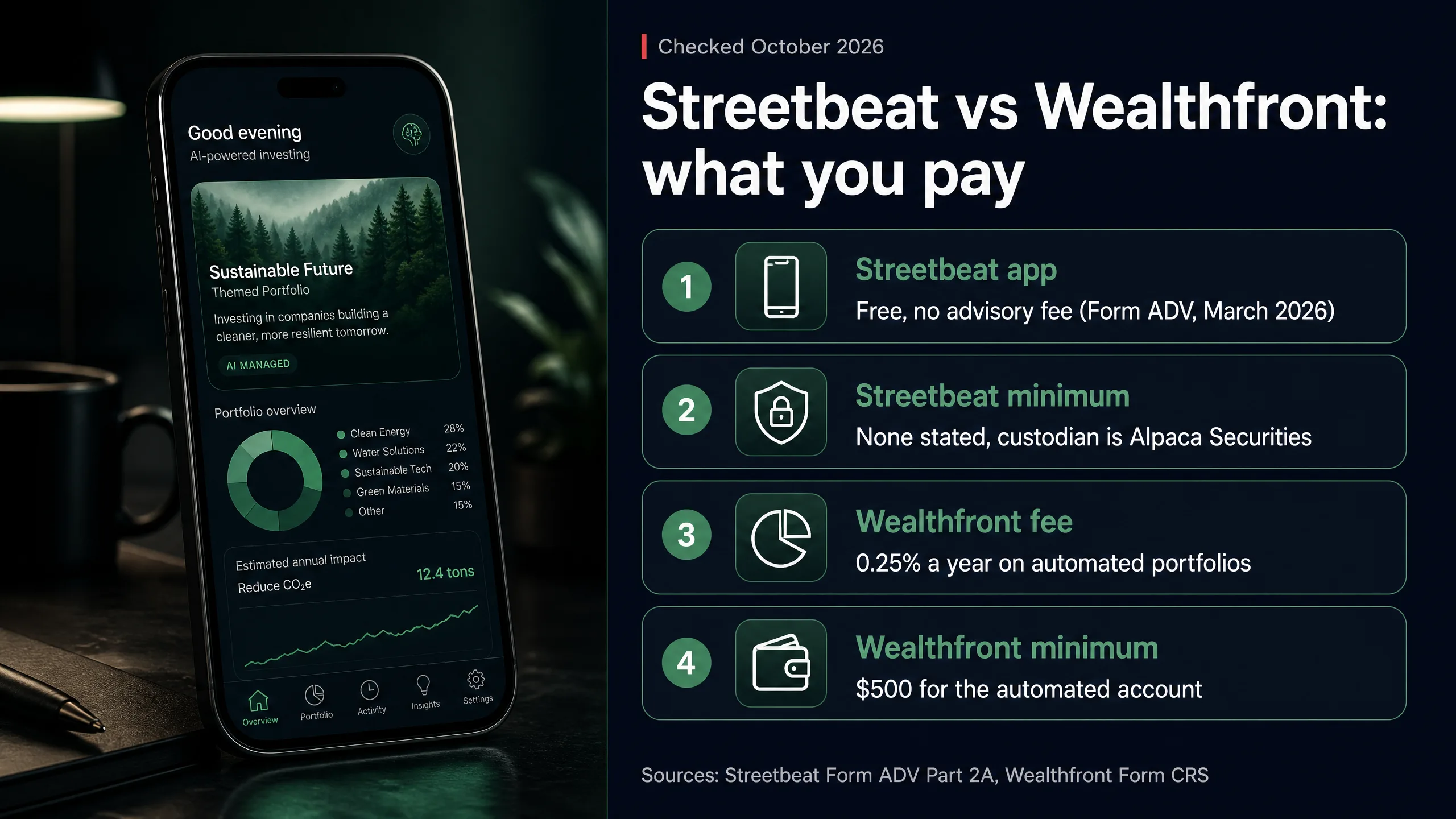
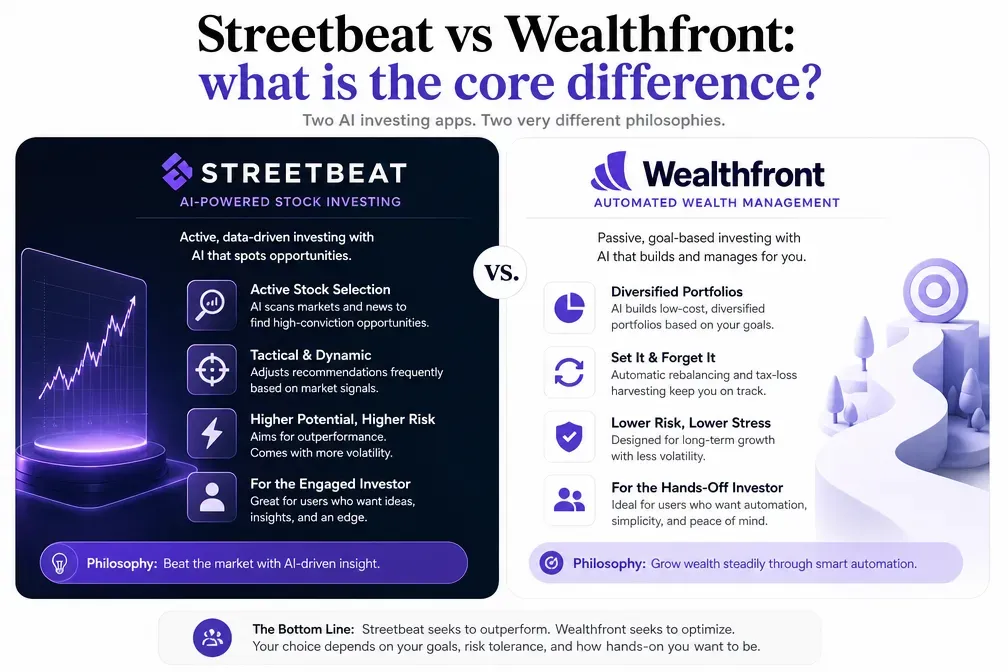
Wealthfront manages a diversified portfolio for you and charges a published fee for it. Streetbeat gives you an AI interface on top of a third-party brokerage account and currently charges nothing for the advice layer. One is a managed service. The other is a software experience.
Wealthfront is an automated portfolio with a long paper trail
Wealthfront builds you a diversified portfolio of low-cost ETFs based on a risk score, then rebalances it, reinvests dividends, and harvests tax losses without you touching anything. That's the entire pitch, and it hasn't changed much in a decade.
What did change recently: on October 15, 2026, Wealthfront expanded its self-directed Brokerage Account with recurring investments, instant trading during market hours, limit orders, share-denominated orders, and more than 8,000 newly added stocks and ETFs. So yes, you can pick individual stocks on Wealthfront now, just not inside the automated portfolio. The automated side stays automated. The brokerage side is yours to drive. Two separate lanes, same login.
It also runs a Cash Account that introduced a 3.55% base APY on September 18, 2026 (checked October 2026). Clients with a funded investing account can add 0.25 percentage point through direct deposits of at least $1,000 a month or recurring deposits of at least $2,500 a month. Cash in that account can receive up to $8 million of FDIC insurance through program banks, though the Cash Account itself is not a bank deposit account. That distinction matters and most people skip it.
Streetbeat is an AI layer sitting on someone else's rails
Streetbeat's Form ADV names Alpaca Securities as the custodian (the same broker behind the Alpaca API that many trading bots plug into), while Streetbeat provides non-discretionary recommendations through the platform. In plain English: the app you tap is Streetbeat, the regulated broker actually holding your shares is Alpaca. That's a normal fintech structure, not a red flag by itself, but it means two companies sit between you and your money instead of one.
The latest rebuild, described in the current App Store release notes (checked October 2026), is genuinely AI-first. The release added:
- The Beat, two AI-written notes a day (an Opening Beat and a Closing Beat) built around what you actually hold
- Discussion rooms for individual securities and whole portfolios
- An exposure tool that estimates how much of a company you indirectly own through your ETFs
- Portfolio libraries, configurable widgets, and support for seven languages
Non-discretionary is the word to circle. It means Streetbeat suggests, you approve. Wealthfront's automated portfolio is discretionary, it acts without asking you each time. If you want a machine that just handles it, that's the real fork in the streetbeat vs wealthfront road.
The scale gap is the uncomfortable part
Wealthfront reported $55.2 billion in investment advisory assets as of September 30, 2026. Streetbeat's March 2026 Form ADV reported $4,866,565 (about $4.87 million) in client assets as of December 31, 2025. Those figures aren't perfectly comparable (different dates, different product scopes), but they're not close enough for the difference to be a measurement quirk.
Small isn't automatically bad. Small means fewer people have stress-tested the withdrawal process, the support queue, and the edge cases. You are part of the test. Price that in.
A free advisory fee is a marketing decision, not a business model. Ask what happens to it when the funding round ends.
Streetbeat vs Wealthfront comparison table: how it invests, AI features, fees, minimums, money movement
Here's the side-by-side. Everything below comes from each company's published materials as of October 2026. Verify Wealthfront fees and minimums at wealthfront.com before you fund anything, because pricing pages move.
Reading the table like an adult
Three things jump out.
One: the fee comparison is lopsided in Streetbeat's favor and that's exactly why you should look harder. Zero advisory fee is real. It's also the single easiest thing for a small company to change. Streetbeat's Digital Customer Agreement, still posted in its disclosure library, describes a monthly account fee for accounts under $400. The March 2026 Form ADV and Form CRS say no advisory fee. Both documents exist. Check the fee schedule shown to you at account opening, not the one a blog quoted.
Two: the money-movement row is where Streetbeat loses points. A nine-day deposit hold is a long time to watch a setup you wanted to buy run without you. If you're an active investor, that's disqualifying. If you're depositing $200 a month and forgetting about it, it's noise.
Three: Wealthfront's cheap products aren't its main product. S&P 500 Direct at 0.09% and Nasdaq-100 Direct at 0.12% both require $5,000 and are single-index strategies, not diversified managed portfolios. US Direct Indexing inside a taxable Wealthfront Portfolio needs $100,000 and is included in the 0.25% fee. Don't quote the 0.09% number as if it's the cost of being a Wealthfront client. It isn't.
Streetbeat vs Wealthfront: which is cheaper?
On the advertised advisory fee, Streetbeat wins outright, it charges nothing today while Wealthfront charges 0.25% a year. On total cost over a multi-year holding period, the answer depends entirely on your balance, your transfer habits, and whether tax-loss harvesting is worth anything to you.
The raw math at common balances
Wealthfront's 0.25% works out to roughly $25 a year on $10,000, around $2.05 a month per its Form CRS illustration. On $50,000 that's $125 a year. On $100,000, $250.
Streetbeat's advisory fee at those same balances is currently $0. That's a genuine saving, and anyone telling you a quarter point is "nothing" has never compounded a fee over twenty years.
But the fee is one line on the bill. Here's the full stack:
- Advisory fee, Wealthfront 0.25%, Streetbeat currently nil
- ETF expense ratios, both platforms, unavoidable, usually a few basis points on broad index funds
- Transfer-out fees, Streetbeat charges $25 to ACAT out; check Wealthfront's current schedule before assuming
- Currency conversion, Streetbeat's 0.50% applies to SEPA currency exchanges, such as funding in euros. That's twice Wealthfront's entire annual advisory fee, charged in one transaction
- Withdrawal friction, $9 for an international SWIFT withdrawal at Streetbeat, plus $25 if an ACH bounces
The tax loss harvesting offset
Wealthfront's pricing page says tax-loss harvesting can typically cover its annual fee more than 4.2 times over for Wealthfront Portfolio clients using the Classic portfolio (checked October 2026). Label that accurately: it's a company estimate, not a guaranteed outcome, and it only matters in a taxable account where you have gains or ordinary income to offset. In an IRA it's worth exactly zero.
Decision rule on cost:
- Taxable account over $25,000, long horizon: the 0.25% is defensible because the tax machinery is doing real work
- Any IRA or Roth: the harvesting argument evaporates, so you're paying 0.25% purely for management and rebalancing
- Funding in a non-USD currency: Streetbeat's 0.50% conversion fee can erase its free-advice advantage in a single deposit
- Under $1,000 either way: fees barely register. Pick on usability and withdrawal speed instead
Common mistake: chasing the lowest headline fee while ignoring the cost of getting your money back out. A $25 ACAT fee on a $600 account is roughly a 4% exit tax. That's the kind of thing nobody models until they're trying to leave.
Streetbeat vs Wealthfront: which is safer and easier to get money out of?
Wealthfront is the easier platform to get money out of, with a longer operating history and a dedicated Cash Account built for liquidity. Streetbeat is SEC-registered with accounts custodied at Alpaca Securities, but a nine-day deposit hold and withdrawal complaints in App Store reviews make it the harder exit.
What "safe" actually means here
Two different questions get mashed together constantly, so separate them.
Custody safety is whether your shares still exist if the company folds. Both firms are SEC-registered advisers. Streetbeat (CRD #315893) uses Alpaca Securities as broker-custodian, which means Alpaca holds the assets. SIPC protection covers custody failure, the broker losing or misappropriating your securities. It does not cover market losses. If your portfolio drops 30% in a correction, no insurance scheme is coming. Anyone implying otherwise is selling you something.
Operational safety is whether you can actually access your money on a Tuesday afternoon when you need it. That's where the two part ways.
The withdrawal reality
Can you withdraw money anytime from Wealthfront? Yes, within standard settlement and ACH timelines. Selling from an automated portfolio takes a trade day plus settlement, then the transfer. The Cash Account is built for faster access and carries program-bank FDIC coverage up to $8 million. For most people, money out in a few business days, no drama.
Streetbeat's picture is rougher. Its fee schedule lists a nine-day hold on deposits, and at least one App Store reviewer flagged trouble withdrawing funds, a complaint the developer acknowledged in a public reply. That doesn't point to fraud. It points to a small platform with conservative deposit controls. But if your plan involves moving money in and out with any regularity, it's the wrong tool.
A quick safety checklist before funding either
- Look up the adviser on the SEC's Investment Adviser Public Disclosure site. Both should appear.
- Read the current fee schedule on the account-opening screen, not a review.
- Confirm who the custodian is and whether they're SIPC members.
- Test the exit: deposit a small amount, wait a week, withdraw it, and time the round trip.
- Check whether two-factor authentication is on by default.
That last one about testing the exit is the single most useful habit in this whole article. Paper trade the withdrawal process before you trust it with real size. Same principle as paper trading a setup before you size up, find out how the thing behaves while the stakes are small.
Edge case worth naming: if you're outside the US, Streetbeat's seven-language support and international funding options are a genuine draw, right up until the 0.50% conversion fee and $9 SWIFT withdrawal show up on both legs of the trip. Run that math before you treat "free" as free.
Where does Magnifi fit?

The three-way framing
Think of it as three different jobs, not three competitors for the same seat:
A lot of beginners buy the wrong one because the marketing for all three uses the same three letters. AI in a managed portfolio means rebalancing logic and tax rules. AI in a chat interface means a language model summarizing your holdings. Those are not the same technology doing the same work, and conflating them is how people end up paying for a chatbot wrapped around a public API.
How to pick between the three
- If you don't want to make decisions: Wealthfront's automated portfolio
- If you want to make decisions but want context: Streetbeat
- If you want to find instruments and then execute elsewhere: Magnifi
- If you want to screen setups yourself with real filters: neither, you want a dedicated screener. Our
Stock Rover vs
Finviz screener comparison covers that fork.
Common mistake: stacking all three. Six tabs open, three subscriptions, and still no idea what to buy Monday. That's not an information problem, it's a process problem. Pick one, run it for 90 days, and let the results argue back. Systems over hacks.
If you want the deeper per-tool breakdowns, we keep them here: the Streetbeat review with its full scorecard, the Streetbeat deep dive, and the Magnifi review. Directory listings with features and pricing: Streetbeat's tool page and Wealthfront's tool page.
Streetbeat vs Wealthfront verdict by investor type
Wealthfront fits the person who wants to stop thinking about it. Streetbeat fits the person who wants to think about it more, with help, and doesn't need their money back quickly. Pick by behavior, not by which demo looked cooler.
The complete beginner with under $1,000
Start with Wealthfront's self-directed Brokerage Account ($1 minimum) or Streetbeat's free app. At this balance, a 0.25% fee is about $2.50 a year, irrelevant. What matters is building the deposit habit.
For streetbeat vs wealthfront at sub-$1,000 balances, the real tiebreaker is exit cost. Streetbeat's $25 ACAT-out fee is a large percentage of a small account. If there's a decent chance you'll move brokers within a year, that's a reason to hesitate.
Is Wealthfront good for beginners? Yes, mostly. The onboarding is short, the risk questionnaire is readable, and you can't easily hurt yourself inside the automated portfolio. The $500 minimum is the only real barrier, and the $1 brokerage account sidesteps it.
The hands-off saver with $5,000 to $50,000
Wealthfront, comfortably. This is its home turf: a diversified portfolio, automatic rebalancing, dividend reinvestment, tax-loss harvesting in taxable accounts, and a Cash Account earning 3.55% base APY for the money you're not investing yet.
Which app is better for completely hands-off investing? Wealthfront, and it isn't close. Streetbeat's non-discretionary model requires you to approve things. If approving things is the part you wanted to avoid, that's the wrong architecture. And if what you actually want is software that places trades for you, that's a different category entirely; our look at the fully automated AI trading app market covers that side.
The tax-aware builder with $100,000+ taxable
Wealthfront, with US Direct Indexing inside the Wealthfront Portfolio at the $100,000 threshold. Owning individual index constituents instead of a single ETF creates more harvesting opportunities. Wealthfront's claim that harvesting can cover the fee more than 4.2 times over for Classic portfolio clients is a company estimate, not a promise, but the structural logic is sound in a taxable account.
Does Streetbeat have tax-loss harvesting? Not as a documented, automated feature equivalent to Wealthfront's. If taxes are your main concern, the streetbeat vs wealthfront comparison is already over.
The curious experimenter
Streetbeat, with money you can leave alone for a while. The 2026 rebuild is one of the more interesting consumer AI investing releases this year, and The Beat's holdings-aware market notes give genuinely useful context. Discussion rooms and the ETF exposure estimator are features Wealthfront doesn't offer and probably never will.
Fund it with an amount you'd be fine having locked up for a few weeks. Treat it as a second account, not the main one.
The self-directed trader
Neither, as a primary platform. Both are built for investing, not trading. A nine-day deposit hold and a once-a-day rebalance don't fit anyone watching price action or sizing into a breakout. You want a broker with fast fills and a real screener on top. Start with our breakdown of which AI ETF screener is most accurate, or if you want AI scoring on individual names, the 

Robo advisor comparison: how Wealthfront stacks up
Against 


Is Wealthfront actually making money for people, or just marketing? Returns come from the market, not the app. What Wealthfront sells is automation, tax machinery, and the removal of your own worst instincts. Whether that's worth a quarter point depends on how reliably you'd rebalance without it. Most people overestimate themselves.
One interactive tool before you decide
Here's a compact streetbeat vs wealthfront fee calculator comparing the annual advisory cost of each option at your balance. It won't predict returns. It'll just show you what the fee line looks like.
FAQ
What's the streetbeat vs wealthfront difference in one sentence? Wealthfront manages a diversified ETF portfolio for you at 0.25% a year with automated tax-loss harvesting, while Streetbeat offers free, non-discretionary AI recommendations and holdings-aware market commentary through an account custodied at Alpaca Securities.
What's the catch with Streetbeat's free app? There isn't a hidden subscription today, but the advisory fee is free by current policy, not by contract. Streetbeat's March 2026 Form ADV reserves the right to introduce a fee after written notice, and its Digital Customer Agreement still describes a monthly account fee for accounts under $400. Transaction-level fees still apply (checked October 2026): 0.50% SEPA currency conversion, $25 ACH return, $25 ACAT out, $9 international SWIFT withdrawal.
What is Wealthfront's minimum investment to get started? $500 for the main automated Wealthfront Portfolio, $1 for the self-directed Brokerage Account, $5,000 for S&P 500 Direct and Nasdaq-100 Direct, and $100,000 for US Direct Indexing inside a taxable portfolio.
Can you withdraw money anytime from Wealthfront? Yes. There's no lock-up or withdrawal penalty. Selling from the automated portfolio takes a trade day plus settlement before the ACH transfer, so plan on a few business days. The Cash Account is designed for faster access.
Is my money safe with Streetbeat? Streetbeat LLC is an SEC-registered investment adviser (CRD #315893) with accounts custodied at Alpaca Securities. SIPC protection covers custody failure, not market losses. The operational friction is real though: deposits are held nine days and App Store reviews include withdrawal complaints.
Does Streetbeat have tax-loss harvesting? Not as a documented automated feature comparable to Wealthfront's. Wealthfront's core portfolio includes automated tax-loss harvesting, tax-aware rebalancing, and direct indexing at qualifying balances. If tax management is your priority, that's the deciding factor.
Can you pick individual stocks on Wealthfront, or is it all automated? Both. The automated Wealthfront Portfolio is hands-off by design, but the separate self-directed Brokerage Account added more than 8,000 stocks and ETFs on October 15, 2026, along with limit orders, recurring investments, and share-denominated orders.
Streetbeat reviews: what are people actually saying? The 2026 rebuild is more AI-centric than anything Wealthfront has shipped, with AI-written market notes and discussion rooms. The App Store listing showed a 4.6 out of 5 rating from 630 ratings (checked October 2026). The complaints that stand out are operational: the nine-day deposit hold and withdrawal problems, which the developer has answered in public review replies. Public discussion volume is thin given the platform's $4.87 million in disclosed client assets, so corroboration is limited.
Which app is better for completely hands-off investing? In a streetbeat vs wealthfront matchup for hands-off investing, Wealthfront wins. Its automated portfolio is discretionary, meaning it rebalances and harvests losses without asking you. Streetbeat is non-discretionary, so you still have to approve recommendations.
Here's the practical move on streetbeat vs wealthfront. Open the one that matches your actual behavior, not your aspirational one. If you've rebalanced your own portfolio zero times in the last two years, pay the 0.25% and stop pretending. If you genuinely want to read AI notes about your holdings every morning and you're comfortable with a small, young platform, fund Streetbeat with an amount you can leave alone.
Then do the one thing almost nobody does: deposit a small sum, wait a week, and withdraw it. Time the round trip. Write down the number. That single test tells you more about a platform than every review on the internet, including this one.
References
- Wealthfront Pricing. wealthfront.com.
- Wealthfront Client Relationship Summary (Form CRS), October 15, 2026. files.brokercheck.finra.org.
- More ways to invest with Wealthfront's Brokerage Account, October 15, 2026. wealthfront.com.
- Cash In Your Wealthfront Cash Account Now Earns 3.55% APY (And Higher), September 18, 2026. wealthfront.com.
- Wealthfront Direct Indexing Accounts: Fees and Minimums. support.wealthfront.com.
- Wealthfront Reports September 2026 Monthly Metrics. ir.wealthfront.com.
- Streetbeat Form ADV Part 2A, March 30, 2026. streetbeat.com.
- Streetbeat Fee Schedule. streetbeat.com.
- Streetbeat Form CRS, March 2026. adviserinfo.sec.gov.
- Streetbeat Digital Customer Agreement. streetbeat.com.
- Streetbeat on the App Store. apps.apple.com.
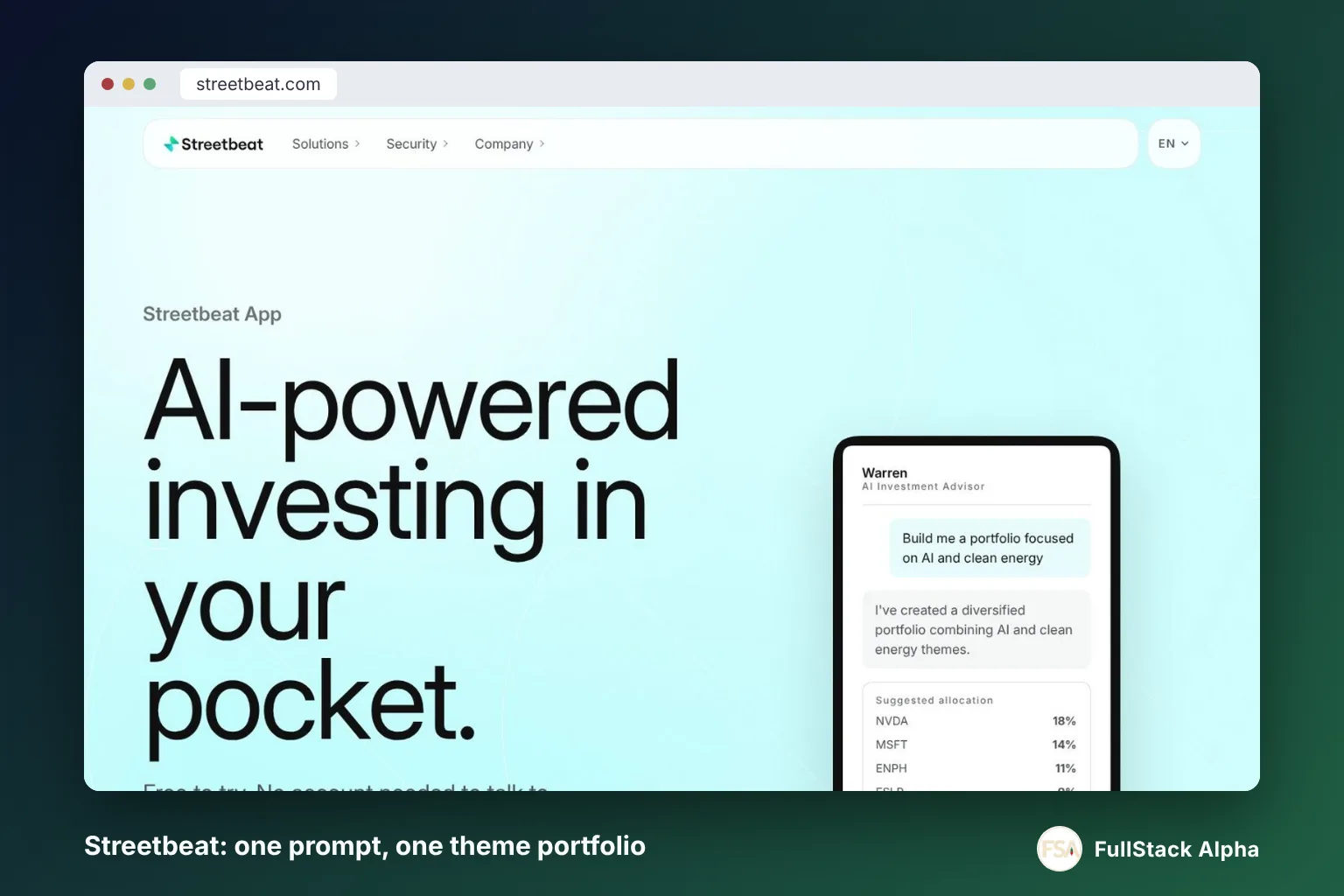
- Streetbeat App. streetbeat.com.
Still deciding between a robo-advisor and an AI co-pilot? Two tools compared here, 200+ catalogued in the FullStack Alpha directory, sorted by category, price and use case. Compare robo-advisors in the directory
This is education, not financial advice.
Your market edge starts with the right tool. Stay alpha.
Some links on this page may be affiliate links. Rankings are never influenced by them.