MarketReader Review 2026: AI That Explains Why Stocks Move

Last updated: October 28, 2026
Quick answer: what MarketReader does and who should pay for it

This MarketReader review comes down to one question: is faster context worth a monthly bill to you? Who should pay for it: active day and swing traders who trade news and catalysts, plus advisors and desk analysts who have to explain moves to clients. Who shouldn't: buy-and-hold index investors, traders whose book lives mostly in forex or futures, and anyone hoping an AI will hand them entries and exits. MarketReader explains. It doesn't predict, and it doesn't trade.
The honest framing of this MarketReader review: this is a research-speed tool, not a signal service. If your bottleneck is "I see a 7% gap and I have no idea what happened," it solves that. If your bottleneck is "I have no system," no subscription fixes that.
One more thing worth knowing before you read further. The company changed shape in 2026. 
What is MarketReader (also searched as market reader)?
MarketReader is a real-time stock move attribution platform. Plain version: it tells you why a stock is up or down right now. A lot of people type market reader as two words when searching, and they land in the same place, so don't worry about the spelling.
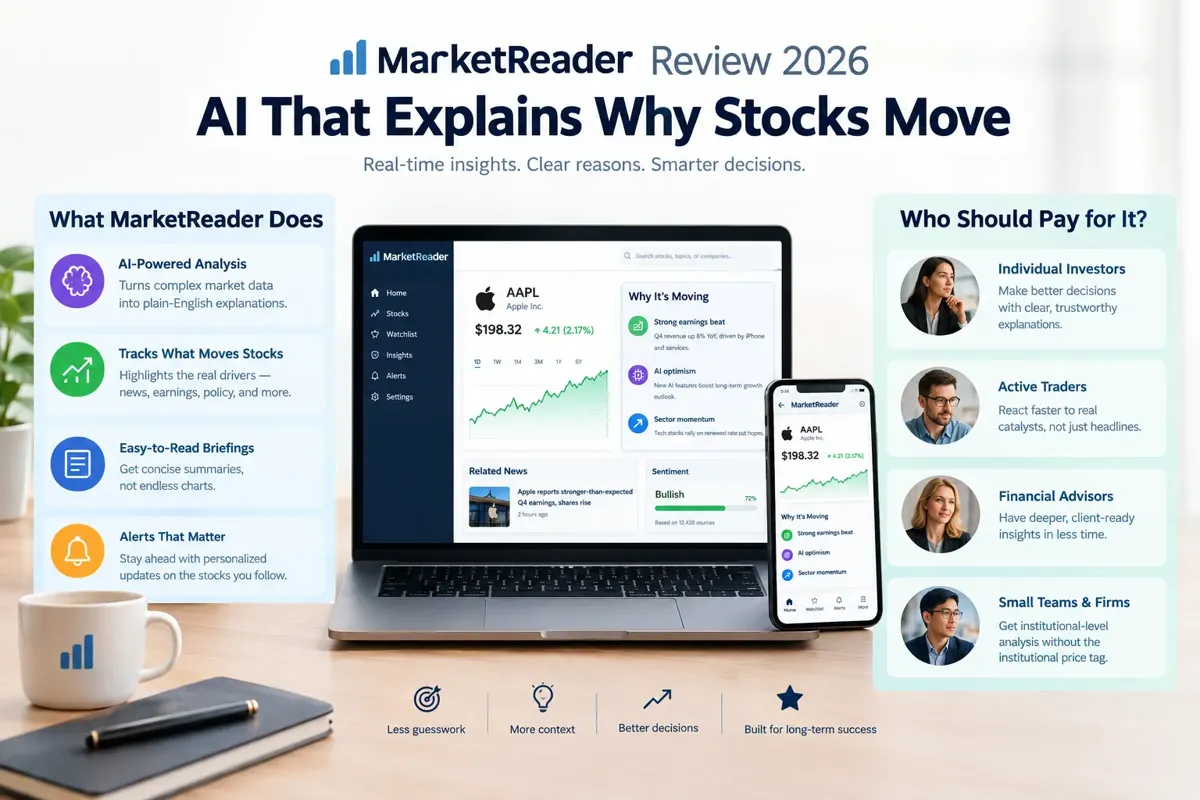
The company says it covers more than 10,000 U.S.-listed assets across equities, ETFs, and ADRs. ADRs are American Depositary Receipts, which are foreign companies that trade on U.S. exchanges. The AI move summaries are built around those U.S.-listed names. Currencies, commodities, rates, and indices show up in the macro view as context. If your book lives mostly in forex or futures contracts, this is the wrong tool.
What it actually gives you
Any honest MarketReader review should separate the feature list from the marketing. Per MarketReader's own pricing page, the platform ships as a web dashboard with these pieces:
- A live view of the day's most unusual moves, with intraday charting
- Real-time AI-written move summaries for stocks and ETFs
- A Smart Screener with customizable, savable filters
- Customizable watchlists
- A Macro ETF Monitor (Professional plan) for seeing whether the move is the stock or the whole tape
- Industry Peers and Correlated Assets filters showing peers moving together
- Longer-horizon summaries, including monthly AI-written summaries for every asset on the Professional plan
The screener is quietly the best feature. During earnings season, the moves worth your attention are often the ones with no earnings print attached, because nobody has a tidy story for them yet. Build a saved screen that hunts for those. That's where the interesting stuff hides.
The entity you're actually buying
MarketReader is a small, focused company, not a sprawling data vendor. Acuity's May 2026 announcement says its investment brings "additional commercial, product and data science capability" and deeper institutional reach, and that MarketReader will keep developing its technology for institutional users, advisory firms, and API-first platforms.
Translation for a retail subscriber: more resources, more institutional customers, and a decent chance the roadmap tilts toward brokerage and advisory integrations rather than retail bells and whistles. Not a problem. Just know who's at the front of the line.
The company also publishes a free daily newsletter, the "MarketReader Minute." Editions from October 23 and October 27, 2026 attributed moves to AI-spending worries, earnings beats, oil, inflation and rate worries, and geopolitics. If you want to audit the writing quality before paying a dime, read a week of those. It's the same engine, compressed.
How does MarketReader explain why a stock moved?
The mechanism is the part of this MarketReader review that matters most. It starts by detecting an abnormal price move, then pulls several data layers to explain it, then points to the most likely driver. The output is a short written explanation, not a chart you have to interpret yourself.
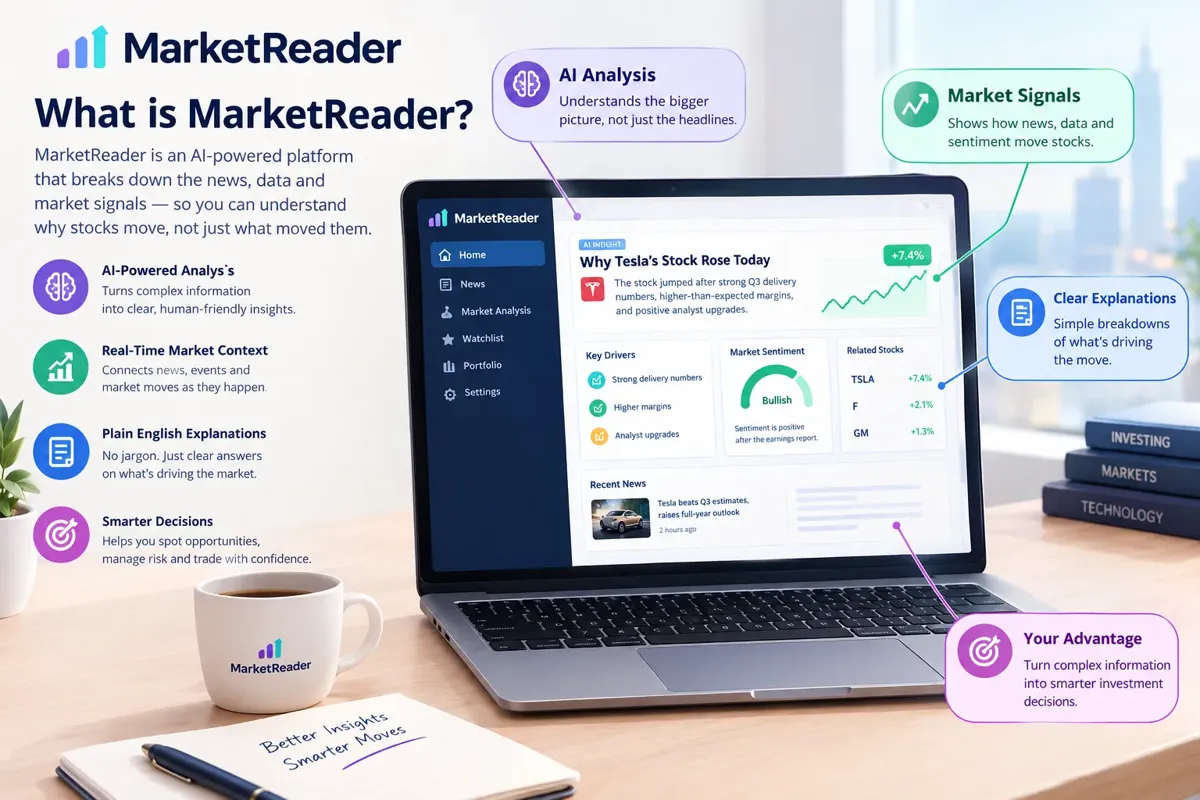
The inputs, per MarketReader's and Acuity's published descriptions:
- Market and volume data. Real-time trade data on U.S. equities. Is the volume unusual for this name at this time of day?
- News and social media. Headlines, filings, and chatter time-stamped against the move.
- Calendar events. Earnings, IPO filings, and macro releases from an economic calendar.
- Macro and cross-asset relationships. Did the whole sector move? Did rates move? Is this a dollar story?
Why the fourth layer is the one that earns the subscription
Most traders can find a headline. What most traders can't do quickly is tell the difference between "this company has news" and "this company is a passenger in a factor move."
A semiconductor name down 4% with no news isn't broken. It's often just beta to a sector repricing. MarketReader's cross-asset layer is what separates those two cases, and getting that wrong is how people end up catching a falling knife on a stock that was never falling for its own reasons.
The lag, explained
MarketReader describes its summaries as real-time and intraday, with longer-term summaries alongside them. Its site does not publish a fixed refresh interval. Every explanation is written after a move is detected, so it trails the price by design.
That lag is fine for swing traders and position sizing decisions. It is not fast enough to be your first alert on a breaking headline. If you're scalping the first 90 seconds of a news print, you need a squawk or a raw wire, and MarketReader arrives after the fact with the context.
Decision rule: use a news terminal to find out that something happened, use MarketReader to find out whether it matters.
Common mistake here: treating the explanation as causation. The model is inferring from correlation and timing. Sometimes a stock moves because one fund rebalanced and there's no public story at all. Good attribution tools say "flow, unexplained." Bad ones invent a narrative. Keep that test in mind every time you read an explanation, from any vendor.
If you want a wider look at how catalyst-detection tools compare, the breakdown of AI stock news tools that catch catalysts faster covers the category.
How much does MarketReader cost, and is there a free trial?
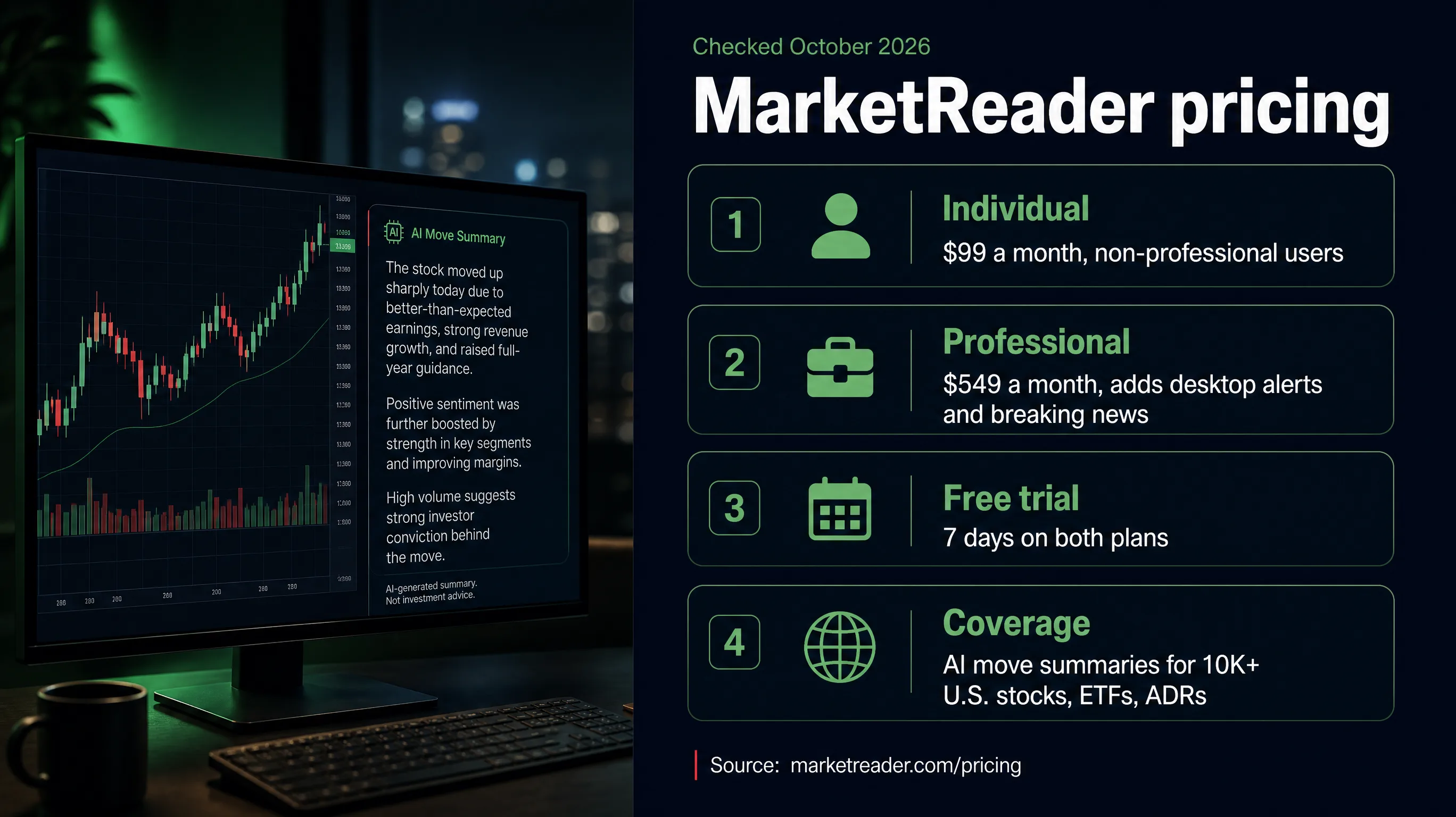
Price is where every MarketReader review should get specific, so here are the numbers from the vendor's own pricing page (checked October 2026):
- Individual: $99 per month (checked October 2026). Live view of unusual moves, real-time AI move summaries for stocks and ETFs, peers and correlated-asset filters, watchlists, intraday charting, the Smart Screener, the MarketReader Minute newsletter, and email support. Limited to non-professional subscribers, who have to pass an eligibility questionnaire.
- Professional: $549 per month (checked October 2026). Everything in Individual, plus the Macro ETF Monitor, monthly AI summaries for every asset, professionally curated watchlists, breaking market news, desktop alerts, intraday macro overviews, and live chat and phone support.
The pricing page lists monthly prices only. Tool pricing in this category changes often, so confirm the live figures at marketreader.com/pricing before you subscribe. For the full marketreader pricing breakdown alongside the rest of the listing, see the MarketReader tool profile.
The free trial situation
Yes, there's a trial. Both plans show a 7-day free trial on the pricing page (checked October 2026). That's the current marketreader free trial structure as of this writing.
Seven days is short for this category. It's still enough to test it properly if you plan the week before you click start.
How to actually use the 7 days
This is the test that makes this MarketReader review useful to you. Don't just poke at the dashboard for an afternoon and forget about it. Run this:
- Days 1 and 2: Load your real watchlist. Nothing else. See whether the explanations tell you anything you didn't already know from your existing feeds.
- Days 3 to 5: Every time one of your names moves more than 3%, write down your own guess before opening MarketReader. Then compare. This is the only test that matters.
- Day 6: Use the screener to hunt for movers with no earnings catalyst. See if it surfaces anything you'd have missed entirely.
- Day 7: Count. How many times did it change a decision? If the answer is zero, cancel before the trial ends. If it's three or more, it has a real shot at paying for itself.
That last line is the whole review in miniature. A tool is worth the money when it changes decisions, not when it feels informative.
Edge case: if you trade fewer than five names and all of them are mega-cap tech, you probably don't need this. The explanations for AAPL and NVDA are available for free within minutes everywhere. The value climbs sharply as you move down the cap scale into names nobody's covering.
Is MarketReader useful for day traders?
Useful, yes. Sufficient, no. For day traders the honest answer in this MarketReader review is that it's a second-screen context tool, not an entry trigger. Most day trading tools sell speed. This one sells context.
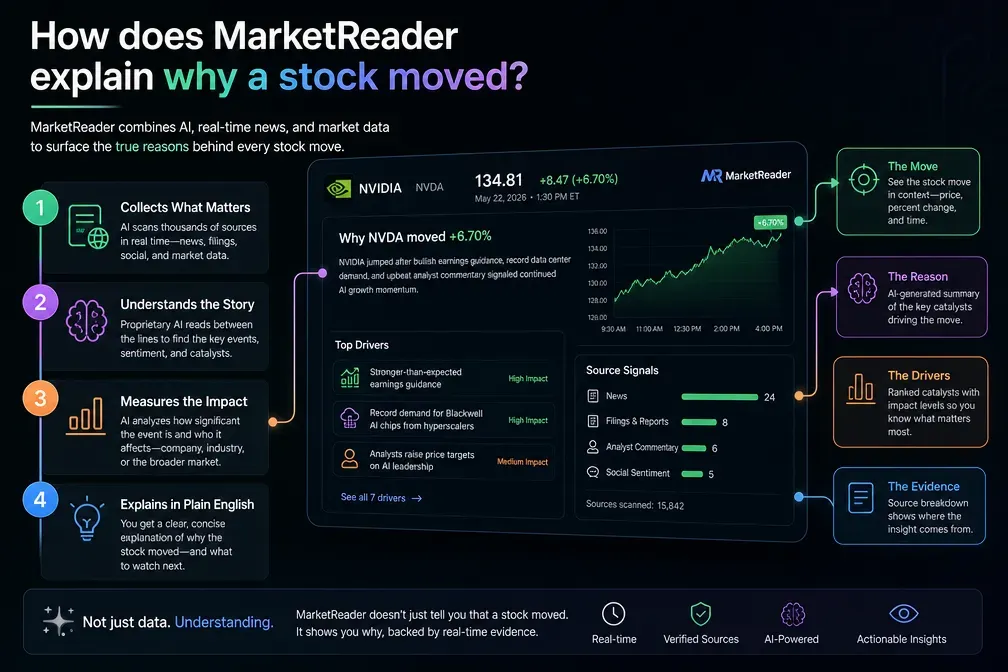
Where it earns its keep intraday
- The 9:45am "what is going on" moment. Your watchlist gapped, six names are red, and you need to know whether it's macro or idiosyncratic before you size anything.
- Mid-session anomalies. A quiet name starts printing unusual volume at 1pm. The unusual-moves view flags it and tells you whether there's a story attached.
- Power hour positioning. Knowing whether a late move is flow-driven or news-driven changes whether you hold overnight.
- Avoiding the bull trap. A pop on no attributable driver, in a stock that's already overextended, is a different trade than a pop on a genuine catalyst.
Where it falls short for scalpers
The lag is the ceiling. If your average hold is 40 seconds, the explanation arrives after your exit. Period. You'd be paying for post-mortems.
Choose MarketReader if your average hold is 20 minutes to several days and you size positions based on why something's moving. Skip it if you're a pure tape-reading scalper who trades price action and ignores narrative entirely. If speed is the whole game for you, an execution-side setup like an AI day trading bot is a different category of tool with different risks.
The swing trader case is stronger
Swing traders get more out of this than day traders do, which is a little counterintuitive for a real-time tool. Here's why: when you hold for three days, the question "is this move real or is it noise?" has actual money attached. A one-day flow-driven dip in a name with strong fundamentals can be a buy. The same dip driven by a guidance cut is a stop-out.
MarketReader answers that question faster than reading six articles and a filing. That's the use case.
Is it worth it for long-term investors?
Mostly no, with one exception. If you hold 25 positions for years, daily move attribution is noise you don't need and shouldn't be watching. The monthly AI summaries on the Professional plan are the only piece built for you, and at $549 a month (checked October 2026) that alone is thin justification.
The exception: investors who use drawdowns as entry points. Knowing within minutes whether a 9% drop is a thesis-breaker or a sector-wide flush is genuinely useful when you're deploying capital. That's a real job. Just be honest about whether it's your job.
If you're building a process rather than collecting tools, the AI stock scanner filter framework pairs well with this kind of attribution layer.
How accurate are MarketReader's explanations?
Accuracy here is the wrong question, and asking it the wrong way is the single most common mistake people make with this tool. MarketReader isn't predicting stock movements. It's explaining moves that already happened. There is no win rate to audit because there are no calls to score, so no MarketReader review can hand you one.
What you can evaluate is attribution quality: does the explanation hold up when you check the primary source?
The three failure modes to watch for
- Over-attribution to news. A headline existed, so the model credits the headline, even when the move started 40 minutes earlier on flow. Check the timestamps. If the move preceded the news, something else moved it.
- Under-attribution to flow. Big institutional rebalances produce violent moves with no story. A good system says "unusual volume, no identified catalyst." That answer is more honest than a manufactured narrative, and it should show up sometimes. If options flow is part of your read, a dedicated flow tool like
Unusual Whales covers a layer MarketReader doesn't specialize in.
- Factor confusion. When rates, the dollar, and a sector all move together, isolating which one is driving a specific name is genuinely hard. Expect the model to be directionally right and sometimes imprecise about weighting.
How to stress-test it yourself
Take ten moves of 4% or more in names you know well. For each one, write your explanation first. Then read MarketReader's. Score three outcomes: agreed, MarketReader found something I missed, MarketReader got it wrong.
If "found something I missed" shows up in three or more of the ten, you're getting real value. One or zero and you already have the coverage you need.
A tool that confirms what you already knew is entertainment. A tool that changes your read is research. Know which one you're buying.
On regulation, because it matters here
Any firm producing AI-generated market content is operating in a tighter environment in 2026. FINRA's annual regulatory oversight report now includes guidance on generative AI, particularly where outputs cross into recommendations, customer communications, or automated advisory processes. Nothing in the public record suggests a rule targeting MarketReader specifically, and MarketReader's product is explanatory rather than advisory, which keeps it on the safer side of the line.
Why you should care as a user: tools that stay explanatory tend to stay available. Tools that drift into "buy this now" invite scrutiny and sometimes disappear. MarketReader's positioning is deliberately conservative, and that's a feature.
For a different approach to the same accuracy question, the 
MarketReader vs Benzinga Pro: which explains moves faster?
Different jobs. 
The table below sums up this MarketReader review against the most common comparison.
How to pick
Choose Benzinga Pro if your edge is reaction speed. You trade the first move on a headline, you need the squawk in your ear, and you've already built the mental model to interpret news instantly. Full scorecard in the Benzinga Pro review.
Choose MarketReader if your edge is judgment. You're deciding whether to hold, add, or cut, and the question "is this real?" is worth more to you than "what just printed?"
Choose both if you day trade news professionally and the combined cost is under 2% of your monthly trading capital. Below a $25,000 account, running both is tool bloat dressed up as preparation.
The overlooked third option
A lot of traders buy neither and get most of the benefit from a free news feed plus a disciplined watchlist of 12 names they actually understand. That's not a joke. Analysis paralysis costs more money than missing a catalyst does. Six scanners and three Discords is not a research process, it's a hobby with a subscription bill.
If you're weighing the broader field, the alternatives to MarketReader page sorts the options by what they actually do rather than by marketing copy.
Pros and cons from this MarketReader review
Short version: strong at its narrow job, genuinely limited outside it, and honest about the distinction. That last part is rarer than it should be in this category.
Pros
- Attribution is the actual product, not a bolt-on. Most tools add an AI summary to a data feed. This one is built around the explanation.
- Cross-asset and macro context separates "this stock has news" from "this stock is riding a sector move," which is the distinction most retail traders get wrong.
- Plain-English output. No jargon wall, no chart you have to decode. Beginners can read it on day one.
- 7-day free trial on both plans (checked October 2026), long enough for a structured test if you plan it.
- Customizable, savable screener that you can point at non-obvious movers during earnings season.
- Free daily newsletter lets you audit the writing quality before paying.
- Conservative positioning. It explains, it doesn't recommend. Lower regulatory risk, less guru energy.
- Operates independently after the Acuity investment, per Acuity, with added commercial, product, and data science capability behind it.
Cons
- Narrow coverage. The move summaries center on U.S.-listed equities, ETFs, and ADRs. If half your book is outside that, half your book is uncovered.
- The lag disqualifies it for scalping. Be clear-eyed about your hold time before subscribing.
- It won't tell you what to do. No entries, no exits, no position sizing. That's by design, and some subscribers will feel shortchanged anyway.
- The useful alerts cost more. Desktop alerts and breaking market news sit on the $549 Professional plan, not the $99 Individual plan (checked October 2026).
Public discussion is thin. Compared with the big retail platforms, there isn't a large volume of unsolicited user reviews across Reddit and the review sites to corroborate the experience. Less corroboration means more weight on your own trial.
- It's a web platform. MarketReader markets it as a web-based platform, and its site lists no native app. Workable on a phone, better on a desktop.
- Overlap risk. If you already run a news terminal and a decent scanner like
Trade Ideas, the incremental value drops fast.
- Leadership changed in 2026. New CEO, founder moved to the board. Usually fine. Occasionally the product drifts toward whoever pays the most, and here that's institutional clients.
The mistakes people make with it
- Treating explanations as predictions and trading off them directly
- Subscribing on the Professional plan before testing whether the Individual plan covers their needs
- Letting it become a seventh tab instead of replacing two existing ones
- Checking it 40 times a day, which is overtrading with extra steps
- Expecting results in a week; the realistic timeline is one to two months of using it against your own watchlist before you can tell whether it changes decisions
If the tool isn't showing explanations for a stock's move, the usual causes are: the asset isn't U.S.-listed, the move wasn't abnormal enough to flag, or the move just started and the explanation hasn't been written yet. Check the asset type first. That's the answer most of the time.
FAQ
What is MarketReader in one sentence? MarketReader is an AI platform that detects abnormal price moves in U.S.-listed stocks, ETFs, and ADRs and writes a plain-English explanation of the likely drivers, intraday.
What is the bottom line of this MarketReader review? It's a strong context tool for swing traders and catalyst-driven day traders, and a poor fit for scalpers and passive investors. Judge it by how many decisions it changes during the trial.
Can beginners use MarketReader, or is it only for professionals? Beginners can use it on day one. The output is written in plain English, not quant notation. The limitation isn't skill, it's relevance: if you don't trade actively, daily move attribution won't change what you do.
What markets does MarketReader cover? The AI move summaries cover U.S.-listed equities, ETFs, and ADRs, which the company puts at more than 10,000 assets. Currencies, commodities, rates, and indices appear as macro context.
How much does MarketReader cost? The Individual plan is $99 per month and the Professional plan is $549 per month (checked October 2026). Confirm current pricing on marketreader.com before signing up.
Does MarketReader have a free trial? Yes. As of October 2026 the pricing page offers a 7-day free trial on both the Individual and Professional plans. Confirm current terms on marketreader.com before signing up.
Can you use MarketReader on your phone? The platform runs as a web dashboard, and MarketReader lists no native app. The full experience (charts, screener, correlated-asset filters) is built for desktop. Treat the phone as a check-in, not a workstation.
How long before MarketReader changes how you trade? Give it the full 7-day trial plus roughly a month of live use against your own watchlist. The honest measure isn't how interesting the explanations are, it's how many times they changed a sizing, entry, or exit decision.
Is MarketReader better than Benzinga Pro? Neither is better; they do different jobs. Benzinga Pro delivers headlines in real time. MarketReader delivers explanations after the move. Speed versus meaning.
Who owns MarketReader now? Acuity Trading made a strategic growth investment announced in May 2026, and Acuity says MarketReader continues to operate independently. Andrew Lane became CEO on May 26, 2026, and co-founder Jens Nordvig moved to a strategic board role.
Conclusion: what to do after this MarketReader review
MarketReader does one thing and does it well: it closes the gap between seeing a move and understanding it. For swing traders and context-first day traders, that gap is where a lot of bad decisions get made, and shrinking it is a real improvement in process.
It is not a signal service. It will not hand you a setup, size your position, or set your stop loss. If you were hoping for that, the problem isn't the tool. If you want rules that act on their own, start with how to automate trading responsibly, not with an explanation feed.
Three steps to take this week:
- Read five days of the free MarketReader Minute newsletter. Zero cost, same engine. If the writing doesn't tell you anything useful, you've saved yourself a subscription.
- If it does, start the 7-day trial and run the structured test from the pricing section: guess first, then read, then count how many times it changed a decision.
- Before you add it, remove something. One in, one out. Tool stacks grow because nobody ever audits them, and a trader with three tools and a written rulebook usually beats a trader with nine tools and a feeling.
Process over prediction. That's the only part of this MarketReader review that's free.
References
- MarketReader Minute newsletter archive. newsletter.marketreader.com.
- Global Equities Slip as Nasdaq Falls 2.6% on AI Spending Worries, MarketReader Minute, October 23, 2026. newsletter.marketreader.com.
- MarketReader pricing. marketreader.com.
- Celestica, Royal Caribbean Jump on Earnings Beats, MarketReader Minute, October 27, 2026. newsletter.marketreader.com.
- A strategic investment in MarketReader, Acuity Trading. acuitytrading.com.
- MarketReader Appoints Andrew Lane as CEO Following Acuity Trading Strategic Investment, May 26, 2026. acuitytrading.com.
- Acuity Trading Invests in MarketReader, May 12, 2026. newsfilecorp.com.
Deciding whether move explanations belong in your stack? MarketReader is one of several AI news and sentiment tools in the FullStack Alpha directory, each listed by what it actually does. Compare the best AI stock news and sentiment tools.
This is education, not financial advice.
Your market edge starts with the right tool. Stay alpha.
Some links on this page may be affiliate links. Rankings are never influenced by them.