FinChat IO Is Now Fiscal.ai: 5 Data Gaps to Know
Last updated: August 31, 2026
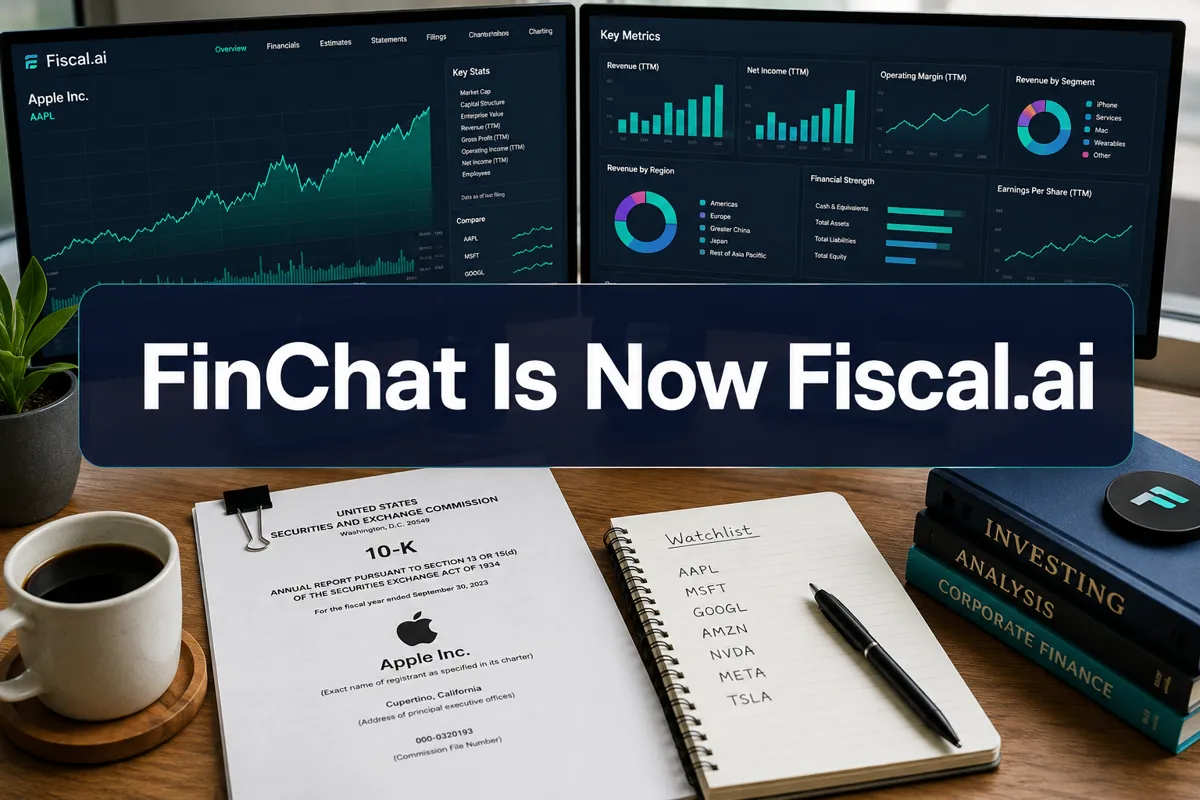
Quick Answer: FinChat IO rebranded to Fiscal.ai in June 2025 after closing a $10 million Series A. The product, team, and core data engine stayed the same. The name changed because "chat" was too small a box for what the company wants to build. Five real data gaps carried over from the old brand: thin international and small-cap coverage, uneven segment-level detail, variable historical depth, AI answers that sometimes outrun the underlying data, and export workflows that hit a wall below the top tier.
Key Takeaways
- FinChat IO officially became Fiscal.ai on June 17, 2025, backed by a $10M Series A led by Portage Ventures
- The rebrand was a positioning move, not a product overhaul. The data engine is the same one FinChat IO users knew
- Coverage is strongest on large-cap US names. International tickers and micro-caps get noticeably thinner data
- Segment-level financial breakdowns exist for many companies but are not consistently populated across all filings
- Historical data depth varies by metric. Some fields go back 10-plus years; others stop at five or fewer
- The AI chat layer can generate confident-sounding answers that are not always traceable to a specific source document
- Spreadsheet export to Excel or Google Sheets is limited on lower tiers. API access requires a paid plan
- Koyfin, Wisesheets, Deepvue, and Tykr each fill one or more of these gaps depending on your workflow
What Happened to FinChat IO?
The Rebrand to Fiscal.ai and the Funding Behind It
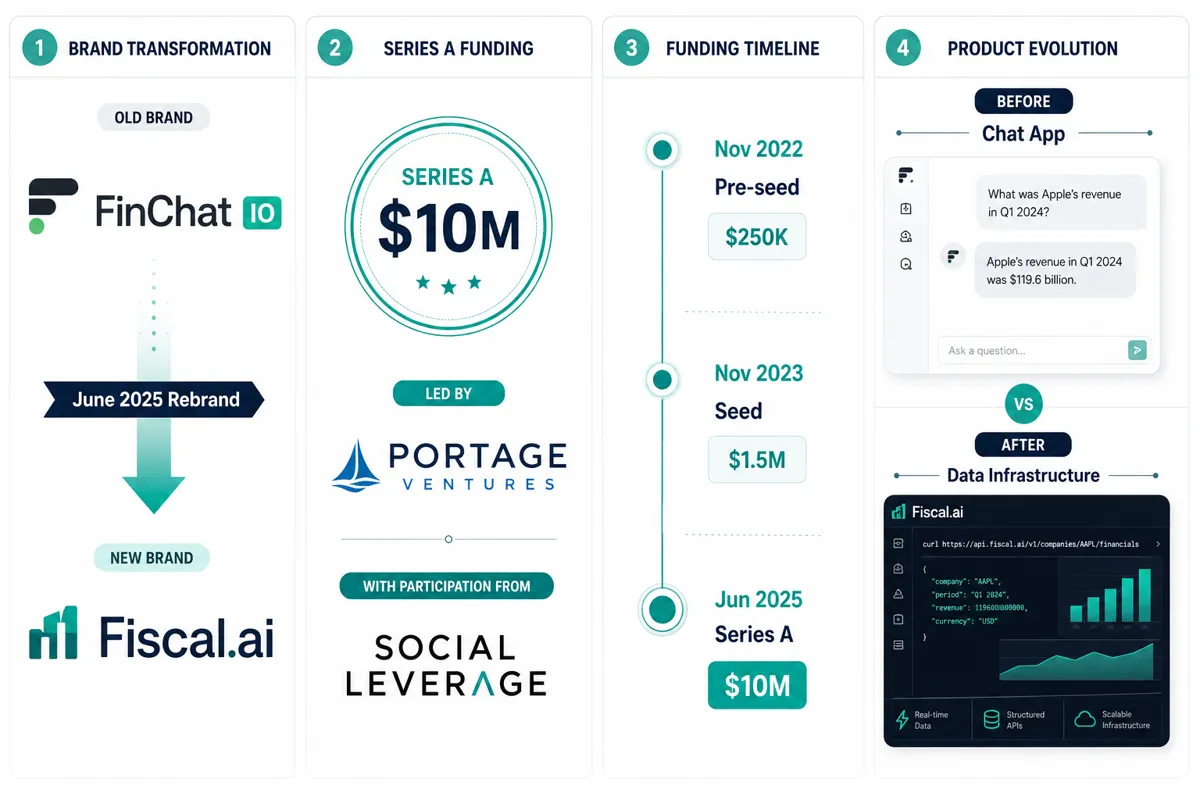
FinChat IO became Fiscal.ai on June 17, 2025. CEO Braden Dennis announced the change alongside a $10 million Series A led by Portage Ventures, with Social Leverage and VanEck also participating. The company had previously raised $250K pre-seed in November 2022 and a $1.5 million seed round from Social Leverage in November 2023.
The stated reason was simple: the word "chat" had become a cage. In an August 2025 interview on Startups for the Rest of Us (Episode 787), Dennis said the name pigeonholed the product as a chatbot when the real ambition was to build financial data infrastructure. The rebrand used the Series A as the natural moment to make the shift.
The new positioning frames Fiscal.ai as "powering the financial data layer for the AI era," targeting both retail users through its Terminal product and developers through its APIs.
Why People Still Search FinChat IO
Old bookmarks do not update themselves. Anyone who saved finchat.io before June 2025 and typed it into a browser found a redirect. Anyone who Googled "finchat io review" found a mix of old articles and new ones using the Fiscal.ai name interchangeably. That is the confusion this article is here to clear up.
For SEO purposes, finchat io and Fiscal.ai refer to the same product. The domain changed; the underlying service did not.
What Changed for Existing Users
Existing subscribers kept their accounts and pricing. The interface updated to reflect the Fiscal.ai branding. The core feature set, including the AI chat layer, financial data tables, and screening tools, remained intact. The company's help documentation migrated to fiscal.ai/help.
What did not change: the data gaps that existed under the FinChat IO name are still present under Fiscal.ai. That is the subject of the next five sections.
Gap 1: Coverage Thins Outside Large-Cap US Names
Where the data stops: Fiscal.ai covers over 100,000 companies globally according to its own marketing, but coverage depth is not uniform across that universe. For S&P 500 names and large-cap US equities, the data is thorough. For international small-caps, emerging market names, and OTC-traded micro-caps, the picture changes fast.
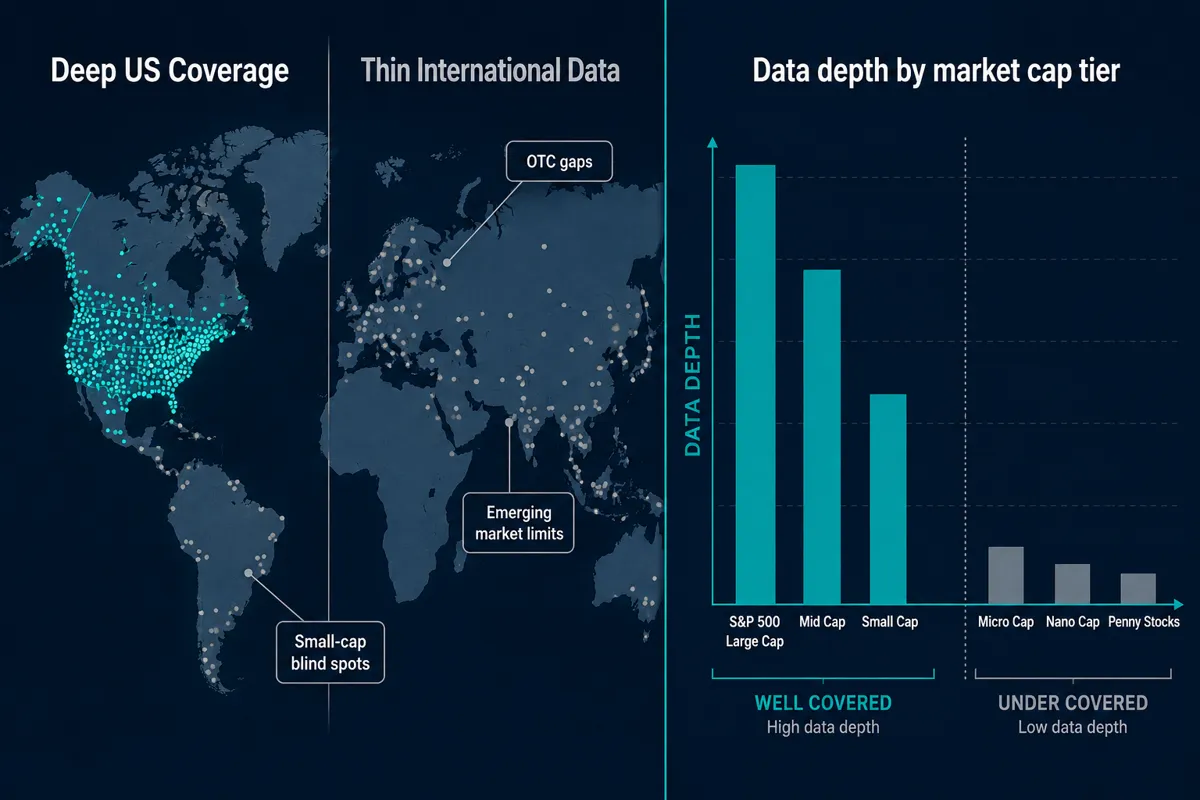
Users doing fundamental research on, say, a mid-cap Korean manufacturer or a small Brazilian retailer will find that key metrics are either missing, delayed, or populated from secondary sources rather than direct filings. This is not unique to Fiscal.ai. Most retail-facing fundamental data platforms face the same trade-off: deep US coverage, thinner everything else.
The practical issue for retail investors: if your watchlist is entirely US large-cap, this gap does not affect you. If you run screens that include international names, or if you follow a specific sector that has significant non-US players, you will hit blank cells more often than you want.
For a broader look at how AI research tools handle data coverage across different market segments, the AI Research and Analysis Tools directory breaks down the field by category.
Gap 2: Segment-Level Detail Is Uneven
What the Filings Have That the Dashboard Does Not
A 10-K or 10-Q filed with the SEC EDGAR system often contains granular segment breakdowns: revenue by geography, operating income by business unit, capital expenditure by division. That data exists in the public record. Getting it to surface cleanly in a dashboard is a different problem.
Fiscal.ai populates segment-level data for many large companies, but the coverage is inconsistent. For a company like Microsoft, you will find segment revenue broken out by Productivity and Business Processes, Intelligent Cloud, and More Personal Computing. For a mid-size industrial company with three reporting segments, the same level of detail may not be there.
Why this matters for fundamental analysis: segment data is where the real story often lives. A company can show flat consolidated revenue while one segment is growing 30% and another is collapsing. If the dashboard only shows the consolidated number, you are reading the headline and missing the article.
The workaround most users land on is going directly to SEC EDGAR for segment detail and using Fiscal.ai for the consolidated financials. That is a reasonable process, but it means the tool is not fully self-contained for deep fundamental work.
For a sense of how alternative data layers can supplement gaps like this, the Altindex review on alternative data for retail traders is worth reading alongside this one.
Gap 3: Historical Depth Varies by Metric
The Lookback That Ends Sooner Than You Expect
For most major financial metrics on large US companies, Fiscal.ai provides 10 or more years of history. That covers a full market cycle and gives you enough data to run a reasonable valuation model. For some metrics, particularly newer or more granular ones, the lookback is shorter.
Free cash flow yield, adjusted EBITDA margins, and certain per-share metrics may only go back five years on some tickers. For companies that went public recently or that restructured their reporting, the history is naturally shorter. But even for established companies, certain calculated fields can have gaps in the middle of the historical record.
The setup this creates for a value investor: you are building a discounted cash flow model and you want 10 years of owner earnings data. For Apple or Johnson and Johnson, you are fine. For a company that changed its segment reporting in 2019, you may find a break in the series that forces you to manually reconcile two different reporting formats.
This is not a fatal flaw. It is a known limitation worth checking before you commit to a paid plan. Pull a few of the specific metrics you rely on for a company you know well, and see how far back they go before you subscribe.
Gap 4: AI Answers Still Need a Source Check
Where the Chat Layer Outruns the Data Layer
The AI chat feature is what made finchat io famous. Ask a natural-language question about a company's gross margin trend, and the tool generates a readable answer with numbers. For many users, this is the primary reason to pay.
The gap is transparency. When the AI generates an answer, it does not always cite the specific filing, quarter, or line item it pulled from. The answer can be accurate. It can also be a confident-sounding synthesis that blends data from slightly different periods or uses a slightly different definition of the metric than you intended.
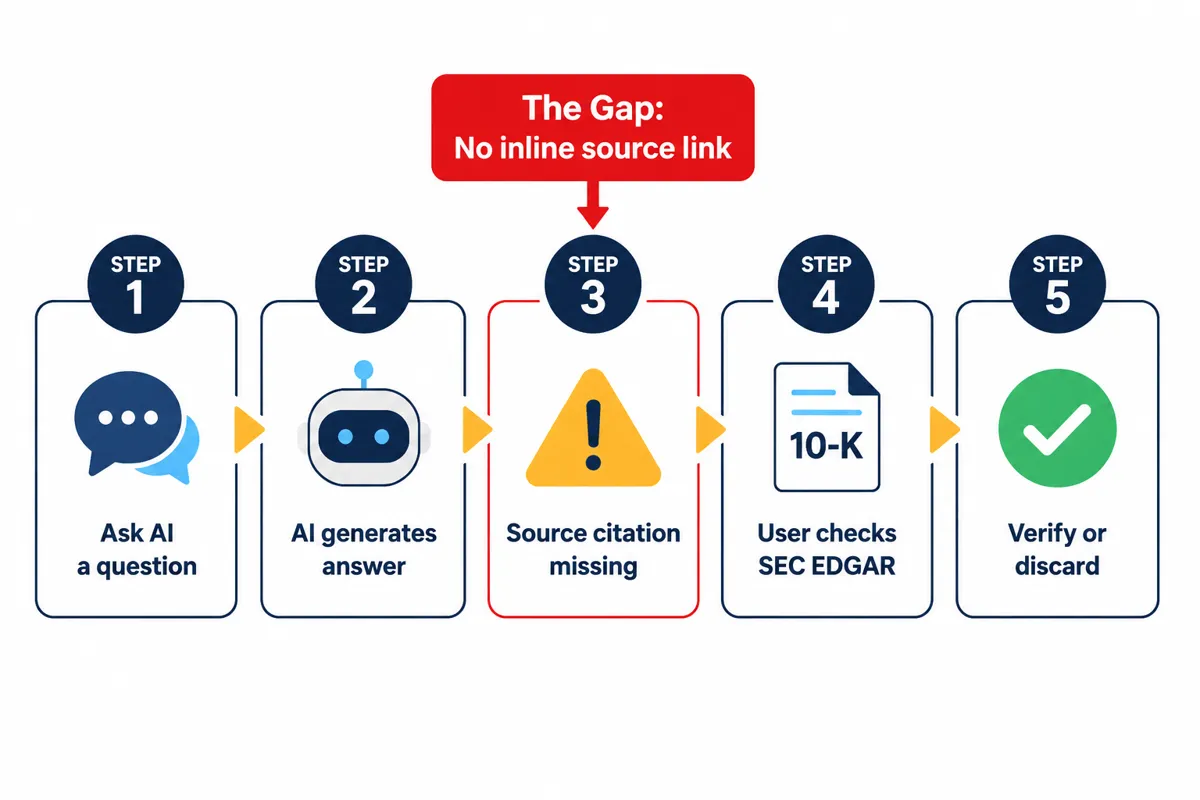
This is not a problem unique to Fiscal.ai. Most AI-powered research tools face the same tension: the chat layer is designed to be fluent and fast, and fluency sometimes trades off against precision. A Bloomberg Terminal gives you a number and a source. An AI chat layer gives you a paragraph and sometimes a footnote.
The practical discipline: treat AI-generated answers as a starting point, not a final check. When a number matters for a real decision, verify it against the underlying filing on SEC EDGAR. This is not extra work. It is the process.
For a broader look at how accurate AI trading signals actually are, the AI trading signals accuracy breakdown covers the verification problem across multiple tools.
Gap 5: Export and Spreadsheet Workflow Limits
Which Fundamentals Tool Exports Clean to Excel
Fiscal.ai's export capabilities depend heavily on which tier you are on. The free plan does not include data export. Lower paid tiers allow some CSV export but do not include native Google Sheets integration or a live Excel connection. API access, which would allow you to pull data programmatically into your own models, is gated behind higher-tier plans.
For a retail investor who builds DCF models in Excel or tracks a watchlist in Google Sheets, this is a real friction point. The data is in the dashboard. Getting it into your spreadsheet cleanly requires either a manual copy-paste, a CSV download and import, or paying for a higher tier.
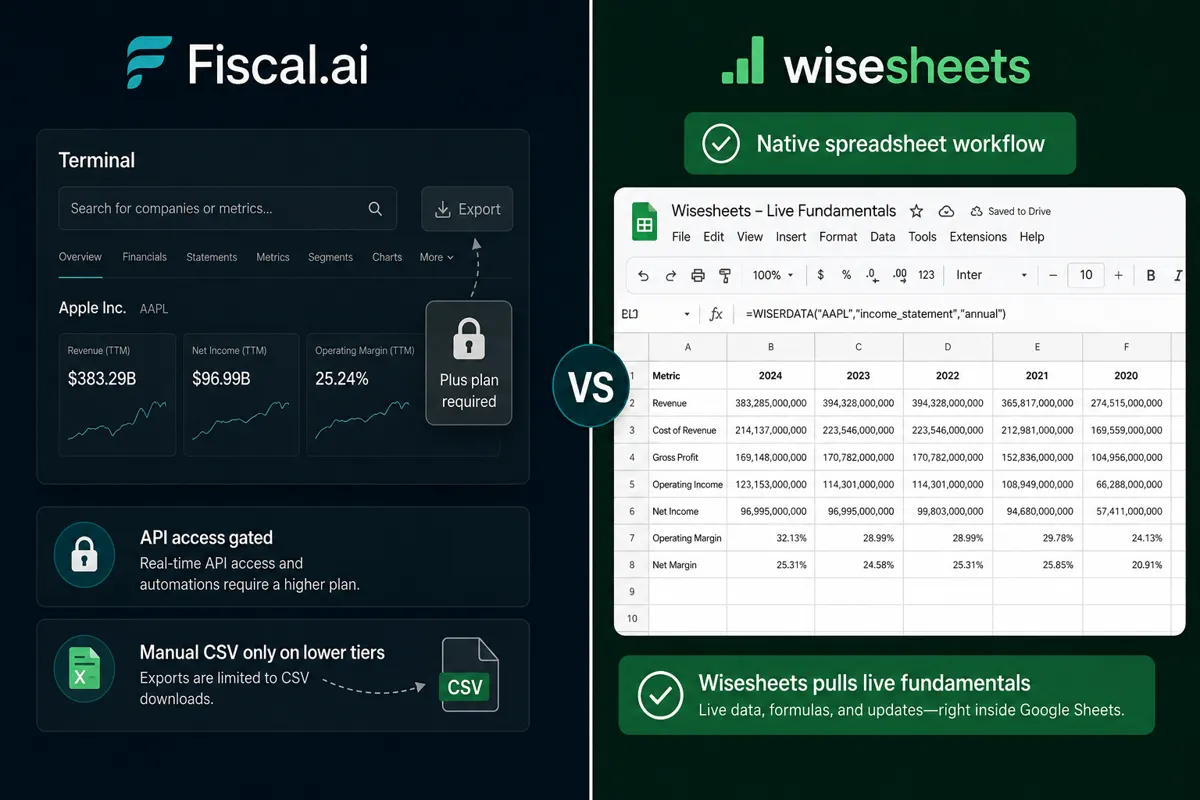
Wisesheets, by contrast, is built specifically for spreadsheet-native workflows. It installs as an add-on in Google Sheets or Excel and pulls live financial data directly into cells. If your entire research process lives in a spreadsheet, that architecture is a better fit than a terminal-first tool with export as an afterthought.
The Wisesheets review on the FullStack Alpha directory covers the specific export capabilities and pricing in detail.
What Does FinChat IO Cost Now?
Free Tier Limits and What They Allow
Fiscal.ai offers a free plan that gives access to a limited number of companies, a restricted set of financial metrics, and the AI chat feature with a daily message cap. The free tier is useful for testing the interface and checking data quality on a handful of names. It is not sufficient for active fundamental research across a broad watchlist.
The free plan does not include data export, API access, or premium screening features.
Paid Tiers and Who Actually Needs Them
As of mid-2026, Fiscal.ai's paid plans start at approximately $30 per month for the Plus tier and scale up to higher tiers for API access and institutional features. Pricing details are subject to change, and the current structure is listed at fiscal.ai/pricing.
The Plus tier covers most retail investor use cases: broader company coverage, more historical data, and higher AI chat limits. The higher tiers are designed for developers building on the API or for professional users who need bulk data access.
For a detailed breakdown of the current tier structure and what each plan includes, the Fiscal.ai review on the FullStack Alpha directory is the most current reference.
Comparison Table: Fiscal.ai vs Koyfin vs Wisesheets vs Deepvue
| Tool | Best For | Coverage Depth | Spreadsheet Export | Free Tier | Starting Price |
|---|---|---|---|---|---|
| Fiscal.ai | AI chat plus fundamentals terminal | Strong US large-cap, thin international | CSV on paid tiers, no native Sheets sync | Yes, limited | Approx. $30/mo |
| Koyfin | Charting, dashboards, macro data | Broad global coverage, strong ETF data | CSV and Excel on paid tiers | Yes, generous | Approx. $19/mo |
| Wisesheets | Spreadsheet-native fundamental research | Good US and international fundamentals | Native Google Sheets and Excel add-on | Free trial available | Approx. $20/mo |
| Deepvue | Screening and visual financial analysis | US-focused, good for screening workflows | Limited export options | Yes | Approx. $15/mo |
Prices are approximate as of mid-2026 and subject to change. Verify current pricing at each vendor's site before subscribing.
Is FinChat IO Worth It for Retail Investors?
Who Gets Real Value From It
Fiscal.ai is a genuinely capable tool for a specific type of retail investor. If your process centers on US large-cap and mid-cap fundamental research, you want to ask natural-language questions about a company's financials without reading through 80 pages of a 10-K, and you are comfortable verifying key numbers against the original filing, this tool earns its subscription.
The AI chat layer is the strongest part of the product. Being able to ask "what was Microsoft's free cash flow margin over the last five years" and get a readable answer in seconds is a real time saver for the research phase. The terminal interface is clean, the data on major US names is solid, and the company is clearly investing in the product given the Series A funding.
For a finchat io review that covers the full feature set and scores it across five pillars, the FullStack Alpha FinChat review and the updated Fiscal.ai review are both worth reading before you decide.
Who Should Use a Cheaper Tool Instead
If your research workflow is spreadsheet-first, Wisesheets or Koyfin will serve you better at a lower price point. If you focus heavily on international names or small-caps, the coverage gaps will frustrate you quickly. If you are a beginner who just wants to screen for basic value metrics, Koyfin's free tier covers most of what you need without a subscription.
The finchat io pricing structure makes the most sense for someone who will actually use the AI chat feature regularly. If you are going to ignore the chat layer and just use it as a data lookup tool, you are paying a premium for a feature you are not using.
What Are the Best Alternatives to FinChat IO?
Koyfin for Charting and Dashboards
Koyfin is the most direct competitor for retail fundamental investors who want a terminal-style interface without the AI chat premium. Its free tier is notably more generous than Fiscal.ai's, covering a wide range of financial metrics, charting tools, and macro data. Koyfin's global coverage is broader, which matters if your watchlist extends beyond US names.
The trade-off: Koyfin does not have an AI chat layer. You look up data; you do not ask questions about it. For some investors, that is a feature, not a bug. For others, the natural-language interface is the whole point.
Wisesheets for Spreadsheet-Native Work
If your research process lives in Microsoft Excel or Google Sheets, Wisesheets is the right tool. It installs as a native add-on and pulls live fundamental data directly into your cells. You build your own models; the tool feeds them. That architecture is fundamentally different from a terminal-first product, and it is the right choice for investors who want to own their own analytical framework rather than work inside someone else's dashboard.
The Wisesheets review covers the specific data fields available and how the add-on performs in practice.
Deepvue and Tykr for Screening
Deepvue is built around visual financial analysis and screening. If you want to quickly filter a universe of stocks by fundamental criteria and see the results in a clean visual layout, it handles that workflow well. Tykr takes a different angle, scoring stocks on a simplified value investing framework and flagging names that meet its criteria. Both are cheaper than Fiscal.ai's paid tiers and serve a more specific use case.
For investors who want to compare these tools side by side before committing, the AI stock tool comparison page on the FullStack Alpha directory is a useful starting point.
Frequently Asked Questions
Is FinChat IO the same as Fiscal.ai?
Yes. FinChat IO rebranded to Fiscal.ai on June 17, 2025. The product, team, and data engine are the same. The domain changed from finchat.io to fiscal.ai. Existing user accounts and subscriptions carried over automatically.
Why did FinChat change its name?
CEO Braden Dennis stated that the "chat" name pigeonholed the company as a chatbot product. With a $10 million Series A and ambitions to build financial data infrastructure for the AI era, the team rebranded to Fiscal.ai to better reflect that broader mission.
Is FinChat IO free to use?
Fiscal.ai (formerly finchat io) offers a free plan with limited company coverage, a restricted set of metrics, and a daily cap on AI chat messages. The free tier is enough to evaluate the product but not sufficient for active research across a broad watchlist.
How much does Fiscal.ai cost per month?
As of mid-2026, the Plus tier starts at approximately $30 per month. Higher tiers for API access and institutional use are priced above that. Check fiscal.ai/pricing for the current structure, as pricing can change.
Does FinChat IO export to Excel or Google Sheets?
CSV export is available on paid tiers. Native Google Sheets integration and live Excel connectivity are not standard features on lower tiers. API access, which enables programmatic data pulls, requires a higher-tier plan. If spreadsheet-native export is critical to your workflow, Wisesheets is a better fit.
How accurate is FinChat IO fundamental data?
For large-cap US names, data accuracy is generally strong and sourced from SEC filings and standardized financial databases. For international names, smaller companies, and certain calculated metrics, accuracy and completeness vary. The AI chat layer can occasionally generate answers that blend data from slightly different periods or definitions. Verify any number that matters for a real decision against the original filing.
What is the best alternative to FinChat IO?
It depends on your workflow. Koyfin is the best alternative for charting and dashboards with a generous free tier. Wisesheets is the best alternative if your research process is spreadsheet-native. Deepvue works well for screening-focused investors. None of them replicate the AI chat layer, which remains Fiscal.ai's clearest differentiator.
Is Fiscal.ai worth it for a retail investor?
For US large-cap fundamental research with regular use of the AI chat feature, yes. For international coverage, spreadsheet-first workflows, or basic screening on a budget, there are cheaper tools that cover those specific needs better. The finchat io pricing makes most sense when the AI chat layer is central to your process, not peripheral to it.
Final Verdict: A Strong Tool With Five Gaps Worth Knowing
Fiscal.ai is not a rebrand of a broken product. It is a rebrand of a capable one that has specific, knowable limitations. The AI chat layer is genuinely useful. The data on major US names is solid. The company has real funding and a clear direction.
The five gaps are real too. International and small-cap coverage thins out. Segment-level detail is inconsistent. Historical depth varies by metric. The AI chat layer can outrun the underlying data without flagging it. And export to spreadsheets hits a wall below the top tier.
None of those gaps are disqualifying for the right user. They are disqualifying for the wrong one. Know which one you are before you pay.
The process here is signal over noise: pull the specific metrics you rely on for a company you know well, run them on the free tier, and see where the data holds and where it breaks. That test takes 20 minutes and tells you more than any review can.
One tool, scored five ways. There are 200+ more in the FullStack Alpha directory, filterable by category, price, and what they actually do. Browse the directory at aistockpickerapps.com.
FullStack Alpha may earn a commission if you subscribe to tools reviewed on this site. Scores and editorial opinions are independent of commercial relationships.
References
Pricing - https://fiscal.ai/pricing/
fiscal.ai - https://fiscal.ai/
Help - https://fiscal.ai/help/
The True Cost Of Fiscalai 2026 Pricing And Feature Breakdown - https://discover.oreateai.com/discover/the-true-cost-of-fiscalai-2026-pricing-and-feature-breakdown
Fiscal Ai Review Jul 2026 - https://quantbrainai.net/blog/fiscal-ai-review-jul-2026/
Fiscalai Formerly Finchat - https://www.aicentralresources.com/tool/fiscalai-formerly-finchat
Fiscal Ai - https://www.findmymoat.com/tools/fiscal-ai
Fiscal Ai Review - https://www.matchmybroker.com/tools/fiscal-ai-review
Fiscal Ai Terminal - https://www.f6s.com/software/fiscal-ai-terminal
skywork.ai - https://skywork.ai/skypage/en/Fiscal.ai-(Formerly-FinChat)-Review-2025:-Your-AI-Co-Pilot-for-Investment-Research/1976115350401118208