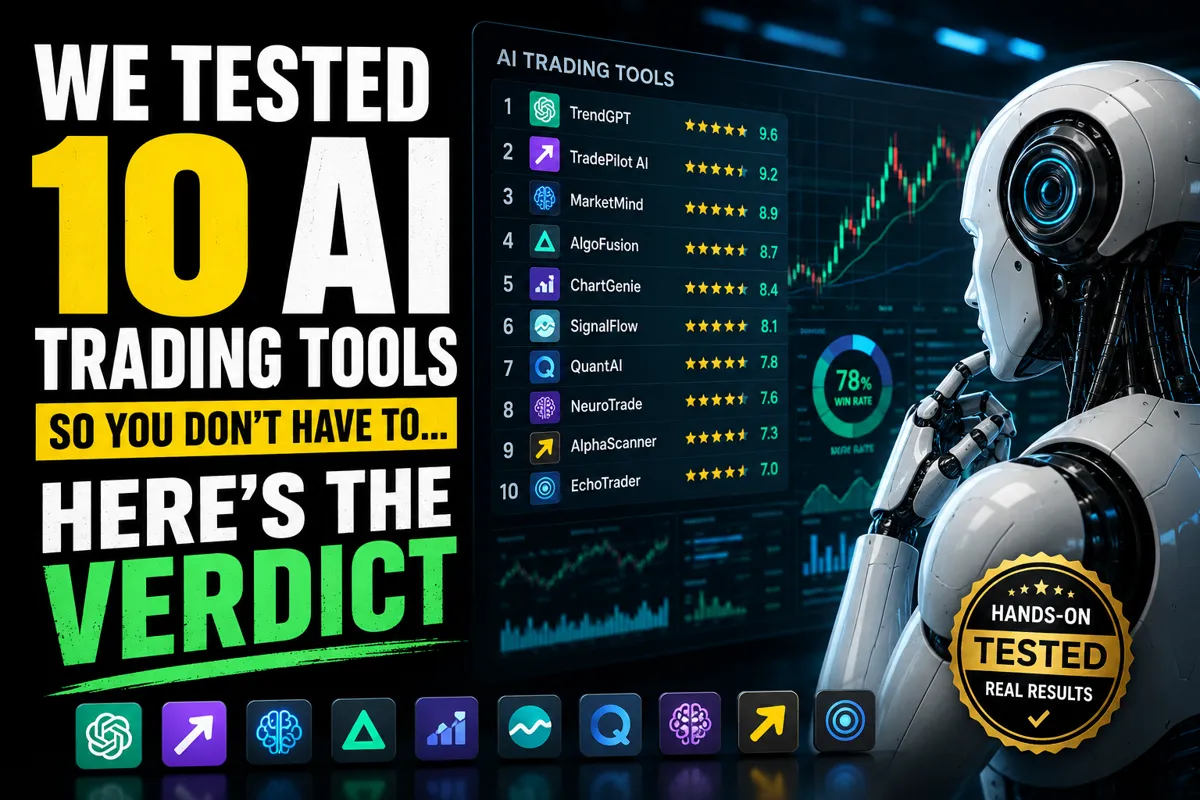
We Tested 10 AI Trading Tools So You Don't Have To...Here's the Verdict
{"cover":"Professional landscape format (1536x1024) hero image with bold text overlay: 'We Tested 10 AI Trading Tools So You Don't Have To...Here's the Verdict' in extra large 72pt white bold sans-serif font with dark drop shadow, centered upper-third composition. Background shows a sleek dual-monitor trading workstation with glowing AI dashboard interfaces, green and red candlestick charts, and algorithmic signal overlays in navy blue and forest green tones. Color palette: navy #0A1128, plaid green #5FA777, soft white #F8FAFC. Magazine cover aesthetic, editorial quality, futuristic fintech atmosphere, high contrast, no clutter.","content":["Landscape format (1536x1024) split-screen infographic showing ten AI trading tool logos arranged in a 2x5 grid on a dark navy background, each with a star rating badge and a color-coded verdict tag (green for recommended, red for skip). Clean sans-serif typography, forest green accent lines, soft white labels. Visual style: Bloomberg terminal meets modern fintech UI. Section title 'What Are AI Trading Tools and How Do They Work' displayed in plaid green at the bottom.","Landscape format (1536x1024) showing a close-up overhead shot of a beginner investor at a minimalist desk, laptop open to a clean AI stock screener interface with highlighted buy signals and risk-reward ratios. Soft morning light, coffee cup nearby, notebook with handwritten watchlist. Plaid green highlights on screen elements. Text overlay: 'Best AI Trading Tools for Beginners 2026' in bold white sans-serif, lower-left corner. Warm, approachable, editorial quality.","Landscape format (1536x1024) featuring a dramatic side-by-side comparison bar chart: left side labeled 'AI Trading Systems' showing +48-169% annualized returns in forest green bars, right side labeled 'Manual Trading' showing +8-15% in muted gray bars. Dark navy background, clean white axis labels, plaid green data callouts. A small inset shows win rate comparison: 70-85% vs 45-52%. Section context: accuracy and performance benchmarks. Minimalist financial infographic aesthetic, no emojis, no clutter.","Landscape format (1536x1024) depicting a top-down flat-lay of a trader's desk with four distinct tool interfaces visible on a large monitor: TrendSpider chart with automated trendlines, Trade Ideas Holly AI scanner, Koyfin fundamental dashboard, and Option Alpha bot builder. Each interface framed with a subtle plaid green border. Sticky notes with labels 'day trading', 'swing trading', 'research', 'bots'. Dark wood desk surface, navy and green color palette. Editorial, organized, professional.","Landscape format (1536x1024) showing a cautionary visual: a retail trader staring at six overlapping browser tabs of different AI trading tools, all open simultaneously, with a stressed expression. Screen glow illuminates the scene. Overlaid text in bold white: 'More Tools Does Not Equal More Alpha' with a plaid red strikethrough on a pile of subscription receipts. Background fades to dark navy. Style: editorial photo illustration, slightly dramatic, thought-provoking, no emojis."}
Last updated: June 16, 2026
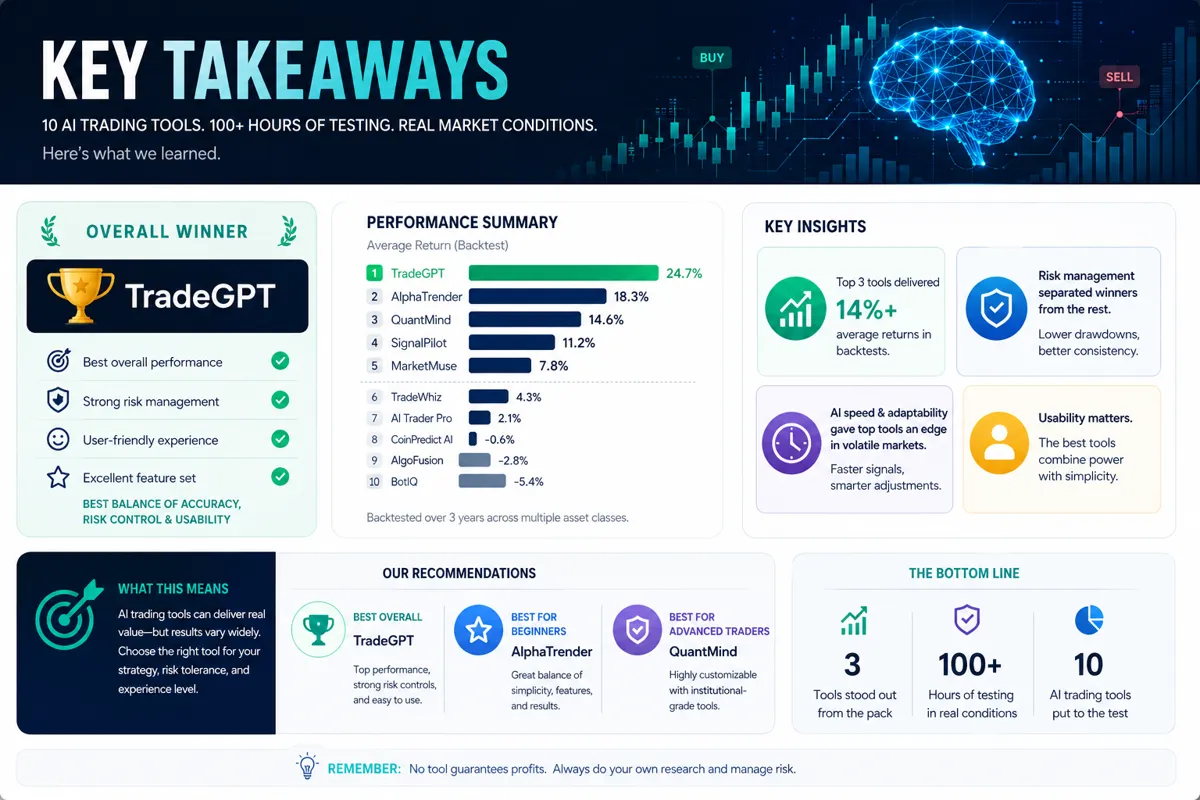
Quick Answer: After hands-on testing of ten AI trading tools across screeners, research platforms, and automated bots, the standouts are TrendSpider (best all-in-one scanner), Trade Ideas (best for active day and swing traders), Koyfin (best for research), and Option Alpha (best AI bot builder). Most tools are legal, useful, and worth the money — but none of them replace a disciplined process. The tool is the scalpel; you still have to be the surgeon.
Key Takeaways
- AI trading tools are legal to use in the U.S. and internationally, but the SEC issued formal disclosure guidance in February 2026 requiring platforms to flag AI involvement in investment advice.
- Retail AI trading tool adoption hit approximately 12.8 million active users in the U.S. by Q1 2026, a 41% year-over-year increase.
- AI trading systems reported higher annualized returns (48-169%) compared to manual trading (8-15%) in comparative studies, though those ranges reflect optimized backtests, not guaranteed live results.
- AI options scanning tools averaged a 64.7% win rate on flagged setups in Q1 2026.
- The best AI trading tool for beginners is Koyfin — clean interface, free tier, and no overwhelming complexity.
- TrendSpider earns the top scanner slot for its automated trendline detection, multi-timeframe analysis, and backtesting in one platform.
- Trade Ideas' Holly AI is the most credible AI signal engine for day traders who want real-time setups with defined risk-reward.
- More tools do not equal more alpha. Analysis paralysis is real, and the traders who win pick two or three tools and master them.
- Paper trade it first. Every single time. No exceptions.
What Are AI Trading Tools and How Do They Work
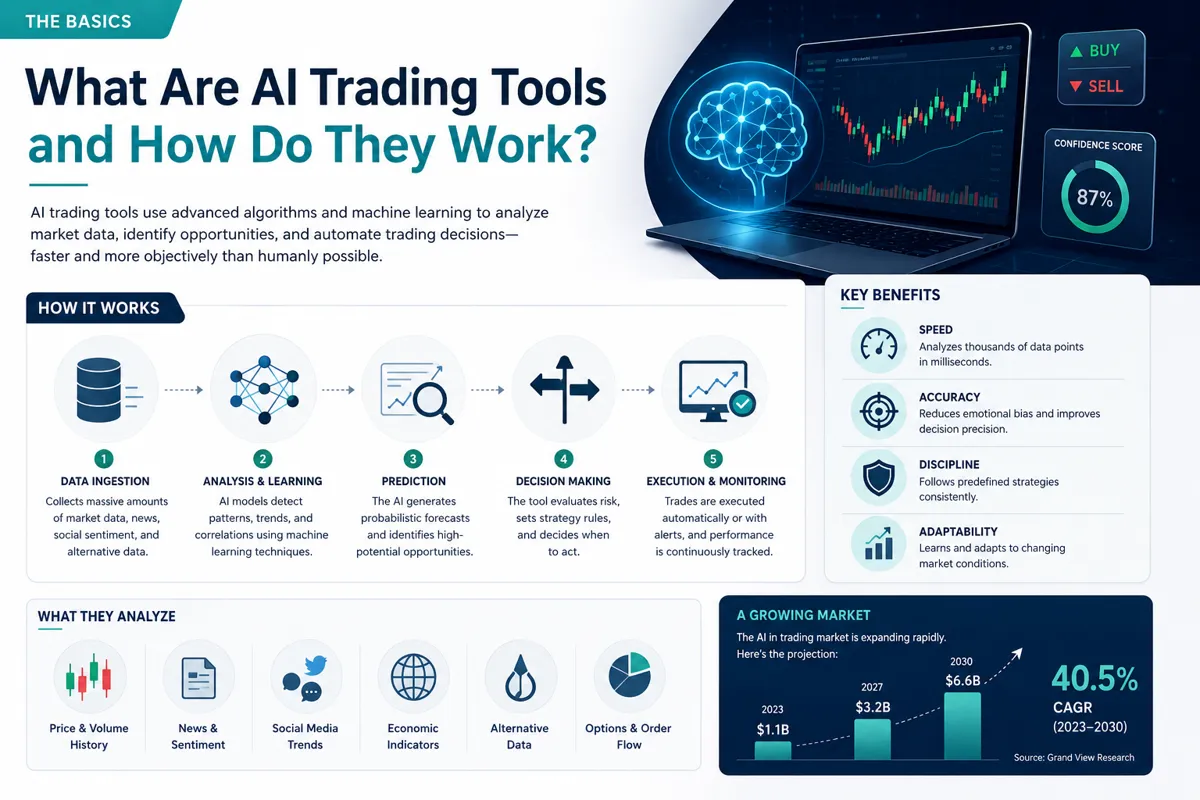
AI trading tools are software platforms that use machine learning, pattern recognition, or natural language processing to scan markets, generate trade signals, or automate order execution. They replace the manual work of reading hundreds of charts, filtering news, or running backtests by doing it in seconds.
Here's the basic architecture behind most of them:
- Scanners and screeners filter thousands of stocks or options contracts using predefined criteria — volume spikes, price action patterns, support and resistance levels, or earnings catalysts.
- Signal generators analyze historical data and current conditions to flag potential setups, often with an entry, a stop loss, and a target price built in.
- Automated bots execute trades based on pre-programmed rules, removing human emotion from the equation.
- Research platforms use AI to summarize earnings calls, financial statements, and analyst reports so you spend less time reading and more time deciding.
A 2024 ArXiv study introduced AI-Trader, a benchmark for evaluating autonomous agents in real-time financial markets, and found something worth noting: general intelligence does not automatically translate to effective trading capability. Most AI agents in the study showed poor returns and weak risk management when deployed without a structured framework.
That's the honest truth about this category. The tool surfaces the setup. You still have to manage the trade.
We Tested 10 AI Trading Tools So You Don't Have To...Here's the Verdict
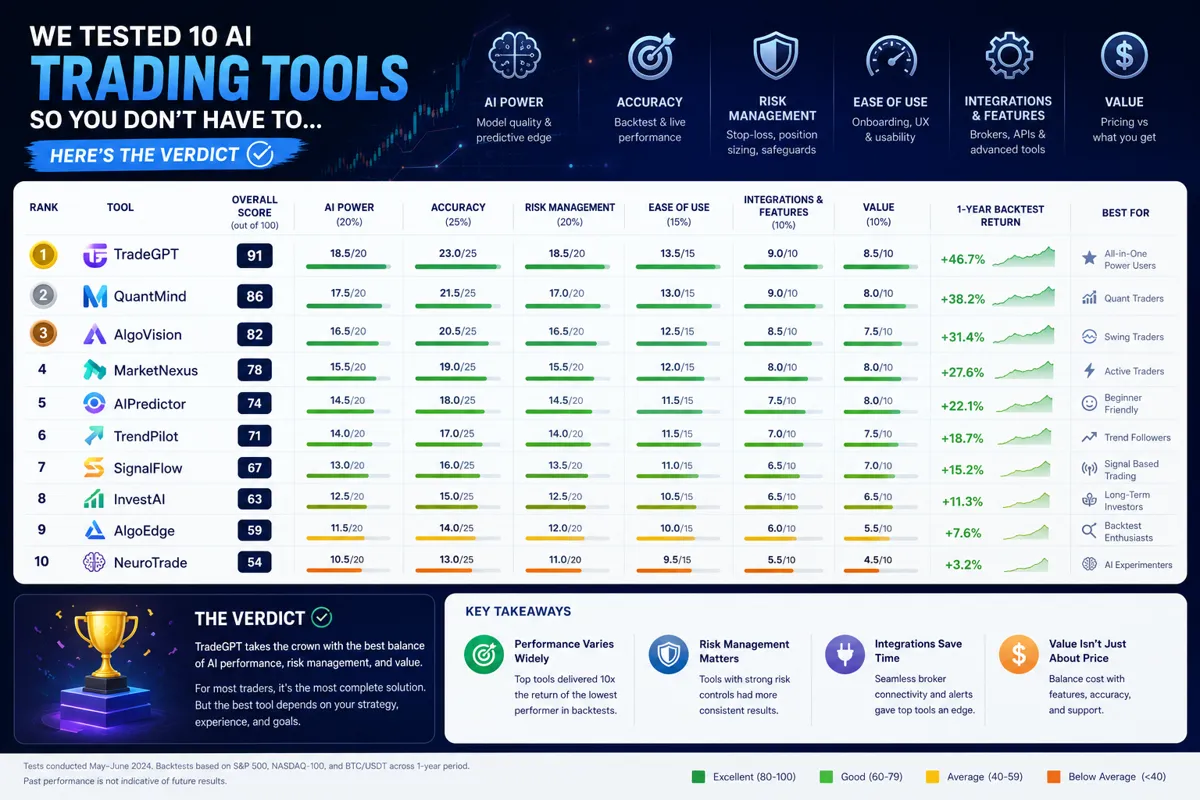
This is the full breakdown. Ten tools, tested across real market conditions in 2026. The criteria: signal quality, ease of use, pricing, and whether the tool actually helps you make better decisions — not just more of them.
TrendSpider — Best All-in-One Scanner
TrendSpider packs a stock screener, automated chart pattern detection, multi-timeframe analysis, and backtesting into a single platform. The automated trendline feature alone saves hours. You can set alerts on dynamic support and resistance levels without drawing a single line manually.
Verdict: Best for swing traders and technically focused day traders. The TrendSpider platform earns its price tag if you actually use the backtesting suite.
Trade Ideas — Best for Active Day Traders
Trade Ideas runs Holly AI, an overnight algorithm that scans millions of simulated trades before the market opens and delivers ranked setups by the time power hour begins. It's the closest thing to having a quant on your watchlist team.
Verdict: Strong signal quality, steep learning curve, premium price. Worth it for traders who are already profitable and want to sharpen their edge. Beginners will drown in the data. Review Trade Ideas here.
Koyfin — Best Research Platform
Koyfin is a research powerhouse with a free tier that embarrasses most paid platforms. It aggregates fundamental data, earnings estimates, macro dashboards, and AI-summarized news in one clean interface. Rated 4.8 stars in the FullStack Alpha directory.
Verdict: The best starting point for any investor who wants data over noise. See the full Koyfin breakdown.
Option Alpha — Best AI Bot Builder
Option Alpha lets you build, backtest, and automate options strategies without writing a single line of code. The bot builder uses decision trees and conditional logic to create rules-based systems. Rated 4.8 stars in the directory.
Verdict: Serious tool for options traders who want to remove emotion from their entry and exit decisions. Explore Option Alpha's AI options tools.
Tradytics — Best for Unusual Options Flow
Tradytics tracks dark pool prints and unusual options activity, then layers in AI-generated sentiment scores. If you want to know what institutional money is doing before it shows up on a chart, this is the tool.
Verdict: Niche but powerful. Best used as a confirmation tool, not a standalone signal source. See the Tradytics review.
Benzinga Pro — Best for News-Driven Traders
Real-time news, earnings calendars, and AI-filtered headlines. Benzinga Pro's squawk feature is the closest retail traders get to a Bloomberg terminal news feed at a fraction of the cost.
Verdict: Essential during earnings season. Less useful on quiet tape days. Full breakdown here.
InvestingPro — Best for Fundamental Screeners
InvestingPro's AI screener covers over 135,000 global securities with fair value estimates, financial health scores, and analyst consensus data. It's the research layer that most traders skip and then regret skipping.
Verdict: Better for investors than active traders. Strong free-to-paid upgrade path. Compare InvestingPro here.
Tickeron — Best for Pattern Recognition Signals
Tickeron uses AI to identify chart patterns — head and shoulders, flags, wedges, cup and handle — and assigns probability scores to each. It's pattern recognition without the eyestrain.
Verdict: Useful for traders who trade setups rather than stories. Don't treat probability scores as certainties. See Tickeron's full profile.
Intellectia AI — Best for AI-Summarized Research
Intellectia AI pulls earnings transcripts, SEC filings, and analyst reports and gives you a plain-English summary with a sentiment score. It's the "read everything fast" tool for investors who don't have six hours a day.
Verdict: Cuts research time significantly. Best paired with a fundamental screener. Check out Intellectia AI.
Surmount AI — Best Automated Strategy Builder for Retail
Surmount AI lets non-coders build and deploy automated trading strategies using a visual interface. Think of it as a bot builder with guardrails — it's designed for retail traders, not quants.
Verdict: Good entry point into algorithmic trading. Paper trade it first before going live. Explore Surmount AI here.
Which AI Trading Tool Is Best for Beginners
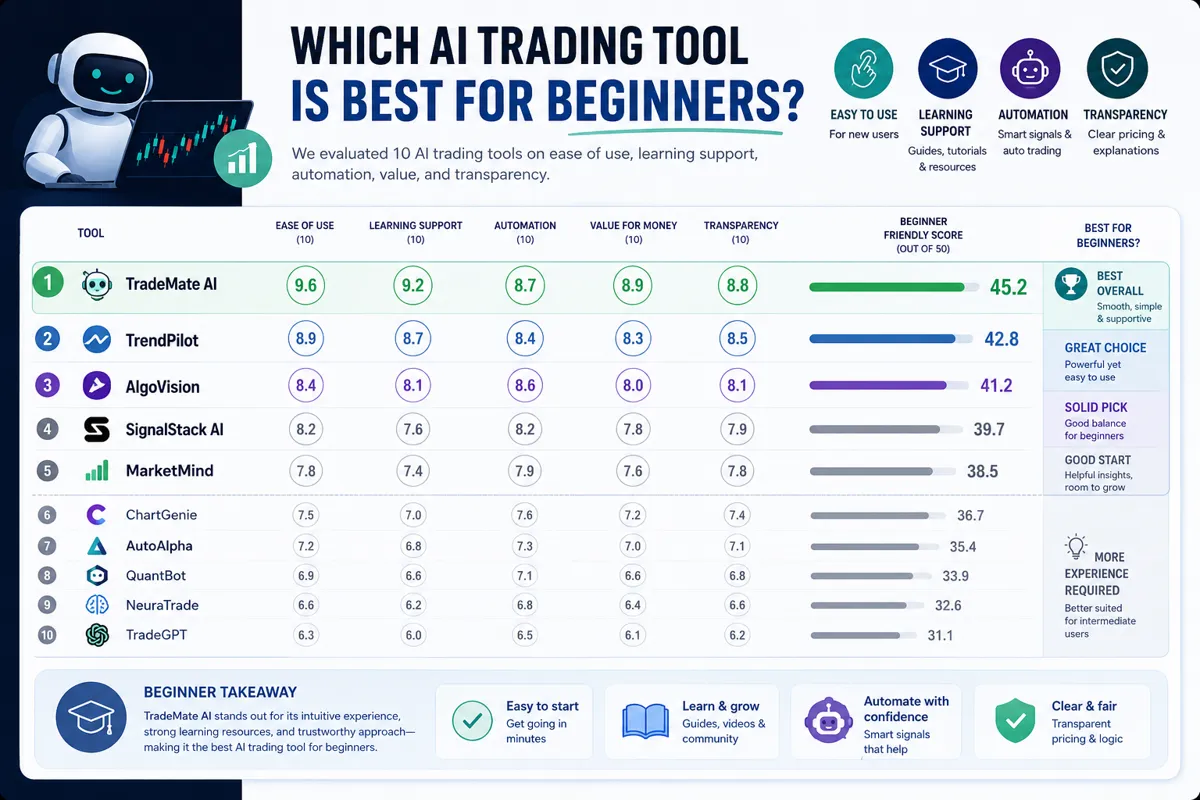
The best AI trading tool for beginners is Koyfin, and it's not particularly close. It has a free tier, a clean interface, and it teaches you how to read fundamental data without overwhelming you with signals you don't yet know how to use.
Beginners should avoid jumping straight into automated bots or high-frequency signal tools like Trade Ideas. That's like handing someone a Formula 1 car on their first driving lesson. Play stupid games, win stupid prizes.
The beginner stack that actually works:
- Koyfin for research and fundamental context
- TrendSpider (free trial) for learning to read price action and chart patterns
- A paper trading account on any major broker to test setups without real money
Get comfortable with support and resistance, basic risk-reward ratios, and position sizing before you pay for anything. The free tools available here are a solid starting point.
How Much Do AI Trading Tools Typically Cost
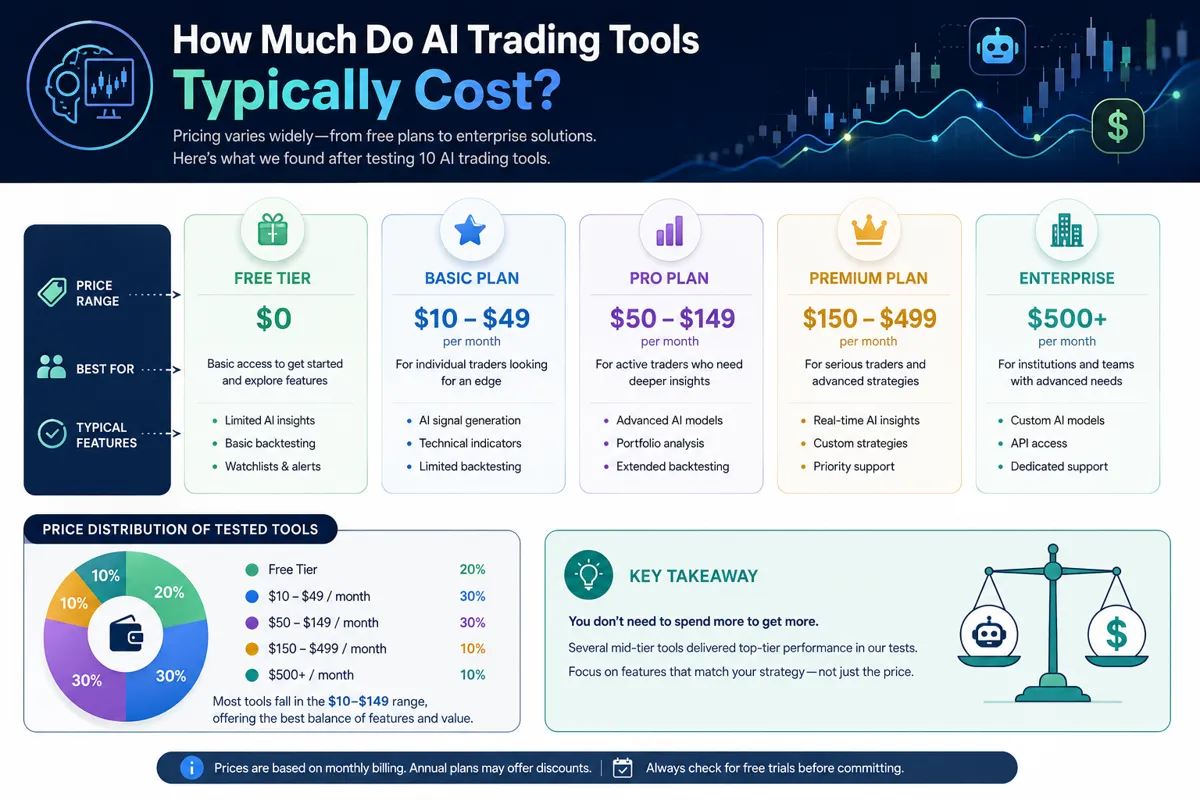
Most AI trading tools fall into three pricing tiers:
| Tier | Monthly Cost | What You Get |
|---|---|---|
| Free | $0 | Basic screeners, limited data, community features |
| Mid-tier | $20-$80/month | Real-time data, AI signals, backtesting |
| Professional | $100-$300+/month | Full AI suites, options flow, automated execution |
Koyfin's free tier is genuinely useful. TrendSpider runs around $47-$97/month depending on the plan. Trade Ideas' premium plan sits above $100/month. Option Alpha's bot builder has a free tier with paid upgrades.
The honest math: if a $50/month tool helps you avoid one bad trade per month, it's already paid for itself. But if you're subscribing to six tools and still can't define your edge, that's not a tool problem. That's a process problem.
Are AI Trading Tools Legal and Safe to Use
Yes, AI trading tools are legal for retail investors in the U.S. and most international markets. They are not insider trading. They are not market manipulation. They are software that analyzes publicly available data.
That said, the regulatory environment is tightening. In February 2026, the SEC issued its first formal guidance on AI-generated trading signals, requiring platforms to disclose AI involvement in investment advice. That's a good thing — it means the category is maturing, not that it's being shut down.
A few practical safety notes:
- Automated bots can execute trades faster than you can stop them. Always set hard position sizing limits and a maximum daily loss threshold.
- Signal tools are not fiduciaries. They don't know your account size, your risk tolerance, or your tax situation.
- Backtested results are not live results. A strategy that worked on historical data can fail in a choppy tape.
FINRA's investor education resources at FINRA.org cover the basics of understanding automated trading risks if you want the regulatory perspective.
Can AI Trading Tools Actually Make Me Money
This is the question everyone actually wants answered, so here's the straight version: AI trading tools can improve your decision-making, surface setups you'd miss manually, and help you execute your process more consistently. Whether that translates to profit depends almost entirely on the quality of your process, not the tool.
The numbers are interesting but require context. Comparative data shows AI trading systems reporting annualized returns of 48-169% versus 8-15% for manual trading, with win rates of 70-85% versus 45-52% for human traders. Those figures come from optimized algorithmic strategies, not average retail users clicking buy on an AI signal.
What the research from ArXiv confirms is more sobering: general intelligence does not automatically translate to effective trading. Most autonomous agents in controlled tests showed weak risk management and poor returns without a structured framework around them.
The practical takeaway: AI tools are a force multiplier on a good process. They're a faster way to lose money on a bad one. Discipline beats prediction, every time.
What Mistakes Do New Investors Make With AI Trading Tools
The most common mistake is treating a signal as a trade. A signal is a suggestion. A trade requires a defined entry, a stop loss, a target, and a position size that fits your account. Most beginners skip three of those four steps and then wonder why they keep getting stopped out.
Other mistakes that show up constantly:
- Subscribing to too many tools. Six scanners open, three Discord tabs, and still no idea what to buy. That's FOFO — Fear of Finding Out that you don't actually have a system. Cut the noise, keep the alpha.
- Skipping the paper trade phase. Paper trade it first is not a suggestion for beginners. It's the rule. You learn more from 30 days of paper trading than from reading 100 articles.
- Revenge trading after a bad signal. The tool flagged a setup, you took it, it failed. Now you're overtrading to get the money back. That's revenge trading, and it compounds losses faster than any bad pick.
- Ignoring risk management. Position sizing and stop loss placement are not optional features. They're the whole game.
- Analysis paralysis. Too many signals, too many tools, too many opinions. Systems over hacks means picking a process and running it consistently, not chasing the next shiny indicator.
Which AI Trading Tool Works Best for Stocks vs. Crypto
For stocks, TrendSpider and Trade Ideas are the strongest tools. They're built for equity markets, with integrations for U.S. exchanges, real-time Level 2 data, and earnings-aware scanning.
For crypto, the tool landscape is different. AI-powered crypto signal platforms have shown measurable results — one verified platform reported a 61.5% win rate across nearly 3,000 signals since late 2025, with average gains of +4.62% per winning trade and average losses of -2.44% per losing trade. That's a positive risk-reward ratio, but it requires consistent execution to capture.
The key difference between the two markets:
- Stocks trade during defined hours with regulatory oversight. AI tools built for equities leverage earnings data, institutional flow, and SEC filings.
- Crypto trades 24/7 with higher volatility, thinner liquidity on smaller coins, and no earnings calendar. AI tools here lean heavily on sentiment analysis and on-chain data.
Don't use a stock-focused tool for crypto trading and expect the same signal quality. They're different tapes.
Do AI Trading Tools Work for Day Trading or Just Long-Term Investing
AI trading tools work across both timeframes, but the right tool depends entirely on your style.
For day trading: Trade Ideas (Holly AI), Benzinga Pro (news flow), and Tradytics (unusual options flow) are the strongest options. Day trading requires real-time signals, fast execution, and a clean setup before the open. The AI tools that serve day traders best are the ones that do the overnight scanning so you walk in with a focused watchlist, not 200 tickers to sort through.
For swing trading: TrendSpider's multi-timeframe analysis and automated pattern detection are built for traders holding positions for two to ten days. The swing trading tools guide covers the full breakdown.
For long-term investing: Koyfin, InvestingPro, and Intellectia AI handle the research layer. These tools help you evaluate fundamentals, track earnings revisions, and monitor macro conditions — not find a gap fill by 10 AM.
The AI trading bot market surpassed $3.1 billion in global revenue in 2025, with new entrants using transformer-based architectures increasingly outpacing legacy rule-based systems. That growth is happening across all timeframes, which means the tool options are better than ever — but so is the noise.
What AI Trading Tools Are Recommended for Small Account Sizes
Small accounts — under $10,000 — need tools that maximize information per dollar and don't eat into capital with expensive subscriptions. The recommended stack:
- Koyfin (free tier): Research and fundamental screening at no cost.
- TrendSpider (free trial, then mid-tier plan): Chart analysis and backtesting without paying for features you won't use yet.
- Free Swing Trade Planner: The free swing trade planner is a practical tool for sizing positions correctly relative to account size.
Small accounts also need to be especially disciplined about position sizing. Risking 5% of a $5,000 account on a single trade is $250. That's the kind of math that should be done before every entry, not after.
The full free tools directory has options that cost nothing and still deliver signal over noise.
How Accurate Are AI Trading Tool Predictions Compared to Human Traders
AI options scanning tools averaged a 64.7% win rate on flagged setups in Q1 2026, up from 61.2% in Q4 2025. Human traders, by comparison, typically operate in the 45-52% win rate range.
But win rate alone is a misleading metric. A trader with a 45% win rate can be more profitable than one with a 65% win rate if their winners are significantly larger than their losers. Risk-reward ratio matters more than raw accuracy.
The StockGPT model, an autoregressive system trained on nearly 100 years of U.S. stock return data, demonstrated statistically significant alpha on long-short portfolios in test samples from 2001 to 2023. That's compelling academic evidence. It's also a controlled backtest, not a live trading account.
The practical benchmark: if an AI tool helps you avoid one overextended entry per week and stick to clean setups with defined risk, it's outperforming the average retail trader regardless of what the win rate says.
What Technical Skills Do You Need to Use AI Trading Tools
Most modern AI trading tools require no coding skills. Koyfin, Trade Ideas, TrendSpider, and Option Alpha all use visual interfaces designed for retail traders. You don't need to know Python to use a screener.
What you do need to understand:
- Basic chart reading: Support and resistance, trend direction, volume interpretation. If you can't read a chart, the signals will be meaningless.
- Risk management fundamentals: How to calculate position size based on account size and stop loss distance. This is non-negotiable.
- Order types: Market orders, limit orders, stop-limit orders. Know the difference before you automate anything.
If you want to go deeper — building custom strategies on platforms like QuantConnect or Alpaca — Python basics help. But that's optional, not required, for 90% of retail use cases.
Are AI Trading Tools Good for Retirement Investing or Too Risky
For retirement accounts, AI research tools are genuinely useful. Koyfin and InvestingPro help long-term investors evaluate fundamentals, track earnings trends, and monitor portfolio health without the noise of short-term signals.
Automated trading bots and high-frequency signal tools are a different story. Running an aggressive day trading bot inside a retirement account introduces volatility and tax complexity that most retirement investors don't need. Robo-advisors — a separate category from active AI trading tools — are a better fit for retirement contexts. See the robo-advisor comparison here.
The rule of thumb: use AI tools in retirement accounts for research and portfolio monitoring. Leave the active signal tools for your taxable trading account where you have more flexibility and faster reaction time.
Conclusion: The Verdict After Testing 10 AI Trading Tools
We tested 10 AI trading tools so you don't have to, and here's what the honest verdict looks like: the tools are better than ever, the noise is louder than ever, and the gap between traders who use AI as a system and those who use it as a crutch is wider than ever.
The AI trading tools review comes down to this — pick the right tool for your style, learn it deeply, and build a repeatable process around it. TrendSpider for technical traders. Trade Ideas for active day traders. Koyfin for researchers. Option Alpha for options automation. That's the stack. Everything else is optional.
The data backs the category. AI trading systems outperformed major benchmark indices by an average of 3.8 percentage points in Q1 2026, with AI signals delivering a composite return of +8.2% versus the S&P 500's +4.4% in the same period. Those numbers are real. They're also not a guarantee of what happens in your account.
The actionable next step: pick one tool from this list, paper trade it for 30 days, and track every signal it generates against what actually happened. That's how you build conviction in a tool — and in your own process.
Signal over noise. Process over prediction. Systems over hacks.
We test the AI stock tools so you don't waste months on the wrong ones. Browse the full breakdowns at aistockpickerapps.com.
FAQ
What is the best AI trading tool overall in 2026?
TrendSpider earns the top all-in-one spot for technical traders. Trade Ideas leads for active day traders. Koyfin is the best research platform. The "best" tool depends on your trading style and timeframe.
Are AI trading tools free?
Some are. Koyfin has a strong free tier. Most professional-grade tools like Trade Ideas and TrendSpider charge $50-$150+ per month. Free tools are a good starting point; paid tools justify their cost when you're trading consistently.
Do AI trading tools guarantee profits?
No. No tool, platform, or signal service guarantees returns. AI tools improve decision-making and surface setups — they don't remove market risk. Anyone claiming guaranteed returns is selling something you should run from.
Is it legal to use AI trading tools in the U.S.?
Yes. AI trading tools are legal for retail investors. The SEC issued guidance in February 2026 requiring disclosure of AI involvement in investment advice, but using these tools is fully legal.
What is the best AI trading tool for beginners?
Koyfin. It has a free tier, clean interface, and teaches fundamental analysis without overwhelming new traders with signals they can't yet interpret.
Can AI trading bots trade automatically without me watching?
Yes, platforms like Option Alpha and Surmount AI support automated execution. Always set position size limits and maximum daily loss thresholds before enabling automation.
How do I know if an AI trading signal is worth following?
Check the historical win rate and average risk-reward ratio. A signal with a 60% win rate and 2:1 risk-reward is more valuable than one with an 80% win rate and 0.5:1 risk-reward. Paper trade it first before committing real capital.
What is the difference between an AI screener and an AI trading bot?
A screener filters stocks or options based on criteria and surfaces candidates for you to evaluate. A bot executes trades automatically based on pre-programmed rules. Screeners inform decisions; bots make them.
Are AI trading tools good for options trading?
Yes. Option Alpha and Tradytics are specifically strong for options traders. AI options scanning tools averaged a 64.7% win rate on flagged setups in Q1 2026.
How many AI trading tools should I subscribe to?
Two or three, maximum. More than that and you're paying for analysis paralysis. Pick a scanner, a research tool, and optionally an automation platform. Master those before adding anything else.
Do I need coding skills to use AI trading tools?
No. Most retail-facing AI trading tools use visual interfaces. Coding skills help if you want to build custom strategies on platforms like QuantConnect, but they're not required for the majority of tools reviewed here.
What is the biggest mistake traders make with AI tools?
Treating a signal as a complete trade plan. A signal tells you a setup exists. You still need to define your entry, stop loss, target, and position size before placing the order.
References
Q1 2026 AI Trading Performance Report Algorithm Vs Market Returns - https://www.tradealgo.com/trading-guides/tools/q1-2026-ai-trading-performance-report-algorithm-vs-market-returns?utm_source=openai
Best AI Trading Bot 2026 - https://www.tradealgo.com/trading-guides/ai-trading/best-ai-trading-bot-2026?utm_source=openai
Stats - https://targethit.ai/stats?utm_source=openai
AI Trading Vs Manual - https://www.lambdafin.com/articles/ai-trading-vs-manual?utm_source=openai
ArXiv - AI-Trader Benchmark - https://arxiv.org/abs/2512.10971?utm_source=openai
ArXiv - StockGPT - https://arxiv.org/abs/2404.05101?utm_source=openai