The Free AI Stock Trading Bots Beginners Keep Flocking To...
Last updated: June 17, 2026
Quick Answer: Free AI stock trading bots are automated software tools that use algorithms and machine learning to scan markets, generate trade signals, and in some cases execute trades automatically. The free AI trading bots beginners keep flocking to in 2026 include Option Alpha's free automation tier, Tickeron's free signal feeds, and Composer's no-code bot builder. They're legitimate starting points, but every free tier comes with real limits, and no bot removes the need for a sound risk management process.
Key Takeaways
- Free AI trading bots can scan markets and generate signals faster than any human, but they don't guarantee profits and they don't replace judgment.
- The most-used free ai trading bots for beginners in 2026 are Option Alpha (free automation tier), Tickeron (free signals), and Composer (no-code strategy builder with a free tier).
- Every free tier has hard limits: restricted trade frequency, delayed data, capped backtesting, or paywalled features that matter most.
- Free vs paid ai trading bots is a real tradeoff — free tools teach you the mechanics; paid tools give you the edge data.
- The biggest beginner mistake isn't choosing the wrong bot. It's skipping the paper trading phase and going live with real money before understanding the setup.
- AI bots are legal and regulated when used through licensed brokers, but the bot itself is not a registered investment advisor.
- Discipline beats prediction. A bot running a bad strategy still loses money — just faster and more consistently.
- Before trusting any bot with capital, run it through an expectancy calculator to see if the math actually works in your favor.
What Exactly Are AI Stock Trading Bots and How Do They Work?
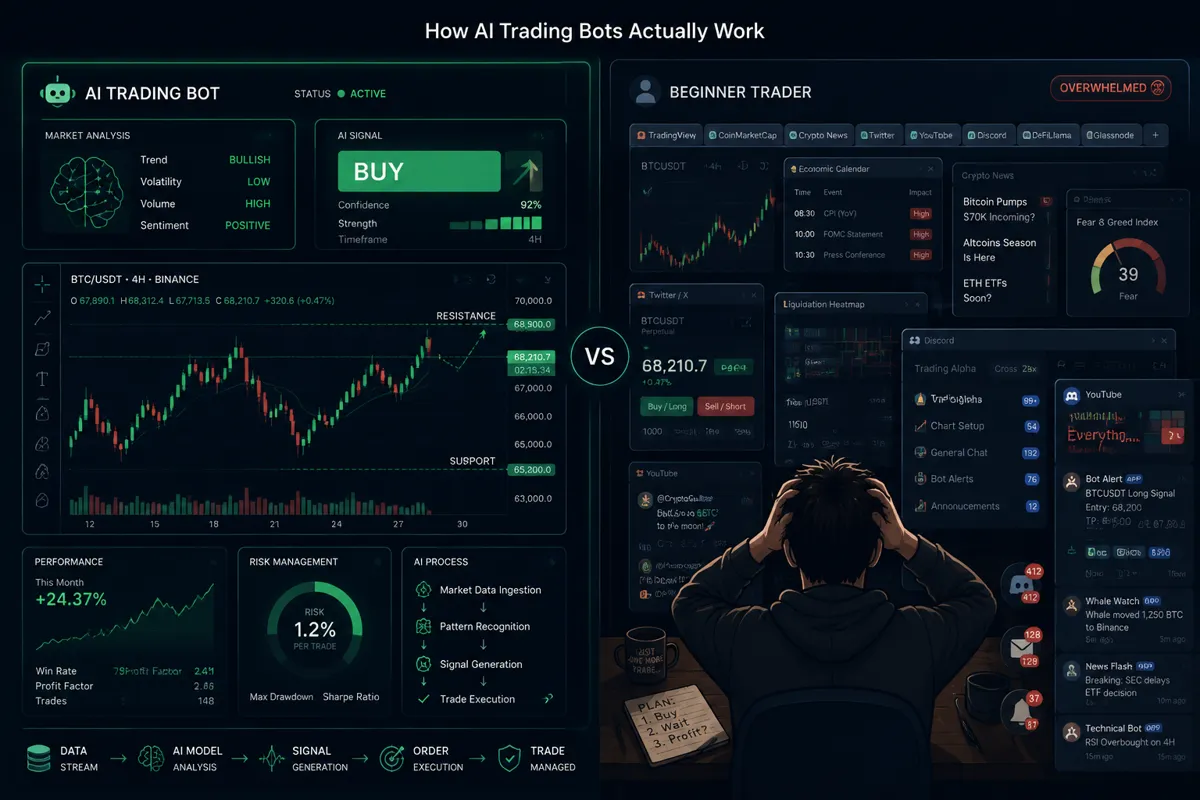
An AI stock trading bot is software that analyzes market data, applies a set of rules or a machine learning model, and either alerts you to trade opportunities or executes trades automatically on your behalf. It connects to a brokerage account via an API (a digital handshake between two software systems) and acts on price action, volume, technical indicators, or news sentiment — depending on how it's built.
Here's the simplified version: the bot watches the market so you don't have to stare at a screen all day. It spots a setup that matches its criteria, then either pings you or pulls the trigger.
What most bots are actually doing under the hood:
- Scanning hundreds or thousands of tickers for specific technical conditions (breakouts, basing patterns, support and resistance levels)
- Applying pre-set entry and exit rules based on price action or indicator crossovers
- Sizing positions based on account parameters you define
- Setting stop loss orders automatically to cap downside
What they're not doing: reading the future. A bot is only as smart as the strategy it runs. Garbage strategy in, garbage trades out. The AI label gets slapped on a lot of tools that are really just rule-based scanners with a marketing budget.
The Free AI Stock Trading Bots Beginners Keep Flocking To in 2026
The free ai trading bots beginners keep gravitating toward share one thing: low barrier to entry. No credit card, no commitment, just enough functionality to feel like you're doing something. That's both the appeal and the trap.
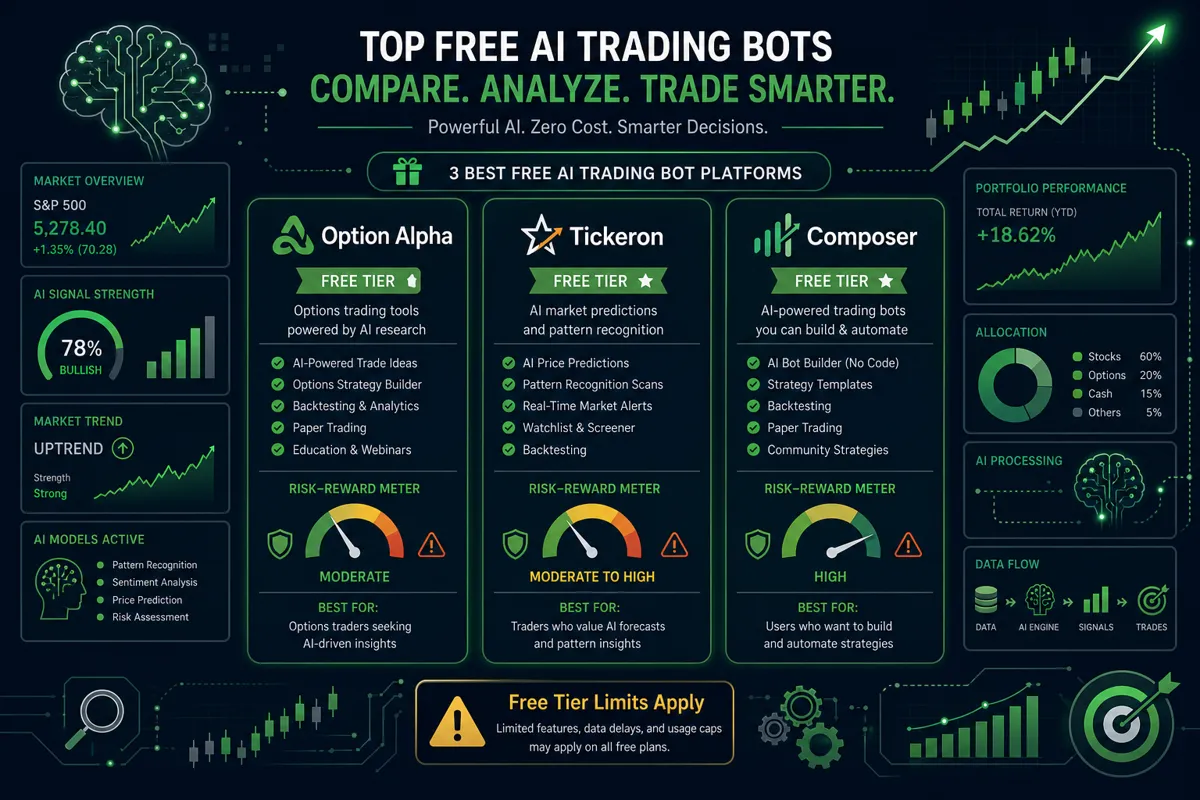
Here are the three platforms that consistently show up at the top of beginner searches — and what you actually get for free.
Option Alpha (Free Automation Tier)
Option Alpha built its reputation in options trading, but its automation platform works for stock strategies too. The free tier lets you build "bots" using a visual decision-tree interface — no coding required. You can automate simple rules like "if price crosses above the 20-day moving average and volume is above average, send an alert."
Free tier reality check: The free plan limits the number of active bots and restricts some advanced triggers. You won't get the full backtesting depth or the live auto-execution features without upgrading. It's genuinely useful for learning how automation logic works, though.
Tickeron (Free Signals)
Tickeron uses AI pattern recognition to generate trade signals across stocks, ETFs, and crypto. The free tier gives you access to a limited number of daily signals and basic AI-generated pattern alerts — things like "head and shoulders detected" or "bullish engulfing on high volume."
Free tier reality check: Signal frequency is capped and the deeper confidence scoring, backtested accuracy rates, and portfolio tools sit behind a paywall. The free signals are a taste, not a full meal. Still worth exploring as a signal-over-noise filter for your watchlist.
Composer (No-Code Bot Builder, Free Tier)
Composer lets you build automated trading strategies using a drag-and-drop interface — no Python, no API keys, no coding. You can create a strategy that rotates between ETFs based on momentum signals and backtest it against historical data. The free tier includes limited backtesting and strategy creation.
Free tier reality check: Live trading execution requires a funded brokerage connection, and some advanced data sources are paid. But for a beginner who wants to understand how systematic strategies work before committing capital, Composer's free tier is one of the better sandboxes available.
For a broader look at how these stack up against 100+ other tools, the AI trading bots comparison at AI Stock Picker Apps is worth bookmarking.
Are Free AI Trading Bots Safe, or Is This Too Good to Be True?
Free ai trading bots are not inherently dangerous, but they're not inherently safe either. The risk isn't the bot — it's what the beginner does with it.
The legitimate platforms (Option Alpha, Tickeron, Composer) are real companies with real products. They're not scams. But "free" in fintech almost always means the product is limited, the data is delayed, or you're being upsold to a paid tier.
The actual risks to know:
- Strategy risk: A bot running a flawed strategy loses money systematically. Automation just makes it faster.
- Overfitting risk: A strategy that looks great in backtesting may have been accidentally tuned to past data and falls apart on live markets. This is called overfitting, and it's the silent killer of backtested results.
- Execution risk: Free tiers often use delayed data or lack direct market access. In a fast-moving tape, that lag matters.
- Scam risk: Not every "free AI bot" you find via a social media ad is legitimate. If it promises specific returns, requires a deposit to a third party, or can't name a regulated broker it connects to — walk away. Play stupid games, win stupid prizes.
The SEC and FINRA have both issued investor alerts about unregistered trading bots and automated systems that promise guaranteed returns. Any tool making that claim is either lying or operating outside the law. Check SEC.gov before trusting any platform you haven't vetted.
Free vs Paid AI Trading Bots: What's the Real Difference?
Free ai trading bots teach you the mechanics. Paid tools give you the edge data. That's the honest summary.
| Feature | Free Tier | Paid Tier |
|---|---|---|
| Signal frequency | Limited (5-10/day typical) | Unlimited or high-volume |
| Data latency | Often 15-min delayed | Real-time |
| Backtesting depth | Basic (1-3 years) | Extended (10+ years) |
| Strategy customization | Pre-built templates | Full custom logic |
| Auto-execution | Restricted or off | Full API execution |
| Support | Community/docs | Priority or live |
The honest answer for a beginner: start free, learn the system, then upgrade only when you've proven the strategy works in a paper trading environment first. Don't pay for a tool you don't understand yet. That's not systems over hacks — that's just burning money with extra steps.
What Are the Top Mistakes Beginners Make With AI Stock Trading Bots?
The number-one mistake is treating the bot like a magic box. You plug it in, it prints money, you retire. That's not how this works. That's never been how this works.
The five mistakes that actually cost beginners money:
Skipping paper trading. Paper trading means running the bot with simulated money before using real capital. Every serious trader does this. Most beginners skip it because it feels slow. Then they get stopped out on their first three live trades and quit. Paper trade it first — no exceptions.
No stop loss defined. A bot without a stop loss is catching a falling knife on autopilot. Define your maximum loss per trade before the bot goes live. Position sizing and stop loss placement aren't optional — they're the whole game.
Overfitting the backtest. If your backtested strategy has a 90% win rate, something is wrong. Real strategies have drawdowns. If yours doesn't show any, you've accidentally built a strategy that memorized the past.
Revenge trading via automation. Yes, this is a thing. Tweaking the bot's settings after a losing streak to "make back" losses is just revenge trading with extra steps. The process doesn't change because you had a bad week.
Analysis paralysis from too many bots. Running five different free ai trading bots simultaneously, getting conflicting signals, and doing nothing — or worse, doing everything — is overtrading dressed up as research. Pick one system, test it, then decide.
The swing trade planner is a practical tool for mapping out your entry and exit rules before you hand anything to a bot.
Do AI Trading Bots Actually Outperform Human Stock Pickers?
Sometimes, in specific conditions, for specific strategies. But not reliably, not universally, and not without proper setup.
Here's the market truth: AI bots have a genuine edge in speed, consistency, and emotion removal. A bot doesn't revenge trade. It doesn't panic sell at the bottom of a dead cat bounce. It doesn't get FOFO (Fear of Finding Out) and avoid checking its positions. Those behavioral advantages are real and measurable.
Where bots underperform humans: choppy tape, low-volume conditions, and market regime changes. A bot trained on a bull market trend may get destroyed when the market shifts to a range-bound or bear environment. The trend is your friend — until it isn't, and the bot doesn't know the difference.
The honest take: AI bots are tools for executing a human-designed strategy with consistency. They don't replace the strategy. They don't replace risk management. They don't replace the need to understand what you're trading and why. Discipline beats prediction, and that applies to bots too.
For a deeper look at how AI prediction tools actually perform, the AI prediction tools breakdown is worth reading before you commit to any platform.
Can AI Trading Bots Work for Day Trading or Just Long-Term Investing?
Free ai trading bots can technically work for both, but the free tier limitations make day trading with them genuinely difficult.
Day trading requires real-time data, fast execution, and tight risk management around power hour (the first and last hour of the trading session, when volume and volatility spike). Most free tiers use delayed data — even a 15-minute delay is catastrophic for intraday trades. A gap fill that resolves in 10 minutes is ancient history by the time a free-tier bot sees it.
For longer-term swing trading and investing strategies, free bots work much better. A weekly momentum rotation strategy or a simple moving average crossover system doesn't need millisecond execution. The signal quality matters more than speed.
Choose free bots for: swing trading, ETF rotation, long-term signal monitoring, learning automation logic.
Upgrade to paid for: day trading, options flow, real-time scanning, low float momentum plays.
The day trading tools guide and the swing trading resources both break down which tools actually fit each style.
What Trading Platforms Integrate the Most Reliable AI Stock Tools?
The platforms with the most reliable AI integrations in 2026 are TradingView (charting and strategy alerts), Alpaca (commission-free API trading for automated bots), Interactive Brokers (institutional-grade execution with API access), and Webull (beginner-friendly with built-in screeners).
Composer connects directly to Alpaca for automated execution. Option Alpha has its own brokerage integration. Tickeron works as a signal layer that you act on manually or connect to a supported broker.
For a side-by-side look at AI trading platforms and how they compare on execution quality, data reliability, and free tier depth, the full comparison covers over 100 tools in one place.
Are AI Trading Bots Legal and Regulated?
Yes, using AI trading bots is legal for retail investors in the United States. The bots themselves aren't regulated — but the brokers they connect to are. FINRA and the SEC regulate the brokerage layer, which means your capital is held in a regulated account even if the bot running on top of it is a third-party tool.
What's not legal: using a bot to manipulate markets, front-run orders, or engage in wash trading (buying and selling the same security to create artificial volume). Those are violations regardless of whether a human or a bot executes them.
The gray area: if a bot provider is giving you personalized investment advice without being a registered investment advisor (RIA), that's a regulatory problem on their end. Most legitimate platforms explicitly state they're tools, not advisors. Read the terms of service before connecting any bot to a live account.
What Technical Skills Do You Actually Need to Use a Free AI Trading Bot?
For the three platforms covered here, the honest answer is: almost none to start. Option Alpha, Tickeron, and Composer are all built for non-coders. No Python. No API configuration from scratch. No command line.
What you do need to understand:
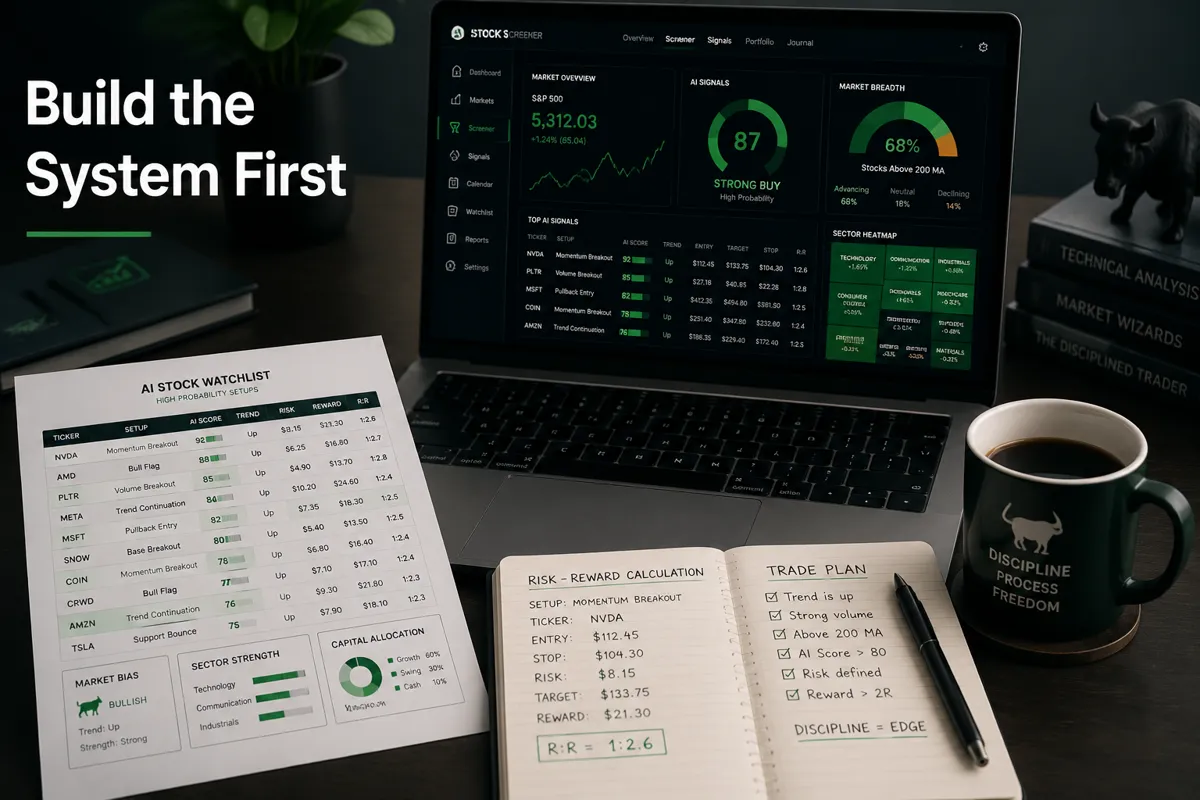
- Basic chart reading: support and resistance, trend direction, volume patterns. If a bot signals a breakout and you don't know what a breakout looks like, you can't evaluate whether the signal makes sense.
- Risk-reward basics: knowing that a 1:2 risk-reward ratio means you risk $1 to make $2, and why that math matters over a large sample of trades.
- Position sizing: how much of your account to put into any single trade. The expectancy calculator handles this math for you.
- How to read a backtest: win rate, average win vs. average loss, maximum drawdown. These three numbers tell you most of what you need to know about whether a strategy is viable.
If you want to go deeper — building custom bots, writing strategies in Python, connecting to raw market data APIs — that's a separate skill set. But it's not required to use the free tools covered here effectively.
FAQ
What are the best free AI trading bots for beginners in 2026?
Option Alpha's free automation tier, Tickeron's free signal feed, and Composer's no-code strategy builder are the most beginner-accessible free ai trading bots available in 2026. Each has meaningful free-tier limits, but all three are legitimate platforms for learning automated trading logic.
Can I make money with a free AI trading bot?
Possibly, but there's no guarantee. A free bot running a sound strategy with proper risk management can generate positive returns. A free bot running a bad strategy loses money consistently. The bot is neutral — the strategy and risk management determine the outcome.
How do free AI trading bots make money if they're free?
They convert free users to paid subscribers. The free tier is a product demo. The real features — real-time data, unlimited signals, full backtesting, live auto-execution — sit behind a monthly subscription. You're the lead, not the customer, until you upgrade.
Are free AI trading bots safe to connect to my brokerage account?
Legitimate platforms like Option Alpha and Composer use standard OAuth or API key connections through regulated brokers. They don't hold your funds — your broker does. Always use a dedicated API key with trade-only permissions (not withdrawal permissions) when connecting any third-party tool.
What's the difference between a free AI trading bot and a paid one?
Data quality, signal frequency, execution speed, and backtesting depth. Free tiers are capped versions of paid products. They're useful for learning; they're not optimized for live trading at scale.
Do I need to know how to code to use these bots?
No. Option Alpha, Tickeron, and Composer are all no-code platforms. Basic market knowledge matters more than programming skills for using these tools effectively.
Can AI trading bots handle earnings season volatility?
Most bots struggle during earnings season because price action becomes unpredictable and gaps are common. Many experienced traders turn off or reduce bot exposure around major earnings announcements. A bot doesn't know a company is reporting after the bell — you have to manage that context manually.
Is paper trading available on free tiers?
Composer and Option Alpha both support simulated or paper trading modes. Always use paper trading to validate a strategy before going live with real capital.
What's the minimum account size to use an AI trading bot?
There's no universal minimum for the bots themselves, but pattern day trader rules in the U.S. require a $25,000 minimum for accounts making more than three day trades in a five-day period. For swing trading strategies, smaller accounts can use these tools without that restriction.
Are there free AI bots for stocks specifically, not just crypto?
Yes. Tickeron and Composer both focus heavily on equities. Option Alpha is options-focused but works with stock strategies. Most crypto-first bots (3Commas, for example) have separate stock-focused features or are crypto-only.
Conclusion: Build the System Before You Trust the Bot
The free AI stock trading bots beginners keep flocking to are real tools with real utility. They're not scams, they're not magic, and they're not a substitute for understanding what you're doing with your money.
Here's what to actually do with this information:
- Pick one platform — Option Alpha, Tickeron, or Composer — and spend two weeks learning how it generates signals before connecting it to a live account.
- Paper trade it first. Run the strategy in simulation mode for at least 20-30 trades. Check the win rate, average win, average loss, and maximum drawdown.
- Run your numbers through the expectancy calculator to confirm the math works before risking real capital.
- Define your stop loss and position size before every trade the bot flags. The bot finds the setup; you manage the risk.
- Upgrade only when you've outgrown the free tier — not because a sales email scared you into it.
Cut the noise, keep the alpha. A bot running a disciplined system beats a human making emotional decisions every single time. But the system has to be sound first.
We test the AI stock tools so you don't waste months on the wrong ones. Browse the full breakdowns at aistockpickerapps.com.