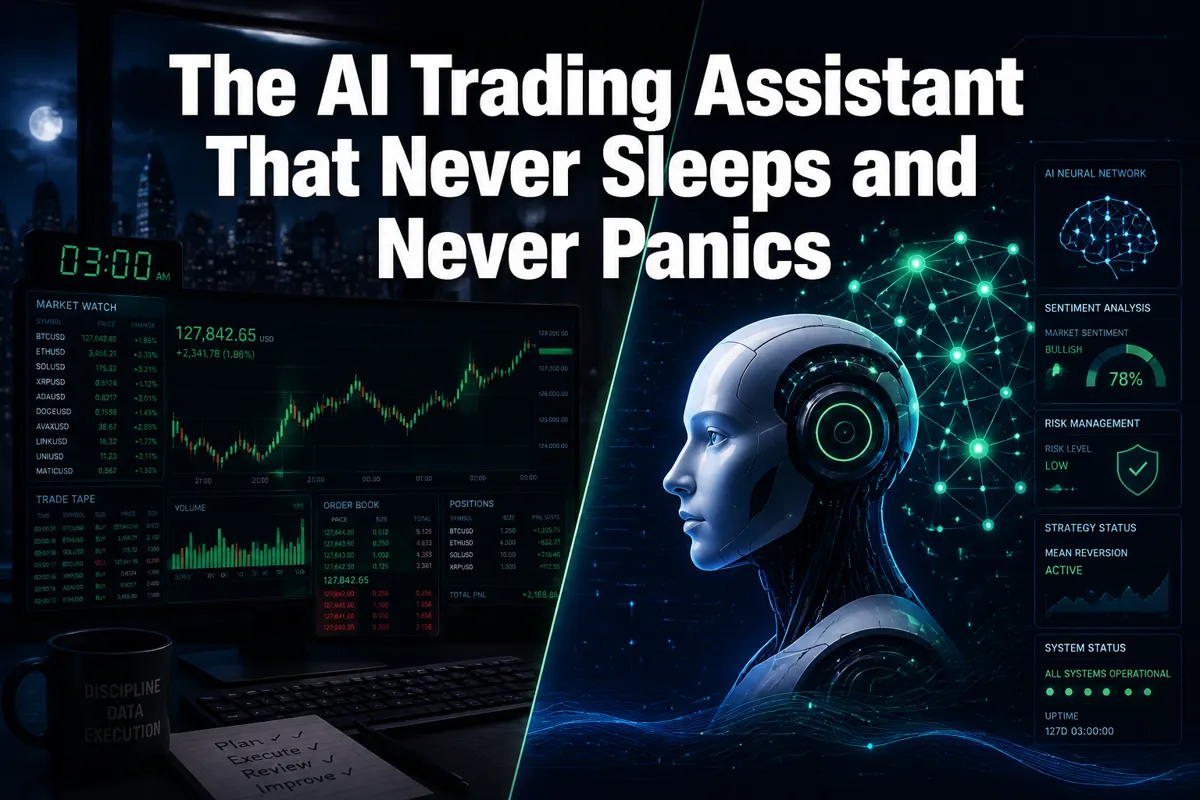
The AI Trading Assistant That Never Sleeps and Never Panics
Last updated: June 16, 2026
Quick Answer: An AI trading assistant is software that monitors markets, scans for setups, and generates trade signals or executes trades automatically, around the clock, without emotional interference. Unlike a human trader who needs sleep, takes breaks, and occasionally revenge-trades after a bad morning, the AI trading assistant that never sleeps and never panics processes data continuously and applies the same rules every single time. It won't chase a gap-up at 9:35 AM because it "feels right," and it won't freeze when a position goes against it.
Key Takeaways
- An AI trading assistant monitors markets 24/7, applying consistent rules without fatigue, fear, or greed
- Costs range from free basic tiers to $200+ per month for professional-grade platforms; most serious tools fall between $30 and $100 per month
- AI assistants don't replace your trading system — they execute it faster and more consistently than you can
- Beginners benefit most from AI tools that explain their signals, not just fire them; black-box outputs are dangerous without context
- The biggest risk isn't the AI making a bad call — it's the trader overriding the system when emotions kick in
- No coding skills are required for most retail-facing AI trading tools in 2026
- AI handles equities, ETFs, crypto, options, and futures — but performance varies significantly by asset class and market condition
- The most common mistake is treating AI trade alerts as guaranteed signals rather than probabilistic inputs to a larger process
What Exactly Is an AI Trading Assistant?
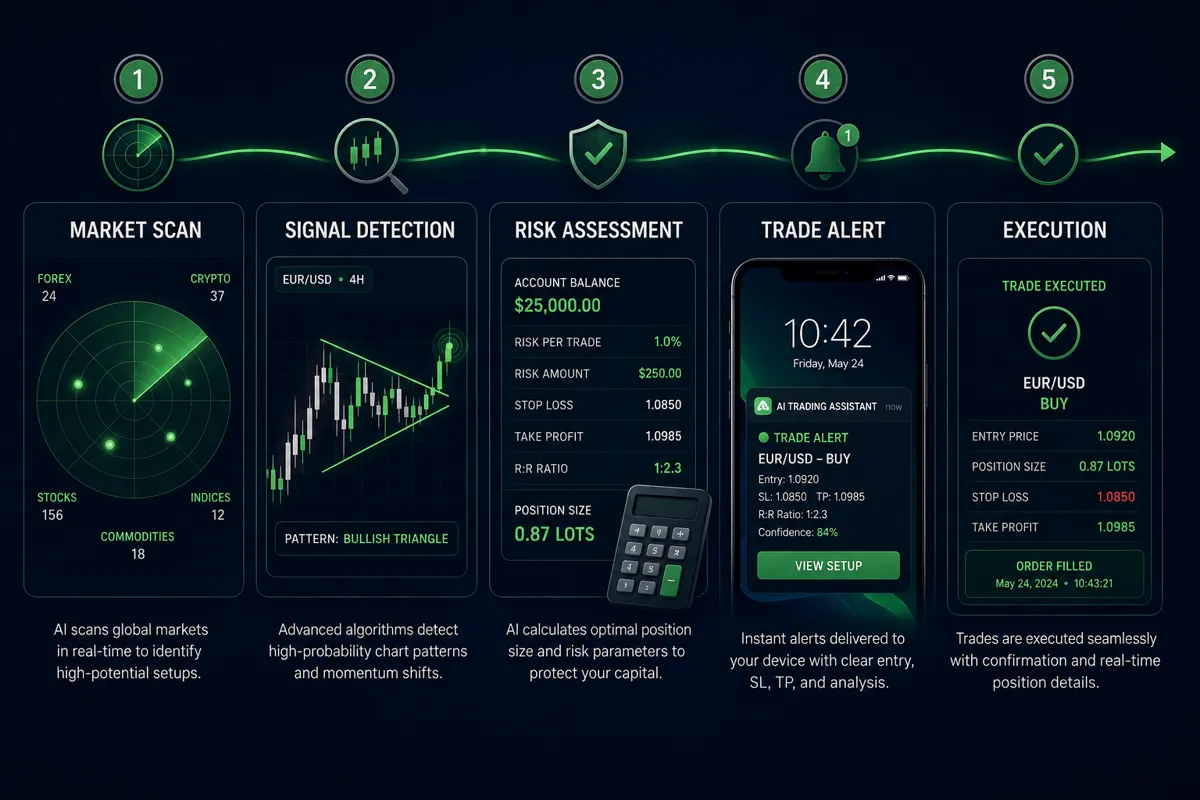
An AI trading assistant is a software system that uses machine learning, natural language processing, or rule-based algorithms to analyze market data, identify trading opportunities, and either alert you or execute trades on your behalf. Think of it as a research analyst, scanner, and risk manager rolled into one, running continuously without a lunch break or a bad mood.
The category is broad. At one end, you have conversational tools like Magnifi, where you ask plain-English investing questions and get data-driven answers — closer to a ChatGPT trading assistant than an autonomous bot. At the other end, you have fully automated systems like those built on platforms such as Wundertrading or 3Commas, which connect to your broker and execute trades based on pre-set conditions without any manual input.
In between those extremes sit the majority of retail-facing tools: AI-powered scanners that surface setups, sentiment analyzers that read news flow, and copilot-style platforms that flag entries and exits while leaving the final decision to you.
The key distinction: an AI trading assistant processes information at a scale and speed no human can match. It's scanning hundreds or thousands of tickers simultaneously, checking price action against historical patterns, and filtering for clean setups — all while you're asleep or doing literally anything else.
The AI Trading Assistant That Never Sleeps and Never Panics: Why This Actually Matters
Most retail traders don't lose money because they picked the wrong stock. They lose money because they made the right call and then panicked out of it at the worst possible moment. Or they revenge-traded after a stop-out. Or they held a loser too long because selling it would make the loss "real."
That's the human condition in markets. And it's expensive.
The AI trading assistant that never sleeps and never panics solves exactly this problem — not by being smarter than you, but by being more consistent than you. It applies the same entry criteria at 2 PM on a Tuesday as it does at 3 AM on a Sunday. It doesn't get FOFO (fear of finding out) when a position starts moving against it. It doesn't overtrade after a losing streak trying to "make it back."
Platforms like Trade Ideas, which uses its Holly AI engine as a real-time trading copilot, scan the market continuously and surface setups based on historical pattern recognition. Holly doesn't care that the broader market is choppy or that some macro pundit scared everyone on TV this morning. It's looking for the setup, evaluating the risk-reward, and flagging what qualifies.
That's signal over noise in practice. Not philosophy — actual mechanics.
The practical takeaway: the value of an AI trading assistant isn't that it predicts the future. It's that it removes the psychological tax that human decision-making adds to every trade. Discipline beats prediction, and AI is structurally more disciplined than any human operating under stress.
Is an AI Trading Assistant Better Than a Human Trader?
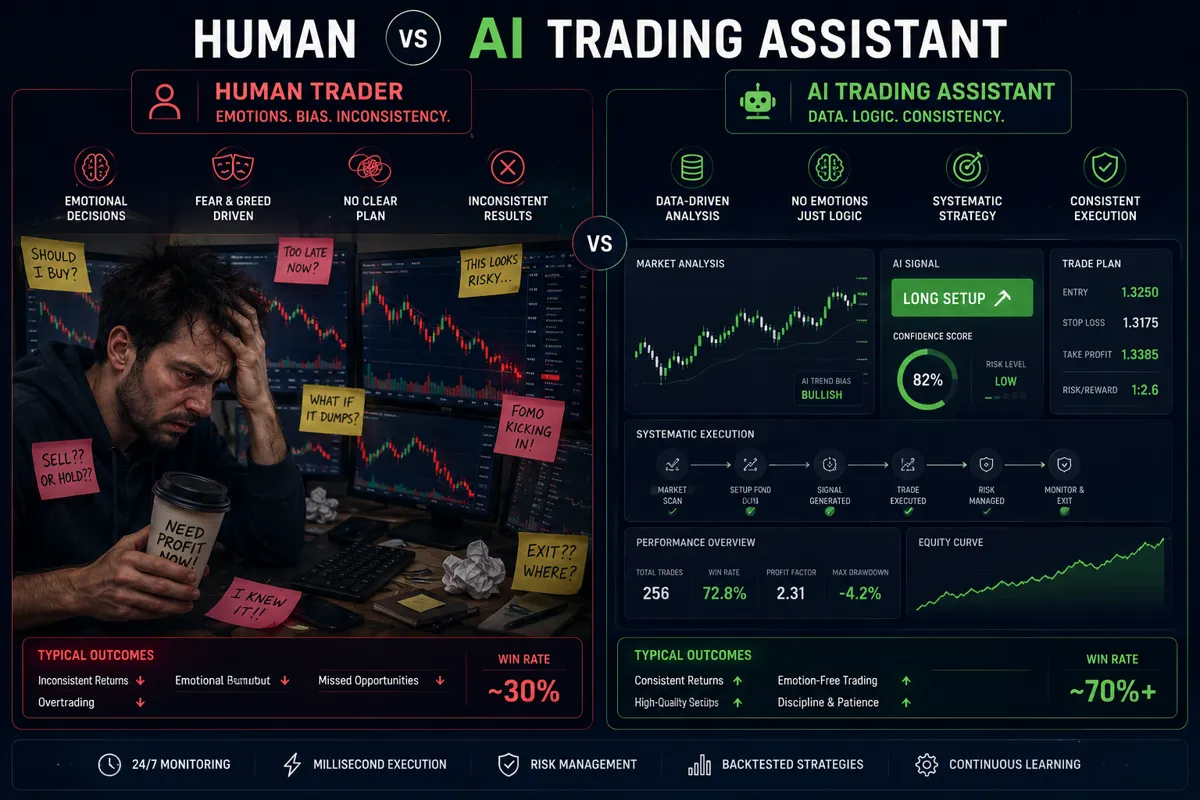
For specific, well-defined tasks — scanning for setups, monitoring positions, applying consistent risk rules — AI outperforms humans reliably. For judgment calls that require contextual understanding of unusual market conditions, experienced human traders still hold an edge.
This isn't a binary competition. The traders who use AI tools most effectively treat them as a force multiplier, not a replacement. The AI handles the mechanical, repetitive, high-volume work. The human provides the strategic overlay: which market environment are we in, what's the macro backdrop, does this setup make sense given what earnings season is doing right now?
Think of it like GPS navigation. GPS is better than your memory at finding the fastest route. But if there's a road closure the map hasn't updated yet, you still need to look out the window.
Where AI clearly wins:
- Scanning hundreds of tickers for specific technical patterns simultaneously
- Monitoring open positions and triggering stop losses without hesitation
- Processing news sentiment across thousands of sources in seconds
- Backtesting a strategy against years of historical data in minutes
- Executing trades at the exact moment conditions are met, without the hesitation that costs traders entry price
Where human judgment still matters:
- Reading the tape in genuinely unprecedented market conditions
- Assessing whether a setup makes sense given the broader macro environment
- Deciding when to pause a strategy because the market structure has changed
- Interpreting qualitative information that isn't yet in the data
The honest answer: for most retail traders, the AI trading assistant wins on consistency, and consistency is what actually drives long-term results.
Can AI Trading Tools Work for Beginners, or Just Pros?
AI trading tools work for beginners — but only the right kind of tools, used the right way. Beginners who plug into a fully automated trading bot on day one without understanding what it's doing are playing stupid games. They will win stupid prizes.
The best AI tools for beginners are the ones that explain their signals. Intellectia AI and Zen Ratings are examples of platforms that surface actionable insights while showing you the reasoning behind them. That's educational as much as it is operational.
For beginners, the recommended path is:
- Start with an AI research tool, not an automated bot
- Use it to build your watchlist and understand why certain setups qualify
- Paper trade it first — run the signals in a simulated account before real money goes in
- Graduate to semi-automated tools once you understand the logic well enough to know when the AI is wrong
Conversational tools like Magnifi (which functions as an AI assistant for investing questions) let beginners ask plain-English questions and get data-backed answers. That's a better starting point than a black-box signal generator that fires alerts with no context.
The key principle: beginners need AI tools that build their thinking, not just their trade count. More trades without more understanding is just overtrading with extra steps.
How Much Does an AI Trading Assistant Cost?
AI trading assistant pricing in 2026 ranges from free to several hundred dollars per month, depending on the tool's depth and automation level.
| Tier | Price Range | What You Get |
|---|---|---|
| Free / Freemium | $0 | Basic scanners, limited signals, delayed data |
| Entry-level | $15 to $50/month | Real-time alerts, AI screening, basic automation |
| Mid-range | $50 to $150/month | Advanced pattern recognition, backtesting, copilot features |
| Professional | $150 to $300+/month | Full automation, multi-asset coverage, API access |
Tools like TradingView offer robust charting and AI-assisted analysis starting around $15 per month. Trade Ideas, with its Holly AI engine, sits in the $150 to $200 per month range for the full suite. Magnifi operates on a subscription model with a free tier for basic queries.
Crypto-focused platforms like those built on the Neyro autonomous agent framework, which markets itself explicitly as an AI system that never sleeps, tend to price on a performance or subscription basis.
The honest cost calculation isn't just the subscription fee. It's the subscription fee versus what emotional trading mistakes currently cost you per month. For most active traders, even a $100/month tool pays for itself if it prevents two or three bad revenge trades.
What Are the Biggest Risks of Using AI for Stock Trading?
The biggest risks of using AI for stock trading are over-reliance, strategy mismatch, and the false confidence that comes from automation.
Over-reliance is the most dangerous. Traders who treat AI signals as guaranteed outcomes stop thinking critically. The AI is a probabilistic tool operating on historical patterns. When market conditions shift — a liquidity crisis, a black swan event, a sector rotation nobody saw coming — the AI's historical training becomes less relevant. The trader who stopped thinking is now flying blind.
Strategy mismatch happens when traders use tools designed for one market environment in a completely different one. A momentum scanner built for trending markets will fire bad signals in a choppy tape. That's not the AI failing — that's the trader not understanding the tool's operating conditions.
False confidence is subtler. Automation creates the illusion of control. A trader running a bot feels like they have a system, even if they've never stress-tested it, never defined their position sizing rules, and never decided what conditions would cause them to shut it down.
Other risks worth naming:
- Technical failures: API disconnections, broker outages, or execution errors can leave positions unmanaged
- Overfitting: AI models trained too tightly on historical data perform poorly on new data
- Regulatory risk: Automated trading strategies may face evolving regulatory scrutiny (check FINRA.org for current guidance)
- Crypto-specific risks: 24/7 markets mean 24/7 exposure; automated crypto tools need hard position limits and stop losses baked in
The fix: treat AI as one input in a larger system, not the whole system. Know what conditions the tool was designed for. Set hard limits on position sizing and maximum drawdown before you turn anything on.
Which AI Trading Platforms Are Most Reliable in 2026?
Reliability depends on what you're using the tool for. The most consistently cited platforms for retail traders in 2026 span several use cases.
For swing trading and technical analysis:
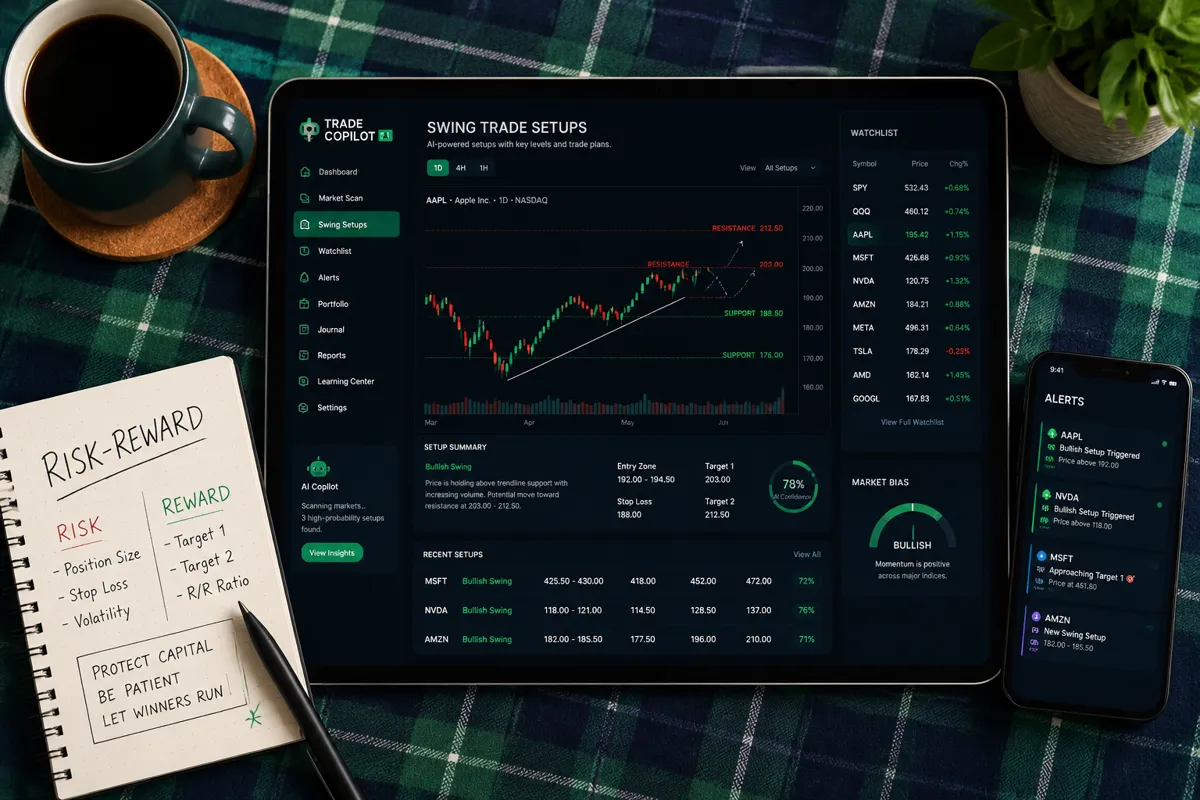
- TrendSpider — automated technical analysis, multi-timeframe pattern recognition
- TradingView — industry-standard charting with AI screening overlays
For AI-powered research and fundamental analysis:
- AlphaSense — institutional-grade AI for earnings calls, filings, and news
- Finchat — conversational AI for financial data queries
For automated trading and bots:
- Wundertrading — crypto and multi-asset bot automation
- Stockhero — no-code bot builder for retail traders
For options flow and unusual activity:
- Cheddar Flow — real-time unusual options activity scanner
- Unusual Whales — options flow with AI-assisted interpretation
For beginners wanting an AI trading copilot:
- Magnifi — conversational AI for investing questions
- Tickeron — AI-generated trade ideas with confidence ratings
You can compare 100+ tools across all these categories at aistockpickerapps.com, where each platform is rated by use case, cost, and skill level required.
How Accurate Are AI Trading Predictions Compared to Traditional Methods?
AI trading predictions are not more accurate than traditional methods in any absolute sense — and any platform claiming otherwise should be treated with serious skepticism. What AI does better is consistency, speed, and scale.
Traditional technical analysis applied by an experienced trader might identify a clean setup with 55 to 60 percent win rate on a specific pattern. An AI running the same pattern recognition across 5,000 tickers simultaneously, with consistent application of the rules, may achieve similar win rates — but it catches far more qualifying setups and never misses one because it was distracted.
The accuracy question also depends heavily on what you're measuring. AI sentiment analysis tools, for example, have shown meaningful predictive value for short-term price moves following news events. AI pattern recognition tools perform well in trending markets and poorly in choppy, low-volume conditions — which is exactly what you'd expect from any technical approach.
The honest benchmark: don't ask "is the AI accurate?" Ask "is the AI more consistent than I am at applying my own rules?" For most retail traders, the answer is yes. And consistency is what actually produces edge over time. That's process over prediction in practice.
Can an AI Trading Assistant Handle Different Market Conditions?
Most AI trading assistants are designed for specific market conditions and perform poorly when those conditions change. This is one of the least-discussed limitations of automated trading tools.
A momentum-based AI scanner built for strong trending markets will generate a lot of false signals in a sideways, low-volatility environment. A mean-reversion bot calibrated for range-bound markets will get destroyed in a strong directional trend. This isn't a flaw in the technology — it's a fundamental characteristic of any strategy, human or algorithmic.
The better AI platforms address this by offering multiple strategy modes or by incorporating regime detection — essentially, the AI identifies what kind of market environment it's operating in and adjusts its signal parameters accordingly. Edgeful and TrendSpider both incorporate elements of this kind of adaptive analysis.
For traders using AI tools, the practical takeaway is simple: know your tool's operating conditions. If the market is in a choppy tape with no clear trend, either reduce position sizing or pause the strategy. The AI won't always tell you when to stop using it. That's still your job.
What Happens If the AI Makes a Bad Trade Recommendation?
The AI making a bad recommendation is not the failure point. The failure point is having no plan for what to do when that happens.
Every AI trading tool will generate losing signals. That's not a bug — it's the nature of probabilistic systems operating in uncertain markets. The question is whether your risk management framework limits the damage from any single bad call.
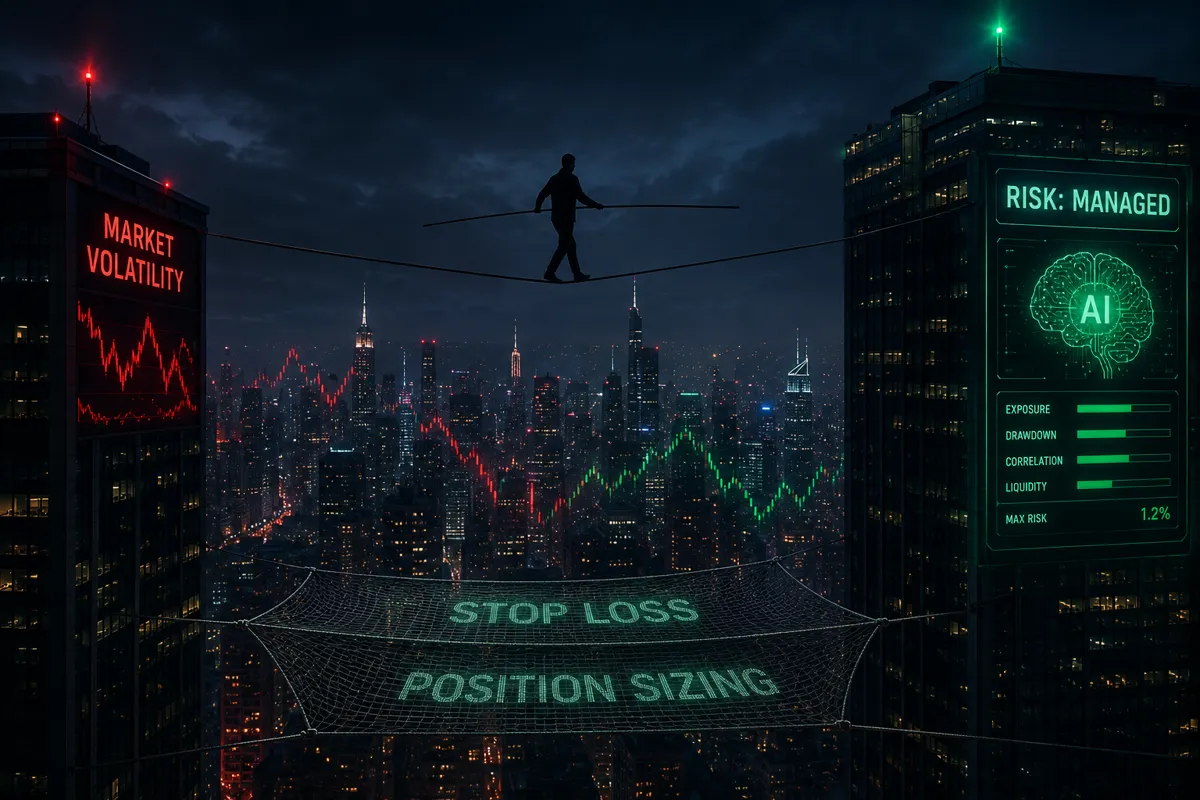
This is why stop loss placement and position sizing are non-negotiable before you act on any AI signal. If an AI copilot flags a breakout entry and you buy without defining your stop loss — the price level where you're wrong and you exit — you've turned a probabilistic tool into a prayer. Catching a falling knife hurts whether a human or an AI handed it to you.
When an AI makes a bad recommendation, the correct response is:
- Exit according to your pre-defined stop loss, not your feelings
- Review whether the signal failed because of a flaw in the AI's logic or because of an unpredictable market event
- Adjust position sizing if the failure reveals a systematic weakness in the tool
- Never revenge trade to "get it back"
The AI trading assistant that never sleeps and never panics still needs a human who has defined the rules for being wrong. That's risk management, and no AI replaces it.
Do I Need Coding Skills to Use an AI Trading Assistant?
No. The vast majority of retail-facing AI trading assistants in 2026 require zero coding skills. The no-code wave hit trading tools hard over the last three years, and most platforms now offer visual interfaces, drag-and-drop strategy builders, and plain-English configuration.
Tools like Stockhero, Composer, and Wundertrading let you build and deploy automated trading strategies without writing a single line of code. Conversational tools like Magnifi and Finchat work exactly like a chat interface — you type a question, you get an answer.
Where coding becomes relevant is at the advanced end: building custom algorithms, accessing raw API data, or creating proprietary signals that no off-the-shelf tool offers. Platforms like Alpaca and Interactive Brokers provide API access for traders who want to build their own systems. But that's a different conversation from using an AI trading assistant as a retail investor.
The bottom line: if you can use a smartphone app and fill out a form, you can use most AI trading tools available today. The barrier isn't technical — it's strategic. Understanding what you're asking the AI to do, and why, matters far more than knowing how to code it.
Which Investment Types Can AI Trading Assistants Handle?
AI trading assistants cover equities, ETFs, options, crypto, and futures — but performance and tool availability vary significantly by asset class.
Equities and ETFs: The most mature AI tooling exists here. Scanners, screeners, sentiment tools, and swing trading copilots are widely available and well-tested. Swing trading tools in this category are particularly strong.
Options: AI options tools have grown significantly. Flow scanners like Cheddar Flow and Unusual Whales use AI to interpret large options orders and flag unusual activity. AI options tools are now a legitimate category with multiple reliable platforms.
Crypto: 24/7 markets are where the "never sleeps" angle matters most. Platforms like Neyro and CoTrader are built specifically for continuous crypto market monitoring. The volatility of crypto also makes automated stop losses and position limits more critical, not less.
Futures: Coverage is thinner for retail traders, but growing. Some platforms offer futures-specific scanning and signal generation, though this asset class generally requires more capital and more experience to trade safely.
The honest assessment: AI tools are strongest in liquid, data-rich markets where historical patterns have meaningful predictive value. Thinly traded assets, low-float stocks, and highly illiquid instruments are where AI pattern recognition breaks down fastest.
What Are the Common Mistakes People Make With AI Trading Tools?
The most common mistake is treating AI trade alerts as guaranteed signals rather than probabilistic inputs. The second most common mistake is buying a tool and never learning what it actually does.
Here's the full list, because this is where real money gets lost:
Mistake 1: Skipping the paper trading phase. Every AI tool should be run in simulation mode before real capital goes in. Paper trade it first — not for a week, but for a full market cycle that includes both trending and choppy conditions.
Mistake 2: No position sizing rules. The AI flags a setup. You put 40 percent of your account into it. The stop loss triggers. Now you've lost 40 percent of your account on one signal. Position sizing isn't optional — it's the whole game.
Mistake 3: Overriding the system when emotions kick in. The AI says exit. You think "it'll come back." This is revenge trading in slow motion. If you're going to override the AI consistently, you don't have a system — you have expensive noise.
Mistake 4: Using the wrong tool for the market environment. A momentum scanner in a dead market generates garbage signals. Know what conditions your tool was built for.
Mistake 5: Analysis paralysis from too many tools. Six scanners, three alert services, two Discord groups, and still no clear entry. That's not more information — that's noise wearing a data costume. Cut the noise, keep the alpha.
Mistake 6: Ignoring fees and slippage. Automated tools can generate a lot of trades. Transaction costs and slippage eat into returns, especially on smaller accounts. Run the numbers before assuming the AI's gross signals translate to net profits.
Conclusion: Build the System, Then Let It Run
The AI trading assistant that never sleeps and never panics is real, it's accessible, and it works — but only inside a framework built by a trader who understands what they're trying to accomplish.
The technology doesn't replace your process. It executes it. If your process is vague, emotional, and inconsistent, the AI will execute that vagueness at scale and at speed. Garbage in, garbage out — just faster.
Here's what to do next, in order:
- Define your trading style: swing trader, day trader, or long-term investor. Different styles need different tools.
- Identify one specific problem you want the AI to solve: scanning for setups, monitoring positions, generating research, or executing rules-based trades.
- Match a tool to that problem. Don't buy the most feature-rich platform — buy the one that solves your specific problem cleanly.
- Paper trade it for 30 days across real market conditions before committing real capital.
- Set hard risk rules — stop loss, position sizing, maximum daily loss — before you go live.
- Review performance monthly. If the tool isn't adding value, cut it. Systems over hacks means being honest about what's working.
The market doesn't care about your feelings, your intentions, or your guru's Discord alerts. It rewards process, consistency, and discipline. An AI trading assistant, used correctly, gives you more of all three.
Related Reading:
- Compare 100+ AI trading platforms to find the right tool for your style
- AI trading bots compared — automation options for every skill level
- Best AI tools for swing trading — setups, scanners, and signals
- Free AI stock tools — start here if budget is a constraint
Frequently Asked Questions
What is the best AI trading assistant for beginners in 2026?
For beginners, tools that explain their signals are better than black-box automation. Magnifi (conversational AI for investing), Tickeron (AI trade ideas with confidence ratings), and Zen Ratings (AI-powered stock scoring) are strong starting points. Paper trade any tool before using real money.
Can an AI trading assistant replace my broker?
No. AI trading assistants generate signals or execute strategies, but they connect to your existing brokerage account. They don't hold your funds or replace the broker relationship. Always verify that your chosen AI tool integrates with your broker before subscribing.
Is it legal to use AI trading bots for stocks?
Yes, for retail traders in most jurisdictions. Automated trading is legal and widely used. However, certain strategies may be subject to regulatory rules — for example, pattern day trader rules in the US apply regardless of whether trades are manual or automated. Check FINRA.org for current retail trading regulations.
How do I know if an AI trading signal is reliable?
No signal is reliable in isolation. Evaluate signals by their historical win rate, the market conditions they're designed for, and whether they align with your own technical read of the setup. A signal that makes no sense to you is a signal you shouldn't take.
What's the difference between an AI trading assistant and a trading bot?
An AI trading assistant typically provides analysis, signals, or recommendations that a human acts on. A trading bot executes trades automatically based on pre-set rules. Many platforms combine both: AI analysis that feeds into automated execution.
Can AI trading tools handle earnings season volatility?
Some can, but most standard AI scanners are calibrated for normal market conditions. Earnings season introduces gap risk and volatility spikes that can trigger stop losses on otherwise valid setups. Reduce position sizing around earnings events and check whether your tool has specific earnings-mode settings.
Do AI trading assistants work for crypto markets?
Yes, and the 24/7 nature of crypto markets is where the "never sleeps" advantage is most tangible. Platforms like Neyro and CoTrader are built specifically for continuous crypto monitoring. The same risk rules apply: hard stop losses and position limits are non-negotiable in volatile crypto environments.
How long does it take to set up an AI trading assistant?
Most retail-facing platforms can be set up in under an hour. Connecting to your broker via API typically takes 15 to 30 minutes. Building and testing a strategy takes longer — plan for at least 30 days of paper trading before going live with real capital.
What happens to my trades if the AI platform goes down?
This is a real risk. Most platforms have contingency protocols, but you should always know how to manually close positions through your broker if the AI tool becomes unavailable. Never be in a position where you can't exit a trade without the tool working.
Is a ChatGPT-style trading assistant useful for active traders?
Conversational AI tools are useful for research, explaining concepts, and generating ideas — not for real-time trade execution. Think of them as a research assistant, not a trading copilot. They're best used in the planning phase, not during active market hours.
References
Watch - https://www.youtube.com/watch?v=lW8rBQNXKWs
AI Trading Assistants: Your 24/7 Market Guardian That Never Sleeps - https://www.blog.brightcoding.dev/2026/01/19/ai-trading-assistants-your-24-7-market-guardian-that-never-sleeps
CoTrader AI - https://www.cotrader.ai
This Trader Never Sleeps and Never Takes a Break - https://thefreeportsociety.com/2025/06/24/this-trader-never-sleeps-and-never-takes-a-break/
FullStack Alpha cuts the noise so you can keep the alpha. See the AI tools, scanners, and systems we actually rate at aistockpickerapps.com.