The AI Stock News Tool That Explains Why Your Stock Just Moved...
{"cover":"Professional landscape format (1536x1024) hero image with bold text overlay: 'Why Did My Stock Just Move?' in extra large 72pt white bold sans-serif font with deep shadow effect, centered upper third. Background shows a dark navy blue trading terminal with glowing green and red candlestick charts, AI neural network nodes connecting news headlines to price action graphs, real-time data streams flowing across dual monitors. Color palette: navy #0A1128, plaid green #5FA777, soft white #F8FAFC. Magazine cover aesthetic, editorial quality, fintech atmosphere, no emojis.","content":["Landscape format (1536x1024) editorial illustration showing an AI system dissecting a stock chart: a glowing brain icon connected by data lines to newspaper headlines, earnings reports, and SEC filings on the left, with a candlestick price chart spiking on the right. Labels reading 'News Signal', 'Sentiment Score', 'Price Catalyst' float between elements. Dark navy background with green accent highlights, clean fintech UI aesthetic, no people, data-forward composition.","Landscape format (1536x1024) side-by-side comparison graphic: left panel shows a cluttered traditional financial news website with dense text blocks, banner ads, and overwhelming headlines labeled 'Old Way'; right panel shows a clean AI stock news summary interface with a single plain-English explanation card, sentiment meter, and source tags labeled 'AI Tool'. Color scheme navy and plaid green, bold sans-serif labels, high contrast, editorial infographic style, no emojis.","Landscape format (1536x1024) overhead shot of a trader's desk with a tablet displaying an AI stock news alert card in plain English, a notebook with handwritten watchlist entries, a coffee cup, and a secondary monitor showing a stock chart with a breakout pattern highlighted. Warm desk lighting against dark background, plaid green accent on the alert card UI, realistic editorial photography style, no people visible, focus on the tools and process."]
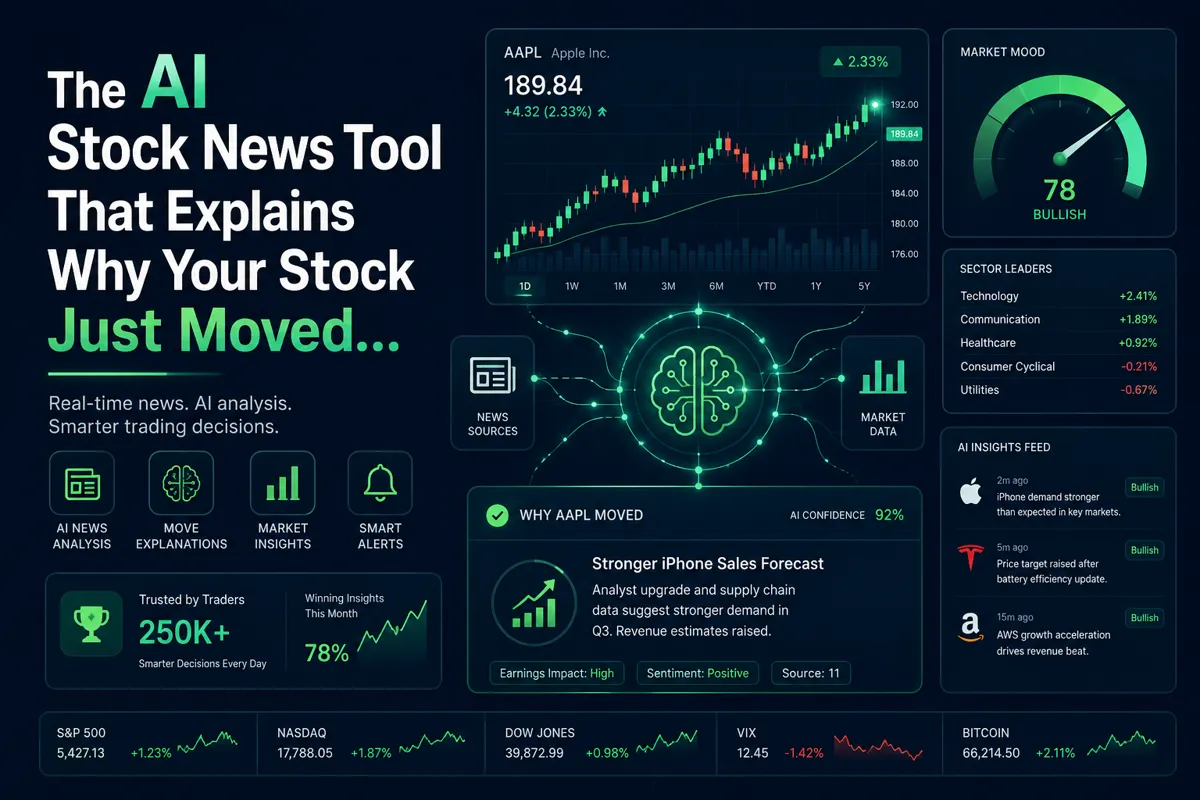
Last updated: June 17, 2026
Quick Answer
An AI stock news tool is software that monitors real-time news, earnings data, SEC filings, and market sentiment — then delivers a plain-English explanation of why a specific stock just moved. Instead of digging through six financial websites and a Discord server, you get one clear summary: what happened, which source triggered the move, and whether the catalyst is likely to last. The best tools in 2026, including AltIndex, Magnifi, and Koyfin, do this in seconds.
Key Takeaways
- An AI stock news tool translates raw market catalysts into plain-English explanations so you stop guessing why your position just moved 4% in ten minutes.
- These tools pull from earnings reports, SEC filings, analyst upgrades, macroeconomic data, and social sentiment simultaneously — something no human can do at the same speed.
- They explain past and present moves. They do not predict future price action with certainty, and any tool claiming otherwise is selling you something.
- Free versions exist, but real-time AI stock news alerts with full data coverage typically require a paid subscription.
- Beginners benefit most from the plain-language summaries; experienced traders use the same tools for faster catalyst validation.
- The biggest mistake traders make is treating an AI explanation as a trade signal. It is context, not a recommendation.
- AltIndex, Magnifi, and Koyfin are among the featured tools worth evaluating in 2026.
- Signal over noise is the goal. More data feeds do not mean better decisions.
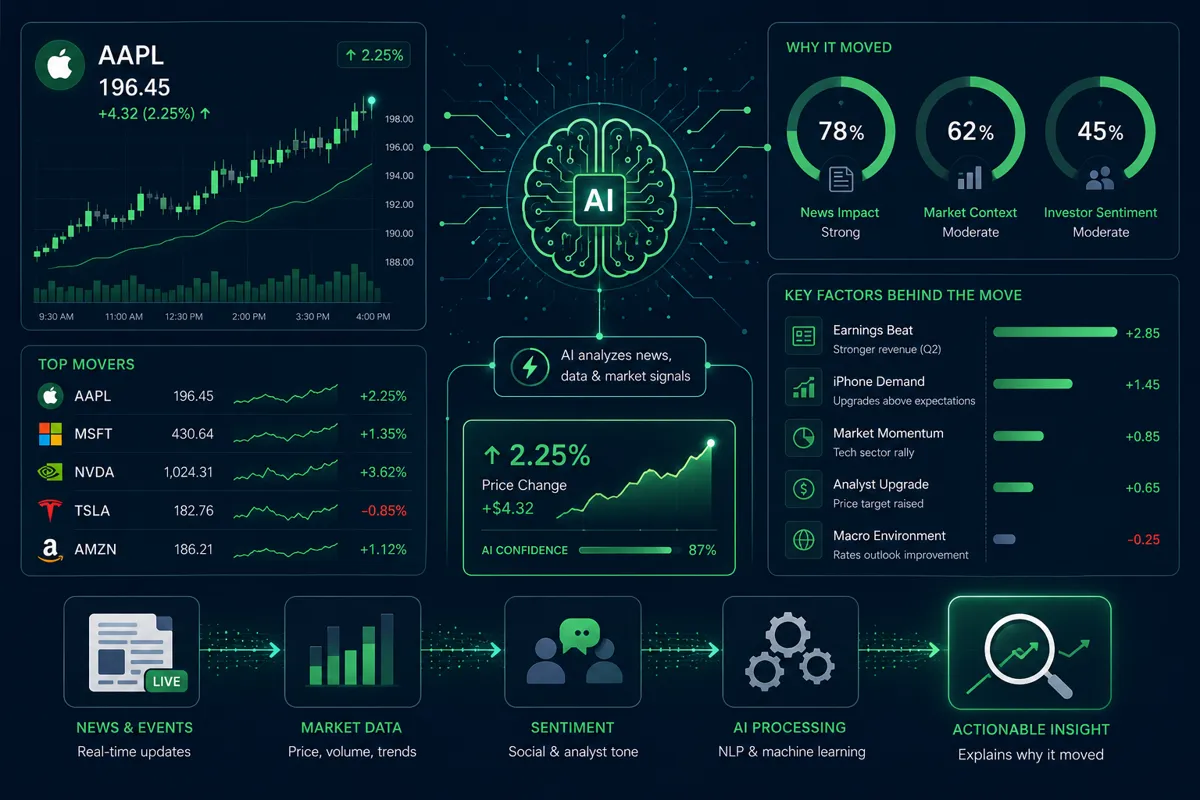
The AI Stock News Tool That Explains Why Your Stock Just Moved — And Why You Need One
Your stock just dropped 6%. You open Twitter, three news sites, and your broker app simultaneously. Fifteen minutes later you have seventeen tabs open and still no clean answer. That is not an information shortage. That is an information processing problem — and it is exactly what an AI stock news tool is built to fix.
The core job of this category of tool is simple: match price action to catalyst, then explain it in plain English.
When a stock gaps down at the open, something caused it. An earnings miss, a CEO resignation, an FDA rejection, a sector rotation triggered by a Fed comment, a short-seller report dropped at 4 AM. A good AI stock news tool surfaces that cause within seconds, ranks its likely impact, and tells you whether the move is a one-day reaction or a structural shift. That is the difference between reading the tape and staring at it.
How Does the AI Stock News Tool Actually Work?
The tool ingests multiple data streams simultaneously: real-time news wires, SEC filings (8-Ks, 10-Qs), earnings call transcripts, analyst rating changes, options flow, and social sentiment signals. Natural language processing (NLP) — the same technology behind large language models — scans those sources, identifies which ones correlate with the current price move, and generates a summary.
Think of it like a research assistant who reads everything published about your stock in the last 24 hours, highlights what matters, and hands you a three-sentence brief. Except this assistant works at machine speed and does not take lunch breaks.
Tools like AltIndex layer in sentiment scoring — they assign a positive, negative, or neutral rating to news events and track how sentiment shifts over time. Magnifi takes a different approach: it lets you ask plain-language questions ("Why did NVDA drop today?") and returns a conversational answer grounded in real data. Koyfin combines news aggregation with fundamental data so you can see the catalyst alongside the financial context in one view.
Is This Better Than Traditional Stock Analysis Websites?
For speed and clarity, yes. Traditional financial news sites like Yahoo Finance or Bloomberg give you the raw information — but they make you do the synthesis yourself. You read five articles, cross-reference the price chart, and still have to decide which headline actually moved the stock.
An AI stock news summary tool does the synthesis for you. It connects the price event to the most likely cause and presents it as a single, readable explanation. That is a fundamentally different product.
Where traditional sites still win: depth of historical data, analyst commentary, and editorial context. A seasoned financial journalist can explain the geopolitical nuance behind a defense sector move in a way that current AI tools still struggle to match.
The honest answer is that the best setup in 2026 uses both. Use the AI tool to get fast context, then go deeper with a traditional source if the trade size warrants it. Systems over hacks — this is one more tool in the process, not a replacement for thinking.
What Stocks and Markets Does It Cover?
Most AI stock news tools focus on U.S. equities listed on the NYSE and Nasdaq. Coverage of international markets varies significantly by platform.
- U.S. equities: Near-universal coverage across major tools.
- ETFs and indices: Covered by most platforms, including sector ETFs and broad market indices.
- International stocks: Partial coverage on tools like Koyfin and AltIndex, which track some European and Asian markets. Full international coverage is less common and often requires higher-tier subscriptions.
- Crypto: Some tools include crypto news sentiment, but this is a separate category with different data sources.
- Futures and forex: Rarely covered in the same depth as equities. Specialized tools handle these better.
If your watchlist includes international names, verify coverage before committing to a subscription. Do not assume global coverage just because a tool has a slick interface.
Can It Predict Future Stock Movements or Just Explain Past Changes?
This is the question that separates signal from noise — and the honest answer is: it explains past and present moves. It does not reliably predict future price action.
Any tool marketing itself as a predictive AI that tells you where a stock will go next is selling you a story. Price action is driven by the collective behavior of millions of participants, many of whom have information and speed advantages that no retail-facing tool can fully offset.
What these tools actually do well:
- Explain why a stock moved in the last hour, day, or week
- Surface emerging sentiment shifts before they become obvious
- Flag catalyst events (earnings, FDA dates, contract announcements) that could drive future volatility
- Help you assess whether a current move has a durable fundamental cause or looks like a bull trap
That last point matters. If your stock spiked 8% on a vague partnership announcement with no revenue details, an AI stock news tool can flag that the catalyst is thin. That is useful risk management context. It is not a prediction — it is information that improves your process.
Discipline beats prediction. Always.
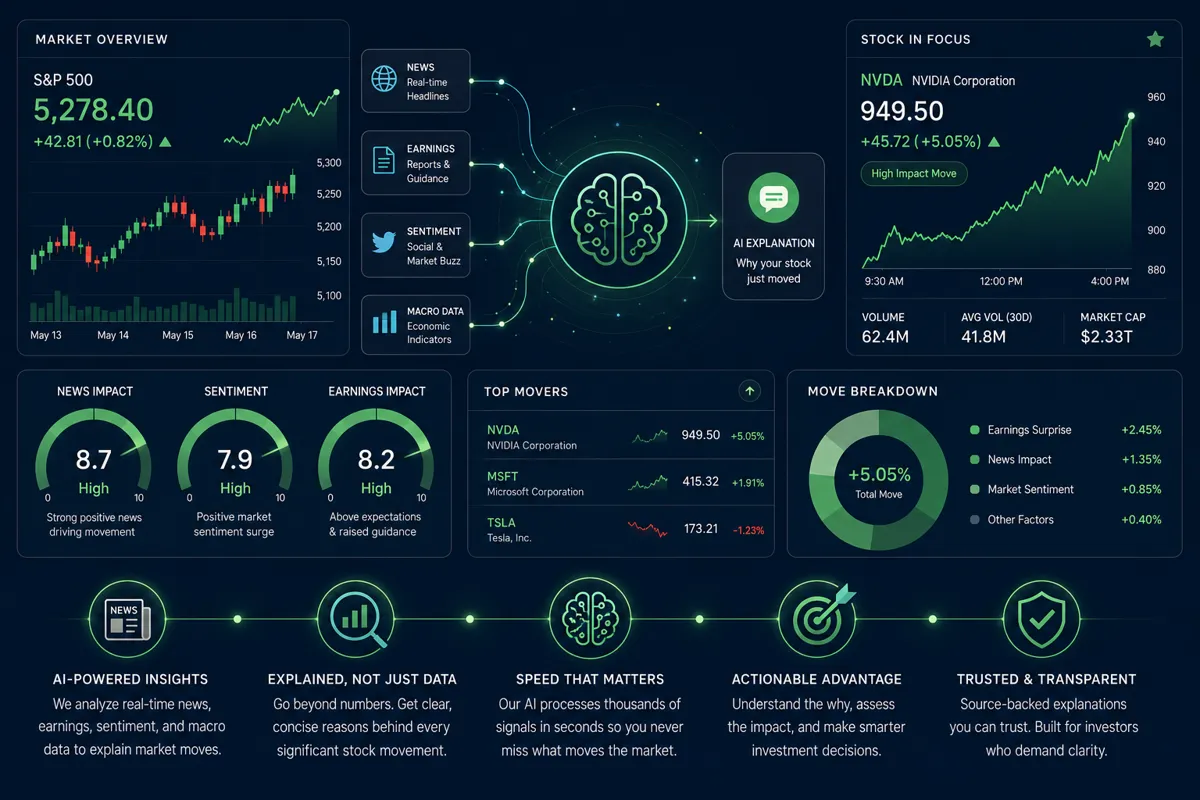
Is This Tool Good for Beginners or Just for Experienced Investors?
Beginners arguably get more value from an AI market news in plain English tool than experienced traders do — because the biggest beginner problem is not knowing why things are happening.
When you are new to markets, a stock moving 5% feels like chaos. An AI explanation that says "the stock dropped because the company missed earnings estimates by 12% and lowered full-year guidance" gives you a framework for understanding market mechanics, not just a data point. That education compounds over time.
For beginners, focus on:
- Plain-language news summaries (Magnifi does this particularly well)
- Sentiment trend indicators that show whether news flow is improving or deteriorating
- Earnings calendar integrations so you know when volatility events are scheduled
For experienced traders, the value shifts to:
- Speed — getting the catalyst explanation before the market fully prices it in
- Options flow correlation — some tools flag unusual options activity alongside news events
- Sector-level sentiment aggregation for macro reads
The free tools section at AI Stock Picker Apps is a reasonable starting point if you want to test the category before spending money. Paper trade it first, understand how the tool's explanations correlate with actual price moves, then decide if a paid tier is worth it.
What Kind of Data Sources Does It Pull From?
The quality of an AI stock news tool lives or dies by its data inputs. Here is what the better tools pull from:
| Data Source | What It Catches |
|---|---|
| News wires (Reuters, AP, Dow Jones) | Breaking company and macro news |
| SEC filings (EDGAR) | 8-K events, insider transactions, material disclosures |
| Earnings transcripts | Guidance changes, management tone shifts |
| Analyst rating changes | Upgrades, downgrades, price target revisions |
| Social sentiment (Reddit, X/Twitter) | Retail momentum, short squeeze setups |
| Options flow data | Unusual activity that often precedes moves |
| Macroeconomic releases | Fed statements, CPI, jobs data |
Tools like AltIndex specifically weight alternative data signals — web traffic trends, app download data, and social sentiment — alongside traditional news. That combination can surface momentum shifts before they show up in price action. It is not magic; it is a wider data net.
The weakest tools pull only from public news aggregators and repackage headlines. That is not AI stock news analysis — that is a news feed with a chatbot wrapper.
Are There Any Free Versions or Trial Periods?
Yes, but with real limitations. Most AI stock news tools offer some form of free access, and a handful offer genuine free tiers worth using.
What you typically get for free:
- Delayed news summaries (15–30 minutes behind real-time)
- Limited number of daily queries or stock lookups
- Basic sentiment scores without granular source attribution
What requires a paid subscription:
- Real-time AI stock news alerts
- Full data source transparency (which specific filing or article triggered the explanation)
- API access for building your own alerts
- International market coverage
Magnifi offers a free query tier that lets you ask plain-language questions about stocks without a subscription — useful for occasional research. AltIndex has a free plan with limited daily signals. Koyfin's free tier covers basic news and data but gates the AI-powered features behind a paid plan.
The honest math: if you are actively trading and making real position sizing decisions, the cost of a good AI stock news tool is almost certainly less than one bad trade made on incomplete information. But start free, validate that the tool actually explains moves you can verify, then upgrade.
What Are Common Mistakes People Make When Using AI Stock Analysis Tools?
The tool is not the problem. How people use it usually is.
Mistake 1: Treating the explanation as a trade signal.
An AI explanation tells you what happened. It does not tell you what to do. "Stock dropped on earnings miss" is context. Whether you buy the dip, hold, or cut the position is your decision — and it depends on your entry, your stop loss, your position sizing, and your overall risk management framework.
Mistake 2: Analysis paralysis from too many tools.
Adding a fifth AI tool to your stack when you are not consistently using the first two is overtrading's quieter cousin. More inputs do not mean better outputs. Cut the noise, keep the alpha.
Mistake 3: Ignoring the source quality.
Not all AI stock news tools are transparent about where their explanations come from. If a tool cannot tell you which specific filing, article, or data point generated its summary, treat that output with skepticism. Data over noise means knowing the data's origin.
Mistake 4: Using it as a substitute for a trading plan.
You still need a defined entry and exit, a stop loss, and a clear thesis before you put capital at risk. The AI tool supports the plan — it does not replace it. Play stupid games, win stupid prizes. Entering a position because an AI said "sentiment is positive" without a clean setup is still a bad process.
Mistake 5: Revenge trading after a bad explanation.
Sometimes the AI gets the catalyst wrong or surfaces a secondary factor while missing the primary one. If a trade goes against you, do not double down because the tool's explanation seemed bullish. That is revenge trading with extra steps.
How Accurate Are the AI Explanations Compared to Human Analysts?
For speed, AI wins by a wide margin. For nuance and qualitative judgment, experienced human analysts still have an edge — particularly on complex geopolitical or regulatory situations.
A 2024 study by researchers at the University of Chicago (Booth School of Business) found that large language models could explain short-term stock price moves with accuracy comparable to junior sell-side analysts when given the same data inputs. The gap widened on longer-horizon analysis where qualitative judgment matters more.
In practical terms: for day trading and swing trading catalysts — the kind of moves that happen around earnings, news events, and macro releases — AI stock news tools perform well. For deep fundamental analysis of a company's five-year competitive position, they are a starting point, not a conclusion.
The MarketReader tool is specifically built around real-time AI explanations of price moves and is worth evaluating if accuracy on intraday catalysts is your primary need. For broader research combining news with fundamentals, Koyfin's news and data integration gives you both layers in one place.
Does the Tool Work With International Stock Markets?
Coverage varies, and this is one area where the category still has meaningful gaps.
Most AI stock news tools were built around U.S. market infrastructure — NYSE, Nasdaq, SEC filings, U.S. earnings seasons. International coverage is improving but uneven.
Current state in 2026:
- European markets (LSE, Euronext, XETRA): Partial coverage on premium tiers of tools like Koyfin and AltIndex
- Asian markets (TSE, HKEX, SSE): Limited; most tools cover ADRs listed in the U.S. but not the underlying foreign exchanges directly
- Emerging markets: Minimal coverage outside of major ADRs
If you trade international names, verify coverage explicitly with each tool before subscribing. Do not assume that because a tool covers 10,000 U.S. stocks, it handles your European or Asian positions with the same depth.
What Technical Skills Do You Need to Use This Tool Effectively?
None, for the basic use case. The whole point of an AI stock news summary tool is that it removes the technical barrier to understanding market catalysts.
You do not need to know how to read an SEC filing, parse an earnings transcript, or interpret options flow data. The tool translates those inputs into plain English. That is the product.
Where basic market literacy helps:
- Understanding what an earnings miss actually means for forward guidance
- Knowing the difference between a one-time charge and a recurring expense
- Recognizing when a "positive" news event is already priced in (the buy the rumor, sell the news dynamic)
That literacy comes from reading, watching markets, and — yes — paper trading before you risk real capital. The swing trade planner and stock health scorecard at AI Stock Picker Apps are practical free resources for building that foundation alongside any news tool you use.
For traders who want to go deeper — connecting news signals to technical setups like support and resistance levels, breakout patterns, and tight consolidation bases — tools like Benzinga Pro combine real-time news alerts with charting in a single interface.
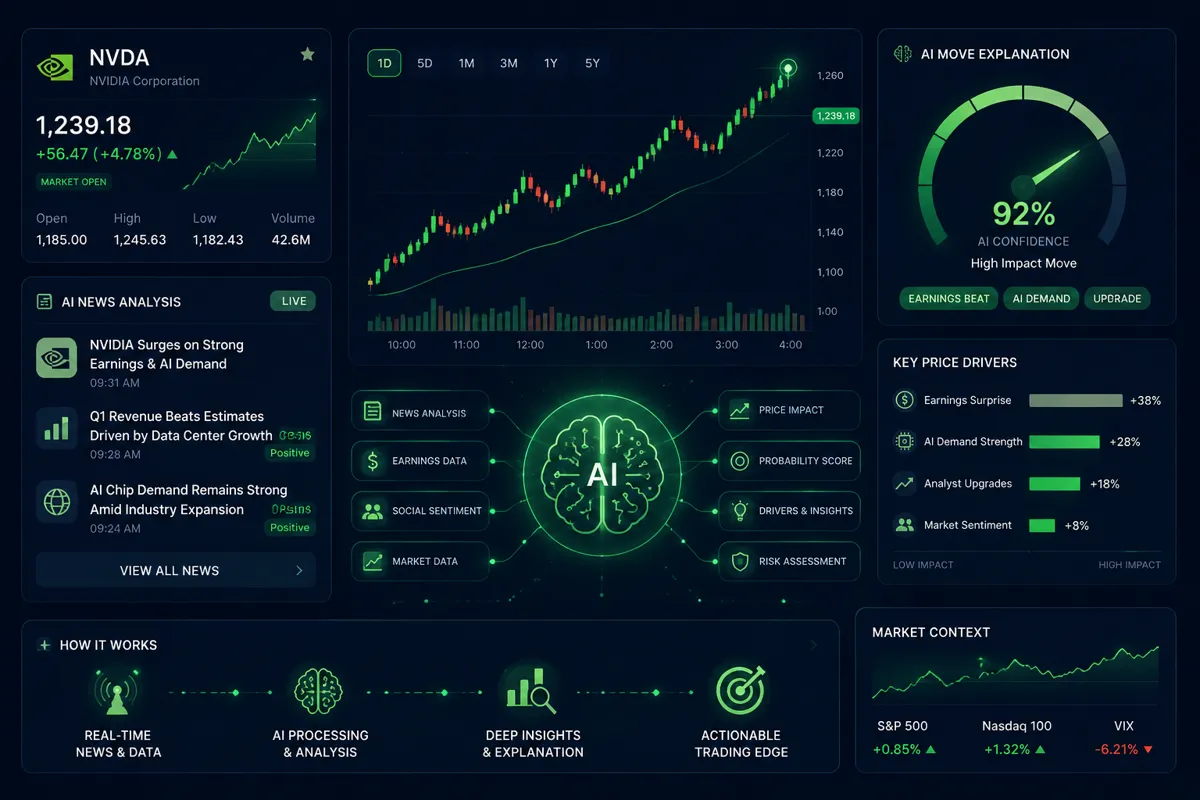
How Much Does the AI Stock News Tool Cost?
Pricing ranges from free to several hundred dollars per month depending on the depth of coverage and real-time capabilities.
| Tier | Typical Cost (2026) | What You Get |
|---|---|---|
| Free | $0 | Delayed summaries, limited queries, basic sentiment |
| Starter | $15–$40/month | Real-time alerts, broader stock coverage, more daily queries |
| Professional | $50–$150/month | Full data source transparency, API access, international coverage |
| Institutional | $200+/month | Custom integrations, bulk data, dedicated support |
Magnifi's paid plans start around $17/month for individual investors. AltIndex's premium tier runs approximately $49/month for full sentiment and news signal access. Koyfin's professional plan sits around $79/month and includes the broadest combination of news, fundamentals, and AI-powered features.
The right question is not "what does it cost?" It is "what does one bad trade from missing a catalyst cost me?" For most active traders, the math favors a paid tool over guessing.
FAQ
What is an AI stock news tool?
It is software that monitors real-time news, filings, and market data, then generates a plain-English explanation of why a specific stock just moved. It replaces the manual process of searching multiple financial sites to find the catalyst behind a price change.
Is there a free AI tool that explains stock moves?
Yes. Magnifi offers free plain-language queries about stocks. AltIndex has a limited free tier with basic sentiment signals. Most free versions use delayed data, so real-time explanations typically require a paid subscription.
Can an AI stock news tool tell me what to buy?
No legitimate tool should claim this. These tools explain catalysts and summarize news context. They do not generate buy or sell recommendations with guaranteed outcomes. Any tool that claims otherwise is a red flag.
How is this different from a stock screener?
A screener filters stocks by technical or fundamental criteria (price, volume, moving averages). An AI stock news tool explains why a stock is moving right now by connecting price action to a specific news event or data release. They serve different purposes and work well together.
What is AltIndex and how does it work?
AltIndex is an AI-powered platform that combines alternative data signals — including web traffic, app downloads, and social sentiment — with traditional news analysis. It assigns sentiment scores to stocks and flags when those scores shift significantly, often before the move shows up clearly in price action.
What is Magnifi and how does it explain stock moves?
Magnifi is an AI investment assistant that answers plain-language questions about stocks, funds, and market events. Ask "why did this stock drop today?" and it returns a conversational, data-backed answer. It is particularly useful for investors who want context without wading through raw financial data.
Does the tool work during after-hours trading?
Most tools monitor news 24/7, including pre-market and after-hours. This is particularly valuable during earnings season, when the biggest moves often happen outside regular trading hours.
How do I know if an AI explanation is accurate?
Check whether the tool cites its sources. A credible AI stock news tool should tell you which specific filing, article, or data point generated the explanation. If it cannot, treat the output as a starting point for your own verification, not a final answer.
Is this useful for ETF investors, not just stock traders?
Yes. AI news tools can explain why a sector ETF moved by summarizing the macro or sector-level catalyst driving it. This is useful for understanding whether a dip in a broad ETF is noise or a signal worth acting on.
Can I set up alerts so I get notified when my stock moves?
Most paid tiers include real-time AI stock news alerts that push notifications when a significant catalyst event is detected for stocks on your watchlist. This is one of the more practical features for active traders who cannot monitor screens all day.
What is the difference between news sentiment and news explanation?
Sentiment scoring tells you whether the overall news tone for a stock is positive, negative, or neutral. An explanation tells you specifically what happened and why. Both are useful; explanation is more actionable for understanding a specific move.
Do I need a brokerage account to use these tools?
No. Most AI stock news tools are standalone subscriptions that work independently of any broker. Some brokers like Webull and Interactive Brokers have built basic news feeds into their platforms, but dedicated AI news tools offer significantly more depth.
Conclusion: Build the Process, Then Add the Tool
Here is the honest summary: an AI stock news tool does not make you a better trader by itself. What it does is remove one of the most common and costly problems in retail trading — not knowing why your position just moved.
That ignorance is expensive. It leads to holding a position through a genuine structural break because you thought it was just noise. It leads to panic-selling a temporary dip because you did not know the catalyst was a one-day event. It leads to revenge trading and overtrading because you are reacting to price without understanding cause.
The AI stock news tool fills that gap. It gives you context fast, in plain English, so your decision-making process starts from a better place.
The process still matters. You still need a defined entry and exit. You still need a stop loss. You still need position sizing that reflects your actual risk tolerance, not your optimism. The tool supports the process — it does not replace it.
Start with a free tier. Verify that the explanations match moves you can independently confirm. Build it into your pre-trade checklist alongside your technical setup. Then, if the value is clear, upgrade to real-time alerts.
Signal over noise. Data over noise. Consistency over hype. That is the framework — and a good AI stock news tool is one more layer in it.
Browse the full breakdown of AI stock news tools, screeners, and research platforms at aistockpickerapps.com — we test the tools so you do not waste months on the wrong ones.