The AI Stock Alert Apps That Buzz Your Phone Before the Move...
Last updated: June 17, 2026
Quick Answer: The best AI stock alert apps in 2026 use machine learning, real-time options flow, and technical pattern recognition to push notifications to your phone before a significant price move develops. Top-rated tools include Trade Ideas for real-time AI alerts, Tickeron for buy/sell signals, and TrendSpider for custom breakout alerts. They won't predict the future, but they do cut the noise and surface the setups worth watching.
Key Takeaways
- The best AI stock alert app in 2026 combines real-time scanning with pattern recognition and push notifications — not just price crossing a moving average.
- Trade Ideas, Tickeron, and TrendSpider are the three most cited tools for real-time AI alerts among active traders.
- AI stock alert accuracy varies by market condition — these tools perform better in trending markets than in a choppy tape.
- Free AI stock alert apps exist but typically lack real-time data and advanced filters; they're fine for learning, not for live trading.
- No app predicts the future. The best ones improve your process by surfacing clean setups faster than manual scanning.
- SEC and FINRA regulations apply to AI alert tools — legitimate apps provide information, not personalized investment advice.
- Day traders and swing traders benefit most; long-term buy-and-hold investors have less use for real-time alert systems.
- The biggest mistake traders make is treating every alert as a trade signal. Discipline beats prediction every time.
The AI Stock Alert Apps That Buzz Your Phone Before the Move...
The AI stock alert app category has exploded in 2026 because the core problem it solves is real: the market moves faster than any human can manually scan. These apps use AI and machine learning to monitor thousands of tickers simultaneously, then push a notification to your phone when a specific condition — a breakout, an unusual options flow spike, a volume surge above the 20-day average — triggers the alert criteria you've set.
That's the honest description. Here's what they're not: crystal balls.
The best tools on the market right now for real-time AI alerts:
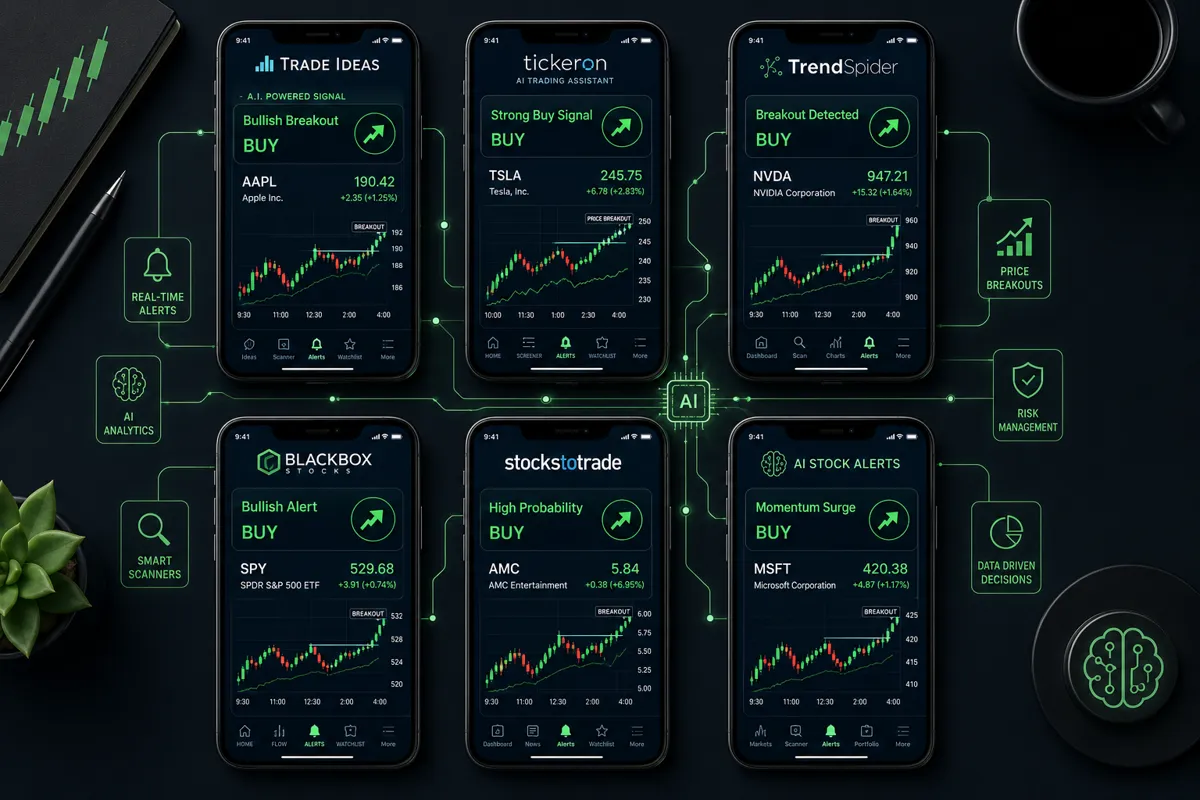
Trade Ideas — The most widely used AI alert platform among active day traders. Its "Holly" AI engine runs overnight simulations and generates a ranked watchlist each morning. Real-time alerts fire during market hours based on price action, volume, and pattern triggers. It's built for day trading and power hour scanning. See the full Trade Ideas breakdown here.
Tickeron — Known for its AI buy and sell signal app functionality, Tickeron uses pattern recognition to identify technical setups like ascending triangles, double bottoms, and flag consolidations, then assigns a confidence score to each signal. Good for swing traders who want a second opinion on a setup. Compare Tickeron with other prediction tools.
TrendSpider — The strongest tool for custom alert logic. Traders can build multi-condition alerts (price crosses VWAP AND volume is 2x the 10-day average AND RSI is above 50) without writing code. Excellent for traders who want precision over convenience.
Blackbox Stocks — Options flow-focused. Alerts fire when unusual institutional-sized options activity appears, which can signal a move is coming before price action confirms it.
StocksToTrade — A scanner and alert platform built specifically for low-float momentum stocks. Strong for traders focused on small-cap setups. Read the StocksToTrade breakdown.
Tradytics — Combines options flow, dark pool data, and AI signals in one dashboard. Useful for traders who want multiple data layers before pulling the trigger. See the Tradytics tool review.
How Accurate Are These AI Stock Prediction Apps?
Accuracy claims in this space are where things get slippery. No independent, audited accuracy benchmark exists for most AI stock alert apps — so treat any "85% accuracy" marketing claim the way you'd treat a stranger on the internet saying they're "basically a doctor."
What the data actually shows, based on third-party backtests and community tracking:
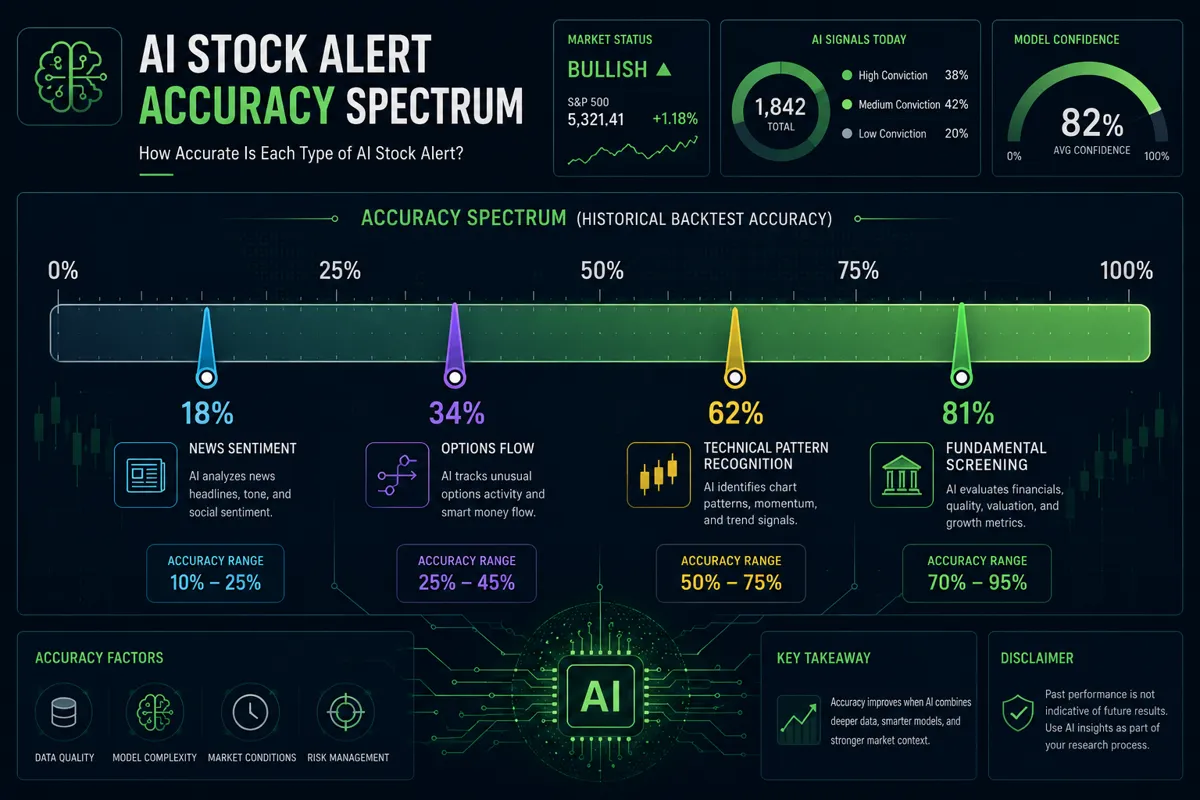
- Pattern recognition accuracy (identifying a valid technical setup) tends to run in the 55–70% range in trending markets. In a choppy tape, that number drops significantly.
- Options flow alerts are more of a leading indicator than a prediction. Unusual options activity precedes a move in the underlying stock more often than not, but the timing and direction aren't guaranteed.
- News sentiment AI can be fast but noisy. A headline that reads bearish to an algorithm may be bullish in context.
The honest framing: these tools improve your hit rate on identifying setups worth watching. They don't replace risk management, position sizing, or a stop loss. A tool that's right 60% of the time still loses you money if you let losers run and cut winners early.
The practical takeaway: Track every alert you act on for 30 days. Build your own accuracy log. That's your real data — not the app's marketing page.
Which AI Stock Alert App Is Cheapest — and Are Free Apps Worth It?
Pricing in 2026 ranges from free tiers to $200+ per month for professional-grade platforms. Here's a realistic breakdown:
| Tier | Price Range | What You Get |
|---|---|---|
| Free | $0 | Delayed data, basic price alerts, limited scans |
| Entry-level | $20–$50/month | Real-time alerts, limited AI signals, mobile app |
| Mid-tier | $50–$120/month | Full AI scanning, custom alert logic, backtesting |
| Professional | $150–$250/month | Institutional-grade flow data, API access, advanced AI |
Free AI stock alert apps like the basic tiers of Webull, Moomoo, and some features inside free tools available here are genuinely useful for learning how alerts work and paper trading setups. The limitation is almost always data latency. A 15-minute delayed alert on a day trade is useless — the move is already over.
For active day traders, the $100–$150/month range (Trade Ideas, TrendSpider) is where the real-time AI breakout alert functionality lives. For swing traders checking in once or twice a day, a $30–$50/month tool is often enough.
The rule: Don't pay for a tier you haven't outgrown. Start with a free trial, paper trade the alerts for two weeks, then decide if the paid tier earns back its cost in better setups.
Do These Apps Actually Work for Day Traders?
Yes — with a hard caveat. The AI stock alert app for day trading is most useful as a scanner replacement, not a decision-maker.
Day trading requires speed. Manually scanning 5,000 tickers for a clean setup during power hour (the last hour of the trading day, when volume and volatility spike) is physically impossible. AI alert apps solve that problem. They surface the candidates. What you do with them is still on you.
Where day traders get burned:
- Alert overload. A platform firing 200 alerts a day isn't cutting the noise — it's adding to it. Good traders filter aggressively. Three to five high-conviction setups per day beats 50 mediocre ones.
- Chasing alerts. The alert fires, you see the stock already up 4%, and you buy the top. That's a bull trap, not a breakout. The alert was right; the entry was wrong.
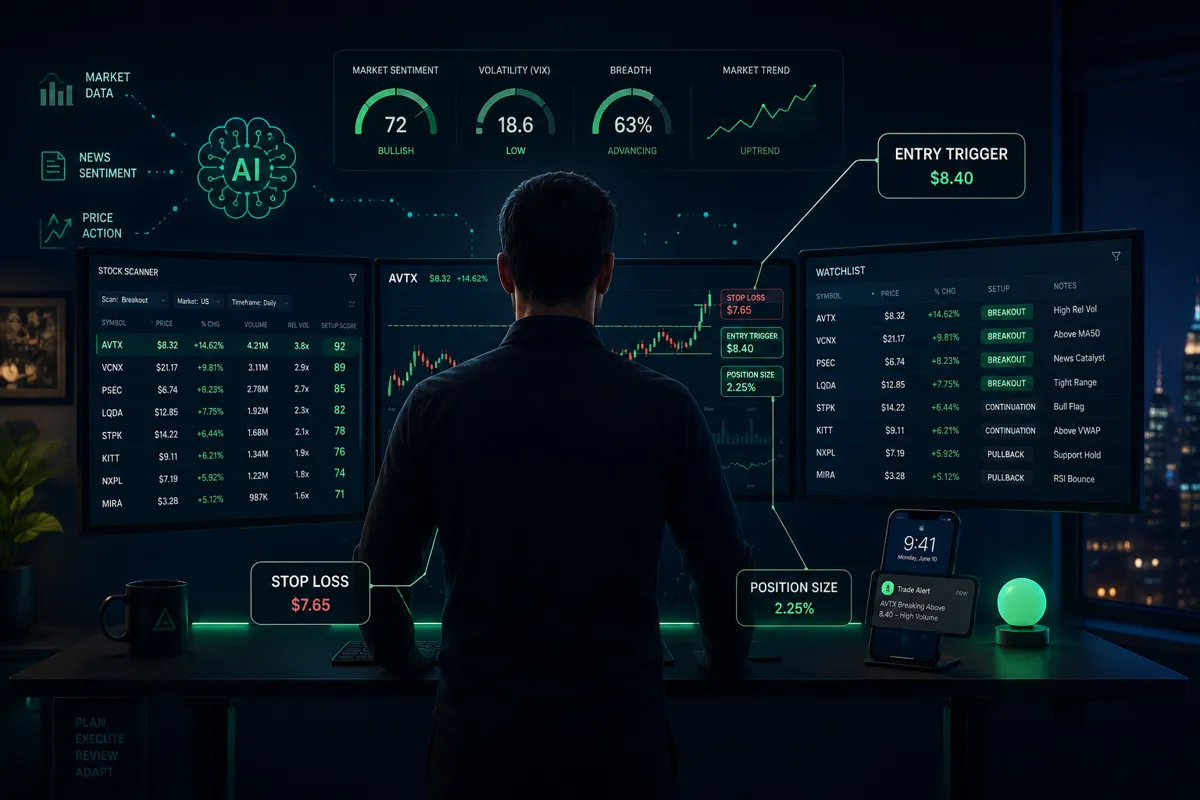
- Skipping the stop loss. An AI alert app tells you when to look. It doesn't tell you when to get out. Set your stop loss before you enter, not after the trade goes against you.
For day trading specifically, Trade Ideas' Holly AI and the real-time options flow tools from Cheddar Flow and Unusual Whales are the most cited by active traders. See the Cheddar Flow review.
Are AI Stock Alerts Legal and SEC Compliant?
AI stock alert apps are legal in the U.S. when they operate as information tools rather than personalized investment advisers. The SEC and FINRA draw a clear line: providing market data, technical signals, and educational content is different from telling a specific person to buy a specific security based on their financial situation.
Legitimate platforms are careful about this distinction. They publish disclaimers stating that alerts are not investment advice, and they don't claim to be registered investment advisers (RIAs) unless they actually are.
What to watch for:
- Apps that guarantee returns or promise specific profit percentages are likely violating SEC guidelines and should be avoided entirely.
- Apps that push "hot tips" on specific penny stocks without disclosure may be running a pump-and-dump scheme. FINRA has enforcement actions on record for exactly this.
- Legitimate tools like Trade Ideas, Tickeron, and TrendSpider are transparent about their methodology and don't make return guarantees.
If you're unsure about a platform's compliance posture, the SEC's investor education resources at Investor.gov are the right starting point.
The bottom line: Play stupid games, win stupid prizes. If an app promises guaranteed profits, it's not an AI stock alert app — it's a scam with a chatbot.
What Kind of Investor Should Use AI Stock Alert Apps?
Real-time AI stock alerts are best suited for active traders — day traders, swing traders, and momentum investors who are making decisions on a timeframe of hours to weeks. The shorter your holding period, the more valuable real-time alerts become.
Use an AI stock alert app if you:
- Actively manage your own trades and check the market daily
- Trade based on technical setups (breakouts, support and resistance levels, volume surges)
- Want to scan more tickers than you can manually watch
- Are building a systematic watchlist process
Skip the real-time alert app if you:
- Invest in index funds or ETFs and hold for years
- Don't have time to act on alerts during market hours
- Are still learning basic market mechanics (paper trade it first)
- Have fewer than 10 trades under your belt
For beginners, the better starting point is understanding price action and risk-reward before adding an alert layer. An alert that fires on a clean setup is only useful if you know what a clean setup looks like. Start with the swing trading fundamentals here.
Which Apps Are Best for Beginners vs. Experienced Traders?
Beginners and experienced traders need different things from an AI buy and sell signal app. Here's the honest split:
For beginners:
- Tickeron — The confidence scores and plain-language pattern explanations make it more accessible than raw scanner output.
- Stock Analysis — Clean interface, solid fundamental data, less overwhelming than professional-grade tools. See the Stock Analysis review.
- Webull's built-in alerts — Free, real-time for U.S. markets, and a reasonable starting point for learning how price alerts work.
For experienced traders:
- Trade Ideas — The Holly AI engine and customizable alert channels are built for traders who know what they're looking for.
- TrendSpider — Multi-condition alert logic rewards traders who have a defined system.
- Tradytics or Cheddar Flow — For traders who read the tape using options flow as a leading indicator.
The mistake beginners make is starting with a professional-grade tool and drowning in features. Analysis paralysis is real, and it costs money. Start simple, build your process, then add complexity when you've earned it.
Common Mistakes People Make With AI Stock Alerts
This is where most of the money gets lost — not in picking the wrong app, but in using the right app the wrong way.
Treating every alert as a trade. An alert is a flag, not a command. The setup still needs to make sense in context. Is the broader market choppy? Is the stock overextended from its base? Is there an earnings announcement in two days? The alert doesn't know. You have to.
No exit plan. Entry and exit are a pair. If you take a trade based on an alert and you don't know where your stop loss is and where you're taking profit, you're not trading — you're gambling. Getting stopped out on a planned stop loss is good risk management. Getting stopped out because you had no plan is revenge trading waiting to happen.
Overtrading. More alerts do not equal more profit. Overtrading is one of the fastest ways to erode an account through commissions, spreads, and emotional decision-making. Discipline beats prediction every single time.
Ignoring the broader tape. An AI breakout alert on a single stock means less when the S&P 500 is in a confirmed downtrend. The trend is your friend — trade with it, not against it.
Can AI Stock Apps Predict Crypto Movements Too?
Some AI price alert apps for stocks have expanded into crypto markets, and a few are built specifically for digital assets. The mechanics are similar — pattern recognition, volume alerts, sentiment analysis — but the market structure is different enough to matter.
Crypto markets trade 24/7, have far less regulatory oversight, and are more susceptible to social media-driven moves than equity markets. An AI alert that works well on NYSE-listed equities during regular market hours may generate significantly more false signals on a crypto pair at 2 a.m.
Tools like Tradytics and some features within AI trading platforms reviewed here cover both asset classes, but the alert logic often needs separate calibration for crypto vs. equities.
The honest take: If you're using an AI stock alert app primarily for equities and want to dabble in crypto, check whether the platform explicitly supports crypto pairs and has separate alert templates for them. Don't assume the same settings that work for a NASDAQ breakout will work on a Bitcoin trade.
What Technology Powers These Stock Prediction Apps?
The AI price alert app category runs on a combination of technologies that have become significantly more capable since 2020. Understanding what's under the hood helps you evaluate which tool fits your process.
Machine learning pattern recognition — Algorithms trained on historical price and volume data to identify chart patterns (flags, cups, wedges) with a statistical edge. This is the core of tools like Tickeron and TrendSpider.
Natural language processing (NLP) — Used for news sentiment analysis. The AI reads earnings reports, SEC filings, and news headlines, then scores the sentiment as bullish, bearish, or neutral. Tools like AlphaSense and MarketReader use NLP heavily.
Options flow analysis — Algorithms that scan the options market in real time for unusually large or directional bets. When a large trader buys a significant number of out-of-the-money calls on a stock before a move, that's a signal. Tools like Cheddar Flow and Unusual Whales specialize here.
Backtesting engines — The ability to run alert logic against historical data to see how often a given setup played out profitably. TrendSpider and Trade Ideas both offer this. It's how you validate a setup before risking real money.
None of these technologies predict the future. They identify conditions that have historically preceded certain outcomes. That's a meaningful edge — but it's a probabilistic one, not a guarantee.
FAQ
What is the best AI stock alert app in 2026?
Trade Ideas is the most widely used for real-time day trading alerts. Tickeron is the strongest for buy/sell signal pattern recognition. TrendSpider leads for custom multi-condition alert logic. The "best" depends on your trading style and timeframe.
Is there a good free AI stock alert app?
Yes, with limits. Webull and Moomoo offer free real-time price alerts. Some platforms offer free tiers with delayed data. For active day trading, free tools typically lack the speed and AI depth needed. Use them to learn, then upgrade when you're ready.
How often are AI stock alerts accurate?
In trending markets, pattern-based AI alerts have historically shown 55–70% accuracy on setup identification in third-party community tracking. Accuracy drops in choppy, low-conviction markets. No platform publishes independently audited accuracy data — track your own results.
Are AI stock alert apps safe to use?
Legitimate platforms are safe to use as information tools. Avoid any app that guarantees returns, pushes specific penny stocks without disclosure, or asks for trading account access without a clear regulatory framework.
Do I need to be at my screen all day to use these apps?
For day trading alerts, yes — the moves happen fast. For swing trading alerts, no. Many platforms let you set alerts that fire to your phone and can be acted on within a reasonable window.
What's the difference between a stock scanner and an AI alert app?
A scanner shows you what's happening right now when you look. An AI alert app pushes a notification to you when a condition triggers, so you don't have to watch constantly. Most professional tools combine both.
Can beginners use AI stock alert apps?
Yes, but start with paper trading. Use the alerts to build pattern recognition skills before risking real capital. An alert means nothing if you don't know what to do with it.
How much should I pay for an AI stock alert app?
For active day traders, $100–$150/month for a professional tool is reasonable if it improves your process. For swing traders, $30–$60/month is often sufficient. Don't pay for features you won't use.
Do these apps work for options trading?
Yes. Options flow alert tools like Cheddar Flow and Unusual Whales are specifically designed to surface unusual options activity as a leading indicator for directional moves.
What's the biggest mistake traders make with AI alerts?
Taking every alert as a trade without a defined entry, stop loss, and exit plan. The alert surfaces the setup. The process determines whether you profit from it.
Conclusion: Signal Over Noise — The Only Standard That Matters
The AI stock alert app market in 2026 is crowded, loud, and full of tools competing for your subscription dollar. Most of them work, to varying degrees. The question isn't whether the technology is real — it is. The question is whether you have the process to use it.
Here's what to actually do:
- Pick one tool that matches your trading style. Day trader? Start with Trade Ideas. Swing trader? Tickeron or TrendSpider. Options-focused? Cheddar Flow or Unusual Whales.
- Paper trade the alerts for two weeks before putting real money behind them. Build your own accuracy log.
- Set your stop loss before you enter every trade. The alert gets you in. Risk management keeps you in the game.
- Cut the alert volume. Five high-quality alerts per day beats 100 mediocre ones. Filter aggressively.
- Track your results. Not just the wins — every trade, every alert, every exit. That data is worth more than any app's marketing page.
Systems over hacks. Process over prediction. Signal over noise. That's the standard — and the only one worth holding your tools to.
Browse the full breakdown of 100+ AI stock tools, scanners, and alert platforms at aistockpickerapps.com — we test them so you don't waste months on the wrong ones.