The AI Day Trading Platforms Beginners Are Starting With in 2026...
Last updated: June 17, 2026
Quick Answer: The AI day trading platforms beginners are starting with in 2026 are tools like Trade Ideas, Tickeron, and Option Alpha — platforms that combine AI-generated alerts, beginner-friendly signal dashboards, and built-in risk education. They don't replace your judgment, but they do cut the noise so you can focus on setups that actually make sense. Start with a paper trading account, learn the risk-reward basics, and treat the AI as a filter — not a crystal ball.
Key Takeaways
- The best AI day trading platforms for beginners in 2026 combine guided alerts, clean interfaces, and educational resources — not just raw signals.
- Trade Ideas, Tickeron, and Option Alpha are the most beginner-accessible AI tools currently on the market for stock day trading.
- Most platforms require $0 to $500 to open an account, but the SEC's Pattern Day Trader (PDT) rule requires $25,000 in a margin account to make more than three day trades per week.
- AI trading platforms are legal for retail traders in the U.S., but they are not regulated as financial advisors — the risk is still yours.
- Beginners consistently lose money by overtrading, revenge trading, and ignoring position sizing — the platform doesn't fix bad habits.
- Paper trade it first. Every platform on this list has a simulation or demo mode. Use it.
- AI tools work better for stocks than crypto in most beginner contexts because stock markets have clearer regulatory structure and more reliable data.
- Realistic returns for beginners using AI tools are modest and inconsistent in year one. Anyone promising otherwise is selling something.
- You need zero coding experience to use the platforms in this guide. Some advanced tools (like QuantConnect) require Python, but they are not beginner picks.
The AI Day Trading Platforms Beginners Are Starting With in 2026
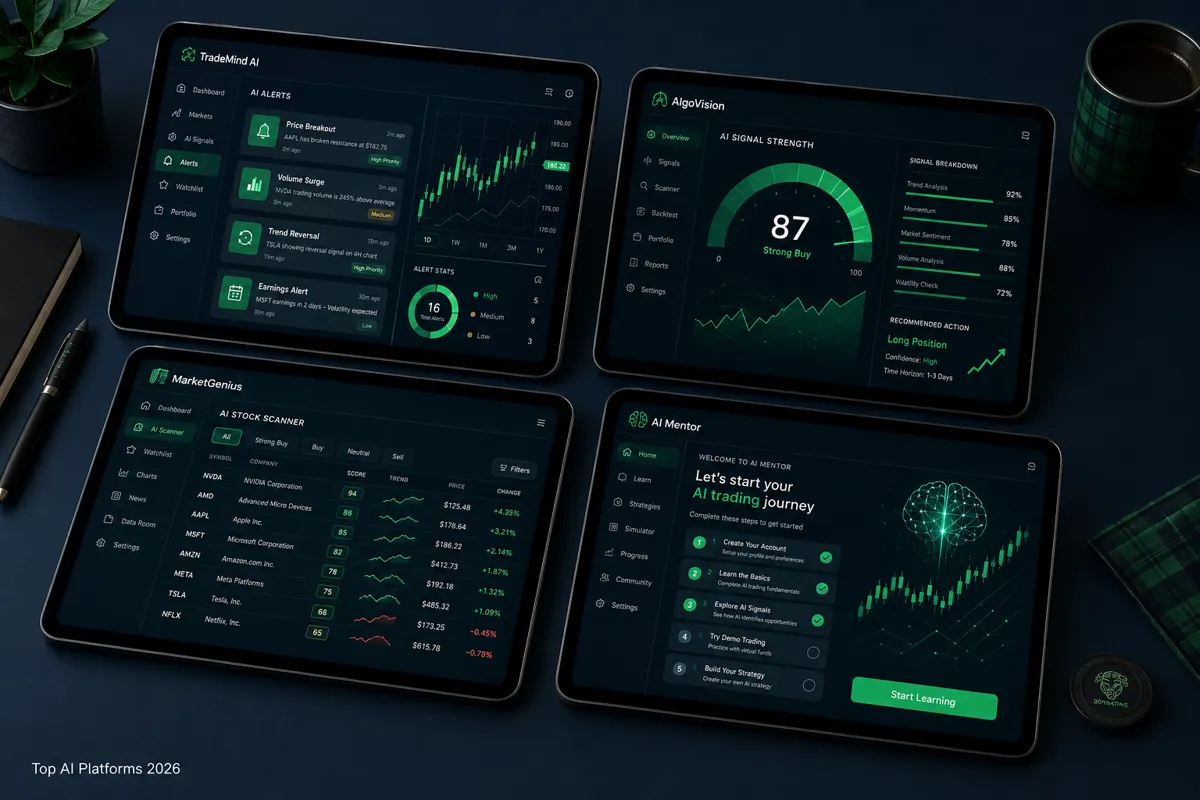
The best AI day trading platforms for beginners in 2026 are Trade Ideas, Tickeron, and Option Alpha. Each one is designed to reduce decision fatigue, surface cleaner setups, and keep newer traders from drowning in data they don't know how to use yet.
Here's the honest breakdown:
Trade Ideas is the closest thing to having a scanner that thinks. Its AI engine, called Holly, runs millions of simulated trades overnight and surfaces the setups with the best historical probability for the next session. For beginners, the guided alerts feature is the entry point — you don't need to build your own scanner from scratch. Holly does the heavy lifting; you learn by watching what she flags and why. See the full Trade Ideas breakdown here.
Tickeron takes a different approach. Its AI pattern recognition is built specifically for traders who don't want to read charts manually. It identifies classic price action patterns — flags, wedges, head-and-shoulders — and assigns a confidence score to each. For someone with zero chart-reading experience, that confidence score acts as a training wheel that gradually teaches pattern recognition. Check out Tickeron for beginners alongside other AI signal tools.
Option Alpha is the pick if you want automation without writing a single line of code. It lets you build "bots" using a visual drag-and-drop interface that executes trades based on rules you set. For beginners, the value isn't in the automation itself — it's in being forced to define your rules before you trade. That process alone prevents a lot of impulsive, costly mistakes.
| Platform | Best For | Price Range | Coding Required |
|---|---|---|---|
| Trade Ideas | Guided alerts, scanning | ~$118-$228/mo | No |
| Tickeron | Pattern recognition signals | ~$90-$200/mo | No |
| Option Alpha | Rules-based automation | Free to ~$199/mo | No |
| TradingView | Charting + community scripts | Free to ~$60/mo | No |
| QuantConnect | Algorithmic backtesting | Free tier available | Yes (Python) |
For a broader comparison of 100+ tools across categories, the AI trading platforms directory is the cleanest place to start.
How Much Money Do You Actually Need to Start?
Most AI day trading platforms have low or no account minimums — but the real barrier is the PDT rule. The SEC's Pattern Day Trader rule (enforced by FINRA) requires any trader making more than three day trades in a rolling five-business-day period to maintain at least $25,000 in their margin account. That's not a platform rule. That's federal regulation.
What this means practically:
- If you have less than $25,000, you're limited to three day trades per week in a U.S. margin account.
- You can avoid the PDT rule by using a cash account, trading futures, or using offshore brokers — but each option carries its own trade-offs and risks.
- Swing trading (holding positions overnight for days or weeks) has no PDT restriction. Many beginners start there. See the swing trading tool comparison for platforms built around that timeframe.
The practical floor: Start with $500 to $2,000 if you're paper trading or swing trading. Start with $25,000+ only when you've proven a consistent process in simulation first. Starting with real money before you have a tested system is not courage — it's just expensive.
Are AI Trading Platforms Legal and Safe for Beginners?
Yes, AI trading platforms are legal for retail traders in the U.S. They are software tools, not regulated investment advisors. That distinction matters. The platform is not responsible for your losses — and it won't be registered with the SEC as a fiduciary.
"Safe" is a different question. The platforms themselves are generally secure (look for two-factor authentication and regulated broker integrations). The risk isn't the software — it's what you do with the signals. A beginner who follows every alert without understanding the setup, position sizing, or stop loss placement is going to lose money regardless of how good the AI is.
The SEC's Investor.gov has plain-English guidance on what protections retail traders do and don't have. Reading it once is worth more than most trading courses.
Which AI Platform Has the Lowest Fees and Best Beginner Interface?
For pure beginner friendliness, TradingView's free tier and Tickeron's entry-level plan are the lowest-friction starting points. TradingView gives you professional-grade charting, a massive community of shared scripts, and a paper trading mode — all free. It's not a signal generator, but it's where most serious traders build their charts and watchlists. Explore TradingView's features here.
For AI-specific signal tools with a clean interface, Tickeron's dashboard is the most visually approachable for someone with zero investing experience. Trade Ideas has a steeper learning curve but more powerful scanning once you're past the basics.
Fee reality check: Most serious AI tools cost $90 to $230 per month. That's not cheap. If you're not yet profitable in paper trading, paying $200/month for a signal tool is burning money. Start free, prove the process, then pay for the upgrade.
Can You Actually Make Money Using AI Trading Bots as a Beginner?
This is the question everyone wants a clean "yes" to. The honest answer is: some people do, most people don't in year one, and the platform is rarely the deciding factor.
Here's what the data actually shows: a widely cited study from the University of California, Berkeley (Brad Barber and Terrance Odean, 2000) found that frequent traders underperform the market significantly — and that was before the noise of social media and AI hype. The problem has never been access to tools. It's been behavior.
AI tools improve your odds by:
- Filtering out low-probability setups (signal over noise)
- Removing emotional bias from the scanning process
- Forcing rule-based entry and exit criteria
AI tools do NOT fix:
- Revenge trading after a loss
- Overtrading because you're bored
- Ignoring your stop loss because "it'll come back"
- Chasing a breakout that's already overextended
The setup matters. The discipline to wait for it matters more. Use the free Expectancy Calculator to run the math on your own win rate and average gain/loss before you commit real capital. If your expectancy is negative, no AI tool fixes that.
What Are the Real Risks of Using AI for Day Trading?
The biggest risk isn't a bug in the algorithm. It's over-reliance. Beginners who treat AI signals as guaranteed entries — rather than one input in a larger process — get crushed when the signal fires into a choppy tape or a bull trap.
Key risks to understand:
- Overfitting: AI models trained on historical data can perform well in backtests and poorly in live markets. Past price action doesn't guarantee future results.
- Latency: Retail AI tools are not high-frequency trading systems. By the time a signal reaches you, institutional algorithms may have already moved the price.
- False confidence: A clean signal on a low-float stock during power hour can still result in getting stopped out if the spread is wide and volume dries up.
- Automation risk: Bots that execute without your oversight can compound losses fast in volatile conditions. Always set hard stop losses in automated systems.
Play stupid games, win stupid prizes. Handing an AI bot your account password and walking away is the trading equivalent of leaving the stove on.
How Do AI Trading Platforms Compare to Traditional Stock Apps?
Traditional apps like Robinhood, Webull, or Fidelity are execution platforms — they let you buy and sell. AI trading platforms are decision-support tools — they help you figure out what to buy, when, and at what size.
The two categories are not competitors. They're complements. Most serious beginners use a traditional broker for execution and an AI tool for research, scanning, and signal generation. Some platforms (like Alpaca) combine both — they offer a brokerage API alongside AI tools for more technically inclined users.
The key difference: a traditional app shows you what happened. An AI platform tries to tell you what's likely to happen next, based on pattern recognition and historical probability. Neither one is a guarantee. One just gives you more data to work with.
What Mistakes Do Beginners Usually Make With AI Trading Software?
The most common and costly mistakes, in order:
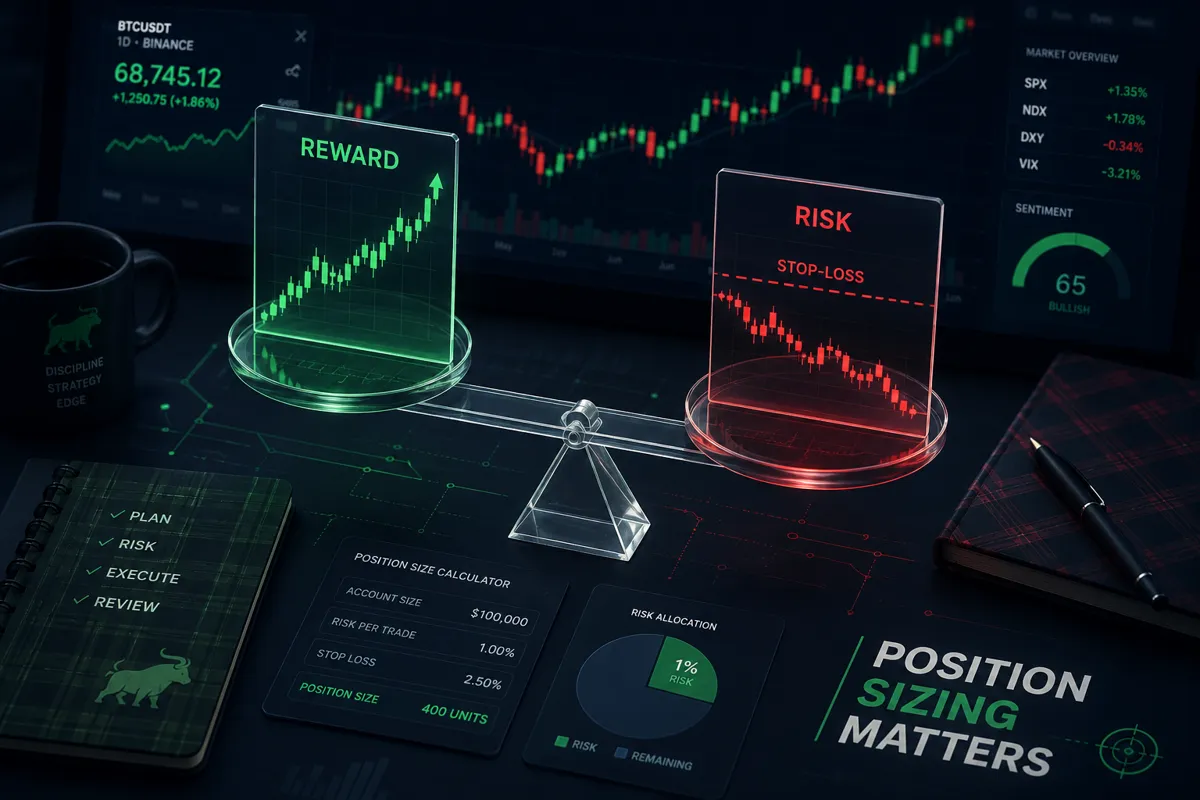
- Treating signals as instructions. An AI alert is a starting point, not a trade order. You still need to check the risk-reward, the broader market context, and your position sizing before entering.
- Skipping the paper trading phase. Every platform on this list has simulation mode. Skipping it to "learn with real money" is just paying tuition to the market.
- Analysis paralysis from too many tools. Running Trade Ideas, Tickeron, three Discord scanners, and two Twitter feeds simultaneously is not research. That's FOFO — Fear Of Finding Out what a clean, simple process actually looks like.
- No defined stop loss. Catching a falling knife because you didn't set a stop is one of the most expensive beginner habits in day trading.
- Overtrading. More trades does not mean more profit. It usually means more commissions, more emotional decisions, and more dead cat bounces mistaken for real reversals.
The fix for all five: build a simple system, paper trade it first, and track every trade in a journal. Tools like TraderSync make trade journaling automated and visual, which is exactly what beginners need to spot their own patterns.
Are AI Trading Platforms Better for Stocks or Crypto?
For beginners, stocks are the more forgiving environment. Here's why: U.S. equity markets have regulatory oversight (SEC, FINRA), defined trading hours, and decades of reliable price data that AI models can train on. Crypto markets trade 24/7, are less regulated, and are significantly more volatile — which amplifies both gains and losses.
Most of the AI day trading platforms for beginners covered in this guide are built primarily for equities. Trade Ideas and Tickeron both focus on U.S. stocks. Option Alpha is options-focused. If crypto is your primary interest, the tool landscape is different and the risk profile is higher.
That said, platforms like 3Commas are built specifically for crypto automation. Just know what you're getting into before you automate anything in a market that can drop 20% overnight.
How Much Technical Knowledge Do You Really Need?
For the beginner-friendly platforms in this guide — Trade Ideas, Tickeron, Option Alpha, TradingView — the honest answer is: almost none. If you can use a smartphone and read a basic chart, you can operate these tools within a week.
The learning curve is not technical. It's conceptual. Understanding what a support level means, why volume matters on a breakout, and how to calculate your risk-reward on a trade — that's the knowledge gap that actually costs beginners money. The software is easy. The market mechanics take longer.
For beginners who want AI tools that also teach as they go, Edgeful and Zen Strategies both surface contextual data that explains why a setup looks favorable, not just that it does.
What Returns Can Beginners Realistically Expect?
Blunt answer: in year one, most beginners should expect to lose money or break even. That's not pessimism — that's what the data consistently shows across retail trading studies. The goal in year one is to lose less than you learn, build a repeatable process, and develop the discipline to follow it.
Realistic benchmarks for a beginner using AI tools consistently and responsibly:
- Year 1: Preserve capital, reduce emotional trading, build a watchlist system
- Year 2: Approach breakeven or modest positive returns with a defined process
- Year 3+: Consistent positive expectancy is achievable with discipline beats prediction as the operating principle
Anyone selling a course that promises 20% monthly returns from AI day trading is not a teacher. They're a salesperson. The trend is your friend — but only if you know how to read it.
Which AI Platforms Offer the Best Educational Resources?
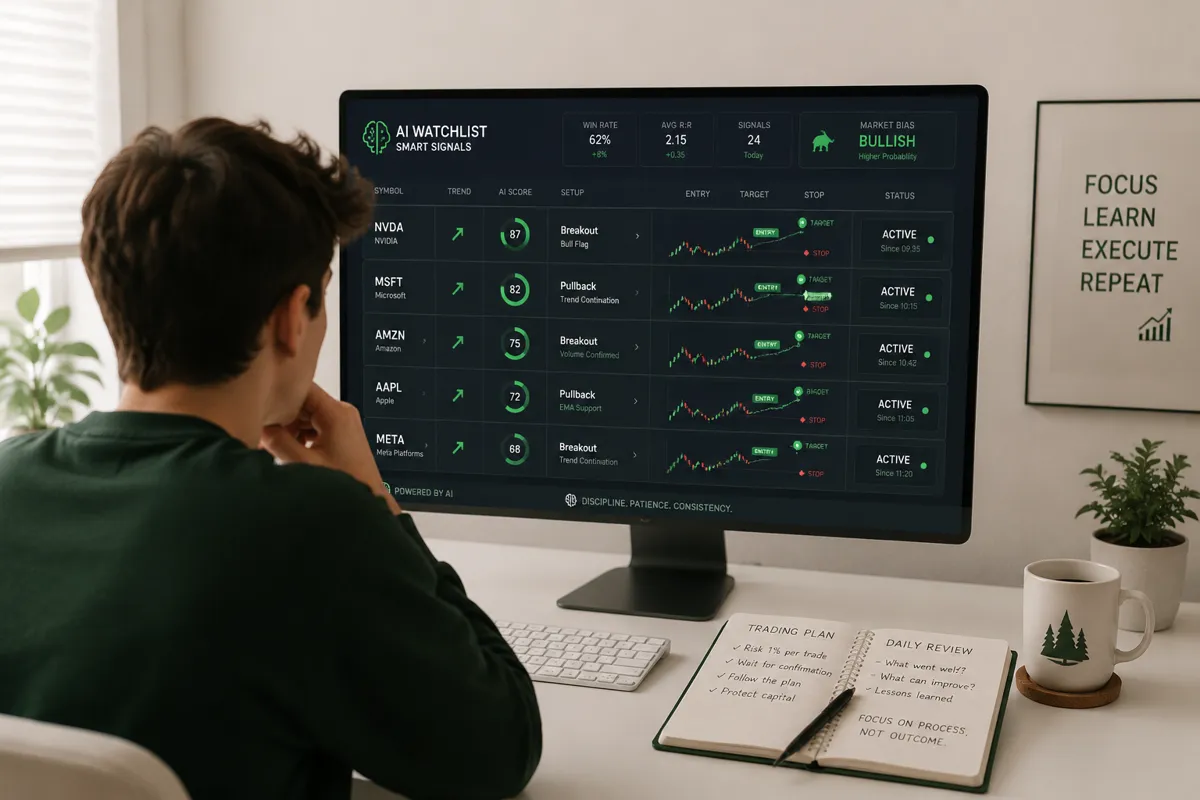
For beginners who want to learn while they trade, Trade Ideas includes video tutorials, webinar replays, and a community chat where experienced traders walk through Holly's daily alerts. Tickeron has a built-in AI pattern education layer that explains each signal as it fires.
Beyond the platforms themselves, pairing any AI tool with structured education dramatically improves outcomes. A few resources worth knowing:
- FINRA's investor education portal (finra.org) covers trading basics, risk management, and broker verification — free and unbiased.
- The AI day trading resource hub at FullStack Alpha covers platform comparisons, scanner setups, and beginner frameworks in one place.
- For bot-specific education, trading bots explained breaks down how automated systems work before you hand one your capital.
The platforms that teach as they go are worth the premium for beginners. Consistency over hype means choosing a tool you'll actually use and understand — not the one with the most features you'll never open.
Conclusion: Build the System Before You Buy the Tool
The AI day trading platforms beginners are starting with in 2026 are genuinely better than anything that existed five years ago. The signal quality is higher, the interfaces are cleaner, and the barrier to entry is lower than it's ever been.
None of that changes the fundamentals.
The traders who succeed with these tools are the ones who treat them as part of a system — not a shortcut. They define their entry and exit rules before they open a position. They set a stop loss and respect it. They paper trade it first. They track every trade. They cut losers fast and let winners run.
The traders who fail are the ones who expected the AI to do the thinking for them.
Here's what to do this week:
- Pick one platform from this guide and open a free or trial account.
- Run the paper trading mode for 20 trades before touching real capital.
- Use the Expectancy Calculator to measure whether your simulated results have positive expectancy.
- If they do, fund a small account and trade one position at a time with a defined stop loss.
- Journal every trade. Review weekly. Adjust the process, not the platform.
Cut the noise. Keep the alpha. The edge isn't in the tool — it's in the discipline to use it correctly.
We test the AI stock tools so you don't waste months on the wrong ones. Browse the full breakdowns at aistockpickerapps.com.