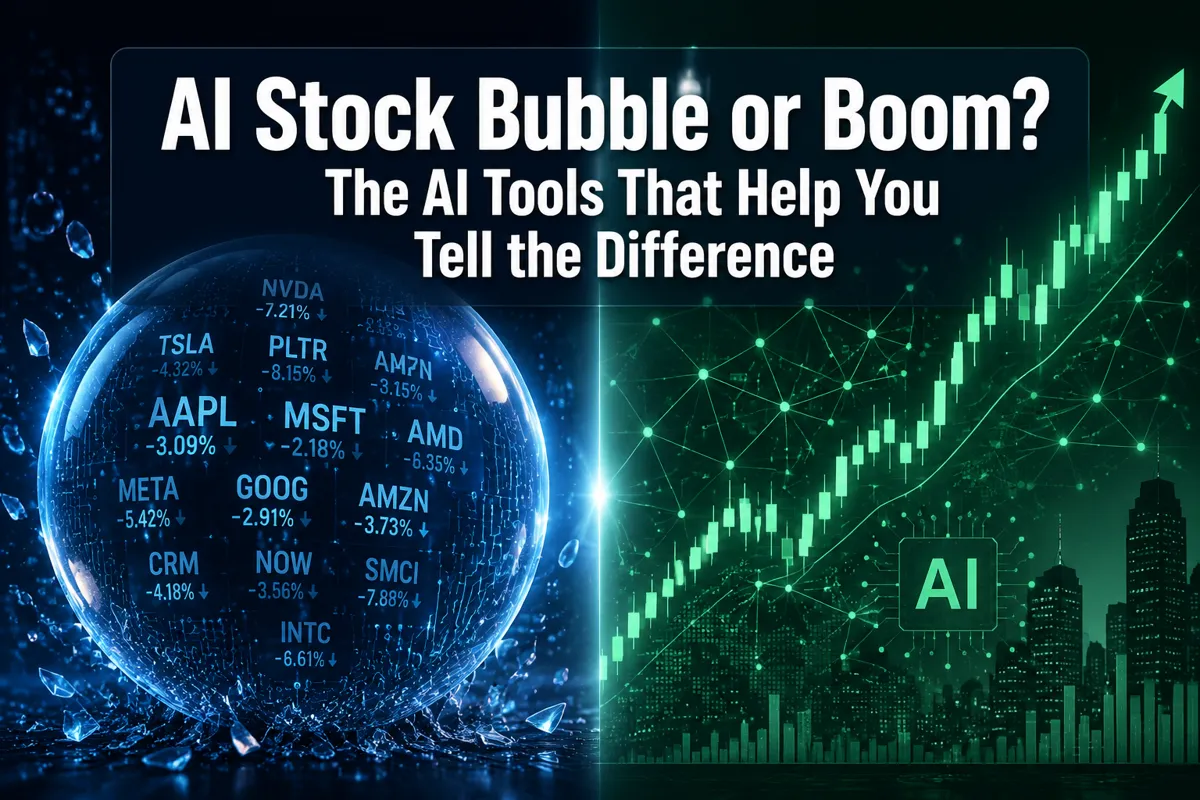
AI Stock Bubble or Boom? The AI Tools That Help You Tell the Difference
Last updated: June 16, 2026
Quick Answer: The AI sector in 2026 contains both real, revenue-generating businesses and genuinely overvalued names riding narrative momentum. The difference isn't obvious from a headline or a hot take — it shows up in valuation multiples, revenue growth rates, earnings quality, and sentiment data. The right AI stock analysis tools let you run that check in minutes, not hours, so you stop guessing and start deciding.
Key Takeaways
- Investors poured $255.34 billion into AI hyperscalers in the first half of 2026 alone — more than double all of 2025 combined. That pace demands scrutiny, not celebration.
- Economist Torsten Sløk has publicly argued AI valuations are more stretched than dot-com era peaks — a claim worth stress-testing with actual data, not dismissing.
- AI is also generating real revenue: U.S. private AI investment hit $109.1 billion in 2024, FDA-approved AI medical devices jumped from 6 to 223 between 2015 and 2023, and AI coding tools are driving measurable productivity gains.
- A bubble and a boom can coexist in the same sector. The question is which specific stocks are which.
- Valuation tools like Koyfin, sentiment platforms like AltIndex, and AI confidence raters like Tickeron give retail investors the same diagnostic layer professionals use.
- A comparative analysis of 12 AI stock prediction tools found only four were genuinely effective — tool selection matters as much as the data itself.
- No tool replaces a process. Systems over hacks. Discipline beats prediction. The tools just sharpen the signal.
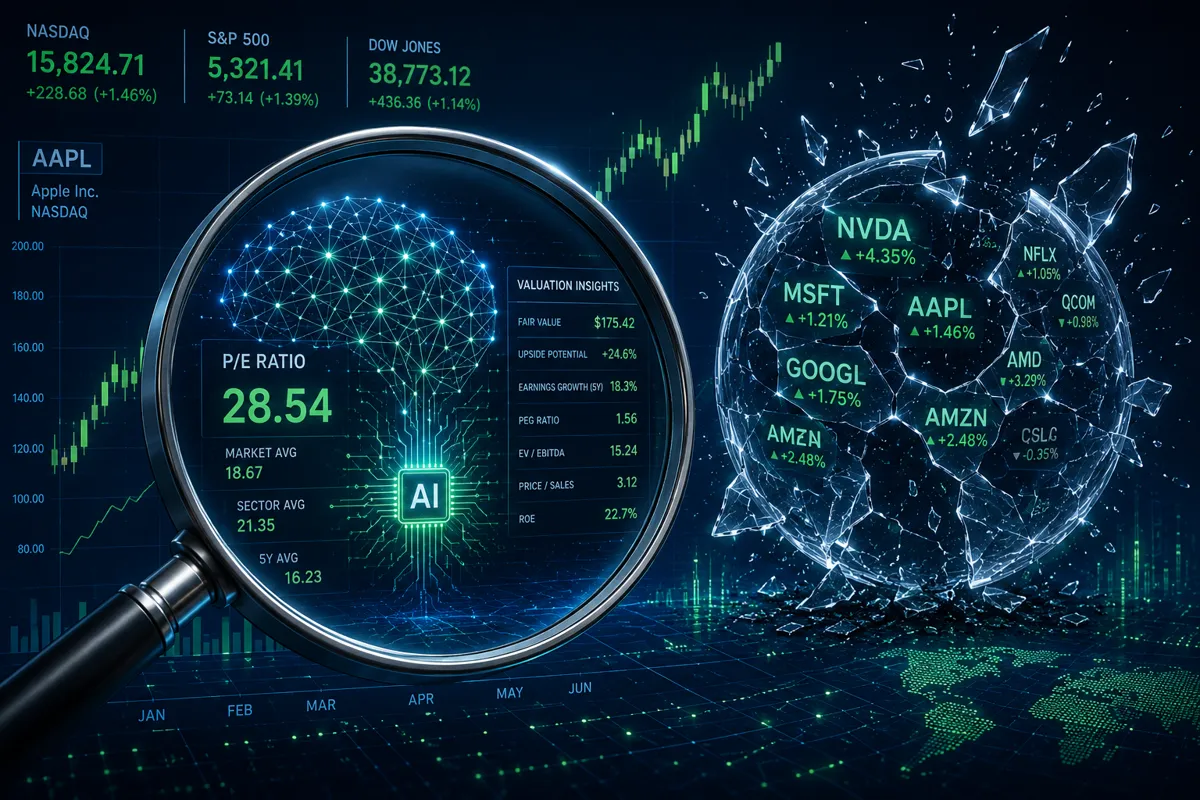
What Exactly Is an AI Stock Bubble — and Why Does It Matter in 2026?
An AI stock bubble means prices have detached from underlying business fundamentals, driven by narrative, fear of missing out (FOFO), and momentum rather than earnings power. It matters because bubbles don't announce themselves — they're only obvious in the rearview mirror, usually after a 40-60% drawdown.
Here's the uncomfortable truth: bubbles and booms are not mutually exclusive. The internet was a genuine revolution AND a speculative mania at the same time in 1999. Some companies survived and became the backbone of the modern economy. Most didn't. The same dynamic is playing out in AI right now.
What makes this cycle different:
- AI is already embedded in real business workflows — not just a promise
- Revenue at companies like Anthropic and OpenAI is growing at rates that were unthinkable two years ago
- But capital expenditure is also running at historic levels, with major hyperscalers collectively expected to spend roughly $750 billion on AI data centers by end of 2026
The risk isn't that AI is fake. The risk is that the market is pricing in perfection for companies that haven't proven they can convert infrastructure spending into durable profit margins.
A recent academic analysis concluded that AI represents a real technological revolution with "localized bubble dynamics" — meaning specific pockets of the market are speculative even as the broader trend is legitimate. That's exactly the nuance most retail investors miss.
AI Stock Bubble or Boom? The AI Tools That Help You Tell the Difference
This is the core question — and it's answerable, but not with vibes. The AI stock bubble or boom debate gets resolved at the individual stock level, using data, not debate.
The framework is simple: separate what a company earns from what the market charges you to own it. If the price assumes flawless execution for the next decade, you're paying for a story. If the price reflects current revenue with a reasonable growth premium, you might have a real setup.
The three-layer check:
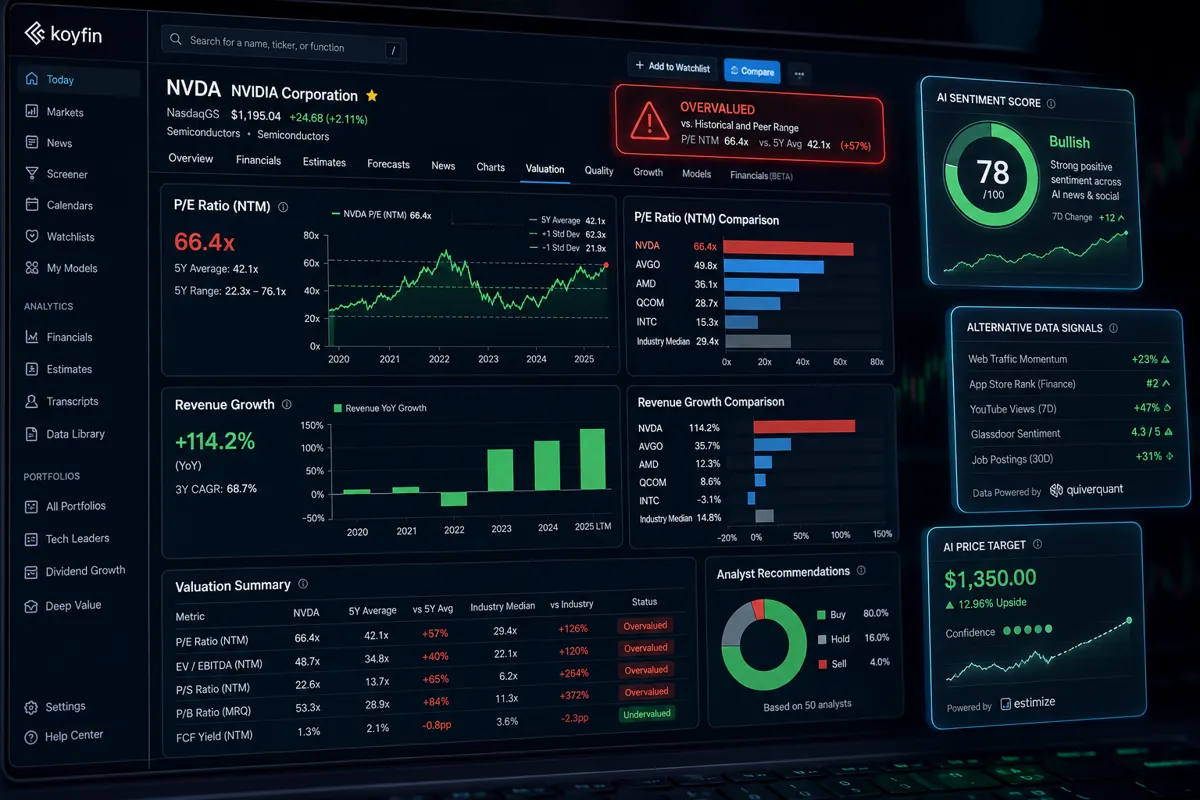
Valuation layer — Is the price-to-earnings (P/E) ratio, price-to-sales (P/S), or EV/EBITDA stretched versus historical norms and sector peers? Koyfin makes this comparison fast and visual, pulling historical multiples and peer benchmarks so you can see at a glance whether a stock is priced like a growth compounder or a lottery ticket.
Sentiment and alternative data layer — Is the bullish narrative being driven by actual institutional positioning or retail hype? AltIndex aggregates alternative data signals — app downloads, web traffic, hiring trends, social sentiment — to give you a ground-level read on whether a company's fundamentals are accelerating or decelerating before the earnings report says so.
AI confidence layer — Tickeron assigns AI-generated confidence ratings to price patterns and trade setups. It's not a crystal ball, but it's a useful sanity check: if a stock looks overextended on price action and Tickeron's pattern confidence is low, that's two signals pointing the same direction.
Use all three layers together. Any single data point is noise. Three converging signals are closer to a clean setup.
For a broader comparison of AI stock analysis tools across categories, the full tool directory at AI Stock Picker Apps covers 100+ platforms with side-by-side breakdowns.
How Do I Know If AI Stocks Are Overvalued?
Overvaluation shows up in the gap between what a company earns today and what the stock price implies it must earn in the future to justify that price. When that gap requires heroic assumptions, the stock is overvalued.
Concrete metrics to check:
| Metric | What It Measures | Red Flag Zone |
|---|---|---|
| Forward P/E | Price vs. next 12 months earnings | Above 60x for a non-hypergrowth name |
| Price-to-Sales (P/S) | Price vs. revenue | Above 20x with slowing growth |
| EV/EBITDA | Enterprise value vs. operating profit | Above 40x without margin expansion |
| Revenue growth rate | Is the business actually accelerating? | Slowing while multiple expands |
| Free cash flow margin | Is profit real or accounting fiction? | Negative FCF with no clear path to positive |
None of these numbers exist in isolation. A 50x P/E is defensible for a company growing revenue at 80% per year with expanding margins. It's a bull trap for a company growing at 12% with flat margins.
The common mistake: looking at absolute P/E without comparing it to growth rate. Use the PEG ratio (P/E divided by growth rate) as a quick normalizer. A PEG above 2 deserves extra scrutiny.
Tools like Stock Analysis and Stratosphere.io pull these fundamentals cleanly, letting you run the check in under five minutes without building a spreadsheet.
Warning Signs That an AI Stock Might Be a Bubble
Several specific signals, when they cluster together, suggest a stock is running on narrative rather than fundamentals. Spot two or three of these at once and the risk-reward has shifted against you.
The warning sign checklist:
- Valuation multiple expanding while revenue growth slows. The stock is getting more expensive as the business decelerates. That's a divergence that eventually closes — usually painfully.
- Leadership concentration. When 80% of a sector's gains are driven by five or six names, the rally is narrow. Narrow rallies are fragile.
- Analyst price target upgrades following the stock, not leading it. When Wall Street raises targets after a 40% run, they're chasing, not forecasting.
- Insider selling at scale. Executives know their business better than anyone. Consistent, large insider sales after a big run are worth noting.
- Revenue is real, but gross margins are compressing. AI infrastructure is expensive. If a company's revenue grows but margins shrink, the unit economics may not work at scale.
- The "picks and shovels" narrative applied to every company in the space. Not every company selling into the AI buildout has durable pricing power.
- Overextended price action with no consolidation. A stock that goes parabolic without basing or tight consolidation is a candidate for a dead cat bounce, not a sustained breakout.
Economist Torsten Sløk's warning that AI valuations exceed dot-com era peaks deserves to be taken seriously — not as a reason to avoid the sector entirely, but as a reason to be precise about which names you own and at what price.
Which AI Stocks Are Most Likely to Survive Long-Term?
Companies with durable AI advantages share a few structural traits: proprietary data, recurring revenue, high switching costs, and a clear path to free cash flow. The survivors of the dot-com era — Amazon, Google — weren't the flashiest names in 1999. They were the ones with real infrastructure and compounding advantages.
Traits of long-term AI survivors:
- Proprietary data moats. AI models are only as good as the data they're trained on. Companies sitting on unique, hard-to-replicate datasets have a structural edge.
- Recurring enterprise revenue. SaaS-style contracts with large enterprises are stickier than consumer-facing products. Churn rates matter.
- Vertical integration. Companies that control both the AI model and the distribution channel are harder to displace.
- Demonstrated margin expansion. Revenue growth is table stakes. Margin expansion proves the model works at scale.
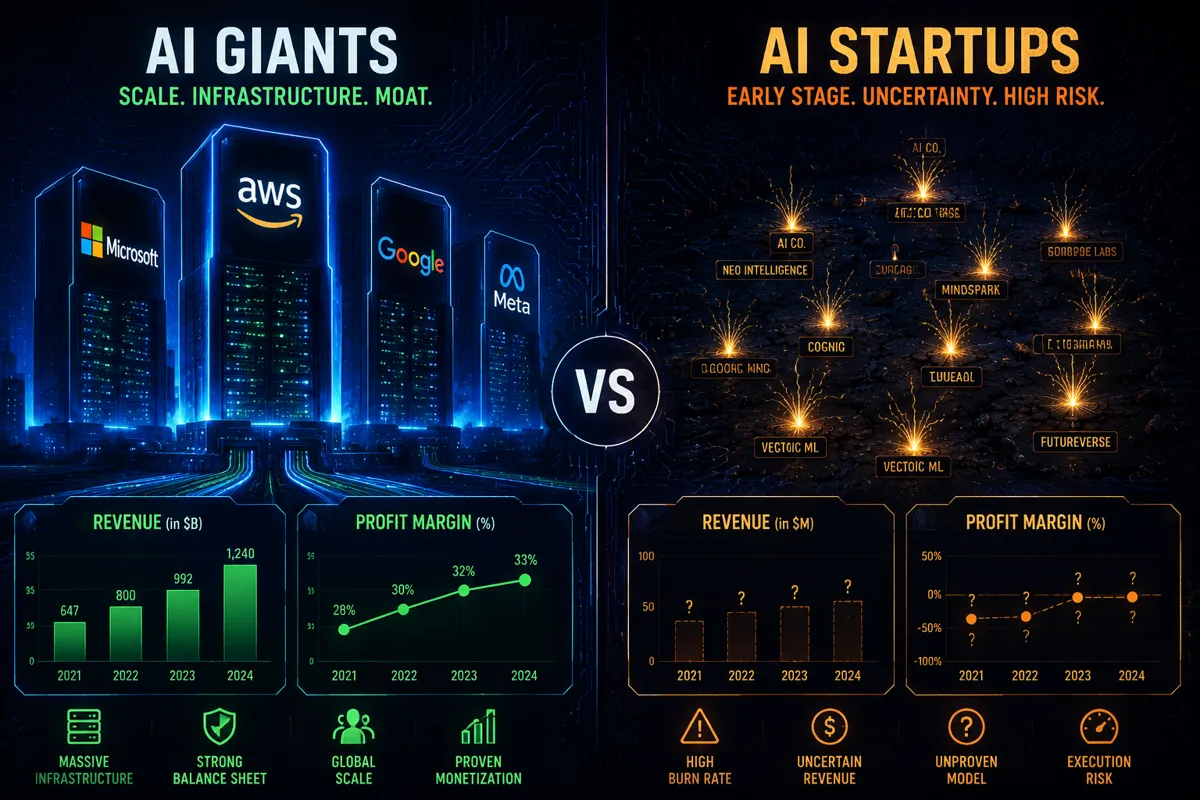
The hyperscalers — Alphabet, Amazon, Meta, Microsoft — have the balance sheets and infrastructure to weather a correction. That doesn't make them cheap, but it does make them structurally different from a startup burning cash on a single AI product.
For AI startups, the question is whether they have 18-24 months of runway and a clear path to profitability before the capital markets tighten. Many don't.
Are Big Tech Companies or AI Startups Better Investments?
Neither is universally better — it depends on your risk tolerance, time horizon, and position sizing. Big tech offers lower volatility and proven cash flows. AI startups offer higher potential upside with significantly higher risk of permanent capital loss.
The honest comparison:
| Factor | Big Tech AI (MSFT, GOOGL, AMZN) | AI Pure-Play Startups |
|---|---|---|
| Revenue visibility | High — diversified businesses | Low to medium |
| Valuation risk | Moderate — still elevated | High |
| Volatility | Lower | Much higher |
| Upside potential | Moderate | High (if they survive) |
| Downside risk | Contained by balance sheet | Can go to zero |
| Suitable for | Core portfolio position | Small speculative allocation |
The practical rule: size your AI startup exposure to what you can afford to lose entirely without it affecting your financial life. That's not pessimism — that's position sizing. Play stupid games, win stupid prizes applies directly to oversizing speculative tech positions.
Top AI Investment Tools for Tracking and Researching AI Stocks
The right AI stock analysis tools don't predict the future — they help you ask better questions faster. Here are the categories that matter and what to look for in each.
Valuation and fundamentals:
- Koyfin — Clean, institutional-grade charting with historical valuation multiples, peer comparisons, and macroeconomic overlays. If you want to see whether a stock's current P/E is stretched versus its five-year average and its sector, Koyfin makes that visual in seconds.
- Stock Analysis — Free, fast fundamentals including revenue trends, margin history, and balance sheet data.
- Stratosphere.io — Strong for financial statement analysis and KPI tracking across tech companies.
Sentiment and alternative data:
- AltIndex — Aggregates non-traditional signals: app store rankings, web traffic, job postings, social sentiment. Useful for catching fundamental shifts before they show up in earnings.
- Quiver Quantitative — Congressional trading data, lobbying disclosures, and institutional positioning. Cuts the noise on who's actually buying.
- Unusual Whales — Options flow data that flags unusual institutional activity before it becomes public knowledge.
AI confidence and pattern recognition:
- Tickeron — AI-generated pattern recognition with confidence scores. Useful for sanity-checking whether a technical setup has historical precedent.
- TrendSpider — Automated technical analysis, multi-timeframe trend detection, and backtesting.
- Intellectia AI — AI-powered stock research combining fundamental signals with sentiment analysis.
Screeners and scanners:
- BlackBox Stocks — Real-time options and equity scanning with unusual activity alerts.
- Use the free screener recipe builder to build custom filters without needing a Bloomberg terminal.
A comparative review of 12 AI stock prediction tools found only four were genuinely effective — which is exactly why comparing tools before committing time and money matters. The AI Stock Picker Apps directory is a good starting point.
What Metrics Do Experts Use to Evaluate AI Stock Potential?
Professionals evaluate AI stocks on a combination of growth quality, capital efficiency, and competitive moat — not just revenue trajectory. The metrics that separate signal from noise are the ones that reveal whether growth is sustainable or borrowed.
The expert's checklist:
- Revenue growth rate vs. consensus estimate. Is the company beating expectations consistently, or just meeting them?
- Gross margin trend. Expanding gross margins signal pricing power and operational leverage. Compressing margins signal commoditization.
- Rule of 40 score. For SaaS and AI software companies: revenue growth rate + free cash flow margin should exceed 40. Below 40 in a high-rate environment is a warning.
- Customer acquisition cost (CAC) vs. lifetime value (LTV). If it costs more to acquire a customer than that customer generates, the model doesn't scale.
- Net revenue retention (NRR). Above 120% means existing customers are spending more over time. Below 100% means churn is eating growth.
- Days sales outstanding (DSO). Rising DSO can signal customers are struggling to pay, which precedes revenue recognition problems.
The free Stock Health Scorecard aggregates several of these signals into a single score — useful as a first-pass filter before going deeper.
Common Mistakes Investors Make With AI Tech Stocks
The mistakes aren't unique to AI — they're the same behavioral traps that show up in every hot sector. The sector changes; the psychology doesn't.
The recurring errors:
- Confusing the technology with the stock. AI is a transformative technology. That doesn't mean every AI stock is a good investment at any price. The technology can win while the stock loses.
- Chasing after the breakout. A stock that's already up 200% on AI enthusiasm requires a lot more to go right from here. Buying overextended is catching a falling knife in slow motion.
- Ignoring position sizing. Putting 20% of a portfolio into a single AI name because you're confident in the thesis is how accounts get blown up. Confidence is not a substitute for risk management.
- Analysis paralysis. Having six AI stock analysis tools open and still not making a decision isn't diligence — it's avoidance. Pick a process, run the check, make the call.
- Revenge trading after a loss. Getting stopped out of an AI position and immediately re-entering to "get it back" is one of the most reliable ways to compound a bad trade.
- Ignoring the macro setup. AI stocks are long-duration assets — their valuations are especially sensitive to interest rate changes. A rate spike that looks small in isolation can reprice the entire sector.
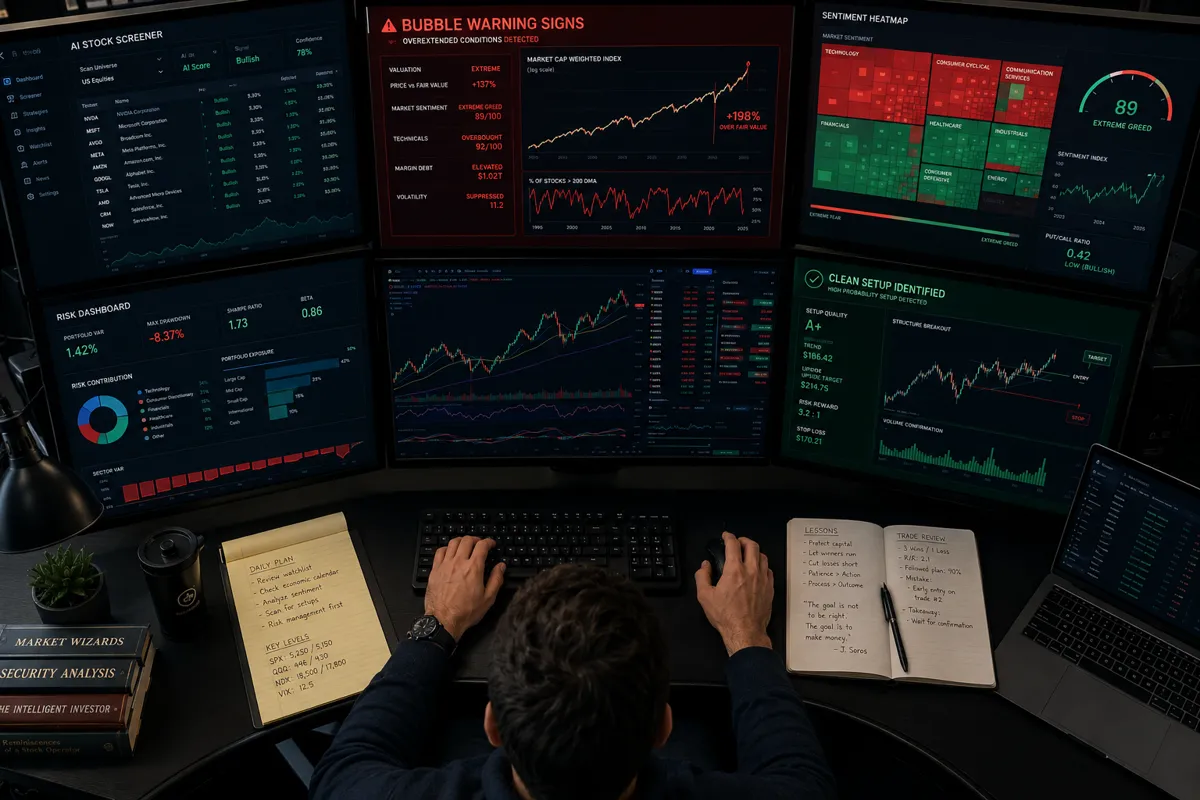
The fix for all of these is the same: a written process. Entry criteria, exit criteria, position size, stop loss. Written down before the trade, not improvised during it.
How Much Should I Invest in AI Stocks Right Now?
There's no universal number — but there is a framework. The right allocation depends on your time horizon, risk tolerance, and how much of your portfolio you can afford to have locked in a volatile sector without it affecting your financial stability.
A practical allocation framework:
- Conservative investor (5-10 years to retirement, lower risk tolerance): 5-10% of the equity portfolio in AI-related names, weighted toward diversified ETFs or large-cap hyperscalers rather than pure-play startups.
- Moderate investor (10+ year horizon, comfortable with volatility): 15-20% in AI, split between established names and a small speculative allocation to higher-growth plays.
- Active trader: Position size per trade based on the risk-reward of the specific setup, not conviction in the theme. A 2% portfolio risk per trade is a common professional benchmark.
The rule that never changes: never size a position so large that a 50% drawdown in that position materially changes your life. That's not pessimism — that's the foundation of staying in the game long enough to be right.
For active traders building a watchlist and planning entries, the free swing trade planner helps structure the risk-reward before the trade, not after.
Risks of Investing in AI Technology Companies
The risks are real and specific. Understanding them doesn't mean avoiding AI stocks — it means pricing the risk correctly.
Key risks to model:
- Valuation compression. If interest rates rise or growth disappoints, high-multiple stocks reprice fast. A stock at 60x earnings that re-rates to 30x loses half its value even if earnings don't change.
- Concentration risk. A significant portion of AI sector gains are concentrated in a handful of names. If those names correct, the sector corrects.
- Regulatory risk. AI regulation is accelerating globally. New rules around data privacy, model transparency, or antitrust could materially change the competitive landscape overnight.
- Capital cycle risk. The current AI infrastructure buildout assumes sustained demand. If enterprise AI adoption slows or ROI on AI investments disappoints, capex will get cut — and the companies supplying that infrastructure will feel it first.
- Commoditization risk. AI models are getting cheaper and more accessible. Companies whose moat is "we have a good AI model" face a shrinking moat as the technology becomes a commodity.
The SEC's investor education resources at Investor.gov cover the basics of evaluating technology company risk disclosures — worth reviewing before sizing up in any speculative sector.
Which AI Sectors Look Most Promising for Long-Term Investment?
The most defensible AI investment opportunities are in sectors where AI solves a specific, high-value problem with measurable ROI — not sectors where AI is a buzzword layered onto an existing product.
Sectors with structural tailwinds:
- Healthcare AI. FDA-approved AI medical devices grew from 6 in 2015 to 223 in 2023. Diagnostic AI, drug discovery, and clinical workflow automation have clear value propositions and regulatory validation.
- Enterprise software. AI-native software companies replacing legacy workflows have high switching costs and recurring revenue. The key is finding names where AI is the core product, not a feature.
- AI infrastructure. Data centers, semiconductor design, power management, and cooling technology are the picks-and-shovels layer. Less glamorous, but the demand is structural.
- Financial services AI. Fraud detection, credit underwriting, and algorithmic trading are areas where AI has demonstrated measurable performance improvements over legacy systems.
- AI coding and developer tools. Anthropic's Claude Code and similar tools are driving real productivity gains — and the companies building on top of these tools are seeing the ROI show up in headcount efficiency.
The sectors to be more cautious about: consumer AI applications with low switching costs and no clear monetization model, and AI companies whose primary revenue is still consulting rather than scalable software.
How Do I Protect My Portfolio From an AI Market Crash?
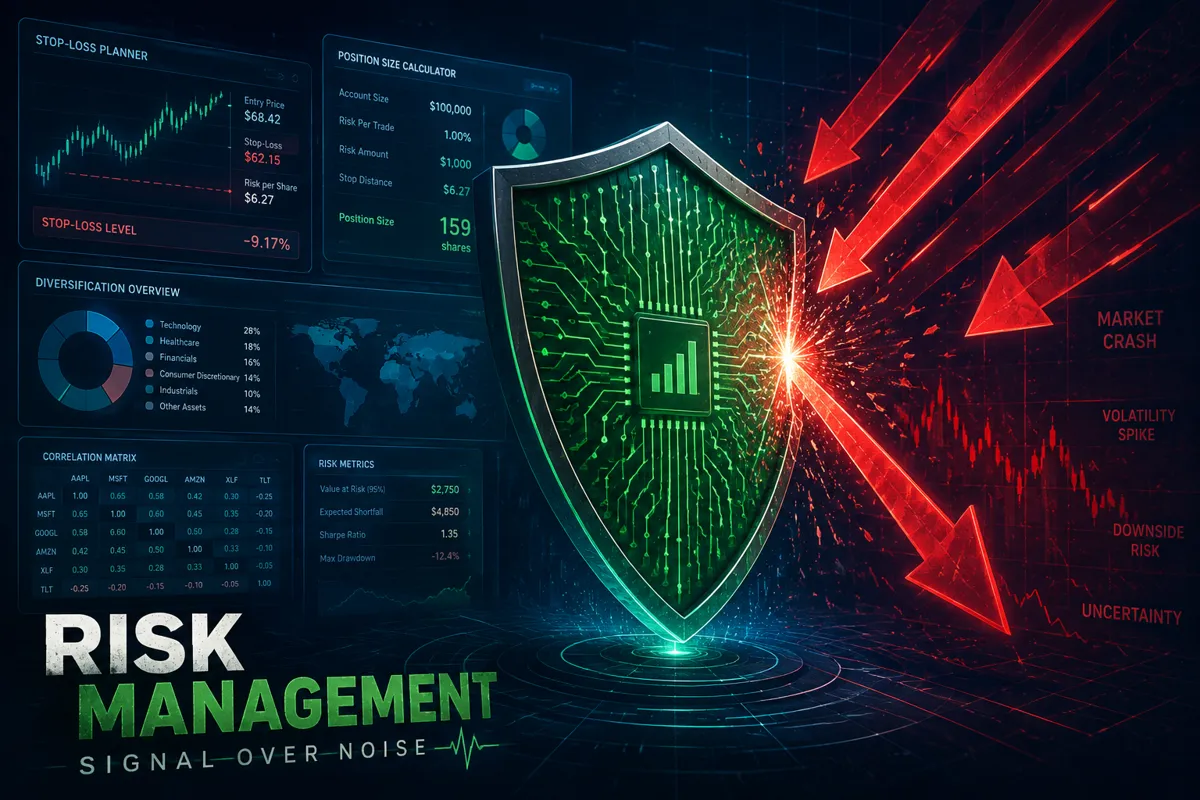
Protection starts before the crash, not during it. The traders who survive sector corrections are the ones who sized positions appropriately, set stop losses in advance, and didn't let a theme become an identity.
The protection playbook:
- Diversify across the AI value chain. Don't concentrate in pure-play AI software. Mix in infrastructure, semiconductors, and diversified tech.
- Use stop losses — and honor them. A stop loss is a pre-committed exit point below your entry. Getting stopped out hurts less than watching a 20% loss become 50%.
- Size down, not up, when volatility increases. A choppy tape is not the time to add to losing positions. Reduce exposure and wait for the setup to clarify.
- Hold cash as a position. Cash isn't a missed opportunity — it's dry powder for when the correction creates real entry points.
- Rebalance on strength. If AI positions have grown to an outsized share of the portfolio due to appreciation, trim into strength rather than waiting for a reversal.
- Paper trade new AI tools before risking real capital. If you're using a new AI stock analysis tool to inform decisions, paper trade it first. Validate the signal before betting on it.
FAQ
Is the AI stock market in a bubble in 2026?
Parts of it are, and parts aren't. Academic analysis describes AI as a real technological revolution with localized bubble dynamics — meaning specific stocks are speculative while the broader trend is legitimate. The answer depends on which stocks you're looking at and what you paid for them.
How do I tell if an AI stock is overvalued?
Compare the current valuation multiple (P/E, P/S, EV/EBITDA) against the company's historical range and sector peers. If the multiple requires heroic growth assumptions to justify, it's overvalued relative to risk. Tools like Koyfin make this comparison fast and visual.
What are the best AI stock analysis tools for retail investors?
Koyfin for valuation multiples, AltIndex for alternative data and sentiment, Tickeron for AI pattern confidence ratings, and TrendSpider for technical analysis automation. The AI Stock Picker Apps directory compares 100+ tools with detailed breakdowns.
How much of my portfolio should be in AI stocks?
A general framework: 5-10% for conservative investors, 15-20% for moderate investors with a long time horizon, and position-sized per trade for active traders using a defined risk-reward framework. Never size a position so large that a 50% drawdown changes your financial life.
What warning signs suggest an AI stock is a bubble?
Watch for: valuation multiple expanding while revenue growth slows, insider selling at scale, gross margin compression, overextended price action without consolidation, and analyst upgrades that follow the stock rather than lead it.
Are AI ETFs safer than individual AI stocks?
Generally yes — diversification reduces the impact of any single company's failure. But AI ETFs can still be overvalued as a group if the sector is broadly stretched. Check the ETF's top holdings and their individual valuations before assuming the ETF is conservative.
What's the difference between AI stocks and regular tech stocks?
AI stocks are typically priced on future potential rather than current earnings, carry higher valuation multiples, and are more sensitive to interest rate changes and narrative shifts. Regular tech stocks with mature business models have more predictable cash flows and lower multiple risk.
Should I invest in big tech AI or AI startups?
Big tech AI (MSFT, GOOGL, AMZN, META) offers lower volatility and balance sheet protection. AI startups offer higher upside with significantly higher risk of permanent capital loss. Most retail investors are better served by a core big-tech position with a small, explicitly speculative allocation to startups — sized to what they can afford to lose entirely.
How do AI sentiment tools work?
Platforms like AltIndex aggregate non-traditional data — app downloads, web traffic, social media volume, job postings — and use machine learning to identify signals that correlate with stock price movements before they show up in earnings reports. They're a supplement to fundamental analysis, not a replacement.
Can AI tools predict a market crash?
No. AI stock analysis tools identify patterns, flag anomalies, and surface data — they don't predict macro events. Their value is in improving the quality of your research process, not in forecasting the future. Anyone selling a tool that claims to predict crashes is selling you something else entirely.
What is the Rule of 40 for AI stocks?
The Rule of 40 is a benchmark for software and AI companies: revenue growth rate plus free cash flow margin should equal or exceed 40. It balances growth and profitability. A company growing at 50% with -15% FCF margin scores 35 — below the threshold, which signals the growth may not be sustainable at current burn rates.
What's FOFO and why does it matter for AI investing?
FOFO is Fear of Finding Out — the tendency to avoid checking whether your thesis is still valid because the answer might be uncomfortable. It's what keeps investors holding overvalued AI stocks long after the warning signs appeared. The fix is a scheduled, systematic review of your positions using objective metrics, not vibes.
Conclusion
The AI stock bubble or boom question doesn't have a single answer for the whole sector — it has a different answer for every stock, at every price, at every moment. That's not a cop-out; it's the actual mechanics of how markets work.
What's clear in 2026 is this: the capital flowing into AI is real, the revenue is real, and the productivity gains are real. What's also real is that some valuations have run so far ahead of fundamentals that they've priced in a decade of perfect execution. Those two things can be true simultaneously.
The investors who navigate this correctly won't be the ones who made the right call on whether AI is a bubble or a boom. They'll be the ones who built a repeatable process: check the valuation, read the sentiment, size the position, set the stop, and let the data — not the narrative — drive the decision.
That's what AI stock analysis tools are actually for. Not to predict the future. To cut the noise and keep the alpha.
Your next three moves:
- Run your current AI holdings through a valuation check — compare current multiples to 3-year historical averages using Koyfin or Stock Analysis.
- Add an alternative data layer with AltIndex or Quiver Quantitative to see whether institutional behavior aligns with the narrative you're hearing.
- Use the free Stock Health Scorecard to get a quick signal-to-noise read on any name before it goes on your watchlist.
The tools are there. The data is available. The only thing standing between a retail investor and a professional-grade research process is the decision to use one.
FullStack Alpha cuts the noise so you can keep the alpha. See the AI tools, scanners, and systems we actually rate at aistockpickerapps.com.
References
Meta Amazon Oracle Data Centers - https://www.axios.com/2026/06/10/meta-amazon-oracle-data-centers?utm_source=openai
Ai Bubble Is Worse Than The Dot Com Crash That Erased Trillions Economist Warns Overvaluations Could Lead To Catastrophic Consequences - https://www.tomshardware.com/tech-industry/artificial-intelligence/ai-bubble-is-worse-than-the-dot-com-crash-that-erased-trillions-economist-warns-overvaluations-could-lead-to-catastrophic-consequences?utm_source=openai
Ai Bubble Tech Experts Say Ai Boom Is Just The Beginning - https://www.kiplinger.com/investing/ai-bubble-tech-experts-say-ai-boom-is-just-the-beginning?utm_source=openai
theatlantic - https://www.theatlantic.com/economy/2026/05/ai-bubble-revenue-anthropic/687022/?utm_source=openai
arxiv - https://arxiv.org/abs/2606.01575?utm_source=openai
Best Ai Stock Market Prediction Tools 2026 - https://getaitoolhub.com/articles/best-ai-stock-market-prediction-tools-2026?utm_source=openai