AI Portfolio Management: Where It Beats Doing It Yourself
Last updated: June 30, 2026
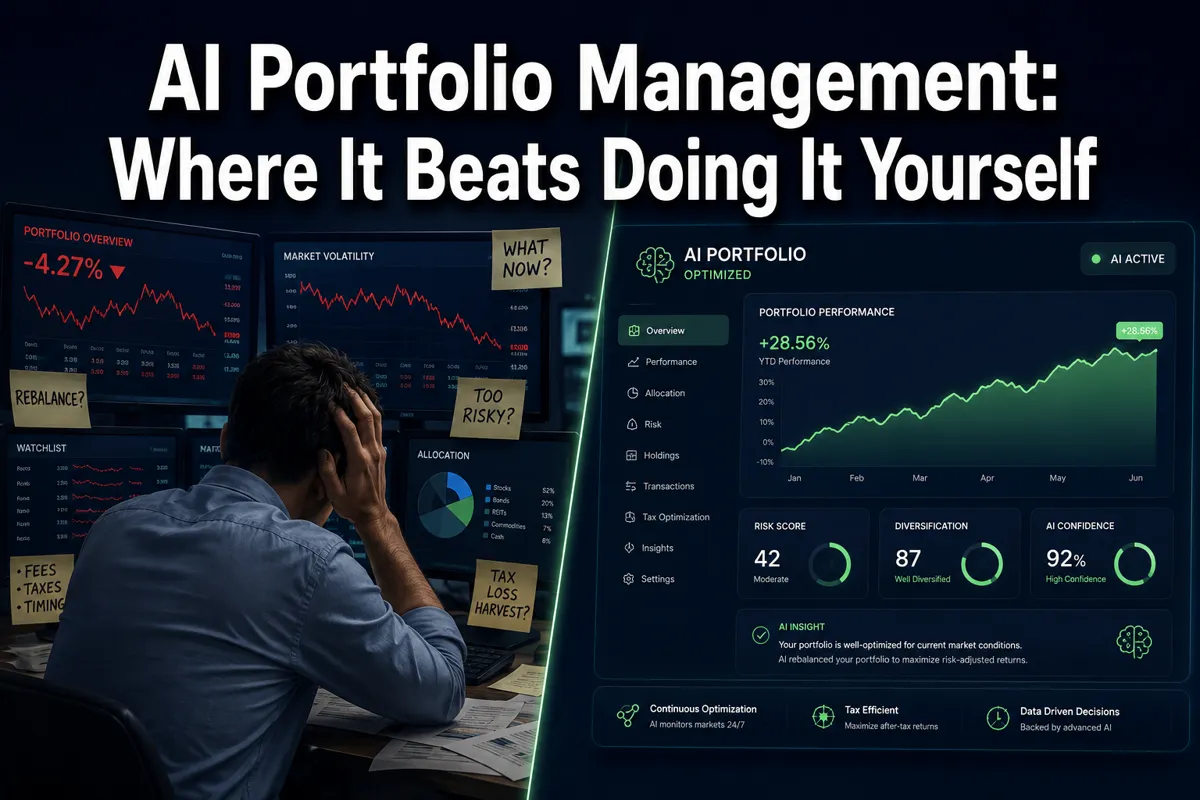
Quick Answer: AI portfolio management uses algorithms to automate allocation, rebalancing, and risk monitoring — and in specific, well-defined tasks, it consistently outperforms the average DIY investor. Not because AI is smarter than humans in a general sense, but because it doesn't panic, doesn't revenge trade, and doesn't check its portfolio 14 times a day. For passive investors and anyone who wants discipline without the daily grind, AI portfolio management in 2026 is worth taking seriously.
Key Takeaways
- AI portfolio management automates allocation, rebalancing, and tax-loss harvesting with fewer emotional errors than most retail investors make manually.
- The clearest edge AI has over DIY isn't stock picking — it's process consistency: no panic selling, no overtrading, no analysis paralysis.
- Robo-advisors (like Betterment or Wealthfront) and AI portfolio tools are different products with different use cases. Knowing which one you need matters.
- Cost ranges from free (basic tools) to around 0.25%–0.50% annually for managed AI platforms — often cheaper than a human advisor's 1%+ fee.
- AI portfolio management underperforms in highly volatile, low-liquidity environments where human judgment and reading the tape still matter.
- Beginners benefit most from the guardrails. Active traders benefit most from AI as a research and screening layer, not a full autopilot.
- You can lose money with AI portfolio management. The market doesn't care who's managing your account.
- The biggest mistake people make: treating AI as a guarantee instead of a system.
What Is AI Portfolio Management and How Does It Work?
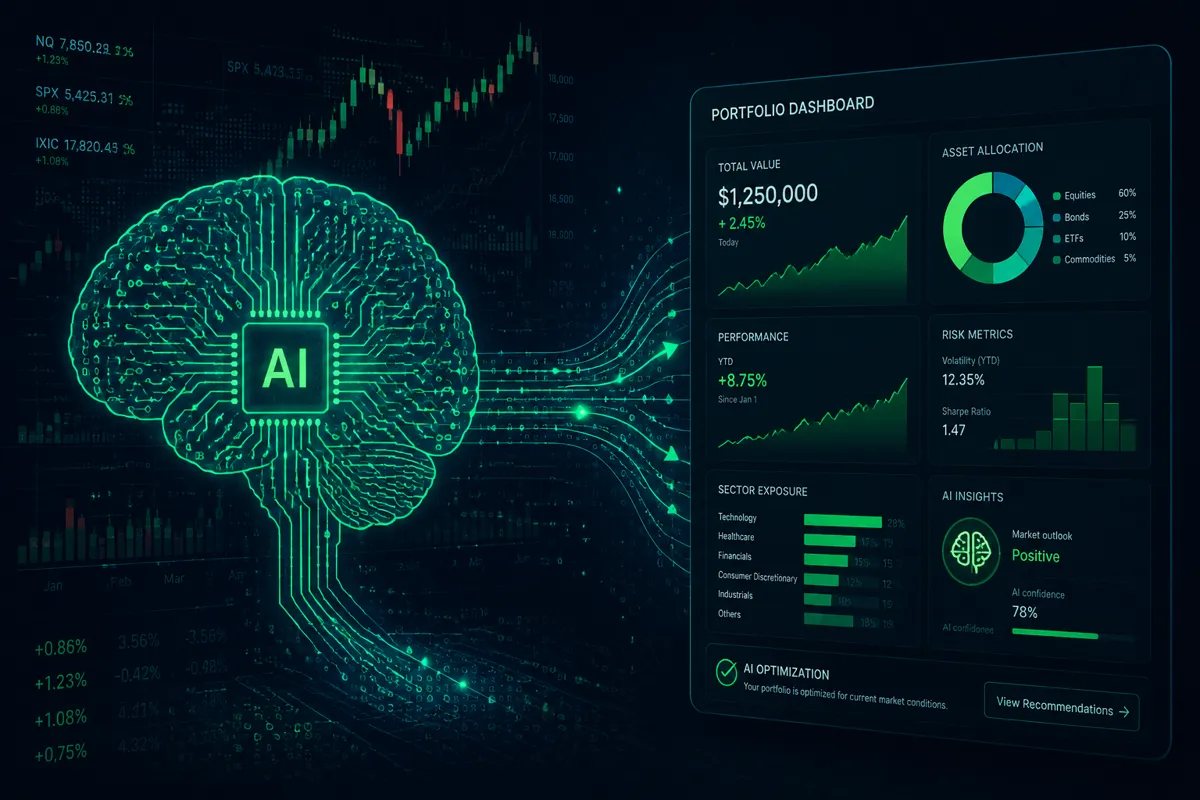
AI portfolio management uses machine learning algorithms and rules-based automation to handle investment decisions that most retail investors do manually — and inconsistently. The system ingests data (price history, fundamentals, macro signals, risk parameters), runs it through a model, and executes allocation or rebalancing decisions without waiting for you to feel ready.
Here's the basic workflow:
- Onboarding: You set your goals, risk tolerance, and time horizon. The AI uses these as constraints.
- Allocation: The model assigns weights to assets based on expected risk-adjusted return — not gut feel.
- Monitoring: The system watches for drift. If your equity allocation climbs from 70% to 78% because of a bull run, it flags or auto-corrects.
- Rebalancing: Either at set intervals or when drift crosses a threshold, the AI rebalances back to target — automatically.
- Tax optimization: More advanced platforms (like Wealthfront) layer in tax-loss harvesting, selling losers to offset gains without you lifting a finger.
The AI isn't predicting the future. It's executing a process better than most humans execute it manually. That's the actual edge.
AI Portfolio Management: Where It Beats Doing It Yourself
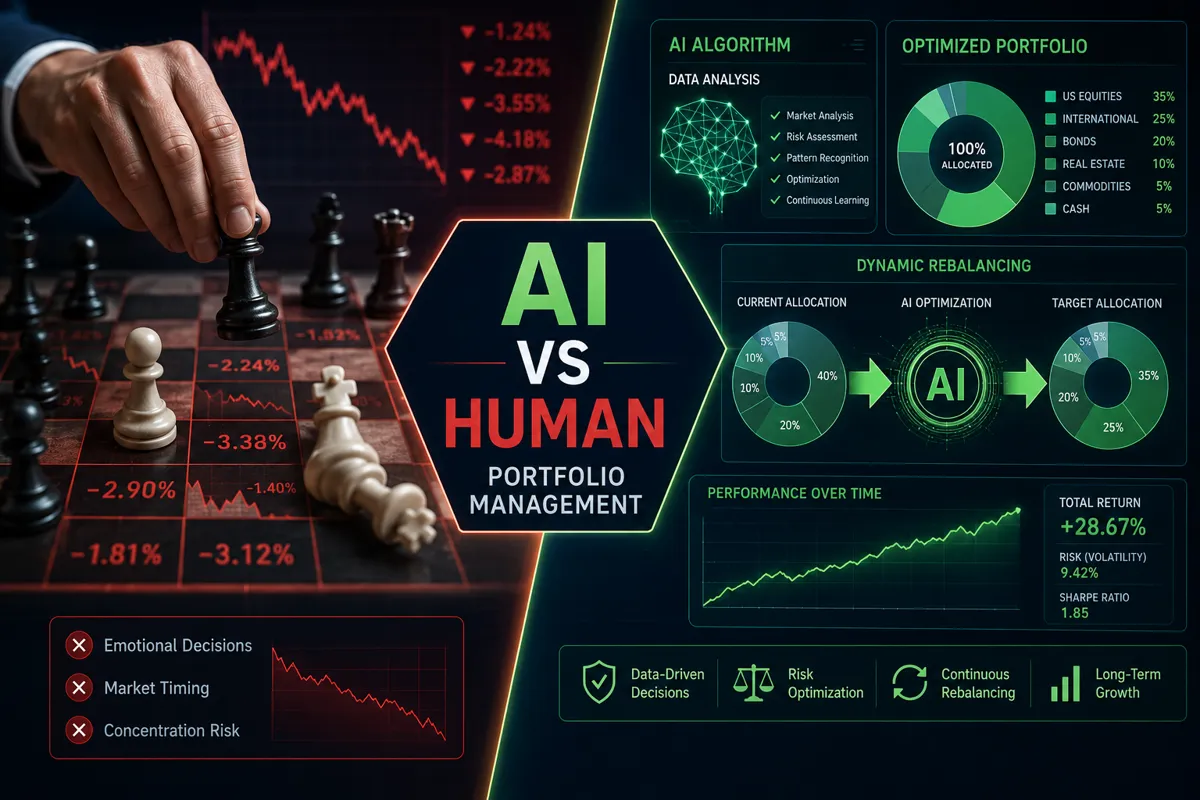
This is the core question. And the honest answer is: AI beats DIY in the places where human behavior is the problem — which, for most retail investors, is most of the time.
Where AI wins clearly:
- Rebalancing discipline. Most DIY investors rebalance too late, too emotionally, or not at all. AI rebalances on schedule, without hesitation.
- Tax-loss harvesting. Doing this manually requires constant attention. Platforms like Wealthfront's automated tax layer handle it continuously.
- Eliminating revenge trading. You can't override an AI at 2 a.m. because a stock dropped 8% and you're convinced it'll bounce. That's a feature, not a bug.
- Position sizing consistency. AI applies the same risk-reward logic to every trade. Humans don't. They size up on conviction and size down on fear — usually at exactly the wrong times.
- Speed and data processing. AI can screen thousands of securities and monitor dozens of signals simultaneously. You cannot.
Where DIY still holds its own:
- Navigating genuinely unprecedented events (think: a novel macro shock with no historical analog).
- Situations requiring qualitative judgment — management changes, regulatory shifts, geopolitical wildcards.
- Active trading strategies where reading the tape and reacting to price action in real time matters.
The bottom line: if your biggest enemy is your own behavior — and for most retail investors, it is — AI portfolio management gives you a structural advantage.
AI Portfolio Management vs Robo-Advisors: What's the Difference?
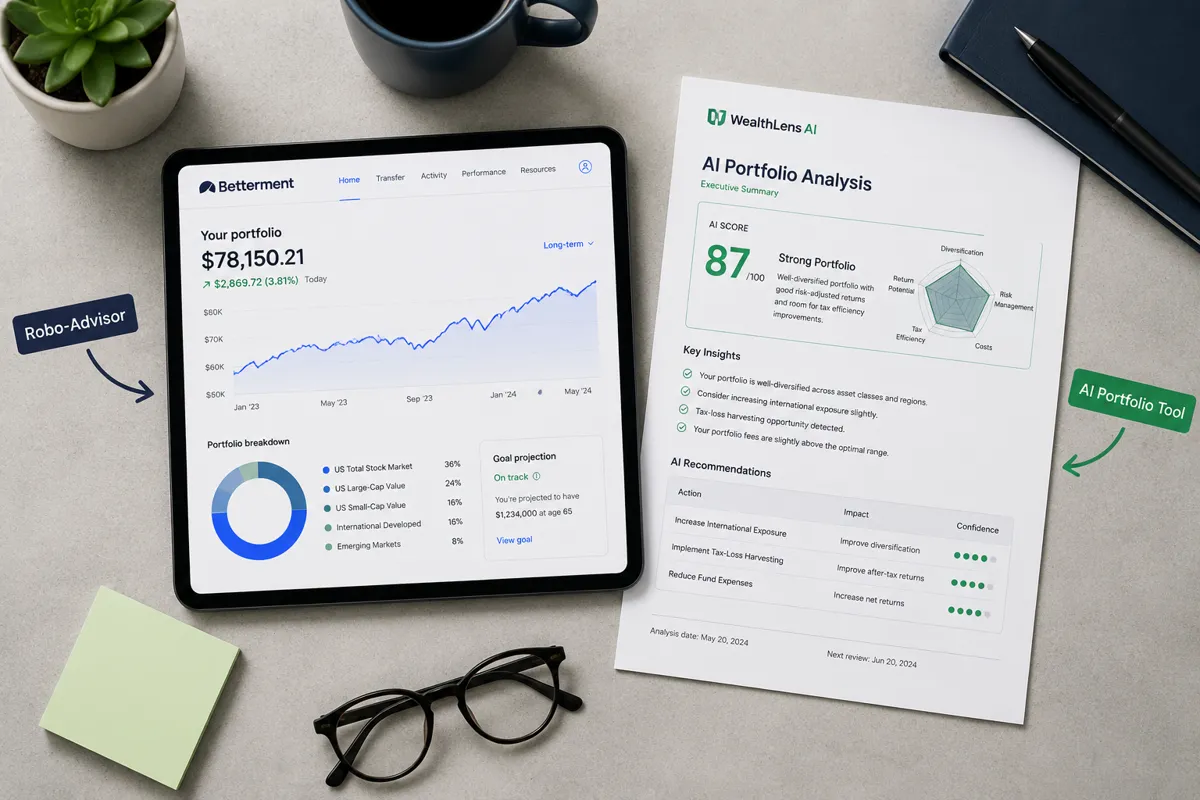
Robo-advisors are a subset of AI portfolio management, not the same thing. Robo-advisors (Betterment, Wealthfront) are fully managed, set-it-and-forget-it platforms. AI portfolio tools are more like intelligent co-pilots you can direct.
| Feature | Robo-Advisor | AI Portfolio Tool |
|---|---|---|
| Control level | Low (automated) | High (user-directed) |
| Customization | Limited | Moderate to high |
| Best for | Passive, long-term investors | Active or semi-active investors |
| Cost | 0.25%–0.50%/yr | Free to ~$50/month |
| Examples | Betterment, Wealthfront | Magnifi, Stock Rover, Danelfin |
Betterment is the benchmark robo-advisor — straightforward, low-cost, and genuinely good at what it does. If you want full autopilot, it's hard to argue with.
Magnifi takes a different approach — conversational AI that helps you build and analyze ETF-focused portfolios. More interactive, more control. For investors who want to stay involved without doing everything manually, that's a better fit.
For a broader comparison of robo-advisor options, the robo-advisor comparison page breaks down the field in detail.
How Much Does AI Portfolio Management Cost?
Cost depends on what you're buying. Here's the honest breakdown for 2026:
- Free tier: Basic AI screening and portfolio analysis tools (Stock Rover's free plan, some screener tools at aistockpickerapps.com/screeners).
- Robo-advisor tier: 0.25%–0.50% annually on assets under management. On a $50,000 portfolio, that's $125–$250/year. Cheaper than most human advisors.
- AI portfolio tool subscriptions: Roughly $20–$100/month for platforms with active AI signals, rebalancing alerts, and deeper analytics.
- Human financial advisor: Typically 1%–1.5% AUM annually. On that same $50,000 portfolio, that's $500–$750/year — for advice that may or may not beat the AI.
The cost comparison isn't even close at the lower end. The question is whether the more expensive AI tools deliver enough signal over noise to justify the subscription. That depends entirely on how much you use them.
Does AI Portfolio Management Actually Outperform the Market?
Here's where the hype gets dangerous. Most AI portfolio management platforms don't promise market-beating returns — and the ones that do should be treated with serious skepticism.
What the data shows (broadly, from academic and industry research on algorithmic and robo-advisory performance):
- Robo-advisors generally match or slightly trail broad index benchmarks before fees, and match or slightly beat them after accounting for tax-loss harvesting benefits.
- AI-driven active strategies show mixed results. Some quantitative hedge funds (Renaissance Technologies being the famous outlier) have delivered exceptional long-term returns. Most retail-facing AI tools have not replicated that.
- The real outperformance isn't in raw returns — it's in risk-adjusted returns and behavioral correction. Investors using automated platforms tend to stay invested longer, avoid panic selling, and end up with better outcomes than DIY investors who trade emotionally.
The honest position: AI portfolio management isn't a market-beating machine. It's a behavior-correcting machine. For most retail investors, that's worth more.
Best AI Portfolio Management Tools and Platforms in 2026
No single tool wins for every investor. Here's a practical breakdown by use case:
For passive, set-it-and-forget-it investors:
- Betterment — clean interface, solid diversification, automatic rebalancing.
- Wealthfront — best-in-class tax-loss harvesting, slightly more customizable.
For active investors who want AI as a research layer:
- Magnifi — conversational AI for ETF portfolio building and analysis.
- Stock Rover — deep fundamental screening and portfolio X-ray analysis. Strong rebalancing signals for self-directed investors.
- Danelfin — AI stock scoring model that layers onto your existing portfolio to flag risk and opportunity.
For traders who want AI-assisted screening and signals:
- Edgeful — data-driven edge detection for active traders.
- TrendSpider — automated technical analysis and pattern recognition.
For a broader view of what's available, the investing tools directory covers 100+ platforms with side-by-side comparisons.
What Are the Risks of Using AI to Manage Your Portfolio?
AI portfolio management carries real risks. Anyone selling you on a frictionless, risk-free automated wealth machine is running a pitch, not a service.
Key risks to know:
- Model risk: AI models are trained on historical data. When market conditions shift in ways the model hasn't seen, it can misfire. The 2020 COVID crash and the 2022 rate shock both created environments that broke assumptions baked into many algorithms.
- Overfitting: A model that performed brilliantly in backtesting may have been optimized for past conditions that no longer exist. Past performance is not a clean setup for future results.
- Lack of transparency: Many AI platforms don't fully disclose how their models make decisions. You're trusting a black box. That's fine if you understand the limitations — dangerous if you don't.
- Complacency: The biggest behavioral risk of automation is that investors stop paying attention entirely. AI doesn't eliminate the need for oversight. It reduces the frequency, not the necessity.
- Concentration risk: Some AI tools chase momentum and can end up heavily concentrated in sectors that are overextended. Check your allocations periodically.
Can you lose money with AI portfolio management? Yes. Absolutely. The market doesn't care whether a human or an algorithm made the call. Drawdowns happen. Crashes happen. AI can reduce behavioral errors but it can't eliminate market risk.
Can AI Portfolio Management Work During Market Crashes?
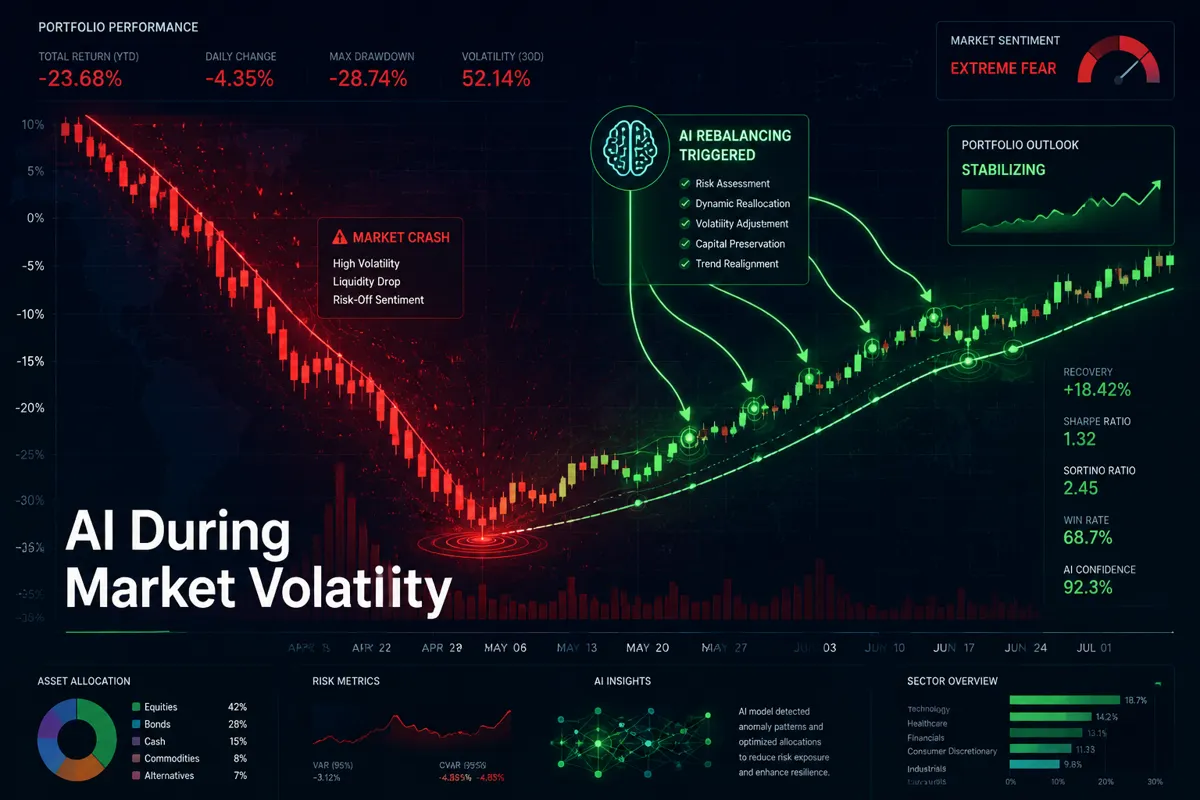
During crashes, AI portfolio management has a mixed record — and that's the honest answer. In a slow, grinding bear market, automated rebalancing and tax-loss harvesting actually shine. In a sudden, violent crash (a flash crash, a liquidity event, a black swan), algorithmic systems can amplify volatility rather than dampen it.
What tends to work:
- Automatic rebalancing that buys equities as they fall (dollar-cost averaging effect).
- Tax-loss harvesting that captures losses for future tax benefit.
- Stop-loss parameters that prevent catastrophic drawdowns.
What doesn't work as well:
- Models that freeze or misfire when correlations break down (everything falling together, no safe haven).
- Platforms without human override options.
- Investors who panic and manually override the AI at the worst possible moment — which defeats the entire purpose.
The setup that survives crashes: AI handles the process, you set the parameters, and you don't touch it when the tape gets choppy.
Who Should Use AI Portfolio Management — and Who Shouldn't
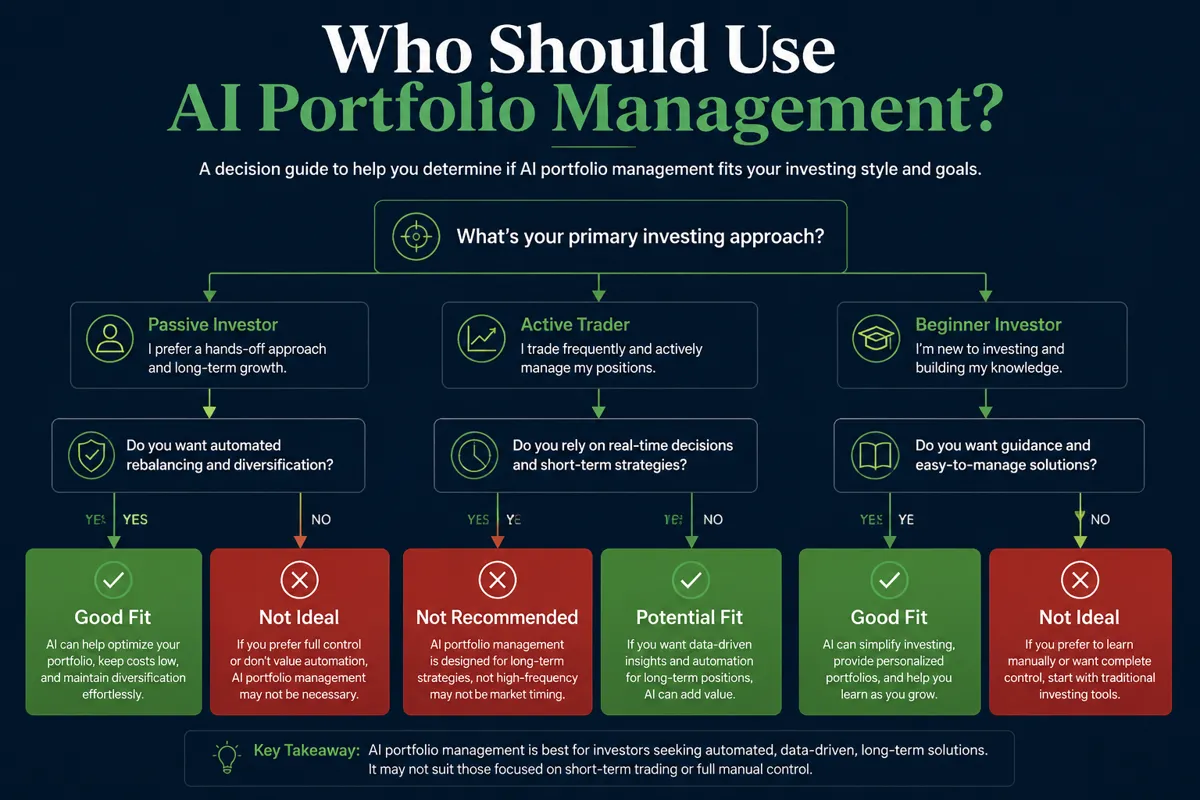
AI portfolio management is a tool. Like any tool, it works better in some hands than others.
Good fit:
- Passive investors who want market exposure without active management headaches.
- Investors who know they're prone to emotional decisions — revenge trading, panic selling, overtrading.
- People with less than $500K who can't cost-justify a human advisor.
- Beginners who need guardrails while they learn. Paper trade it first, then let the AI manage the real account.
Not a good fit:
- Active day traders who need to read the tape and react in real time. AI portfolio tools aren't built for that cadence.
- Investors with highly complex situations — business ownership, concentrated stock positions, estate planning needs — where a human advisor earns their fee.
- Anyone who won't check in at all. Automation reduces oversight requirements; it doesn't eliminate them.
FOFO (Fear of Finding Out) is real. A lot of investors avoid AI tools because they're afraid of what the analysis will show about their current portfolio. That's exactly why you should run the analysis.
Common Mistakes People Make with AI Portfolio Managers
Play stupid games, win stupid prizes — and this applies directly to how most people misuse AI portfolio management.
The most common mistakes:
- Setting it and forgetting it completely. Check your allocations quarterly at minimum. Goals change. Life changes. The model doesn't know that.
- Overriding the AI emotionally. If you're going to second-guess every rebalancing decision, you've paid for a tool you don't trust. Either trust the process or don't use it.
- Choosing the wrong platform for your actual behavior. A robo-advisor is wrong for an active trader. An active AI signal tool is wrong for a passive investor. Fit matters.
- Ignoring fees on small accounts. A 0.40% fee on a $5,000 account is $20/year — fine. On a $500 account, the math starts to hurt.
- Treating AI accuracy as certainty. AI portfolio management accuracy improves with more data and longer time horizons. Short-term predictions are still noisy. Don't bet the farm on a 30-day AI forecast.
How to Set Up AI Portfolio Management for Your Investments
Getting started doesn't require a finance degree. Here's a clean, practical sequence:
- Define your goal. Retirement in 20 years? Income in 5? Capital preservation now? The AI needs a target.
- Set your risk tolerance honestly. Not what you think you can handle — what you've actually handled in past drawdowns. If a 20% drop made you sell everything in 2022, set a conservative allocation.
- Choose the right platform. Passive investor? Start with Betterment or Wealthfront. Want more control? Look at Magnifi or Stock Rover.
- Fund the account and let the AI set the initial allocation. Don't override it on day one because you "have a feeling" about tech stocks.
- Set a calendar reminder to review quarterly. Check allocations, confirm the strategy still matches your goals, and resist the urge to tinker.
- Track your results against a benchmark. A simple S&P 500 index is a fair benchmark for most portfolios. If you're consistently underperforming it after fees, something needs to change.
For more tools and platforms to layer into this process, the FullStack Alpha blog covers new AI tools as they launch.
AI Portfolio Management vs Hiring a Financial Advisor
For most retail investors with straightforward goals and portfolios under $500K, AI portfolio management in 2026 wins on cost, consistency, and accessibility. A human advisor wins on complexity, relationship, and situations where judgment matters more than process.
| Factor | AI Portfolio Management | Human Financial Advisor |
|---|---|---|
| Cost | 0%–0.50% AUM or flat fee | 1%–1.5% AUM |
| Availability | 24/7 automated | Scheduled appointments |
| Emotional discipline | Built in | Depends on the advisor |
| Complex planning | Limited | Strong |
| Personalization | Algorithm-based | Relationship-based |
| Minimum account | Often $0–$500 | Often $100K+ |
The honest take: these aren't mutually exclusive. A lot of investors use a robo-advisor for their core long-term portfolio and a human advisor for tax strategy or estate planning. That's not hedging — that's systems over hacks.
Conclusion: Stop Debating It, Start Using It Right
AI portfolio management isn't a silver bullet. It's a discipline machine — and discipline beats prediction every single time. The investors who benefit most aren't the ones who hand over control and disappear. They're the ones who set clear parameters, let the system run, and review the results without letting emotion drive the override.
Actionable next steps:
- If you're passive: Open an account with Betterment or Wealthfront this week. Set your risk tolerance, fund it, and stop checking it daily.
- If you're active: Use AI as a research and screening layer, not a full autopilot. Tools like Edgeful and TrendSpider give you signal without replacing your judgment on entries and exits.
- If you're unsure: Run your current portfolio through a free AI analysis tool first. See what the data actually says before you make any moves.
Cut the noise. Keep the alpha. The tools exist — the question is whether you'll use them with a process or without one.
We test the AI stock tools so you don't waste months on the wrong ones. Browse the full breakdowns at aistockpickerapps.com.
Frequently Asked Questions
What is AI portfolio management in simple terms?
It's software that uses algorithms to automatically allocate, rebalance, and optimize your investment portfolio based on rules you set — removing the emotional decision-making that costs most retail investors real money.
Is AI portfolio management safe?
It carries the same market risks as any investment approach. AI reduces behavioral errors but doesn't eliminate drawdowns or market losses. Always check that any platform you use is registered with the SEC or FINRA.
Can AI portfolio management beat the S&P 500?
Most AI platforms don't consistently beat the S&P 500 on raw returns. Their advantage is in risk-adjusted performance, tax efficiency, and keeping investors from making costly emotional mistakes — which often produces better net outcomes than beating the index by 1% while panic-selling at the bottom.
What's the minimum amount needed to start?
Many robo-advisors have no minimum (Betterment) or a low minimum ($500 for Wealthfront's basic plan). AI portfolio tools with subscription models often have no AUM minimum at all.
How is AI portfolio management different from a trading bot?
Trading bots execute short-term trades based on technical signals. AI portfolio management focuses on long-term allocation, rebalancing, and risk management. Different tools, different time horizons, different goals.
Does AI portfolio management work for retirement accounts?
Yes. Most robo-advisors support IRAs and Roth IRAs. Tax-loss harvesting features are especially valuable inside taxable accounts, but the allocation and rebalancing benefits apply to retirement accounts too.
What happens to my AI-managed portfolio during a market crash?
Most platforms will rebalance automatically, buying equities as prices fall (which is the correct long-term move). The risk is that investors panic and override the system at the worst moment. The AI's job is to hold the process. Your job is to let it.
Is AI portfolio management worth it for small accounts?
For accounts under $10,000, focus on fee ratios carefully. A 0.25% fee on $5,000 is negligible. A $30/month subscription on a $2,000 account is 18% annually — that's not a clean setup.
How accurate is AI portfolio management?
AI portfolio management accuracy is high for process-driven tasks (rebalancing, tax-loss harvesting) and variable for predictive tasks (expected returns, market timing). Don't evaluate it on prediction accuracy — evaluate it on process consistency.
Can I use AI portfolio management alongside my own stock picks?
Yes. Many platforms allow a "core and satellite" approach — AI manages the core diversified allocation while you manage a smaller sleeve of individual positions. That's a reasonable structure for semi-active investors.