Tradeify Review 2026 | Pricing, Rules and Is It Legit
By FullStack Alpha Editorial Team | Reviewed by Jay Rocco, Chief Editor
This tradeify review covers a Florida-based futures prop firm that sells one-time evaluation accounts starting around $99 for a nominal $25,000 account, with no monthly subscription on its current Growth, Select and Lightning Funded products according to the official pricing page checked October 2026. Tradeify publishes trader-outcome statistics covering August 2025 through July 2026, which is more disclosure than most competitors offer. Payouts come from simulated-funded accounts, not your own capital, and are gated behind consistency and drawdown rules. On automation, the official page does not publish a blanket bot ban or a blanket approval, so check the current rules page before you connect anything.
What You Should Know
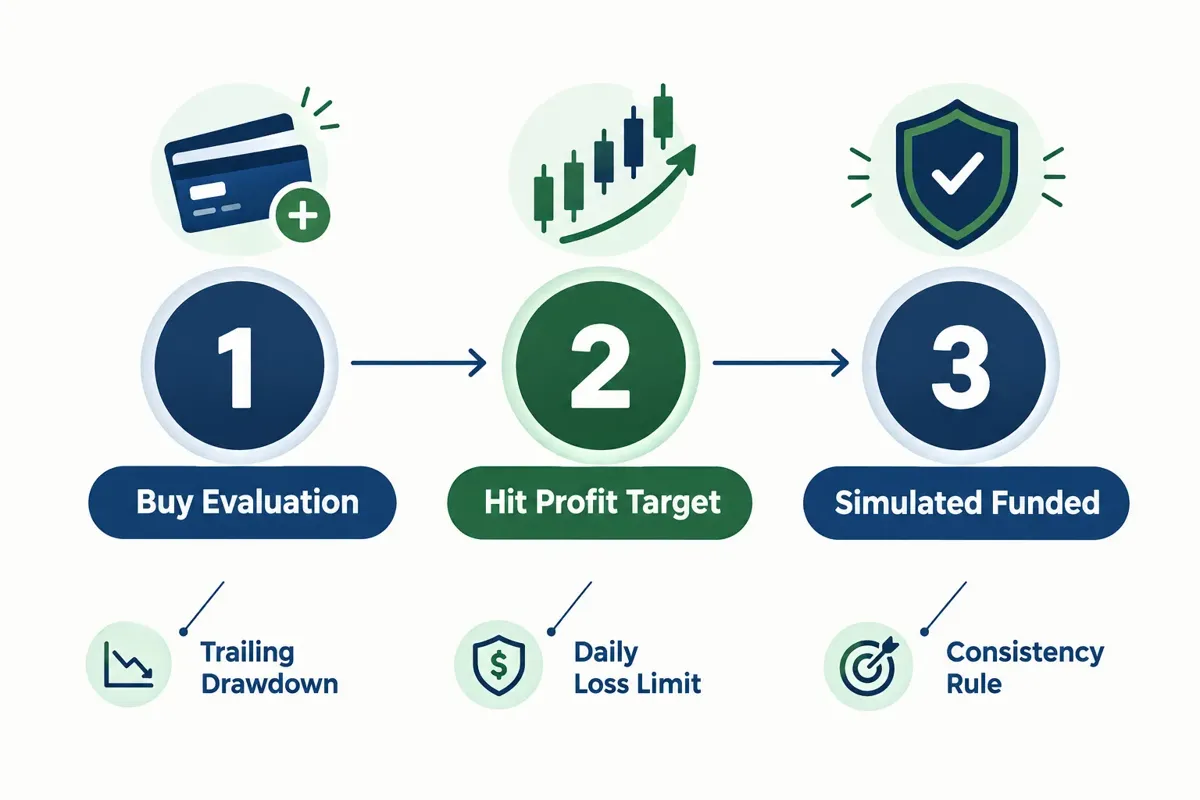
- The current product line is Growth, Select and Lightning Funded. The older Advanced Challenge is described by BestPropFirms in its September 14, 2026 review as legacy-only, unavailable for new purchase since December 2025.
- A 30% discount code, "GEMS," is live on the official pricing page through October 2026 at 11:59 p.m. EST, per Tradeify's own site as of October 2026.
- Tradeify Holdings, Corp. lists its address as 1700 S. Dixie Highway, Suite 305, Boca Raton, Florida 33432. Tradeify Brokerage LLC, doing business as Slay Markets, is identified as a CFTC-registered introducing broker and NFA member, NFA ID 0575972.
- Growth uses a 6% profit target; the published 50K example carries a $3,000 target, a $2,000 end-of-day trailing drawdown and a roughly $1,250 soft daily-loss limit, per Rize Trade's Tradeify review.
- Lightning Funded accounts cannot be reset. Break a rule and you buy a new account, per BestPropFirms' September 2026 breakdown.
What Is Tradeify and How Does It Work?
Tradeify is a futures prop firm that sells evaluation accounts. You pay a one-time fee, trade a simulated account against a profit target and a drawdown limit, and if you clear the rules you move to a simulated-funded account where profits can be withdrawn. You are not trading your own money, and in most cases you are not trading real money at all until the firm chooses to copy your orders to a live book.
That distinction matters more than anything else in this tradeify review. A prop firm is a product company selling access to a performance contract. Your edge gets tested, the firm keeps the fee either way, and the payout is the firm's obligation, not a brokerage balance you own.
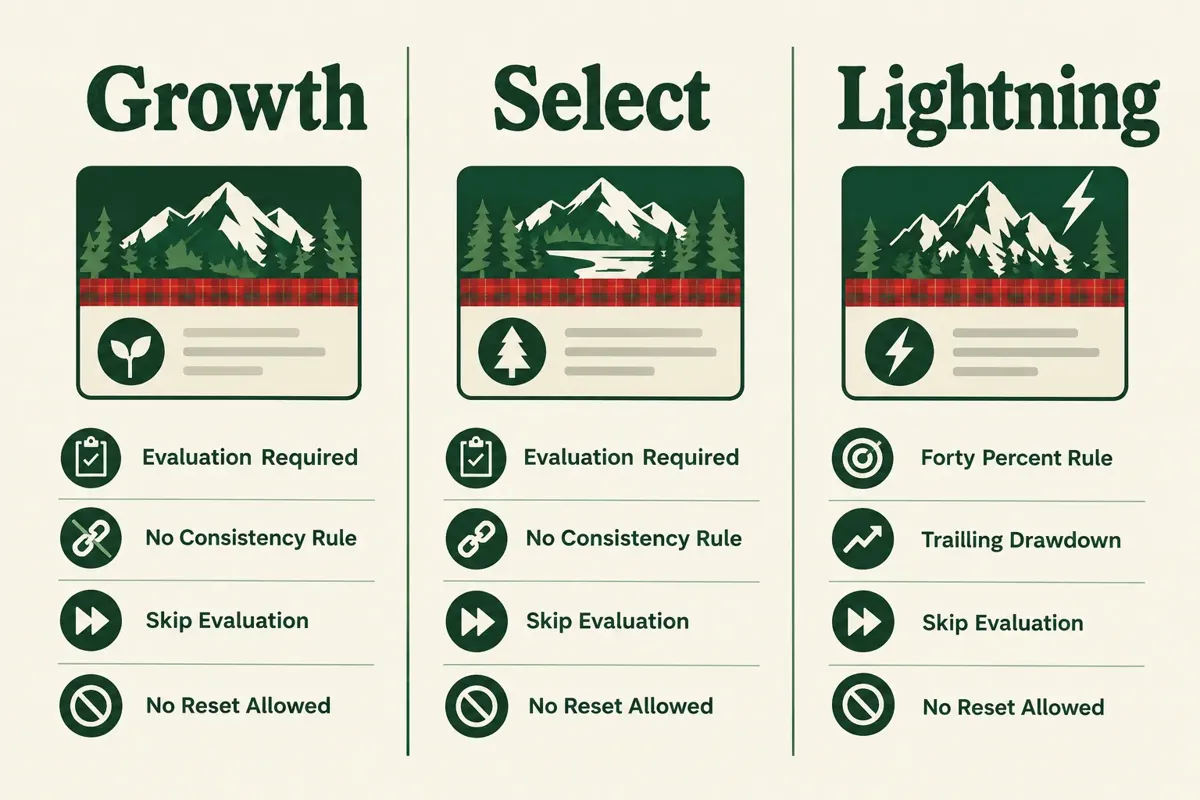
The structure has three doors:
- Growth, evaluation required, 6% profit target, end-of-day trailing drawdown, a soft daily-loss limit. No evaluation consistency rule, so it can technically be cleared in a single session.
- Select, evaluation required, 40% consistency rule, no standard daily-loss limit in the described structure, minimum three trading days.
- Lightning Funded, skips the evaluation entirely and drops you at the simulated-funded stage. Costs materially more. No resets.
Who the tradeify prop firm actually suits: a futures trader who already has a tested setup, knows their position sizing cold, and wants size they can't fund themselves. A $25,000 nominal account for roughly $99 is cheaper than funding $25,000.
Who it doesn't suit: anyone treating the evaluation as practice. You'd be paying to paper trade, badly. Paper trade it first on a free simulator, then buy the evaluation when your win rate and risk-reward are already documented. Most buyers skip that order and wonder why the fee recurs.
A useful mental model: the evaluation fee is a tuition bill with a refund clause. The refund only triggers if you already knew the material.
What Are the Tradeify Pricing and Rules?
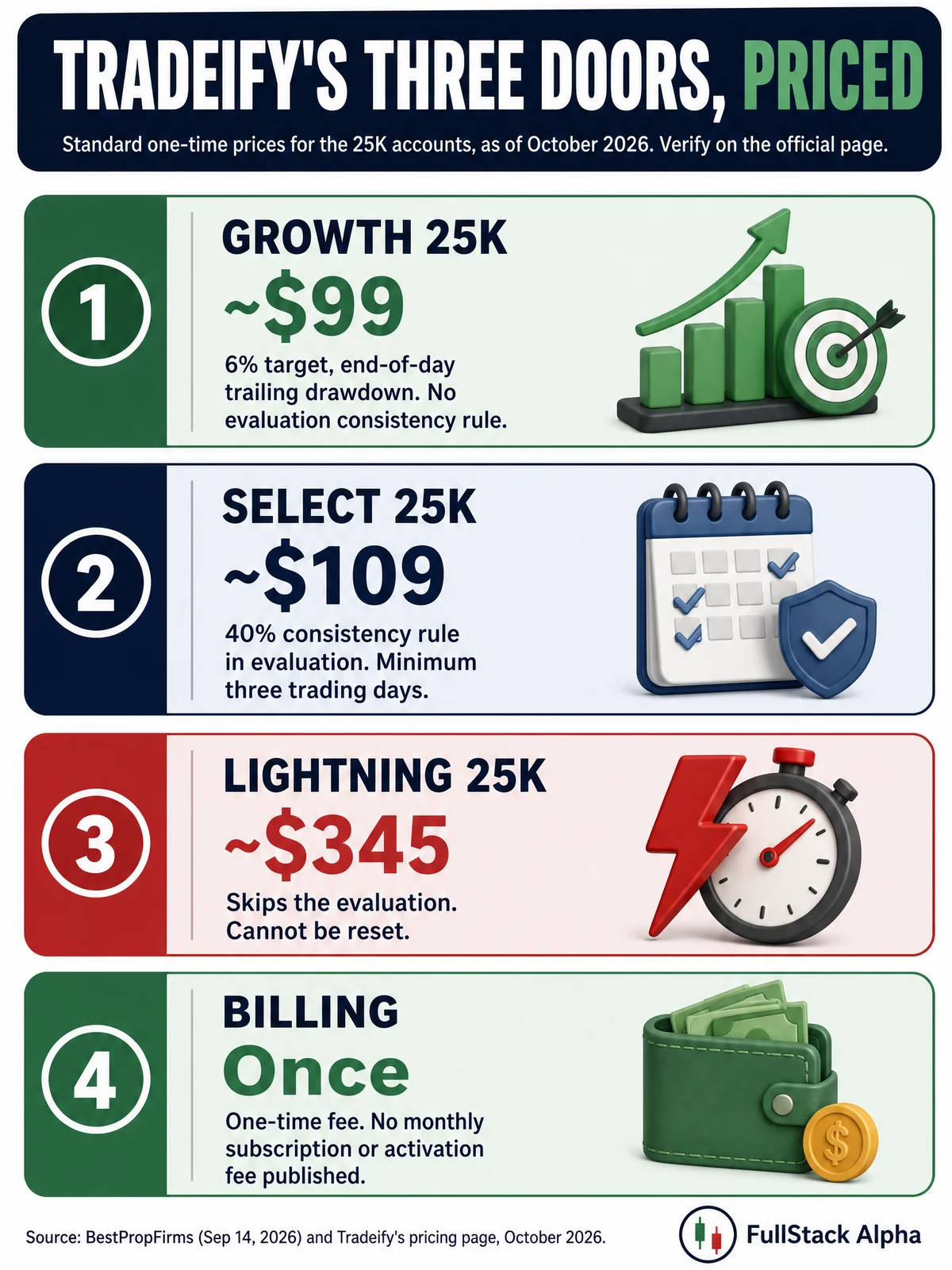
Tradeify charges one-time fees, not a monthly subscription, on its current Growth, Select and Lightning products. The official pricing page states there is no activation fee. There is no recurring monthly subscription fee published for these three products as of October 2026, which is a real difference from firms that bill monthly until you pass. Resets may cost money on eligible evaluation products. Lightning accounts cannot be reset at all.
Here's where the numbers sit. Standard prices below are from BestPropFirms' September 14, 2026 review. Promotional prices are from Tradeify's official pricing page as displayed on October 19, 2026 for the Select configuration shown there, under code "GEMS."
| Account | Fee (one-time) | Profit target | Drawdown | Notes |
|---|---|---|---|---|
| Growth 25K | ~$99 standard (BestPropFirms, Sep 14, 2026) | 6% | Trailing, end-of-day | No evaluation consistency rule |
| Growth 50K | ~$145 standard | 6% ($3,000 per Rize Trade) | $2,000 EOD trailing | Soft daily-loss limit ~$1,250 |
| Growth 100K | ~$255 standard | 6% | Trailing, end-of-day | Check official page for exact figures |
| Growth 150K | ~$369 standard | 6% | Trailing, end-of-day | Check official page for exact figures |
| Select 25K | ~$109 standard; ~$71 promo (official page, Oct 19, 2026) | Check official page | Check official page | 40% consistency rule in evaluation |
| Select 50K | ~$165 standard; ~$107 promo | Check official page | Check official page | No standard daily-loss limit in evaluation |
| Select 100K | ~$265 standard; ~$172 promo | Check official page | Check official page | Minimum 3 trading days |
| Select 150K | ~$369 standard; ~$240 promo | Check official page | Check official page | Flex or Daily chosen after passing |
| Select 300K V2 | ~$349 (limited product) | Separate terms | Separate terms | Verify directly before purchase |
| Lightning 25K | ~$345 | No evaluation | Funded-stage rules apply | Cannot be reset |
| Lightning 50K | ~$492 | No evaluation | Funded-stage rules apply | Cannot be reset |
| Lightning 100K | ~$660 | No evaluation | Funded-stage rules apply | Cannot be reset |
| Lightning 150K | ~$796 | No evaluation | Funded-stage rules apply | Cannot be reset |
The rules that actually end accounts
Three mechanics do most of the damage, and none of them are the profit target.
End-of-day trailing drawdown. On Growth, the drawdown line follows your highest closing balance. Make $800 on Tuesday, and your floor moves up by $800 overnight. Traders who scale in on a winner, give it back, and assume they're flat on the week discover the floor moved while they weren't watching. That's the single most common breach in the evaluation model.
The 40% consistency rule on Select. No single trading day can account for more than 40% of your required evaluation profit. One monster day doesn't pass you. It can delay you, because you then have to grind out additional smaller days to rebalance the ratio. The rule exists to filter out one-lucky-trade accounts, and it does.
Soft daily-loss limits. Growth's ~$1,250 figure on the 50K is described as soft, meaning behavior rather than hard liquidation in the structure reported. Treat it as hard anyway. A soft limit you respect is a system. A soft limit you argue with is revenge trading with a permission slip.
Growth versus Select, decided in one line
Choose Growth if you want speed and a hard daily guardrail, and you can live with a trailing floor that moves against you. Choose Select if you grind consistent small days and hate having a daily loss cap breathing down your neck. If your P&L curve looks like one spike and twelve flat days, Select's consistency rule will fail you before the market does.
Every number above should be re-checked on the official pricing page before you pay. Prop firm terms change on no notice, and this tradeify review is a snapshot of October 2026, not a contract.
Does Tradeify Allow Bots and Automation?
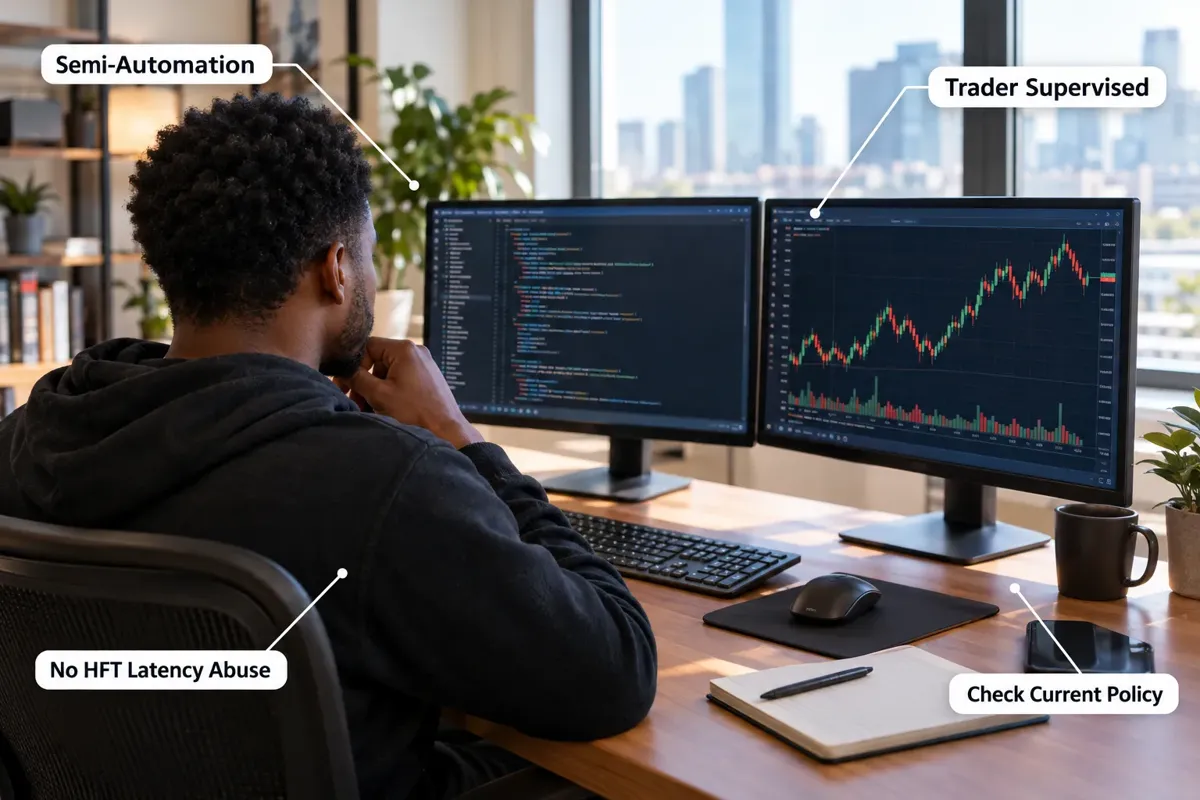
Tradeify does not publish a blanket, unambiguous bot policy on its public pricing and disclosure pages as reviewed on October 19, 2026. That means the honest answer for this tradeify review is: check the official rules and terms page directly, and get written confirmation from support before you connect any automation to a funded account.
That is not a dodge. It is the correct posture, and anyone telling you "tradeify bots are definitely allowed" or "definitely banned" without naming the clause and the date is guessing with your money.
What futures prop firms generally police
Across the futures prop category, the restrictions that show up most often are these, and they're the ones to look for in any current Tradeify terms document:
- Latency and arbitrage exploitation, strategies that profit from the gap between simulated fills and live market pricing. Universally banned, everywhere, no exceptions.
- Copy trading across multiple accounts, running identical orders on several accounts to multiply a single outcome. Usually restricted or capped.
- Fully unattended automation, bots running while no one is at the desk. Often restricted, sometimes allowed with disclosure.
- Semi-automation, a script that manages entries, stops and position sizing while a human supervises. The most commonly tolerated form.
- High-frequency order spamming, thousands of orders that stress the platform rather than express a view. Banned.
The practical rule for bot traders
If you're building or buying automation, assume the firm reserves the right to review your trade log and disqualify anything that looks like it's exploiting the simulation rather than trading the market. That's the line. A strategy that would work identically on a live retail futures account is defensible. One that only works because fills are simulated is not, and the payout review is exactly where it gets caught.
If automation is central to your plan, read our broader breakdown on whether AI-driven trading is legitimate before you spend a dollar on an evaluation, and check which trading bots work with which brokers so you're not retrofitting a strategy to a platform that can't run it.
Common mistake: buying a Lightning account, connecting a bot on day one, and breaching a rule you never read. Lightning cannot be reset. That's a $345 to $796 lesson in reading terms first. Play stupid games.
Does Tradeify Actually Pay Out and What Is the Maximum Payout?
Tradeify publishes trader-outcome statistics for August 2025 through July 2026, calculated as of August 9, 2026, on its official disclosures. Those figures report both the share of participants who reached funded and payout stages and the share who did not. That is a genuine transparency signal, and it separates official claims from the marketing most of this industry runs on. For the specific maximum payout amount and withdrawal thresholds on your account type, check the official page, because those limits differ by product and by the payout plan you select.
What the official structure says
After passing Select, you choose between Select Flex and Select Daily, and the choice is described as permanent for that account.
- Select Flex, emphasizes five winning days and carries no funded-stage consistency rule.
- Select Daily, allows more frequent withdrawals but applies a buffer and daily-continuity conditions.
Picking is a real decision with no undo button. Flex suits a trader with lumpy results who wants fewer constraints. Daily suits a trader who wants cash flow and can produce steady green days without gaps.
Official claims versus user reports
Official: the firm publishes outcome data, states no activation fee, and operates through a CFTC-registered introducing broker relationship.
User reports: across public prop-firm discussion, the recurring themes for firms in this category are payout delays during KYC verification, denied withdrawals tied to consistency-rule violations the trader didn't realize applied, and disputes over whether a trade constituted news straddling. Those are category-level patterns, not verified Tradeify-specific allegations, and no Reddit quote appears in this tradeify review because none could be confirmed with a live permalink. Treat unsourced forum screenshots the way you'd treat an anonymous stock tip.
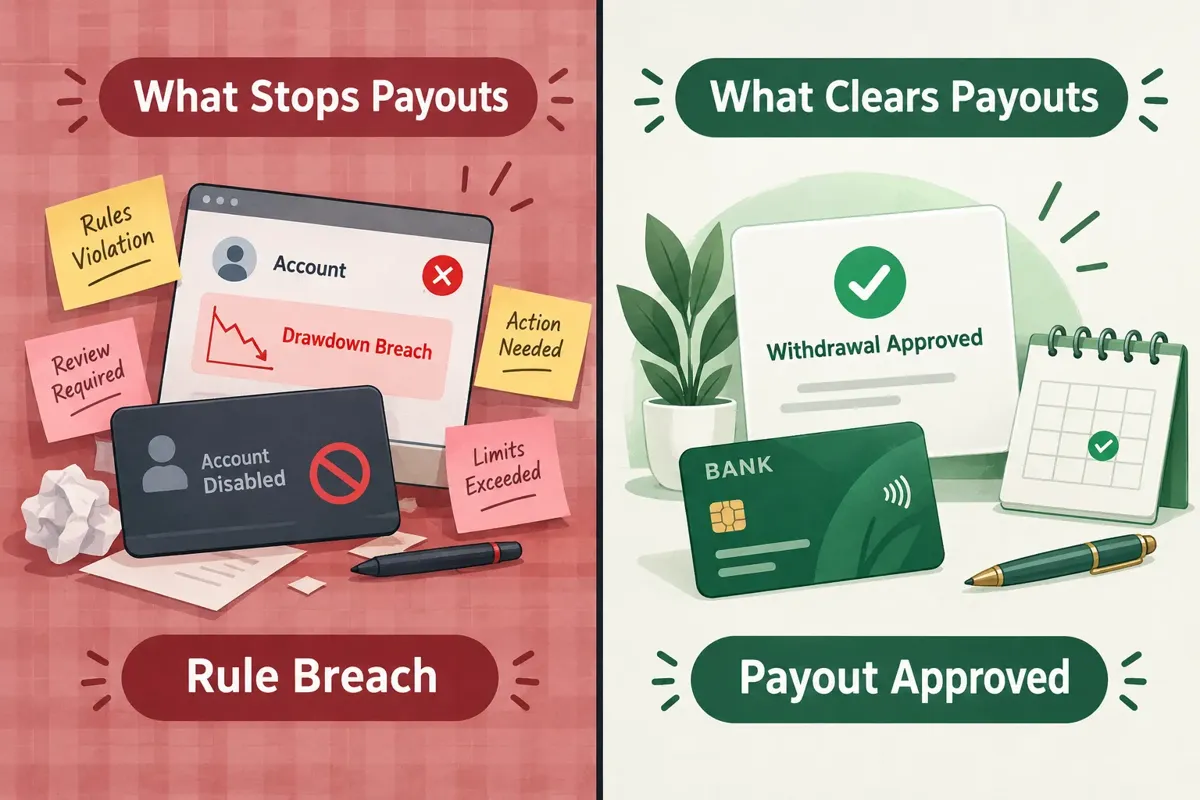
How to make a payout clear
- Complete KYC the day you get funded, not the day you request a withdrawal. Verification delays are the most common cause of "they didn't pay me."
- Read the funded-stage consistency rule for your exact plan and write the daily cap on a sticky note.
- Don't let one day carry your month. It's the fastest way to trip a consistency rule.
- Request a modest first withdrawal to test the pipe before you build a plan around the maximum.
- Keep your own trade log. Trade journaling tools like TradeZella give you a record the firm can't dispute.
The honest frame: a payout from a simulated-funded prop account is a contractual obligation, not a brokerage balance. It clears when you satisfied the terms. It doesn't clear when you didn't, even if you feel you should have.
Is Tradeify Legit and What Do Users Say?
On the question of is tradeify legit, the verifiable trust signals are real: Tradeify Holdings, Corp. publishes a physical address in Boca Raton, Florida, and Tradeify Brokerage LLC, doing business as Slay Markets, is identified as a CFTC-registered introducing broker and NFA member with NFA ID 0575972, with clearing relationships involving NinjaTrader and other listed entities. The firm also publishes trader-outcome statistics for August 2025 through July 2026. That's a legitimate operating business with a regulated brokerage affiliate.
Two caveats belong in the same breath.
First, the registered brokerage affiliate does not make the prop program a regulated brokerage account. The evaluation and simulated-funded products are a performance contract with a company. NFA membership covers the introducing broker entity. It is not investor protection for your evaluation fee.
Second, you can verify the registration yourself. NFA ID 0575972 is checkable through NFA's public BASIC database, and general futures-industry registration status is searchable through CFTC.gov. Thirty seconds of verification beats thirty forum posts.
The complaints worth taking seriously
- Trailing drawdown confusion. The most common source of frustration in the whole category. People breach, then argue the rule was unclear. The rule is published. The reading wasn't done.
- Permanent plan selection. Choosing Flex or Daily without understanding the trade-off, then wanting to switch. You can't.
- Lightning with no reset. The premium product with the least forgiveness is also the one impulse buyers reach for.
- Changing terms. Products get retired. The Advanced Challenge disappeared for new buyers in December 2025. Anything you read in a review from six months ago, including this tradeify review in six months, needs re-verification.
Review scores
Public rating aggregates for futures prop firms are heavily solicited on review platforms and heavily negative on Reddit, and the gap between those two sources is the finding, not the average. Where no verified score could be confirmed for Tradeify at the time of writing, this tradeify review declines to publish one rather than repeat a number from an unnamed roundup. If you see a specific star rating cited without a platform and a date, that number is decoration.
Which Tradeify Account Is Best for Bot Traders?
Based only on confirmed rules, Growth is the most forgiving starting point for an automated or semi-automated approach, because it has no evaluation consistency rule and resets are available on eligible evaluation products. Lightning is the worst fit for untested automation, because it cannot be reset after a failure.
| Account | Fit for automation | Why |
|---|---|---|
| Growth | Best starting point | No evaluation consistency rule, resets available on eligible products, hard daily guardrail protects against a runaway script |
| Select | Good if your bot produces steady small days | 40% consistency rule punishes a single outsized session; fine for high-frequency-of-days, low-variance systems |
| Lightning | Highest risk | No reset after failure, premium price, no evaluation phase to validate the system first |
The decision rule
Choose Growth if your automation is new, untested on this platform, or produces variable day-to-day results. The daily-loss limit acts as a circuit breaker a bot won't argue with.
Choose Select if your system has a documented record of many small green days and rarely produces a single day representing more than a third of a week's profit. The 40% rule becomes a non-issue for that profile, and losing the daily cap gives the strategy room.
Choose Lightning only if you've already run the identical automation to a funded stage on another account and you're buying speed, not hope. Paying $660 for a 100K account with no reset while testing a new script is the definition of catching a falling knife.
Edge case worth naming: if your bot trades the open aggressively, the end-of-day trailing drawdown on Growth is more dangerous than it looks, because a strong morning raises your floor permanently and an afternoon giveback can breach a balance that's still green on the week. Code the trailing floor into your risk check, not just the starting balance.
What Broker or Platform Does Tradeify Use?
Tradeify's official disclosures identify Tradeify Brokerage LLC, doing business as Slay Markets, as a CFTC-registered introducing broker and NFA member, NFA ID 0575972, with clearing relationships involving NinjaTrader and other listed entities. For the full, current list of supported trading platforms and data feeds, check the official platforms page, because prop firms add and drop platform partners regularly.
What that structure means in practice:
- An introducing broker accepts orders and passes them to a clearing firm. It doesn't hold your funds in that role.
- The clearing relationship with NinjaTrader places Tradeify inside the standard futures plumbing used by most retail futures prop firms.
- Platform access for evaluation accounts is typically simulated, routed through the firm's own risk engine before anything reaches a live venue.
If charting and execution quality matter to your workflow, compare the platform options against tools you already know, like the charting and analysis stack at StockCharts.com or TrendSpider's automated pattern scanning, so you're not rebuilding your entire process around an unfamiliar terminal.
Tradeify vs Other Prop Firms
Tradeify's distinguishing features against the futures prop category are one-time pricing with no recurring subscription on current products, published trader-outcome statistics, and a no-evaluation Lightning route. Its weak spots are the permanent Flex-or-Daily choice and the no-reset Lightning policy.
| Factor | Tradeify | Typical futures prop firm |
|---|---|---|
| Billing model | One-time fee, no monthly subscription on current products (official page, Oct 2026) | Often monthly subscription until you pass |
| Activation fee | None stated on current programs | Commonly charged at funded stage |
| Outcome transparency | Publishes Aug 2025, Jul 2026 trader statistics | Rarely published |
| Skip-evaluation option | Lightning Funded, no reset | Less common |
| Reset availability | Yes on eligible evaluations, never on Lightning | Usually available at a fee |
| Regulatory footprint | Affiliated IB, NFA ID 0575972 | Varies widely; many have none |
| Consistency rule | 40% on Select evaluation | 20-50% range is common |
Two honest comparisons. Topstep has the longer operating history and the deeper public track record, and charges monthly. Apex Trader Funding runs frequent heavy discounts and a larger account menu, with a reputation for terms that shift often. Tradeify's pitch sits between them: one-time pricing with more published data than either, and less operating history than Topstep.
The decision that matters isn't the firm. It's whether you have a documented edge before you buy anything. A trader with a tested system passes at most firms. A trader without one fails at all of them and blames the drawdown rule. Discipline beats prediction, and it beats shopping for the most forgiving terms.
Is the Tradeify Fee Worth It for Your Plan?
The fee only makes sense if your expected profit over the account's life exceeds the cost of the evaluation plus the resets you'll realistically need. The calculator below lets you plug in your own fee, win rate and target to see where your break-even sits instead of guessing.
FullStack Alpha
Break-even on the evaluation fee plus resets
Put in what you actually pay and what you expect to clear once funded. This shows the point where the account has paid for itself.
Set months before you pass to the number of attempts you realistically need, since each reset is another fee. Re-check the current fee and split on the firm's own pricing page. The profit figure is your own estimate and nothing here forecasts it. Most funded accounts are lost before they pay out.
Frequently Asked Questions
Does Tradeify actually pay out?
Tradeify publishes trader-outcome statistics for August 2025 through July 2026, calculated as of August 9, 2026, covering both successful and unsuccessful participants. Payouts are contractual obligations from simulated-funded accounts and clear when consistency, drawdown and verification conditions are met. Complete KYC early and request a small first withdrawal to test the process.
What broker does Tradeify use?
Tradeify's disclosures identify Tradeify Brokerage LLC, doing business as Slay Markets, as a CFTC-registered introducing broker and NFA member with NFA ID 0575972, with clearing relationships involving NinjaTrader and other listed entities. Evaluation accounts are simulated and routed through the firm's own risk engine. Check the official platforms page for the current supported terminal list.
What is the maximum payout on Tradeify?
Maximum payout limits differ by account size and by whether you selected Select Flex or Select Daily, so check the official pricing and payout page for your specific product. Flex emphasizes five winning days with no funded-stage consistency rule; Daily allows more frequent withdrawals with a buffer and daily-continuity conditions. The choice is permanent for that account.
Which Tradeify account is the best?
Growth suits traders wanting speed and a hard daily guardrail, since it carries a 6% target, no evaluation consistency rule and available resets. Select suits grinders with steady small days, given its 40% consistency rule and absence of a standard daily-loss limit. Lightning suits only traders with a proven system, because it cannot be reset.
Is there a Tradeify discount code?
Yes, as of October 19, 2026 the official Tradeify pricing page advertises a 30% discount using the code "GEMS," valid through October 31, 2026 at 11:59 p.m. EST. Promotional prices displayed on that page for the Select configuration were roughly $71 for 25K and $172 for 100K. Verify the code on the official page before purchase, since promotions expire.
Can you reset a failed Tradeify account?
Resets are available at a cost on eligible evaluation products, but Lightning Funded accounts cannot be reset after a rule violation. A failed Lightning account generally requires buying a new one, which starts around $345 for the 25K size. Factor that into the decision before choosing the no-evaluation route.
Our Take
For bot traders, Tradeify is workable but not plug-and-play. Start on Growth, because the reset option and the absence of an evaluation consistency rule give an automated system room to prove itself without a permanent decision hanging over it. Avoid Lightning until your script has already reached a funded stage somewhere else. And get the automation policy confirmed in writing from support before you connect anything, because the published pages don't settle it.
The firm's transparency on trader outcomes is better than the category average, the one-time pricing beats a subscription that bills while you struggle, and the regulated introducing broker affiliate is verifiable at NFA. None of that makes the evaluation easy. It makes the terms honest. Those are different things, and the traders who confuse them are the ones funding everyone else's payouts.
Not sure Tradeify fits your risk budget or your bot? Compare it with the other firms we've reviewed before you buy.
Cut the noise, keep the alpha. Stay alpha.