The AI Tools for Stocks Traders Won't Admit They're Using...
Last updated: June 17, 2026
Quick Answer: The AI tools for stocks that serious traders actually use aren't the ones getting hyped on social media. They're pattern recognition engines, automated chart scanners, and institutional-grade research platforms — tools like Tickeron, TrendSpider, and Koyfin — that cut the noise and surface actual setups. Most traders won't publicly admit they use them because admitting it would mean admitting their "gut" has a co-pilot.
Key Takeaways
- The best ai tools for stocks focus on pattern recognition, price action scanning, and fundamental research — not magic predictions.
- Tickeron offers AI-driven stock picks and real-time alerts; TrendSpider automates technical chart analysis; Koyfin delivers institutional-quality research at retail prices.
- AI trading tools are legal for retail traders in the U.S. when used within standard brokerage and SEC guidelines.
- No AI tool can reliably predict stock market movements — the honest ones don't claim to. They improve your process, not your luck.
- Free ai tools for stocks exist and are worth testing, but the tools with real edge typically cost between $20 and $200 per month.
- Beginners can use ai tools for stock market entry, but without a system behind them, the tools just produce faster bad decisions.
- The biggest mistake traders make with AI tools is using them as a replacement for a process rather than a layer inside one.
- Discipline beats prediction. AI tools are only as good as the trader using them.
The AI Tools for Stocks Traders Won't Admit They're Using...
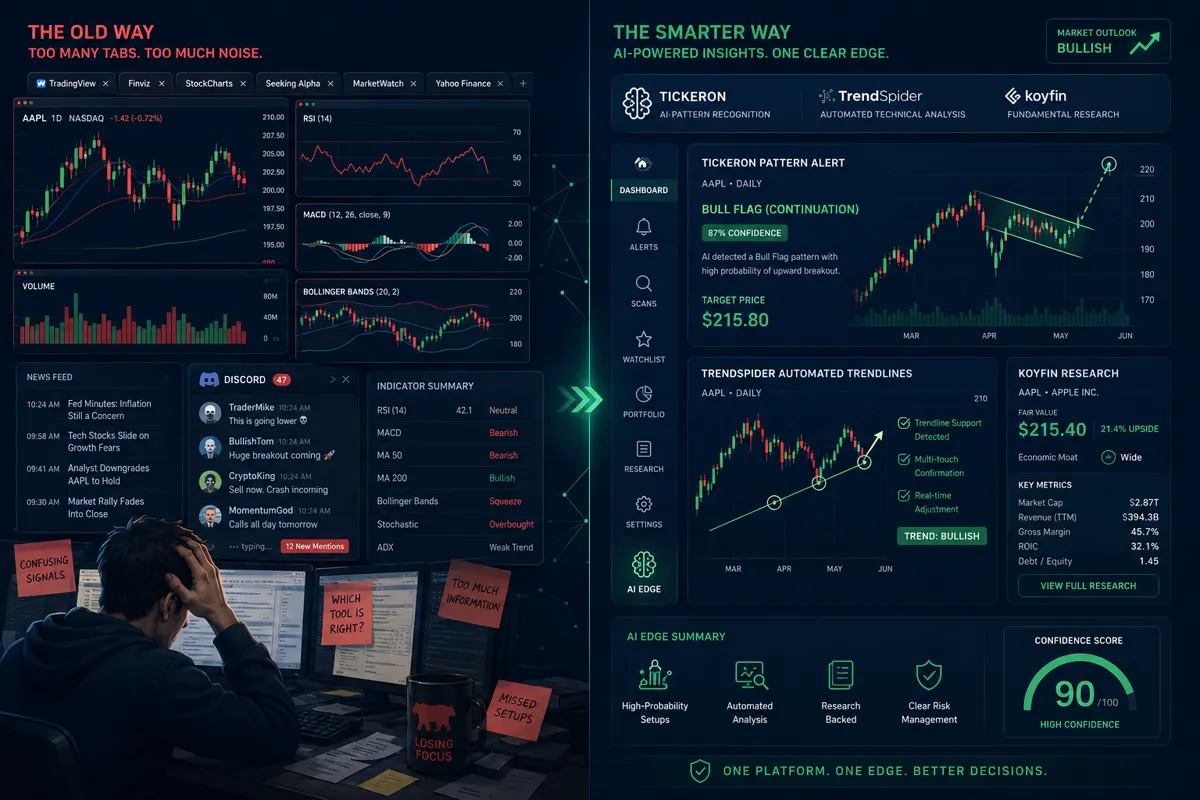
Here's the open secret on every serious trading desk in 2026: the traders who say they "just read the tape" are also running AI scanners in a second tab. The ones who claim pure technical analysis are cross-referencing AI-generated sentiment scores before they pull the trigger. Nobody's bragging about it, but the stack is real.
The ai tools for stocks that actually move the needle aren't the ones with the loudest ads. They're the ones quietly doing the work — scanning thousands of charts for tight consolidation patterns, flagging unusual options flow, and summarizing earnings call transcripts in 30 seconds flat. That's not cheating. That's process.
So which tools are we actually talking about?
The honest short list for 2026:
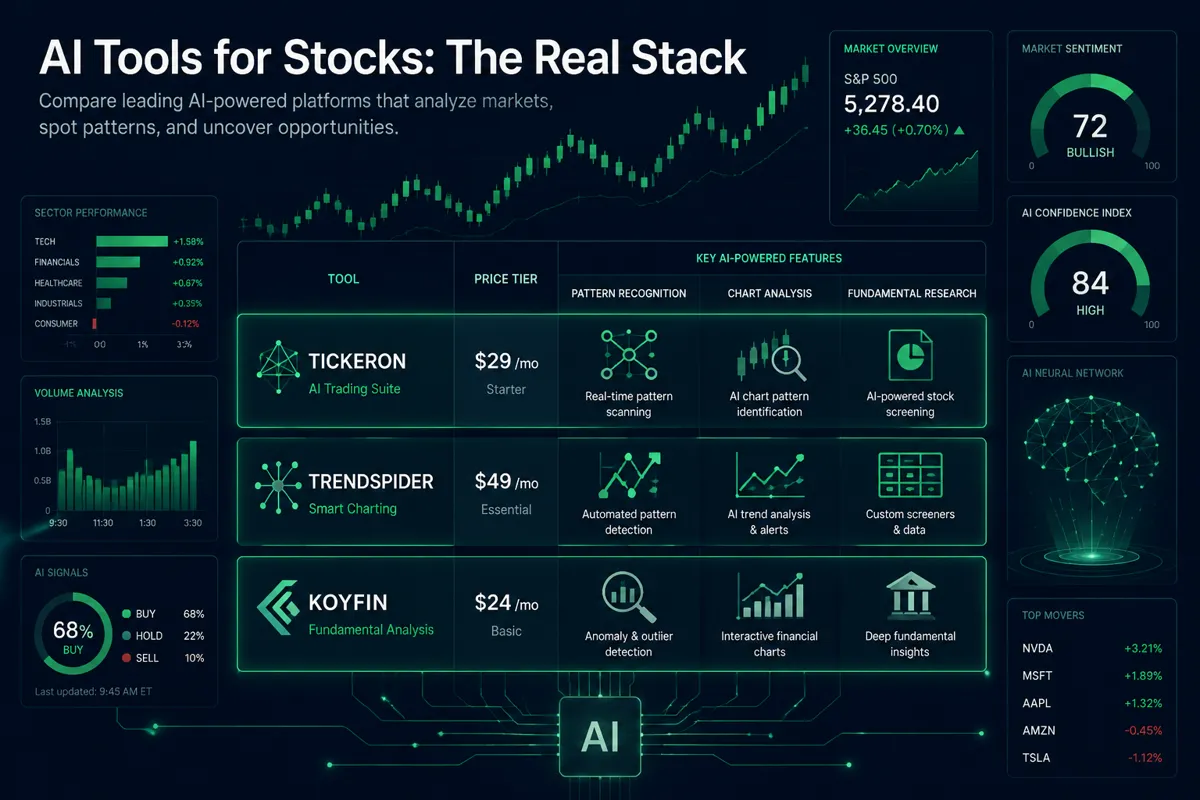
- Tickeron — AI-driven pattern recognition, stock picks, and real-time alerts. Strong for traders who want the setup surfaced automatically.
- TrendSpider — Automated trendline detection, multi-timeframe analysis, and backtesting without writing a single line of code. The chart nerd's best friend.
- Koyfin — Institutional-grade fundamental research, earnings data, and macro dashboards at a fraction of what Bloomberg charges. The serious researcher's tool.
- Trade Ideas — AI-powered scanner built for active day traders. Runs thousands of scans simultaneously during power hour.
- Tickeron + AI Signals — For traders who want alerts layered on top of pattern detection.
These aren't the only options. The full directory of 100+ AI stock tools covers the broader landscape if you want to compare before committing.
What AI Tools Do Professional Stock Traders Actually Use?
Professional traders — from prop desks to sophisticated retail operators — use AI tools for four core jobs: scanning for setups, analyzing price action, processing news and earnings, and managing risk. The specific tools vary, but the function is consistent.
At the institutional level, firms use proprietary machine learning models built on decades of tick data. At the retail level, the closest equivalents are platforms like TrendSpider for automated chart analysis, Tickeron for AI pattern recognition and alerts, and Koyfin for research depth. Tools like AlphaSense and Brightwave are increasingly used for parsing earnings transcripts and SEC filings at speed.
What separates the tools pros actually use from the ones they ignore:
- They surface the setup — they don't make the decision.
- They reduce time on low-value tasks (scanning 5,000 charts manually).
- They have transparent methodology, not black-box "our AI says buy."
- They integrate with a broader system rather than replacing one.
The common thread: signal over noise. Every tool worth paying for is in the business of cutting the noise so you can keep the alpha.
What's the Difference Between AI Trading and Algorithmic Trading?
AI trading and algorithmic trading are related but not the same thing. Algorithmic trading executes pre-programmed rules automatically — if price crosses X moving average, buy Y shares. AI trading uses machine learning to identify patterns and adapt over time, without needing every rule hard-coded in advance.
Think of it this way: an algorithm is a recipe. AI is a chef who's tasted 10 million dishes and keeps refining the recipe based on what worked.
| Feature | Algorithmic Trading | AI Trading |
|---|---|---|
| Rule-based | Yes, fixed rules | No, learns from data |
| Adapts over time | No | Yes |
| Requires coding | Usually | Not always (retail tools) |
| Used by | Quant funds, prop desks | Hedge funds + retail platforms |
| Example tools | Custom scripts, MetaStock | Tickeron, TrendSpider, Trade Ideas |
For retail traders, the practical difference is this: algorithmic tools execute your rules faster; AI tools help you find better rules in the first place. The best ai tools for stock analysis do both — they surface the pattern and let you decide whether to act on it.
Are AI Trading Algorithms Legal?
Yes, AI trading tools and algorithms are legal for retail traders in the United States. The SEC and FINRA regulate what information you can trade on (no insider trading) and how trades are executed — not what software you use to analyze publicly available data.
The legal line is about the data source, not the tool. Using an AI scanner to find breakout setups from public price data is completely legal. Using non-public material information — regardless of whether an AI flagged it — is not. For a clear breakdown of what constitutes insider trading, the SEC's investor education resources are the authoritative reference.
Practical rule: If the data feeding your AI tool is publicly available, you're fine. If someone's tipping you off before an announcement, no AI wrapper makes that legal.
Can AI Really Predict Stock Market Movements?
No AI tool can reliably predict stock market movements with consistent accuracy. Any platform claiming otherwise is selling something you shouldn't buy. Markets are influenced by too many variables — geopolitical events, Fed policy shifts, earnings surprises, liquidity conditions — for any model to forecast with precision.
What AI tools can do is identify historical patterns that have repeated with statistical regularity, flag anomalies in price action or volume, and surface setups that match a trader's defined criteria. That's probability management, not prediction. And that distinction matters enormously.
The honest framing: AI tools for stock picking improve your odds on individual setups by helping you find cleaner entries, tighter risk-reward ratios, and more consistent position sizing. They don't eliminate losing trades. They help you lose smaller and win with more discipline.
Discipline beats prediction. Every time.
How Much Does an AI Stock Prediction Tool Cost?
Free ai tools for stocks exist and are worth testing. Paid tools range from roughly $20 to $200 per month for retail-grade platforms, with institutional tools running into thousands monthly.
Rough cost tiers in 2026:
- Free tier: Basic screeners, limited AI alerts (Finviz free, Webull's built-in scanner, the free tools section at AI Stock Picker Apps)
- $20–$50/month: Entry-level AI pattern tools, basic sentiment data (Tickeron starter plans, Tykr)
- $50–$150/month: Full-featured AI chart analysis, backtesting, multi-timeframe scanning (TrendSpider, Trade Ideas)
- $150–$300/month: Institutional research platforms, deep fundamental AI (Koyfin Pro, InvestingPro)
- $500+/month: Quant-level tools, API access, custom model training (Boosted.ai, AlphaSense)
The question isn't what the tool costs. It's whether the edge it gives you is worth more than the subscription. If a $100/month scanner helps you avoid one bad $500 trade per month, the math works. Run it like a business expense, not a hobby purchase.
Are Free AI Stock Trading Tools Worth Trying?
Free ai tools for stocks are worth testing as a starting point, but they come with real limitations. Most free tiers offer delayed data, capped scans, or stripped-down AI features designed to push you toward a paid plan.
That said, a few genuinely useful free options exist. The free swing trade planner and stock health scorecard at AI Stock Picker Apps are solid starting points for building a system without spending anything. Finviz's free screener remains one of the best watchlist-building tools available at zero cost.
The honest verdict: Paper trade it first with free tools. If the process works and you're ready to scale, then invest in the paid version. Don't pay for a tool you haven't tested. Play stupid games, win stupid prizes — and paying $150/month for a scanner you don't understand qualifies.
What Are the Risks of Using AI for Stock Trading?
The biggest risk isn't that the AI is wrong. It's that the trader stops thinking. AI tools for stocks create a false sense of certainty — a clean signal on a dashboard feels more authoritative than it actually is.
The real risks, ranked:
- Over-reliance: Using AI output as a decision, not an input. The tool surfaces the setup; you still need to evaluate the risk-reward and size the position.
- Overfitting: AI models trained on historical data can fail hard in new market conditions. A pattern that worked in a bull tape may not survive a choppy tape.
- Analysis paralysis: More AI tools don't mean more clarity. Six scanners open simultaneously is the trading equivalent of eating at every restaurant on the block and wondering why you're not full.
- Revenge trading: An AI signal that gets stopped out doesn't mean the next signal is "due." That's not how probability works.
- Cost drag: Stacking five subscriptions without a clear system is just expensive noise.
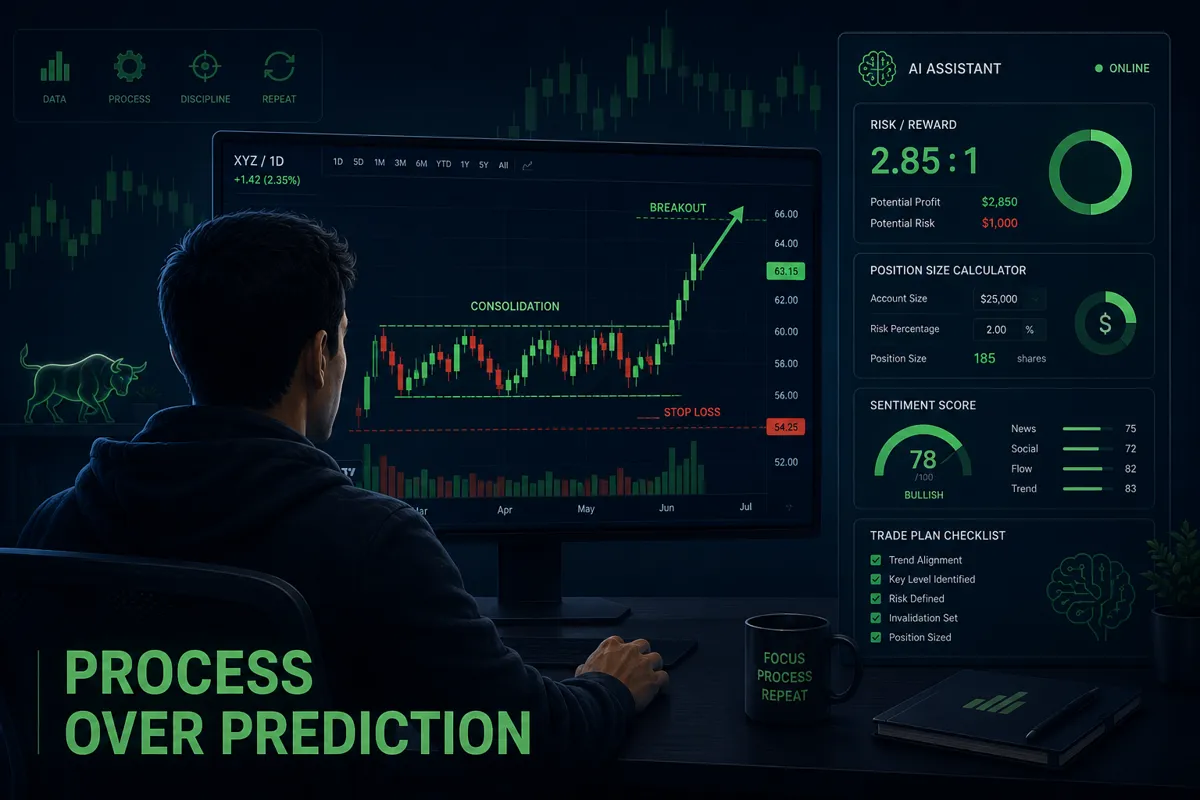
The fix for all of these is the same: systems over hacks. Build a process first, then use AI tools to support it — not replace it.
How Do Hedge Funds Use Machine Learning for Trading?
Hedge funds use machine learning for trading in ways that go well beyond what retail tools offer, but the underlying logic is the same. They train models on massive datasets — price history, options flow, satellite imagery, credit card transaction data, earnings call tone analysis — to identify edges before they're priced in.
Renaissance Technologies, the most cited example, built systematic models that reportedly generated extraordinary returns over decades by finding statistical patterns invisible to human analysts. Two Sigma and Citadel run similar quantitative approaches at scale.
The retail version of this is tools like TrendSpider for automated pattern detection and Tickeron for AI-driven alerts. They're not the same as a $50 billion quant fund's infrastructure, but they apply the same core idea: let the machine find the pattern, let the human decide whether to trade it.
Can Beginners Use AI Stock Trading Tools?
Yes, beginners can use ai tools for stock market research and scanning — but only if they understand what the tool is doing and why. Handing a new trader an AI scanner without teaching them support and resistance, position sizing, and stop loss placement is like handing someone car keys before they know what a brake pedal does.
For beginners, the right sequence is:
- Learn the basics of price action and risk management first.
- Paper trade a simple system for 30 days before risking real capital.
- Add one AI tool that solves a specific problem (finding setups, not making decisions).
- Track every trade in a journal. Data over noise — your own data matters most.
The AI trading platforms guide at AI Stock Picker Apps is a good starting point for understanding which tools fit which experience levels. Don't stack tools before you have a system. That's overtrading before you've even placed a trade.
Which AI Trading Platforms Have the Best Track Record?
No AI trading platform has a verified, independently audited track record that retail traders can inspect — and any platform claiming guaranteed win rates should be treated with serious skepticism. What can be evaluated is methodology transparency, user longevity, and feature depth.
Platforms with strong reputations for consistency in 2026:
- TrendSpider — Widely respected for its automated technical analysis. Transparent about what the tool does and doesn't do.
- Tickeron — Long-standing platform with documented pattern recognition methodology and real-time alerts. See the Tickeron breakdown for a full feature review.
- Trade Ideas — Used by active day traders for years. Known for its Holly AI scanner and real-time market scanning during power hour.
- Koyfin — Trusted for fundamental research quality. The go-to for ai tools for stock research among self-directed investors who want institutional data.
- TradingView — The chart platform most traders already use, now with AI-assisted analysis layers. See the TradingView review.
Track record in trading tools means: does the methodology hold up over time, and does the platform keep improving? Not: did it predict the last 10 trades correctly.
Top Mistakes Traders Make With AI Stock Tools
The tool isn't the problem. The process is. Here are the mistakes that show up repeatedly when traders add AI tools to a broken workflow.
Mistake 1: Treating alerts as trade signals.
An AI alert that a stock is in a breakout pattern is the beginning of your analysis, not the end. You still need to check the broader market context, volume confirmation, and your own risk-reward before entering.
Mistake 2: Subscribing to too many tools.
FOFO — Fear of Finding Out you're missing the "right" tool — drives traders to stack five subscriptions. The result is analysis paralysis, not edge. Pick two tools that solve real problems in your process and cut the rest.
Mistake 3: Ignoring the stop loss.
AI tools for stock alerts can tell you when to get in. They can't force you to get out. Getting stopped out is part of the system. Skipping your stop loss because the AI "seemed confident" is how small losses become large ones.
Mistake 4: Not backtesting.
Before trusting any AI-generated signal with real money, test it against historical data. TrendSpider's backtesting feature exists for exactly this reason. If the pattern doesn't hold up historically, the live signal isn't worth much.
Mistake 5: Confusing activity with process.
More scans, more alerts, more tabs open — none of that is a trading system. Consistency over hype means fewer, higher-quality setups with a defined entry and exit, not a firehose of AI noise.
Which AI Tools Give the Most Accurate Stock Predictions?
No AI tool gives "accurate predictions" in the way that phrase implies. What the best tools do is surface high-probability setups based on historical pattern data — and that's a meaningful distinction. Tickeron's pattern recognition has documented historical accuracy rates for specific patterns (head and shoulders, bull flags, cup and handle), which gives traders a statistical baseline rather than a gut feeling.
For ai tools for stock picking based on fundamentals, Koyfin and InvestingPro surface valuation metrics, earnings trends, and analyst consensus data that help identify stocks with favorable setups before price action confirms them.
For ai tools for stock alerts in real time, Tickeron and Trade Ideas are the most consistently cited platforms among active traders. For ai tools for stock analysis with a technical bias, TrendSpider remains the benchmark.
The honest answer: the "most accurate" tool is the one that fits your specific trading style and that you actually use consistently. A mediocre tool used with discipline beats a sophisticated tool used randomly.
Conclusion: Build the System, Then Add the Tools
The ai tools for stocks that serious traders use in 2026 aren't magic. They're process accelerators. They find the setup faster, surface the data cleaner, and reduce the cognitive load of scanning thousands of charts manually. But they don't replace the judgment call, the position sizing, or the stop loss discipline that separates traders who last from traders who don't.
The formula is simple, even if the execution isn't: build a repeatable process first. Identify one or two specific problems in your workflow — finding setups, researching fundamentals, managing alerts. Then pick the AI tool that solves that specific problem. Test it. Track the results. Cut what doesn't work.
Actionable next steps:
- Audit your current tool stack. If you're paying for more than three tools and can't explain what each one does for your process, cancel one today.
- Test Tickeron's free tier for pattern recognition alerts on your current watchlist.
- Use TrendSpider's backtesting feature on your most common setup before trading it live again.
- If fundamental research is the gap, start a free Koyfin trial and compare it against what you're currently using.
- Visit the full AI stock tool directory to compare 100+ options by category, price, and use case.
Cut the noise. Keep the alpha. The tools are there — the system has to come first.
FAQ
What are the best ai tools for stocks in 2026?
Tickeron (pattern recognition and alerts), TrendSpider (automated chart analysis), Koyfin (fundamental research), and Trade Ideas (active day trading scanner) are consistently rated among the strongest options for retail traders.
Are ai tools for stock picking reliable?
They're reliable for surfacing setups that match historical patterns — not for predicting outcomes. Use them as a filter, not a decision-maker.
What are the best free ai tools for stocks?
Finviz's free screener, Webull's built-in scanner, and the free tools available at AI Stock Picker Apps (including the swing trade planner and stock health scorecard) are solid starting points with no cost.
Can ai tools for stock market beginners actually help?
Yes, but only after learning the basics of price action and risk management. AI tools accelerate a process — if there's no process, they just accelerate bad decisions.
How do Tickeron tools work?
Tickeron uses machine learning to scan for chart patterns (bull flags, head and shoulders, triangles) and generates real-time alerts with historical accuracy data for each pattern type. It also offers AI-driven stock picks and portfolio analysis.
How do Koyfin tools differ from Bloomberg?
Koyfin delivers institutional-quality fundamental data, earnings analysis, and macro dashboards at retail-accessible pricing — typically a fraction of Bloomberg Terminal costs. It's the go-to for serious ai tools for stock research without the enterprise price tag.
Is it legal to use AI for trading stocks?
Yes. Using AI tools to analyze publicly available market data is completely legal. The legal line is about the data source — trading on non-public material information is illegal regardless of what tool you use.
What's the difference between AI trading tools and algorithmic trading?
Algorithmic trading executes fixed, pre-programmed rules automatically. AI trading uses machine learning to identify patterns and adapt over time without every rule being hard-coded.
How much do ai tools for buying stocks cost?
Free tiers exist. Paid platforms range from roughly $20 to $200 per month for retail traders, with institutional tools running significantly higher.
What is the biggest mistake traders make with AI stock tools?
Treating AI alerts as trade decisions rather than inputs. The tool surfaces the setup; the trader still needs to evaluate risk-reward, size the position, and set the stop loss.
Do hedge funds use AI for trading?
Yes. Firms like Renaissance Technologies, Two Sigma, and Citadel use sophisticated machine learning models trained on vast datasets. Retail AI tools apply similar logic at a much smaller scale.
Should I paper trade before using AI stock tools with real money?
Always. Paper trading a new AI-generated signal for 30 days before committing real capital is the single best way to know whether the tool's output fits your process.
FullStack Alpha tests the AI stock tools so you don't waste months on the wrong ones. Browse the full breakdowns and compare 100+ platforms at aistockpickerapps.com.