The AI Stock Tools Smart Money Is Using to Ride the Data-Center Boom
Last updated: June 16, 2026
Quick Answer: The AI stock tools smart money is using to ride the data-center boom include AI-powered screeners like TrendSpider and Trade Ideas for momentum and breakout detection, fundamental research platforms like Koyfin for cross-sector valuation work, and sentiment analysis tools that flag institutional flow into semiconductor, hyperscaler, and data center REIT names. These tools don't predict the future — they help you build a repeatable process for finding clean setups in the sector driving 2026's narrowest, most concentrated market leadership.
Key Takeaways
- As of Q1 2026, NVIDIA reported a 35% year-over-year increase in data center revenue, making it the clearest benchmark for AI infrastructure demand.
- BlackRock committed $2 billion to AI-optimized data centers in May 2026 — institutional money is not sitting on the sidelines.
- The AI infrastructure trade has three distinct layers: chip makers, hyperscalers (cloud providers), and data center REITs. Each carries different risk-reward profiles.
- Roughly 70% of hedge funds now use AI-driven stock analysis platforms to identify data center investment opportunities, per April 2026 estimates.
- AI stock tools like TrendSpider, Trade Ideas, and Koyfin give retail investors access to the same screening logic institutional desks use — without the Bloomberg terminal price tag.
- Beginners should start with broad ETF exposure before touching individual names. Lower volatility, lower complexity, same theme.
- The biggest mistake new investors make is chasing overextended stocks after a headline run. The setup matters more than the story.
- Risk management — position sizing and a defined stop loss — is non-negotiable in a sector this volatile.
What Are the Top AI Stocks Right Now for Data Center Tech
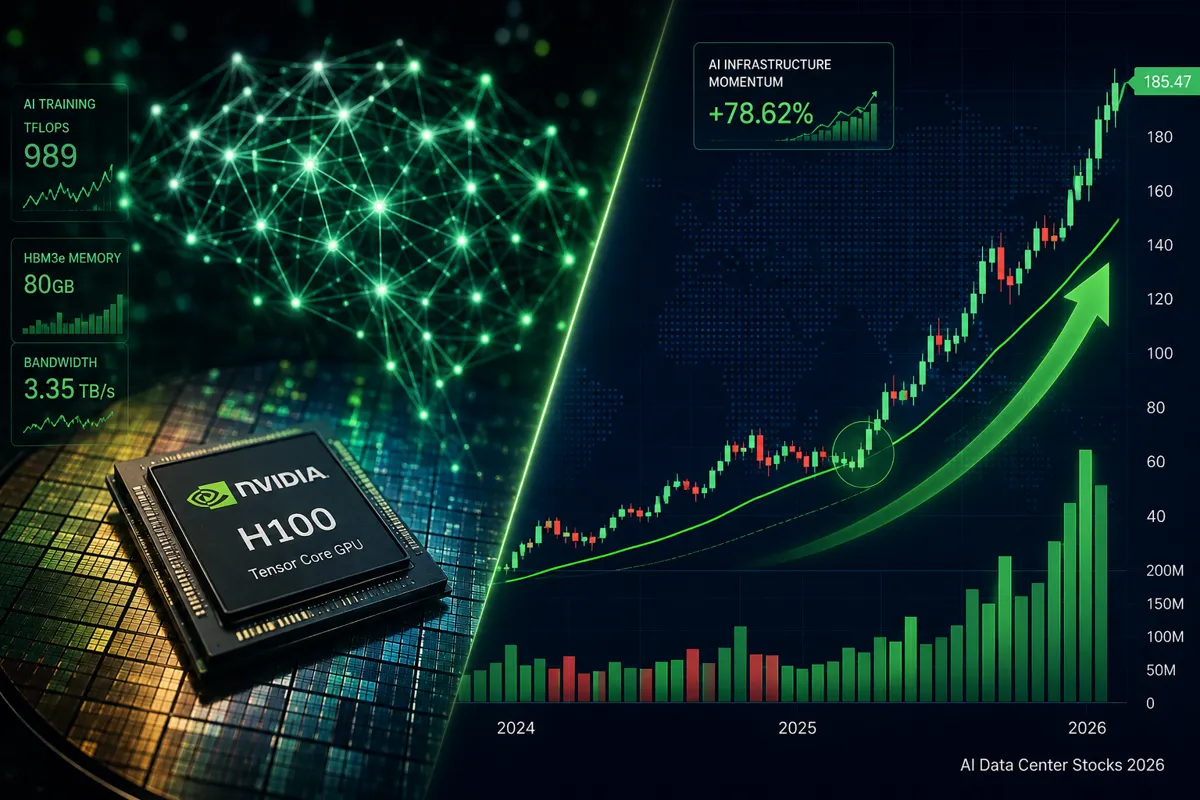
The top data center tech names in 2026 cluster around three categories: GPU and AI chip designers, hyperscale cloud providers, and data center infrastructure REITs. NVIDIA remains the clearest proxy for AI compute demand, with data center revenue up 35% year-over-year in Q1 2026. AMD has gained ground in the AI accelerator market. On the infrastructure side, Equinix (a data center REIT) rose roughly 15% over a two-month stretch in mid-2026 as institutional confidence in AI-driven colocation demand grew.
The hyperscaler tier — Microsoft Azure, AWS, and Google Cloud — is also worth tracking. Microsoft announced a $1.5 billion Azure expansion in June 2026. Google Cloud reported a 25% increase in AI infrastructure investment in Q2 2026. AWS launched new AI optimization services in May 2026 that attracted significant institutional attention.
The practical takeaway: Don't treat this as a single-stock bet. The data center boom has a supply chain — chips, power, cooling, connectivity, cloud. The smart money is spread across that chain, not concentrated in one name.
The AI Stock Tools Smart Money Is Using to Ride the Data-Center Boom
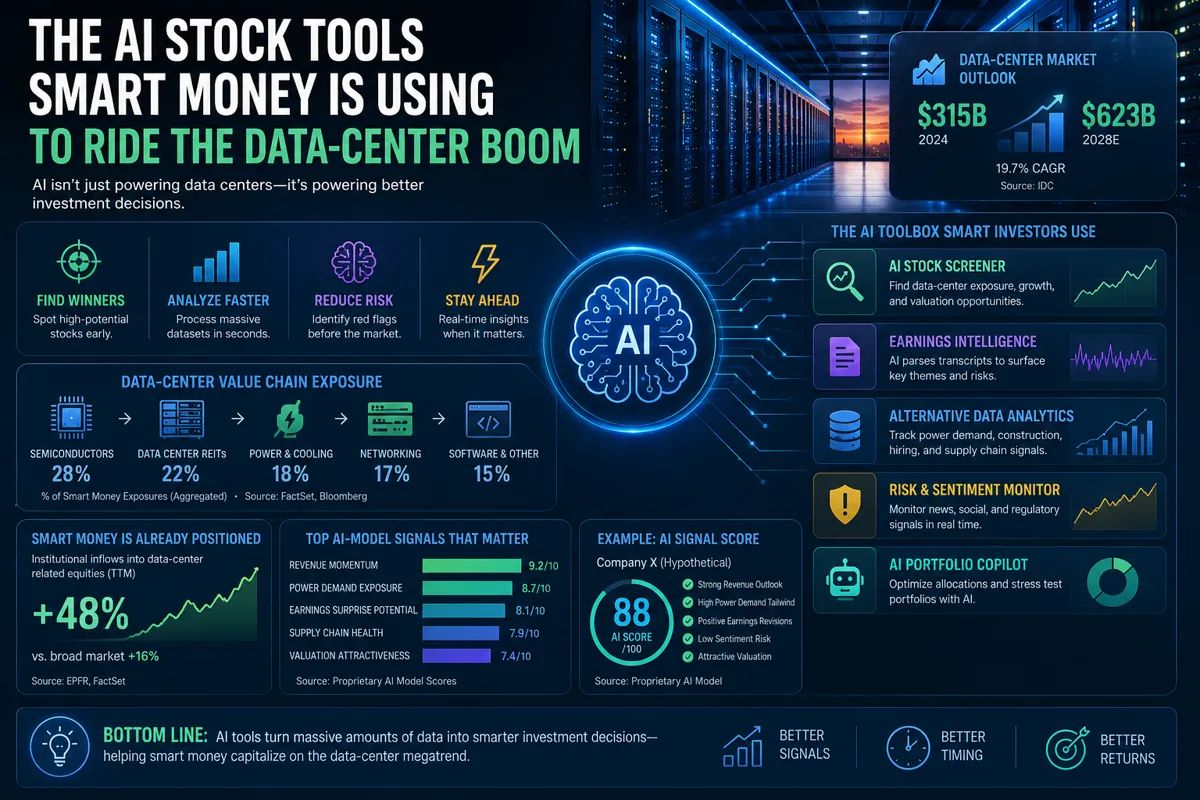
This is the actual question worth answering. Seventy percent of hedge funds now integrate AI-driven stock analysis platforms to find data center opportunities, and Goldman Sachs reported a 20% increase in trading efficiency after deploying AI-enhanced algorithms focused on this sector. The tools aren't magic — they're process accelerators.
Here's what the institutional playbook looks like, translated for retail:
TrendSpider handles momentum tracking and automated chart analysis. It scans for breakout patterns, flags tight consolidation zones, and can alert you when a data center name clears a key resistance level on volume. That's the kind of signal that used to require a full-time technical analyst. Now it's a dashboard filter. See how TrendSpider stacks up against other momentum tools.
Trade Ideas runs real-time alerts on heavy-volume tech movers. During power hour or around earnings season, it surfaces names showing unusual activity — the kind of price action that precedes a breakout or a gap fill. It's a scanner, not a crystal ball, but it keeps your watchlist focused on what's actually moving. Compare Trade Ideas with other real-time scanners.
Koyfin is where you do the valuation work — comparing price-to-earnings, EV/EBITDA, and revenue growth rates across semiconductor and hyperscaler names side by side. When a stock looks overextended relative to peers, Koyfin shows you that before the chart does.
Blackbox Stocks and Tickeron add options flow and AI pattern recognition for traders who want a second layer of signal confirmation. Check out Blackbox Stocks here and Tickeron's AI pattern tools here.
The common thread across all of them: signal over noise. You're not reading 40 analyst reports. You're running a defined screen, watching the setup develop, and acting on a rule — not a feeling.
Which Companies Build the Semiconductor Chips for AI Data Centers
The semiconductor layer is where the most direct AI infrastructure exposure lives. NVIDIA's H100 and B100 GPU series dominate AI training workloads. AMD's MI300 series is gaining traction with hyperscalers looking to diversify supply. Intel unveiled new AI-optimized processors in June 2026 designed specifically for data center performance, which shifted some institutional positioning.
Beyond the big three, the supply chain includes:
- Memory manufacturers (HBM — high-bandwidth memory — is essential for AI chips)
- Networking chip designers (moving data inside data centers at scale)
- Power management semiconductor companies (data centers consume enormous electricity)
Each sub-sector has different volatility profiles. Pure-play GPU designers like NVIDIA carry the highest beta (meaning they move more dramatically than the broader market). Memory names tend to be more cyclical. Power management plays can be steadier.
Common mistake: New investors buy the most famous name at the top of a news cycle. That's catching a falling knife or buying overextended — both expensive habits. Use a screener to find the setup, not the headline.
Are NVIDIA Stocks Still a Good Buy After Their Recent Surge
This is the question everyone's asking, and the honest answer is: it depends entirely on your time horizon, risk tolerance, and entry point — not on anyone's opinion. That's not a hedge; that's the actual framework.
What the data shows: NVIDIA's data center revenue grew 35% year-over-year in Q1 2026. That's real demand, not narrative. But a stock can have great fundamentals and still be a terrible trade if you're buying it after a 40% run with no consolidation.
The setup matters more than the story. A clean setup means the stock has pulled back to a support level, formed a base, and is showing tight consolidation before a potential breakout. Buying NVIDIA when it's basing near a key moving average is a different risk-reward than buying it three days after a gap-up earnings move.
Use a tool like TrendSpider to identify where support and resistance sit. Use Koyfin to check whether the current valuation is stretched relative to forward earnings estimates. Then size the position according to your risk — not your conviction.
Never size a position based on how much you believe in the company. Size it based on where your stop loss sits and how much of your portfolio you're willing to lose on this trade. That's position sizing, and it's the difference between a system and a gamble.

What's the Difference Between AI Chip Makers and Data Center Providers
These are two distinct business models with different revenue drivers, margins, and risk profiles. Conflating them is one of the most common mistakes retail investors make in this sector.
AI chip makers (NVIDIA, AMD, Intel) design and sell the processors that run AI workloads. Their revenue is tied directly to how much compute capacity hyperscalers and enterprises are buying. High margins, high cyclicality, high sensitivity to capex cycles.
Data center providers fall into two sub-groups:
- Hyperscalers (Microsoft Azure, AWS, Google Cloud) build and operate their own data centers, then sell compute as a service. Their data center spend is a cost center that drives cloud revenue.
- Data center REITs (like Equinix, Digital Realty) own and lease the physical buildings, power, and connectivity infrastructure. They don't care which chips are inside — they charge for floor space and power. More stable cash flows, lower growth ceiling, dividend income.
| Category | Revenue Driver | Volatility | Income |
|---|---|---|---|
| AI Chip Makers | Hardware sales cycles | High | Low/none |
| Hyperscalers | Cloud service subscriptions | Medium | Low |
| Data Center REITs | Lease revenue | Lower | Dividend yield |
Choose based on your goal. If you want growth and can handle volatility, chip makers. If you want steadier exposure with income, REITs. If you want a blend, a thematic ETF covers all three.
What Are the Risks of Investing in AI Infrastructure Stocks
The risks are real and specific. This sector isn't a one-way trade just because the long-term thesis is compelling.
Concentration risk: Market leadership in 2026 is narrow. A handful of names are driving most of the sector's gains. When the rotation happens — and it always does — concentrated positions get hit hard.
Valuation risk: Several AI infrastructure names trade at multiples that price in years of perfect execution. Any earnings miss, guidance cut, or macro shock can trigger a sharp selloff in overextended stocks.
Capex cycle risk: Data center buildout requires massive capital expenditure. If hyperscalers slow their spending — due to rising interest rates, regulatory pressure, or demand disappointment — chip makers and REITs feel it immediately.
Geopolitical risk: Semiconductor supply chains run through Taiwan, South Korea, and the Netherlands. Any disruption to that chain affects chip availability and pricing.
The bull trap: A stock breaks out, retail piles in, and then it reverses. That's a bull trap. It happens constantly in high-momentum sectors. A defined stop loss is the only protection.
JP Morgan introduced AI-driven risk assessment tools in April 2026 specifically to model these scenarios for data center investments. Retail investors don't have JP Morgan's quant team, but they do have access to research tools that score stock health and flag risk factors.
How Do Smaller Investors Get Exposure to the AI Data Center Market
Smaller investors have more options than they think — and the cheapest, lowest-complexity entry point is almost always an ETF.
ETF route (recommended starting point):
Thematic ETFs focused on AI infrastructure, semiconductors, or data centers give you diversified exposure without single-stock concentration risk. You're not betting on one company's earnings call. You're betting on the theme.
Individual stocks (intermediate level):
Once you understand the sector's structure — chips, hyperscalers, REITs — you can build a small watchlist of names to track. Use a screener to find clean setups rather than buying on news. The free swing trade planner at FullStack Alpha is a practical starting point for mapping your entry and exit before you commit capital.
Fractional shares:
Most major brokers now offer fractional shares. If NVIDIA's per-share price is outside your budget, fractional ownership lets you get exposure without going all-in on a single position.
Paper trade it first. Seriously. If you've never traded individual tech stocks, spend 30 days tracking your hypothetical trades before using real money. The process of watching your thesis play out — or not — teaches more than any article.
55% of asset management firms now use AI-based portfolio management systems to allocate to data center assets, per May 2026 estimates. The tools exist for retail investors too. The question is whether you'll use them with discipline.
What Mistakes Do New Investors Make When Trying to Invest in AI Stocks
Play stupid games, win stupid prizes. Here are the most common ones:
Chasing the headline. A stock is up 20% on an AI announcement. You buy it. It reverses. You're now holding a position that's down 15% with no plan. That's not investing — that's FOFO (fear of finding out how bad your process actually is) dressed up as conviction.
No stop loss. A stop loss is a pre-defined price where you exit a losing trade. Without one, "I'll just hold until it comes back" becomes the strategy. Sometimes it works. Often it doesn't. Catching a falling knife is a real thing — and it hurts.
Overtrading. The data center sector moves fast. That doesn't mean you need to trade every move. Overtrading generates commissions, taxes, and emotional exhaustion. More trades do not equal more alpha.
Analysis paralysis. Six screeners, four Discord servers, two newsletters, and still no trade. More information is not the problem. A clear process is. Pick three signals you trust, build a watchlist, and trade only what meets your criteria.
Revenge trading. You got stopped out on a semiconductor name. Now you want to "make it back" immediately. That's revenge trading, and it's how small losses become large ones.
The fix for all of these: a written trading plan before every position. Entry price, stop loss, target, position size, and the reason for the trade. If you can't write it down in two sentences, the setup isn't clean enough.
Which Countries Are Leading the AI Data Center Infrastructure Race
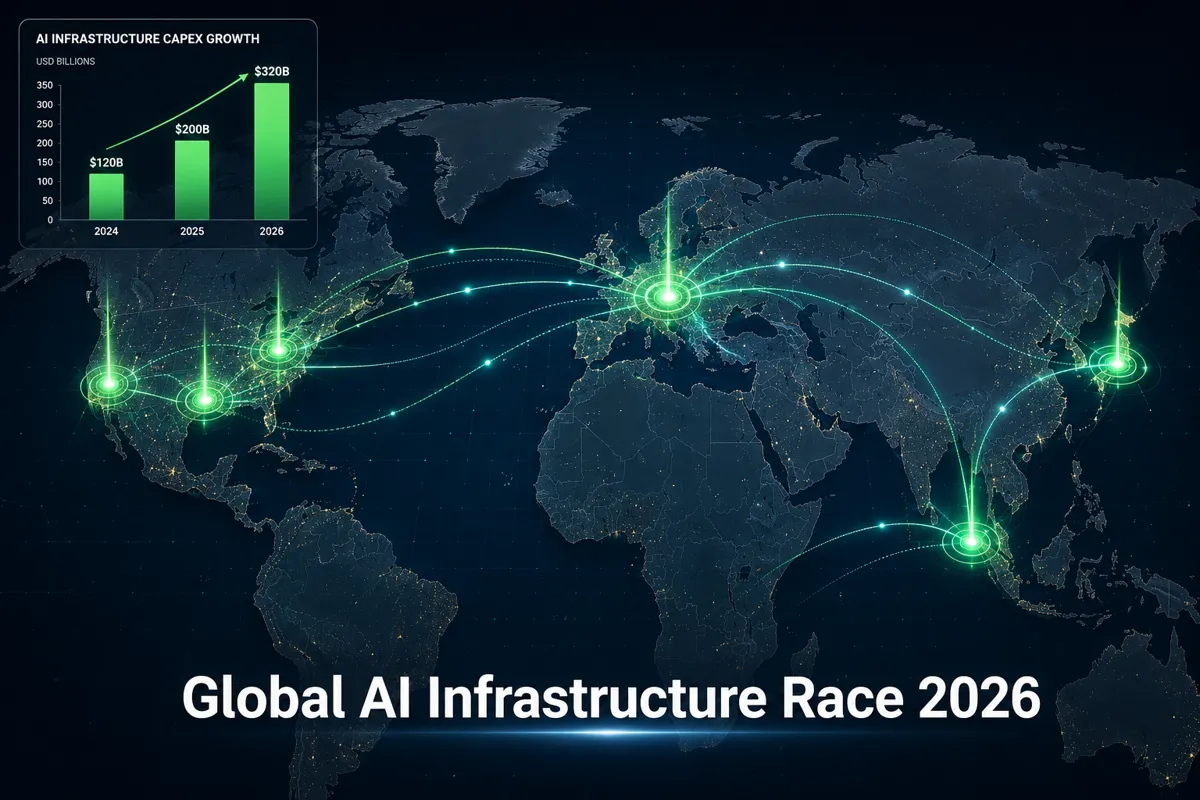
The United States leads by a significant margin — hyperscalers like AWS, Microsoft Azure, and Google Cloud are headquartered here and are deploying capital at a scale no other country matches. BlackRock's $2 billion AI data center commitment in May 2026 is just one data point in a much larger domestic buildout.
Northern Europe (particularly the Netherlands, Sweden, and Ireland) is a major hub due to cooler climates (lower cooling costs), renewable energy access, and favorable EU data regulations. Several large colocation providers operate significant capacity there.
Singapore and Japan anchor the Asia-Pacific region. Singapore is the primary Southeast Asian hub for hyperscaler capacity. Japan has seen accelerated investment as its government pushes domestic AI infrastructure development.
China is building aggressively but operates largely in a separate ecosystem, with domestic chip alternatives gaining ground following export controls on advanced semiconductors.
For retail investors, the geographic angle matters for two reasons: supply chain risk (Taiwan's semiconductor dominance creates concentration) and regulatory risk (EU AI Act, US export controls). Both can move individual stocks quickly. A tool like Benzinga Pro can surface geopolitical news that affects these names in real time.
What Are the Cheapest Ways to Invest in AI Data Center Technology
The cheapest path — in terms of cost, complexity, and time — is a broad-market or thematic ETF with low expense ratios. You get sector exposure without research overhead, single-stock volatility, or the time cost of running a screener every day.
For investors who want to go deeper without a large capital outlay:
- Fractional shares let you own partial positions in high-priced names.
- Commission-free brokers (most major platforms in 2026) eliminate per-trade costs.
- Free screening tools — including several listed in the FullStack Alpha research tools directory — let you do meaningful research without a paid subscription.
The real cost in this sector isn't the commission. It's the bad trade made on incomplete information. A $0 trade in the wrong direction at the wrong time costs more than a $10 commission on a well-researched position.
What Emerging AI Data Center Technologies Should You Watch
Three technology shifts are worth tracking because they affect which companies win the next phase of the buildout:
Liquid cooling: Traditional air cooling can't handle the heat density of modern AI chips. Liquid cooling systems are becoming standard in new data center construction. Companies supplying this technology are a second-derivative play on AI infrastructure growth.
Custom AI silicon: Hyperscalers (Google's TPUs, Amazon's Trainium, Microsoft's Maia) are designing their own chips to reduce dependence on NVIDIA. If this trend accelerates, it shifts the competitive dynamics for chip makers.
Optical networking: Moving data between chips and servers at AI scale requires faster interconnects. Optical networking companies are seeing increased demand as data center bandwidth requirements grow.
Power infrastructure: Data centers are power-hungry. Utility companies, nuclear energy providers, and power management semiconductor firms are all indirect beneficiaries of the buildout.
Tracking these emerging areas requires a tool that goes beyond price charts — you need fundamental data on smaller, less-covered companies. Stratosphere.io and Finchat are worth exploring for that kind of deep fundamental research on emerging names.
How Much Should a Beginner Invest in AI Infrastructure
There's no universal number, but there is a universal principle: never risk more than you can afford to lose entirely on a single sector thesis. AI infrastructure is a real, durable trend — but individual stocks within it can still drop 40-60% in a correction.
A reasonable framework for beginners:
- Start with no more than 5-10% of your total investable portfolio in any single sector theme.
- Within that allocation, diversify across the three layers (chips, hyperscalers, REITs) rather than concentrating in one name.
- If you're using individual stocks rather than ETFs, keep each position small enough that a 30% drawdown doesn't materially damage your overall portfolio.
- Scale up only after you've demonstrated a repeatable process — not after one lucky trade.
The goal isn't to maximize exposure to the hottest sector. The goal is to build a system that keeps you in the game long enough to benefit from compounding. Discipline beats prediction, every time.

How to Screen for AI Infrastructure Stocks Using AI Tools
Screening for AI infrastructure stocks is a three-step process: define the universe, apply filters, and confirm the setup.
Step 1: Define the universe.
Start with a sector or thematic filter — semiconductors (SIC code or GICS sector), data center REITs, or cloud infrastructure. Most screeners let you filter by industry. This narrows thousands of stocks to a manageable list.
Step 2: Apply fundamental and momentum filters.
- Revenue growth above a threshold (e.g., 20%+ year-over-year)
- Relative strength — is the stock outperforming its sector?
- Volume trend — is institutional money flowing in?
- Valuation check — is it trading at a reasonable multiple relative to growth?
Step 3: Confirm the technical setup.
This is where TrendSpider earns its place. Once you have a shortlist from your fundamental screen, check the chart. Is the stock basing near support? Is it in a tight consolidation before a potential breakout? Is the risk-reward favorable — meaning the distance to your stop loss is smaller than the distance to your target?
If all three steps align, you have a clean setup. If only one or two do, wait. The market always offers another entry. Patience is a position.
The free stock health scorecard is a quick way to run a structured check on any name before it hits your watchlist.
FAQ
What are the best AI stock tools for screening data center stocks in 2026?
TrendSpider is the strongest option for momentum and breakout detection. Trade Ideas excels at real-time alerts on volume spikes in tech names. Koyfin handles cross-sector valuation comparisons. For fundamental deep-dives, Stratosphere.io and Finchat cover smaller, less-followed names in the AI supply chain.
Is it too late to invest in AI infrastructure stocks?
The structural buildout of AI infrastructure is a multi-year capital cycle, not a single event. Whether any specific stock is "too late" depends on its current valuation and setup — not on the theme's longevity. Buying overextended names is the risk, not the theme itself.
What's the difference between a data center REIT and an AI chip stock?
A data center REIT (like Equinix) owns physical buildings and earns lease revenue — more stable, lower growth, dividend income. An AI chip stock (like NVIDIA) sells hardware into a cyclical demand cycle — higher growth potential, higher volatility, no dividend.
How do AI stock tools help with risk management?
They help by making your process systematic rather than emotional. A screener with defined filters prevents you from chasing random setups. An alert system tells you when a position hits your stop loss level. A valuation tool tells you when a stock is overextended before you buy it.
Can I invest in AI data center stocks with a small account?
Yes. Fractional shares, commission-free brokers, and thematic ETFs all provide access regardless of account size. The key is position sizing — keeping each bet small enough that a loss doesn't wipe out your progress.
What's FOFO and why does it matter for AI stock investors?
FOFO is "Fear of Finding Out" — the tendency to avoid checking your portfolio or your process because the truth might be uncomfortable. In a volatile sector like AI infrastructure, FOFO leads to holding losers too long and missing the exit. A defined stop loss removes the emotion from that decision.
Are there free AI stock tools for researching data center names?
Yes. Several platforms offer free tiers with meaningful functionality. The FullStack Alpha free tools section includes a stock health scorecard and swing trade planner that work for sector-specific research without a paid subscription.
What's a bull trap in the context of AI stocks?
A bull trap is when a stock appears to break out above a resistance level, drawing in buyers, then reverses sharply lower. It's common in high-momentum sectors after a news catalyst. A stop loss just below the breakout level is the standard protection.
How much of my portfolio should be in AI infrastructure stocks?
No single sector should dominate a diversified portfolio. A reasonable starting range for a growth-oriented investor is 10-20% total sector exposure, spread across chips, hyperscalers, and REITs. Beginners should start at the lower end and scale up as their process matures.
What's the best way to track institutional money flow into data center stocks?
Options flow analysis (unusual call activity), dark pool prints, and relative volume spikes are the primary signals. Tools like Blackbox Stocks and Trade Ideas surface these in real time. Sixty percent of institutional investors now use AI-powered sentiment analysis to gauge data center investment flows, per June 2026 estimates.
Conclusion
The data center boom is real. The institutional money is real — $2 billion from BlackRock, $1.5 billion from Microsoft, 35% revenue growth at NVIDIA. The theme has legs.
But the AI stock tools smart money is using to ride the data-center boom aren't there to tell you what to buy. They're there to help you build a process — a repeatable system for finding clean setups, managing risk, and staying out of the noise that costs retail investors money every single earnings season.
Here's what to do next:
- Define your universe. Decide whether you want chip makers, hyperscalers, REITs, or a mix. Each has a different risk-reward profile.
- Pick two or three tools. TrendSpider for momentum and breakouts. Trade Ideas for real-time alerts. Koyfin for valuation context. Start there — don't add more until you've mastered what you have.
- Build a watchlist, not a portfolio. Track 8-10 names before you own any of them. Watch how they react to news, earnings, and sector rotation.
- Write your trade plan before every entry. Entry, stop loss, target, position size. If you can't write it in two sentences, the setup isn't ready.
- Paper trade it first if you're new to individual tech stocks. Thirty days of hypothetical trades will teach you more than any newsletter.
Systems over hacks. Process over prediction. Signal over noise. The data center boom will reward the disciplined — not the ones who chased the loudest headline.
FullStack Alpha cuts the noise so you can keep the alpha. Browse the AI tools, screeners, and systems that actually move the needle at aistockpickerapps.com.