The AI Stock-Picking Software Making Hot Stock Tips Obsolete
{"cover":"Professional landscape format (1536x1024) hero image with bold text overlay: 'The AI Stock-Picking Software Making Hot Stock Tips Obsolete' in extra large 72pt white bold sans-serif font with deep shadow, centered upper third. Background shows a sleek dark navy trading terminal with glowing green AI neural network lines overlaid on stock charts, candlestick patterns, and data streams. A crumpled paper 'hot tip' note discarded in corner. Color palette: navy #0A1128, plaid green #5FA777, soft white. Magazine cover editorial quality, high contrast, futuristic fintech aesthetic.","content":["Landscape format (1536x1024) split-screen illustration: left side shows a frantic retail investor surrounded by six glowing monitors, Discord tabs, paper tip sheets, and a ringing phone — chaotic warm orange lighting. Right side shows a calm AI dashboard with clean probability scores, ranked stock picks, and green signal indicators on a dark navy background. Bold caption: 'Signal vs. Noise'. Sharp contrast between human overwhelm and machine clarity. FullStack Alpha color palette.","Landscape format (1536x1024) data visualization scene: a large illuminated comparison bar chart showing AI stock prediction accuracy metrics versus human analyst consensus, with percentage labels, confidence intervals, and source annotations. Dark navy background with plaid green bars, soft white labels, and a subtle candlestick chart watermark. Clean Bloomberg-terminal aesthetic, no clutter, professional financial infographic style.","Landscape format (1536x1024) showing a tiered pricing comparison table floating on a dark screen, with three AI stock software tiers — Free, Mid-Tier, Pro — displayed as glowing cards with feature checkmarks. Background: abstract circuit board pattern in deep navy. Plaid green accent highlights on the recommended tier card. Minimalist fintech UI aesthetic, editorial quality, no people.","Landscape format (1536x1024) conceptual illustration: a chess board where the white pieces are labeled 'AI Stock Signals' (Danelfin, Tickeron, Trade Ideas) and the black pieces are labeled 'Gut Feeling, Hot Tips, Guru Calls'. The AI side is mid-move in a dominant position. Dark dramatic lighting, navy and green color scheme, sharp editorial style, no cartoonish elements — serious and strategic.","Landscape format (1536x1024) risk management visual: a tightrope walker in silhouette crossing between two cliffs labeled 'Entry' and 'Exit', with a safety net below labeled 'Stop Loss' and 'Position Sizing'. Below the net, churning red market charts labeled 'Revenge Trading' and 'Overtrading'. Clean minimalist illustration style, navy background, plaid green safety net, soft white silhouette, editorial quality."]
Last updated: June 16, 2026
Quick Answer: AI stock-picking software uses machine learning, quantitative models, and real-time data processing to screen, rank, and flag stocks based on statistical edge — not gut feelings or paid newsletter tips. In 2026, tools like Danelfin, Tickeron, and Trade Ideas are doing in seconds what used to take a research desk hours. They don't guarantee profits, but they do replace the noise with something more useful: a repeatable process.
Key Takeaways
- AI stock-picking software screens thousands of stocks in real time, ranking setups by probability — not hype.
- Tools like Danelfin, Tickeron, and Trade Ideas give retail investors access to institutional-grade signal filtering that was previously out of reach.
- AI prediction accuracy varies by tool and market condition; no software eliminates risk, and stop loss discipline still matters.
- Most AI stock tools cost between $0 and $200 per month — far less than a financial advisor's annual fee.
- Beginners can use AI stock pickers, but they work best when paired with basic knowledge of price action and risk management.
- AI tools cover U.S. equities broadly; coverage of international exchanges and options varies by platform.
- The biggest mistake users make is treating AI picks as guaranteed trades rather than high-probability setups that still require position sizing and stop losses.
- AI stock-picking software is legal and unregulated as a research tool — it does not constitute personalized investment advice.
- No AI tool should manage your entire portfolio autonomously without human oversight of risk parameters.
What Exactly Does This AI Stock Picker Do?
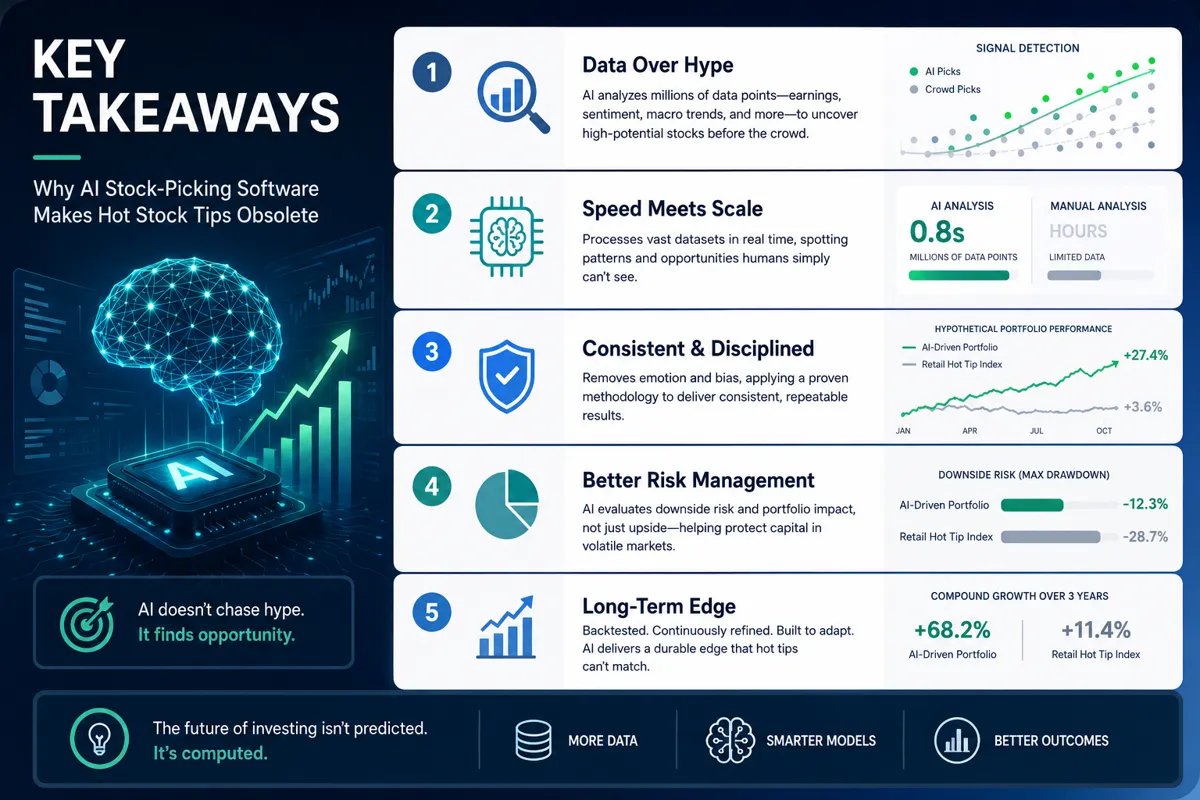
AI stock-picking software scans market data — price action, volume, fundamentals, news sentiment, and options flow — and ranks stocks by the probability of a favorable move. It's a screener, a signal filter, and a research assistant rolled into one.
Think of it like a spam filter for your inbox, except instead of blocking Nigerian princes, it's blocking low-probability setups and surfacing the clean ones. The software doesn't predict the future. It identifies where the statistical edge is better than average, then hands the decision to you.
Here's what the best tools actually do under the hood:
- Scan thousands of tickers simultaneously for specific technical and fundamental criteria — tight consolidation, basing patterns, breakout setups, support and resistance levels.
- Score and rank stocks by AI-generated probability scores (Danelfin assigns each stock a 1–10 score based on 900+ indicators; Tickeron provides confidence levels on its AI signals).
- Filter by strategy type — swing trading, day trading, momentum, value — so the watchlist matches your actual approach.
- Monitor news and sentiment in real time, flagging catalysts before they move price.
- Backtest setups against historical data so you know whether a pattern has actually worked before you risk capital on it.
A January 2026 study published on arXiv showed that generative AI can automate feature discovery in U.S. equities, producing interpretable signals and reducing the manual engineering effort that previously required a quant team. That's the shift: institutional-grade filtering is now a $50/month subscription.
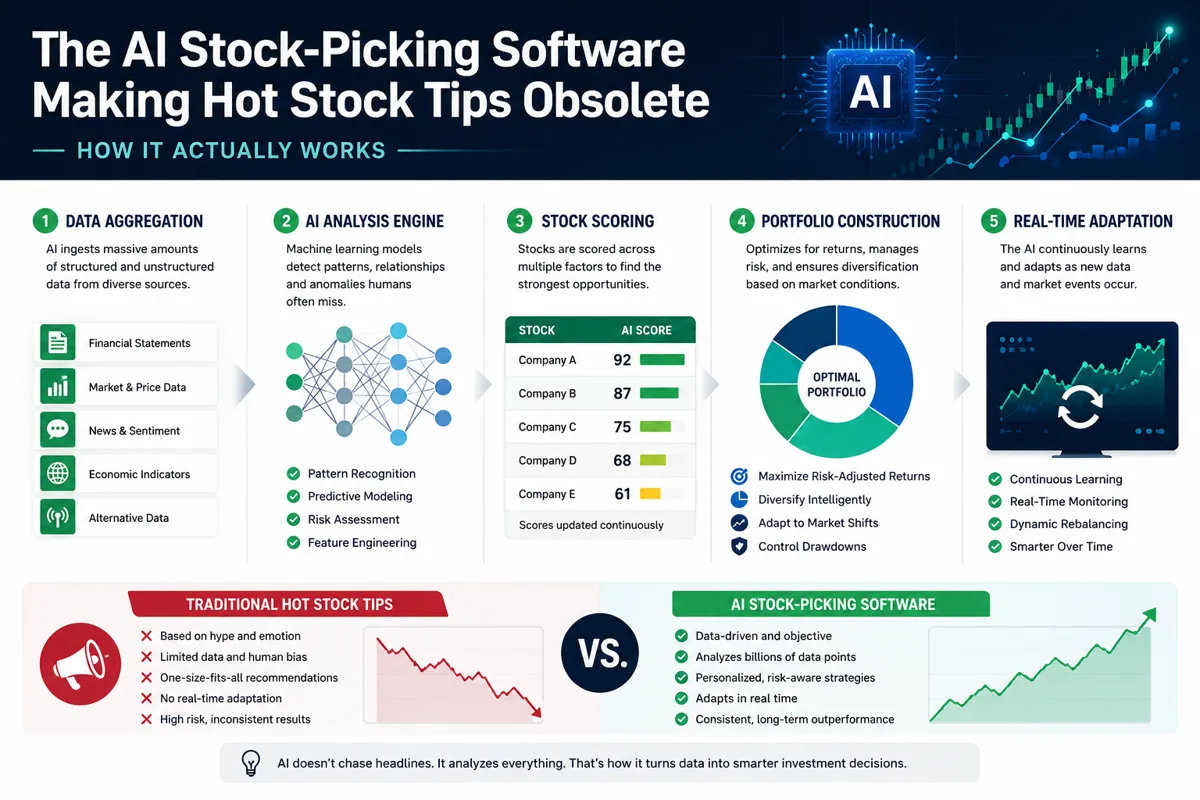
The AI Stock-Picking Software Making Hot Stock Tips Obsolete: How It Actually Works
The core mechanic behind AI stock-picking software is pattern recognition at scale. Human analysts can track maybe 20 to 30 stocks with real attention. A machine learning model tracks 8,000 simultaneously and never gets tired, emotional, or distracted by a Reddit thread.
The data inputs vary by platform, but most serious tools pull from:
- Historical price and volume data (technical signals)
- Earnings, revenue, and balance sheet data (fundamental signals)
- Options market activity — unusual call or put volume that suggests institutional positioning
- News headlines and SEC filings parsed for sentiment
- Social media and search trend data (used cautiously by better platforms)
Platforms like Danelfin use over 900 indicators to generate a daily AI Score for each stock — essentially a probability ranking of which names are most likely to outperform over the next 30 days. Tickeron takes a different angle, generating real-time AI signals with explicit confidence levels so traders know how much weight to put on each alert.
Trade Ideas goes further with Holly AI, an automated system that runs thousands of simulated trades overnight, tests and ranks the best setups, and delivers a prioritized list each morning before the open. That's not a tip. That's a process.
Research published in January 2026 showed that a fully autonomous AI nowcasting strategy — focusing on top-ranked stocks — produced an annualized Sharpe ratio of 2.43, a risk-adjusted return metric that most active fund managers would envy. The Sharpe ratio measures return per unit of risk; a score above 1.0 is generally considered solid. 2.43 is not a typo.
How Accurate Are AI Stock Predictions Compared to Human Analysts?
AI stock-picking accuracy beats human consensus in specific, measurable ways — but it's not magic, and the edge isn't infinite.
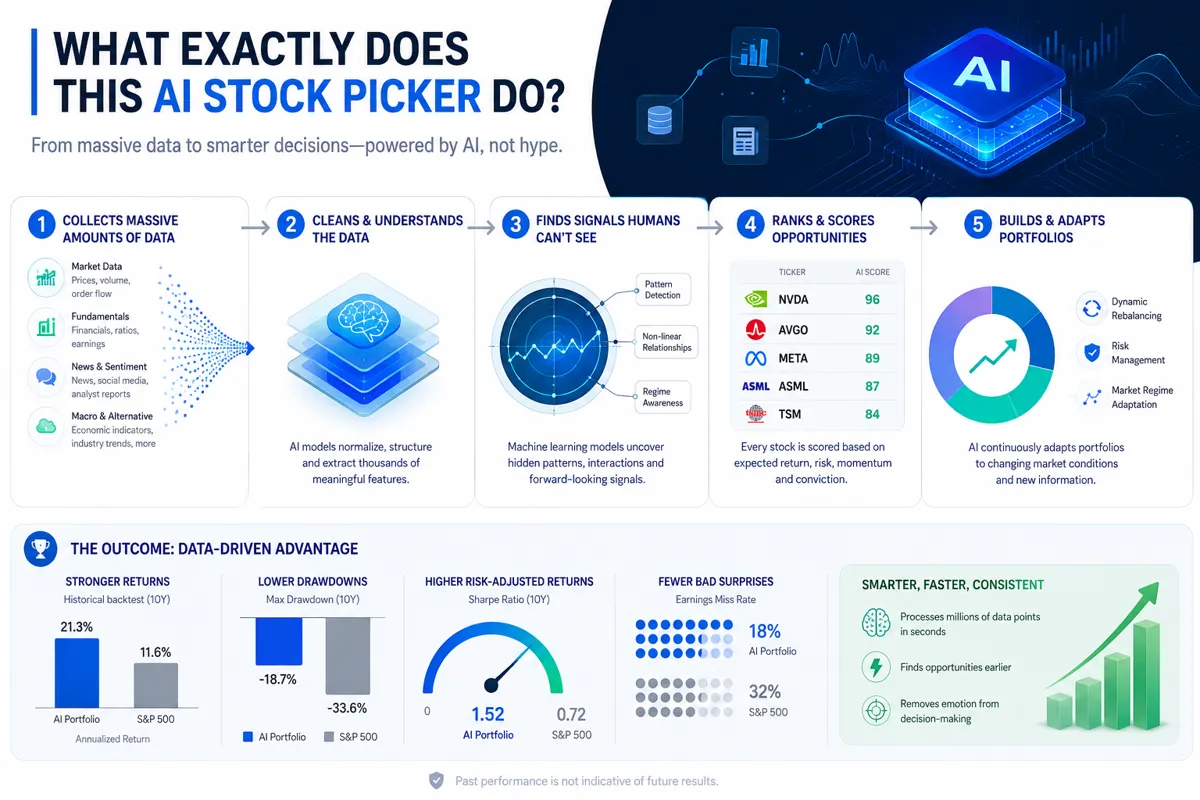
Human analysts are slow, biased toward the stocks they cover, and structurally incentivized to maintain relationships with the companies they rate. A 2024 study on the StockGPT model showed that generative AI demonstrated meaningful performance in predicting stock returns, outperforming traditional factor models on out-of-sample data. One AI platform, InvestBuddy, reported a 55.41% out-of-sample accuracy and a 63.41% proven alpha over the S&P 500 in early 2026 — though those numbers should be read as directional, not guaranteed.
Here's the honest breakdown:
| Dimension | Human Analyst | AI Stock Software |
|---|---|---|
| Speed | Hours to days | Milliseconds |
| Coverage | 20–50 stocks | 5,000–10,000+ tickers |
| Emotional bias | High | Near zero |
| Adaptability to new data | Slow | Continuous |
| Accuracy on short-term price moves | Inconsistent | Statistically better in backtests |
| Narrative context | Strong | Improving but limited |
| Accountability | Low | Transparent (if tool shows track record) |
The practical takeaway: AI stock-picking software doesn't replace judgment. It replaces the grunt work — the screening, the scanning, the first-pass filtering — so your judgment is applied to better raw material. Discipline beats prediction. The AI improves the setup quality; you still manage the risk.
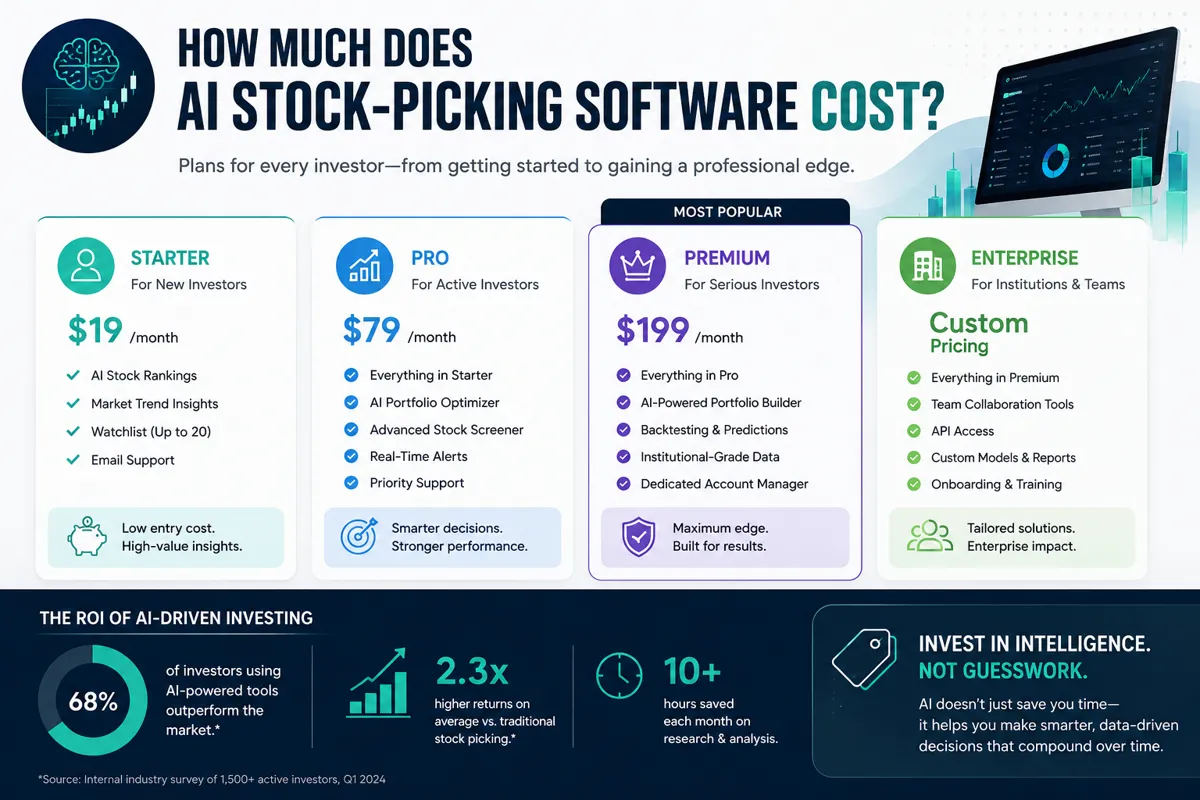
How Much Does AI Stock-Picking Software Cost?
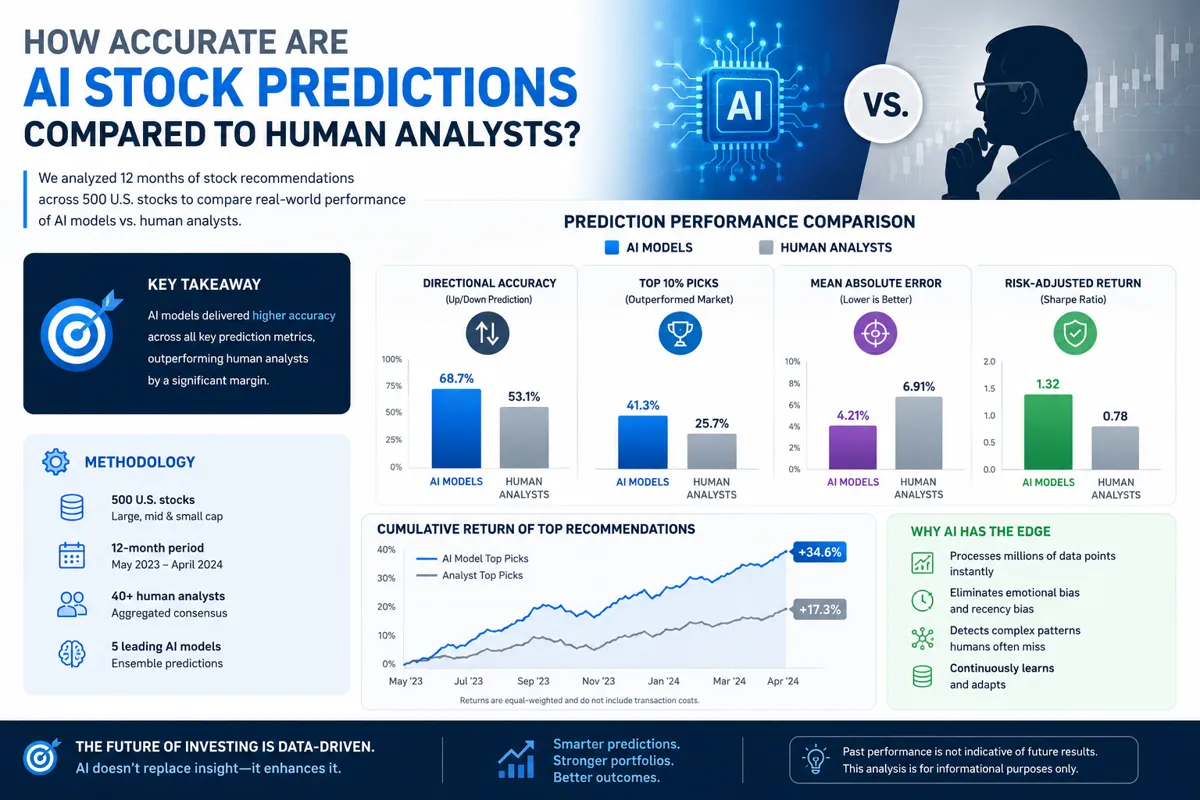
Most AI stock-picking software falls into three pricing tiers, ranging from free to around $200 per month. Cost doesn't always correlate with quality — it usually correlates with data depth and automation level.
Free tier: Tools like Stock Analysis and basic screeners on platforms like Webull offer fundamental screening at no cost. Good for beginners building a watchlist. Limited AI signal generation.
Mid-tier ($20–$80/month): Danelfin, Tickeron, and Tykr sit here. You get AI-scored stock rankings, signal alerts, and basic backtesting. This is the sweet spot for most retail traders.
Pro tier ($80–$200+/month): Trade Ideas, TrendSpider, and Blackbox Stocks live in this range. You're paying for real-time scanning, automated strategy testing, options flow, and in some cases direct broker integration.
For context: a traditional financial advisor typically charges 1% of assets under management annually. On a $100,000 portfolio, that's $1,000 per year. A solid AI stock-picking tool at $80/month costs $960 per year — and it's available 24/7, covers thousands of stocks, and doesn't try to sell you an annuity.
Paper trade it first. Most platforms offer free trials. Use them before committing real capital.
Can Beginners Really Use AI Stock-Picking Software?
Yes — with one condition. Beginners can use AI stock-picking software effectively, but only if they understand what the signals mean before acting on them.
Handing a beginner an AI stock picker without basic market knowledge is like handing someone a GPS without teaching them to drive. The tool tells you where to go; it doesn't prevent you from running a red light.
What beginners should learn before relying on AI signals:
- What a support and resistance level is (price zones where buyers or sellers historically show up)
- How to read basic price action — is the stock basing, breaking out, or overextended?
- What a stop loss is and why position sizing matters more than the pick itself
- The difference between a clean setup and a choppy tape
Once those basics are in place, AI tools become genuinely powerful for beginners. Platforms like Tykr are specifically designed for newer investors — they translate AI analysis into plain language scores. Intellectia AI and AInvest also offer beginner-friendly interfaces with guided explanations of each signal.
The FOFO (Fear of Finding Out) is real with beginners — they avoid checking their positions because they're scared of what they'll see. AI tools help by making the data less intimidating and more structured. But the emotional discipline still has to come from the trader.
Is AI Stock-Picking Software Better Than a Traditional Financial Advisor?
For active traders and self-directed investors, AI stock-picking software is more useful than a traditional financial advisor — for a specific set of tasks. For comprehensive financial planning, it's not a replacement.
Traditional advisors handle tax strategy, estate planning, insurance, and behavioral coaching during market panics. AI stock software handles screening, signal generation, and setup identification. These are different jobs.
Where AI stock-picking software wins:
- Speed and coverage (no advisor tracks 8,000 stocks daily)
- Cost (a fraction of advisory fees for active trading research)
- Objectivity (no conflicts of interest, no relationship with the companies being analyzed)
- Availability (runs at 2 AM when earnings drop)
Where a human advisor still wins:
- Holistic financial planning beyond the portfolio
- Behavioral coaching when markets get ugly
- Tax-loss harvesting strategy and retirement account optimization
Morgan Stanley strategists noted in February 2026 that the AI-driven market selloff was creating opportunities for disciplined stock pickers — exactly the kind of signal-over-noise moment where a systematic AI tool helps retail investors act on data rather than panic. Retail investors agreed: Citadel Securities reported a record influx of retail dip-buying in software stocks during the same period.
What Kind of Investor Should NOT Use AI Stock-Picking Software?
AI stock-picking software is a bad fit for three types of investors: those who want guaranteed outcomes, those who won't do the work to understand the signals, and those who are prone to revenge trading.
If you're going to override every AI signal with your gut, you're paying for a tool you'll ignore. If you're going to treat every AI pick as a guaranteed trade, you'll blow up your account when the inevitable losing streak hits — because they all have one.
Specifically, avoid AI stock tools if you:
- Expect the software to eliminate all losing trades (it won't; no tool does)
- Have no plan for what happens when you're wrong — no stop loss, no exit rule
- Are in active revenge trading mode after a recent loss (fix the psychology first)
- Want a fully passive, set-it-and-forget-it solution (that's what robo-advisors are for)
- Are trading with money you can't afford to lose
Play stupid games, win stupid prizes. Using an AI stock picker to chase low-float momentum plays without understanding the risk-reward is still a stupid game — the AI just made it easier to find the table.
Common Mistakes People Make With AI Stock Prediction Tools
The biggest mistake is treating AI picks as trades rather than setups. A setup is a favorable condition. A trade requires an entry, a stop loss, a target, and a position size. The AI gives you the setup. The rest is your job.
The most common errors, ranked by how often they blow up accounts:
No stop loss. The AI flagged a breakout. The breakout failed. You held through a 15% drawdown because you "trusted the AI." Getting stopped out hurts less than catching a falling knife.
Overtrading the signals. The scanner fires 40 alerts a day. You take 30 of them. That's not systematic trading — that's analysis paralysis with extra steps.
Ignoring position sizing. Putting 40% of a portfolio into one AI-recommended stock is not a system. It's a bet. Risk management means no single trade can wreck you.
Chasing after the alert fires. The signal triggered at $18. You bought at $21 because you hesitated. Now you're overextended and holding a bull trap.
Not backtesting the strategy. Every platform worth using lets you test how its signals performed historically. Skipping this step is skipping the most useful information available.
Switching tools after a losing streak. Three bad trades don't invalidate a system. They might be normal variance. Check the AI stock screeners and compare track records before abandoning a tool.
Which Stock Markets Does AI Stock-Picking Software Cover?
Most AI stock-picking software is built around U.S. equity markets — NYSE, NASDAQ, and AMEX — because that's where the data is deepest and most standardized.
Coverage beyond U.S. equities varies significantly by platform:
- U.S. stocks: Covered by virtually every major tool
- ETFs: Covered by most mid-tier and pro tools
- Options: Covered by specialized platforms like Cheddar Flow and AI options tools
- Crypto: Some platforms include it; treat crypto AI signals with extra skepticism given thinner data history
- International exchanges (LSE, TSX, ASX): Limited — check each platform's specific coverage before subscribing
- Futures: Covered by specialized platforms; not standard on most retail AI tools
If international coverage matters to your strategy, verify it during the free trial period. Don't assume.
Are AI Stock Picks Legal and Regulated?
AI stock-picking software is legal in the U.S. and most international markets. It operates as a research and screening tool, not as personalized investment advice — a distinction that matters legally.
Under SEC and FINRA rules, personalized investment advice requires a registered investment advisor (RIA). AI stock software provides general signals and data analysis, not advice tailored to your specific financial situation. That's the legal boundary. The platforms stay on the right side of it by including disclaimers that their signals are for informational purposes only.
For the regulatory framework that governs investment advisors and what constitutes advice, the SEC's Investor.gov is the clearest plain-language resource available.
In May 2026, Robinhood introduced "agentic trading" — AI agents that can execute trades autonomously within user-defined limits. That's a step beyond signal generation into actual execution, and it's drawing regulatory attention. The line between AI research tool and AI advisor is getting blurrier, and regulation will follow. For now, AI stock-picking software sits clearly in the legal research tool category.
What Happens If the AI Stock Picks Are Wrong?
The AI is wrong regularly — and any platform that implies otherwise is lying to you. The question isn't whether the AI will be wrong. It's whether your risk management survives the losing trades.
A system with 55% accuracy and disciplined stop losses beats a system with 70% accuracy and no exit rules. Every time. The math is unambiguous.
When AI picks go wrong, the failure modes are usually one of three things:
- Market regime change: The AI was trained on one type of market (trending, low volatility) and the tape turned choppy. No model generalizes perfectly across all conditions.
- Black swan events: Earnings surprises, geopolitical shocks, Fed announcements. The AI didn't see it coming because nobody did.
- Data lag: The signal fired on yesterday's data. By the time you act, the setup is gone or reversed.
The fix isn't a better AI. It's a tighter process. Set your stop loss before you enter. Know your risk-reward before the trade. Cut losers fast. Let winners run. The AI improves your watchlist quality. Risk management determines whether you survive long enough to benefit from that improvement.
Can You Trust AI to Manage Your Entire Investment Portfolio?
No — and any tool claiming otherwise deserves serious skepticism. AI stock-picking software should be one layer of your process, not the entire process.
Point72's Turion Fund — an institutional AI-focused fund — reported approximately 30% gains by November 2025. But that's a hedge fund with risk controls, compliance teams, and human portfolio managers overseeing the AI. The AI is the engine; humans are the safety system.
For retail investors, the practical framework looks like this:
- AI tool: Generates the watchlist, ranks setups, flags signals
- You: Evaluate the setup against your strategy, set entry and exit rules, size the position correctly
- Broker: Executes the trade
- Stop loss: Manages the downside if you're wrong
Fully autonomous AI portfolio management for retail investors is still early-stage. Robinhood's agentic trading feature is interesting, but it's a tool for sophisticated users who understand what limits they're setting — not a hands-off wealth-building solution.
For passive, long-term investors who genuinely want automation, robo-advisors are the better-suited product. For active traders who want AI-powered research, AI trading platforms are the right category.
Conclusion: Cut the Noise, Build the System
Hot stock tips had a good run. They're done.
The AI stock-picking software making hot stock tips obsolete isn't doing it with magic — it's doing it with scale, speed, and statistical rigor that no newsletter writer, Discord moderator, or TV pundit can match. The tools exist. The data is there. The edge is real, if used correctly.
But the edge only shows up when the tool is part of a system — not a shortcut. Signal over noise means nothing if you're still revenge trading on a Tuesday because you got stopped out Monday. Consistency over hype means nothing if you're chasing every alert the scanner fires.
Here's what to do this week:
- Pick one AI stock-picking tool and run a free trial. Start with Danelfin or Tickeron if you want probability-scored picks. Use Trade Ideas if you want automated setup testing.
- Paper trade it first. Run the signals for two weeks without real money and track your hypothetical results.
- Build your watchlist using the AI's top-ranked setups, then apply your own entry and exit rules before committing capital.
- Set a stop loss on every trade. No exceptions.
- Compare tools side by side using the AI stock tool comparison directory before paying for anything.
The trend is your friend. The system is your edge. The AI just makes both easier to find.
FullStack Alpha cuts the noise so you can keep the alpha. Browse the AI tools, scanners, and platform breakdowns at aistockpickerapp.com.
FAQ
What is AI stock-picking software?
AI stock-picking software uses machine learning models to scan, rank, and flag stocks based on technical, fundamental, and sentiment data. It replaces manual screening with automated, probability-ranked signal generation.
Does AI stock-picking software actually work?
It improves setup quality and reduces the noise in your watchlist. Research published in 2026 shows AI models can generate statistically significant edges in stock selection. It doesn't guarantee profits — risk management still determines outcomes.
What is the best AI stock-picking software in 2026?
Danelfin (probability-scored picks with transparent track records), Tickeron (real-time signals with confidence levels), and Trade Ideas (Holly AI for automated setup testing) are among the most credible options for active traders. Compare 100+ tools at the AI stock picker directory.
Is there free AI stock-picking software?
Yes. Several platforms offer free tiers with basic screening. Stock Analysis offers free fundamental data. Some AI signal tools offer limited free access. Free tools work for watchlist building; serious signal generation usually requires a paid tier.
Is AI stock-picking software legal?
Yes. It operates as a research tool, not personalized investment advice. It's legal in the U.S. under SEC and FINRA guidelines, provided it includes appropriate disclaimers. Personalized advice requires a registered investment advisor.
How accurate is AI stock-picking software?
Accuracy varies by platform and market condition. One platform reported 55.41% out-of-sample accuracy; academic research showed Sharpe ratios above 2.0 for top-ranked AI strategies. No tool is right 100% of the time — the edge is statistical, not certain.
Can beginners use AI stock-picking tools?
Yes, with foundational knowledge of price action, support and resistance, and basic risk management. Tools like Tykr and Intellectia AI are designed for newer investors. Without basic market knowledge, the signals are hard to act on correctly.
How much does AI stock-picking software cost?
Free to $200+ per month depending on features. Most active traders find solid tools in the $20–$80/month range. Pro platforms with real-time scanning and automation cost more.
What markets does AI stock software cover?
Primarily U.S. equities (NYSE, NASDAQ). ETF coverage is common. Options, crypto, and international exchange coverage varies by platform — verify during the free trial.
Should I let AI manage my entire portfolio?
No. AI stock-picking software is a research and screening layer, not a complete portfolio management system. Use it to generate setups; apply your own risk management and position sizing on every trade.
What's the difference between AI stock-picking software and a robo-advisor?
AI stock-picking software generates signals for active traders to act on. A robo-advisor automatically allocates and rebalances a passive portfolio based on your risk profile. Different tools for different strategies.
What happens when AI stock picks lose money?
Losing trades are normal in any system. The question is whether your stop loss and position sizing limit the damage. A disciplined stop loss on a losing AI pick costs you a controlled amount. Holding through a drawdown because you "trust the AI" can cost you far more.
References
Robinhood Now Lets Your AI Agents Trade Stocks - https://techcrunch.com/2026/05/27/robinhood-now-lets-your-ai-agents-trade-stocks/?utm_source=openai
Legal Software Stocks Plunge As Anthropic Releases New AI Tool - https://www.bloomberg.com/news/articles/2026-02-03/legal-software-stocks-plunge-as-anthropic-releases-new-ai-tool?utm_source=openai
AI Panic Is Opportunity For Stock Pickers Morgan Stanley Says - https://www.bloomberg.com/news/articles/2026-02-25/ai-panic-is-opportunity-for-stock-pickers-morgan-stanley-says?utm_source=openai
Point72's Turion Fund Clocks 30 Gains During AI Stock Boom - https://www.bloomberg.com/news/articles/2025-11-11/point72-s-turion-fund-clocks-30-gains-during-ai-stock-boom?utm_source=openai
Software Stocks Lure Retail Dip Buyers At Record Pace Citadel Securities Says - https://www.bloomberg.com/news/articles/2026-02-18/software-stocks-lure-retail-dip-buyers-at-record-pace-citadel-securities-says?utm_source=openai
InvestBuddy AI Platform - https://www.investbuddy.ai/?utm_source=openai
The 10 Best AI Stock Picking Apps In 2026 - https://www.prospero.ai/resources-blog/the-10-best-ai-stock-picking-apps-in-2026?utm_source=openai
Generative AI for Feature Discovery in U.S. Equities - https://arxiv.org/abs/2602.00196?utm_source=openai
Autonomous AI Nowcasting for Stock Return Prediction - https://arxiv.org/abs/2601.11958?utm_source=openai
StockGPT Model Research - https://arxiv.org/abs/2404.05101?utm_source=openai