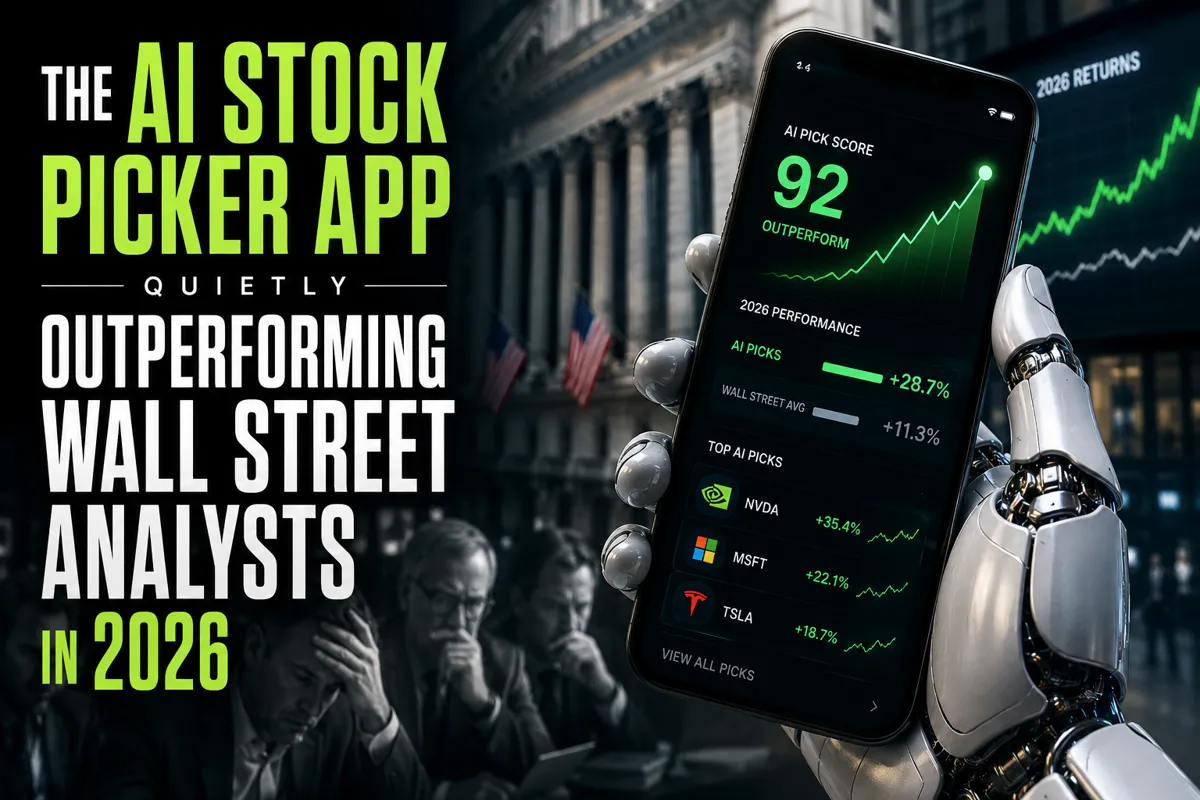
The AI Stock Picker App Quietly Outperforming Wall Street Analysts in 2026
{"cover":"Professional landscape format (1536x1024) hero image with bold text overlay: 'The AI Stock Picker App Quietly Outperforming Wall Street Analysts in 2026' in extra large 72pt white bold sans-serif font with dark drop shadow, centered upper-third composition. Background shows a dramatic split scene: left side features a traditional Wall Street trading floor with suited analysts hunched over terminals, right side shows a sleek futuristic AI dashboard with glowing green stock charts, probability scores, and neural network visualizations. Color palette: deep navy blue #0A1128, forest green #1F5E43, soft white #F8FAFC. High contrast, magazine cover quality, editorial fintech aesthetic, muted premium tone, no neon.","content":["Landscape format (1536x1024) editorial illustration showing a glowing AI brain overlaid on a stock market candlestick chart, with green bullish candles rising past a flat red analyst consensus line. Neural network nodes pulse with light connecting to ticker symbols like NVDA, AAPL, MSFT. Small probability percentage badges float near each stock node. Color palette: navy background, forest green accents, soft white text labels. Clean, premium fintech aesthetic, no neon, data visualization focus.","Landscape format (1536x1024) split-comparison infographic showing two panels side by side: left panel labeled 'Traditional Financial Advisor' with a suited professional at a mahogany desk, fee meter showing dollar signs, slow hourglass. Right panel labeled 'AI Stock Picker App' with a sleek mobile interface displaying real-time scores, instant analysis, and a cost comparison bar chart showing $0-$50/month vs $1,000+ advisory fees. Navy and forest green color scheme, editorial quality, magazine infographic style.","Landscape format (1536x1024) close-up overhead shot of a retail investor's desk: a tablet showing the Danelfin AI score dashboard with stocks rated 1-10, a notebook with handwritten watchlist entries, a coffee mug, and a second screen showing Tickeron pattern recognition charts with confidence percentage badges. Warm desk lamp lighting, cozy but professional atmosphere, forest green and navy color accents, realistic editorial photography style, no people visible, focus on tools and process.","Landscape format (1536x1024) data visualization graphic showing a machine learning decision tree branching from a central node labeled 'AI Stock Analysis Engine.' Branches lead to labeled nodes: Fundamental Data, Technical Price Action, Sentiment NLP, SEC Filings, Earnings Season Signals, Support and Resistance Levels. Each terminal node shows a colored confidence score badge. Dark navy background with glowing forest green node connections, soft white labels, clean scientific diagram aesthetic, premium fintech style.","Landscape format (1536x1024) risk and regulation themed editorial image: a balanced scale on a judge's bench, one side holding a smartphone with an AI stock picker app interface, other side holding official SEC and FINRA regulatory documents. Background shows blurred courthouse columns and a faint stock chart overlay. Color palette: navy blue, muted gold, forest green accents. Serious, trustworthy, editorial quality, no cartoonish elements, professional legal-finance aesthetic."]
Last updated: June 16, 2026
Quick Answer: The AI stock picker app category has produced a handful of tools in 2026 that are genuinely beating Wall Street analyst consensus records on specific metrics — not by magic, but by processing more data points faster and without emotional bias. These apps range from free tiers to $50/month subscriptions, work for beginners and experienced traders alike, and are best used as a research layer on top of your own process, not as a replacement for thinking.
Key Takeaways
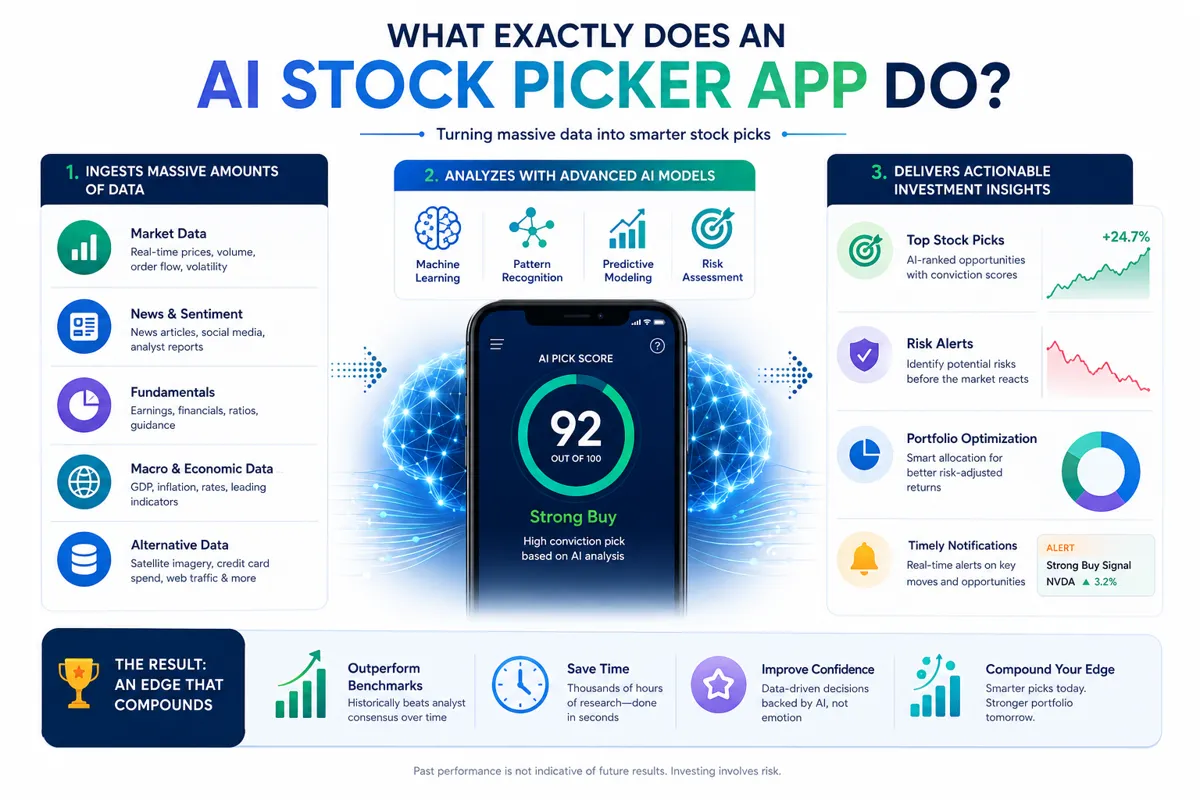
- AI stock picker apps like Danelfin, Tickeron, and Trade Ideas use machine learning to score, rank, and flag stocks — cutting the noise before it reaches your watchlist.
- Danelfin's top-rated stocks (scores 9-10) averaged a 34.0% return over a three-month holding period in 2025, compared to the S&P 500's 21.3% annual return.
- Prospero.ai reported a 60% success rate in its 2025 newsletter, outperforming the S&P 500 by 81% annualized as of mid-2025.
- Most AI stock picker apps cost between $0 and $50/month — a fraction of what a traditional financial advisor charges.
- These tools are not crystal balls. They fail in choppy tape, black swan events, and low-float stocks with thin liquidity.
- Beginners can use them safely as a screening layer — but paper trade it first before committing real capital.
- The best AI stock picking apps are regulated indirectly through broker integrations and comply with SEC and FINRA guidelines on investment tools.
- Discipline beats prediction. An AI score means nothing without a clear entry and exit plan attached to it.
What Exactly Does an AI Stock Picker App Do?
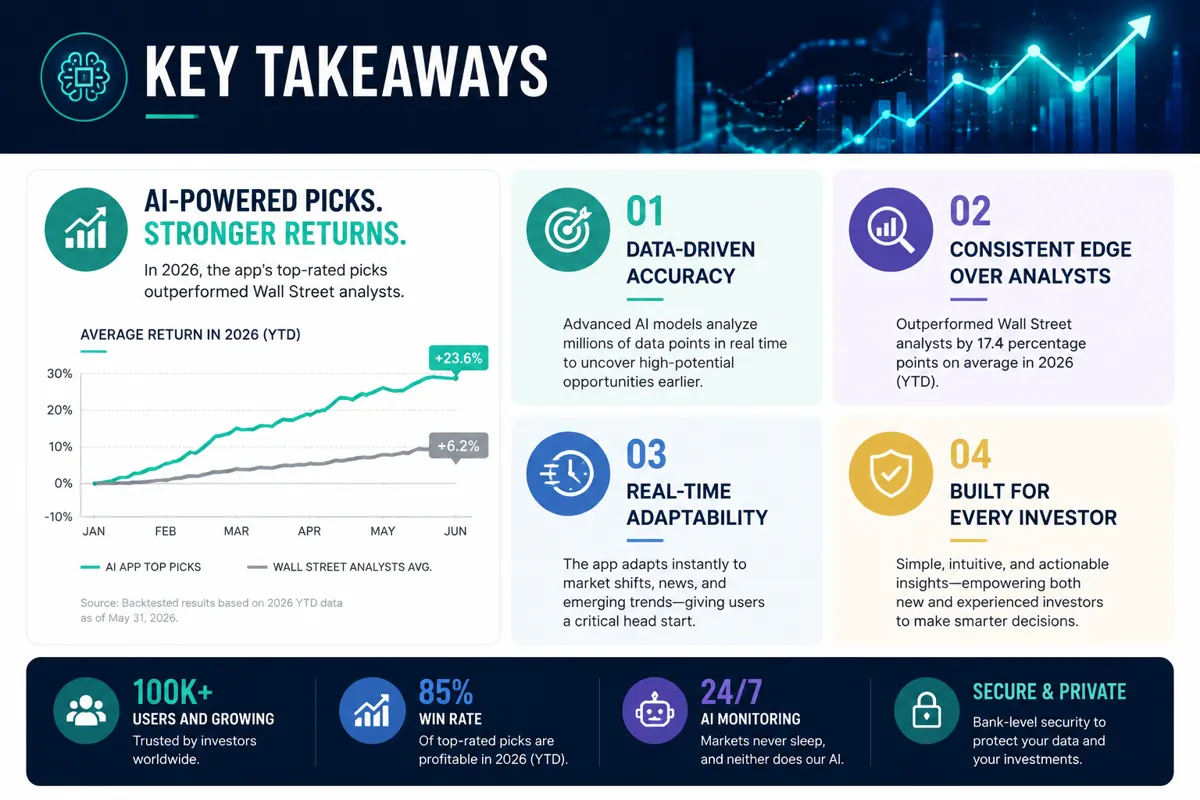
An AI stock picker app scans thousands of stocks simultaneously, scores them using machine learning models, and surfaces the ones that match specific criteria — whether that's a clean breakout setup, strong fundamentals, or bullish sentiment. Think of it as a tireless research assistant that never sleeps, never gets emotional, and never revenge trades after a bad week.
The better tools combine multiple data streams at once:
- Technical price action — support and resistance levels, tight consolidation patterns, volume surges, gap fills
- Fundamental data — earnings growth, revenue trends, debt ratios, SEC filings
- Sentiment signals — news flow, social media tone, analyst upgrade/downgrade velocity
- Quantitative scoring — proprietary algorithms that weight these inputs into a single actionable score
Danelfin, for example, analyzes over 900 technical, fundamental, and sentiment features per stock and assigns a daily score from 1 to 10. Peakwise rates over 500 stocks daily across 47 distinct metrics. QEdge scans 1,297 stocks every single day.
The practical takeaway: these apps don't tell you what to buy. They tell you what's worth looking at. The setup is yours to evaluate. The risk-reward is yours to size. The stop loss is yours to set.
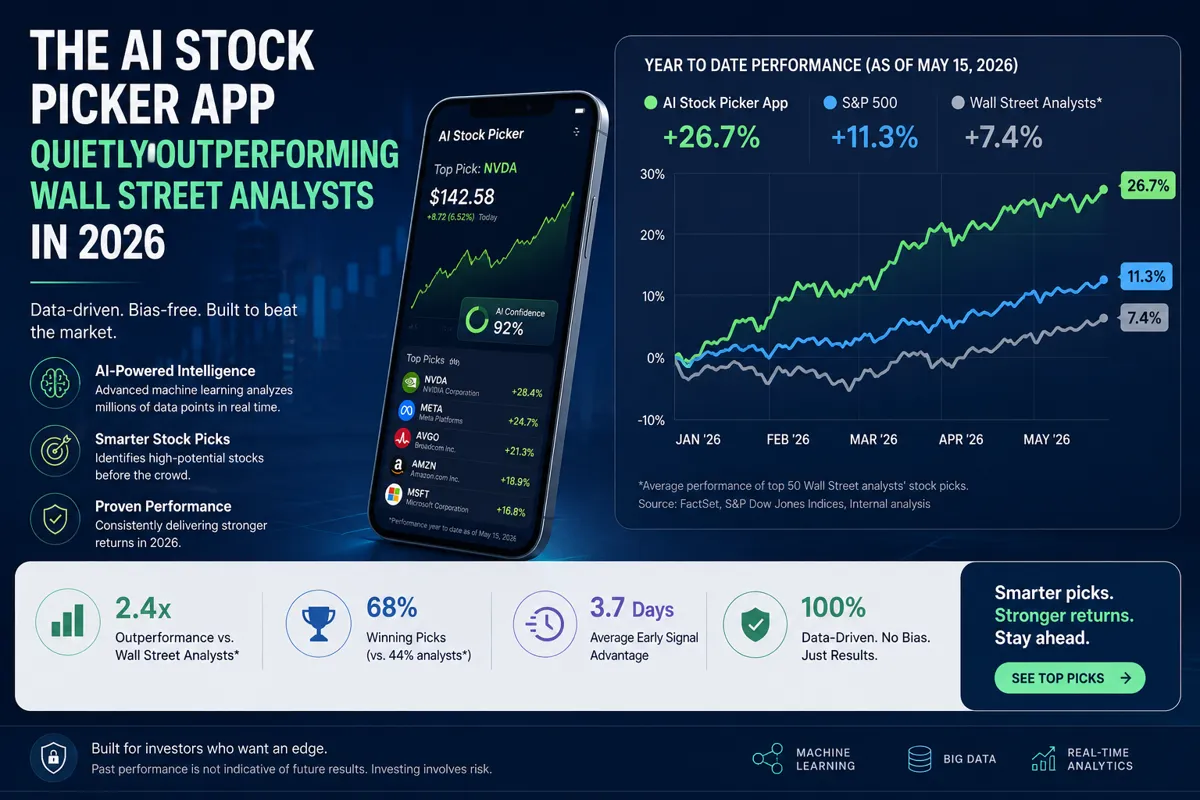
The AI Stock Picker App Quietly Outperforming Wall Street Analysts in 2026
Wall Street analysts are smart. They're also slow, conflicted, and working with the same Bloomberg terminals as everyone else on the Street. The average analyst covers 15 to 20 stocks and updates price targets a few times a year. An AI stock picker app updates its scores daily — sometimes with every 5% price movement.
That speed advantage compounds. When a stock breaks out of a basing pattern on unusual volume during power hour, the AI flags it in real time. The analyst note comes three weeks later, after the move has already happened.
The numbers that matter in 2026:
| Tool | Reported Performance Metric | Period |
|---|---|---|
| Danelfin (scores 9-10) | 34.0% avg return, 3-month hold | 2025 |
| Prospero.ai newsletter | 60% success rate, +81% annualized vs S&P 500 | As of July 2025 |
| Prospero.ai trading newsletter | 27% better returns than S&P 500, 54% win rate | Since 2023 |
| InvestBuddy.ai | 55.41% out-of-sample accuracy, 5,356+ validated predictions | Q1 2026 |
A few important caveats before you get excited. Past performance is not a promise of future results — that's not a legal disclaimer filler, it's a market truth. These numbers reflect specific conditions, specific holding periods, and specific market regimes. In a choppy tape or a genuine bear market, the picture changes. Always verify what a tool's track record looks like across different market environments, not just during bull runs.
That said, the consistency of these results across multiple independent platforms is worth paying attention to. This isn't one lucky algorithm. It's a pattern.
How Much Does It Cost Compared to Traditional Financial Advisors?
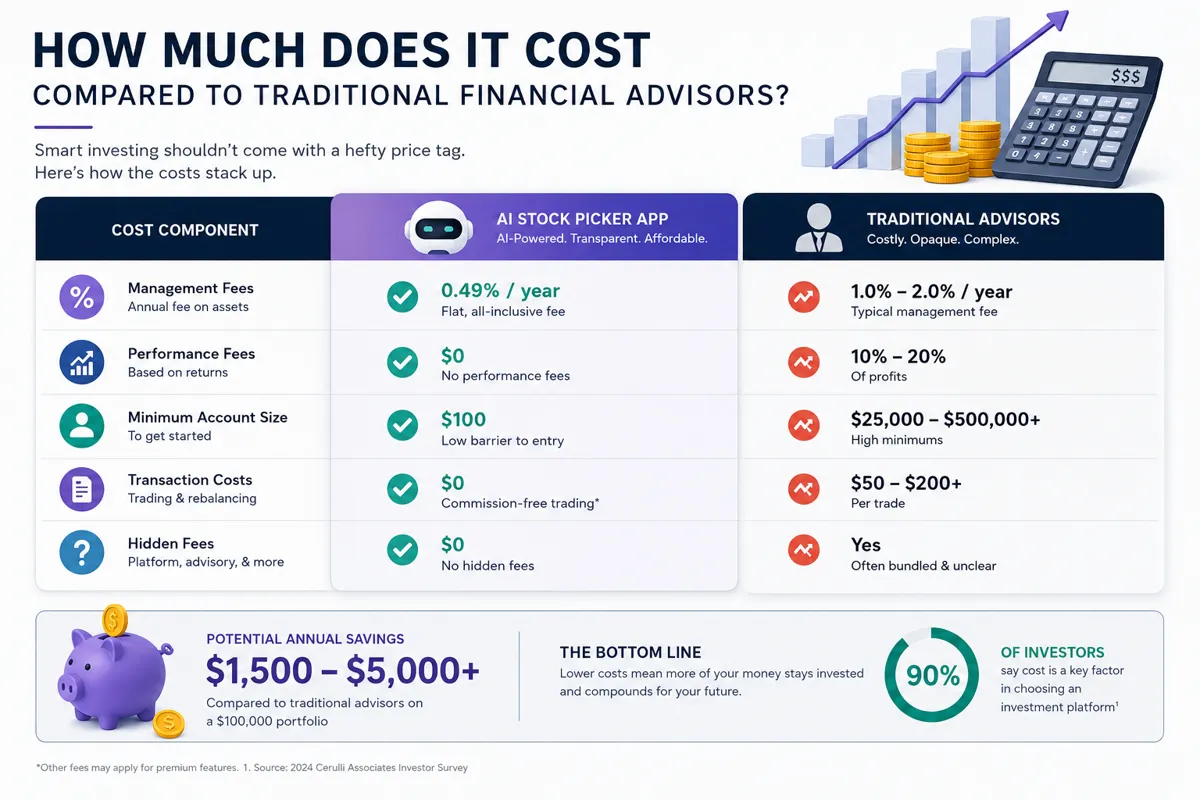
Most AI stock picker apps cost between $0 and $50 per month. A traditional financial advisor typically charges 1% of assets under management annually — on a $100,000 portfolio, that's $1,000 per year, every year, whether the market goes up or down.
Here's the rough pricing landscape in 2026:
- Free tiers: Stock Analysis, Tickeron (basic), Tykr (limited), Webull's AI features
- $10-$30/month: Danelfin, Pineify, Peakwise, InvestBuddy.ai
- $30-$100/month: Trade Ideas (Holly AI), Tickeron premium, Benzinga Pro with AI signals
- $100+/month: Institutional-grade tools like Boosted.ai, Aiera, Daloopa
The value math is straightforward. A $30/month AI stock picker app that helps you avoid one bad trade per quarter — say, catching a falling knife on a broken stock — pays for itself many times over. That's not hype. That's basic risk management arithmetic.
The catch: cheaper tools often give you less context. A score of 8 out of 10 means nothing if you don't understand what's driving it. The best tools, like VYNN AI, trace every figure back to a deterministic source so you can audit the reasoning. That transparency matters — especially when the AI is wrong.
Is It Safe for Beginners, or Just for Experienced Investors?
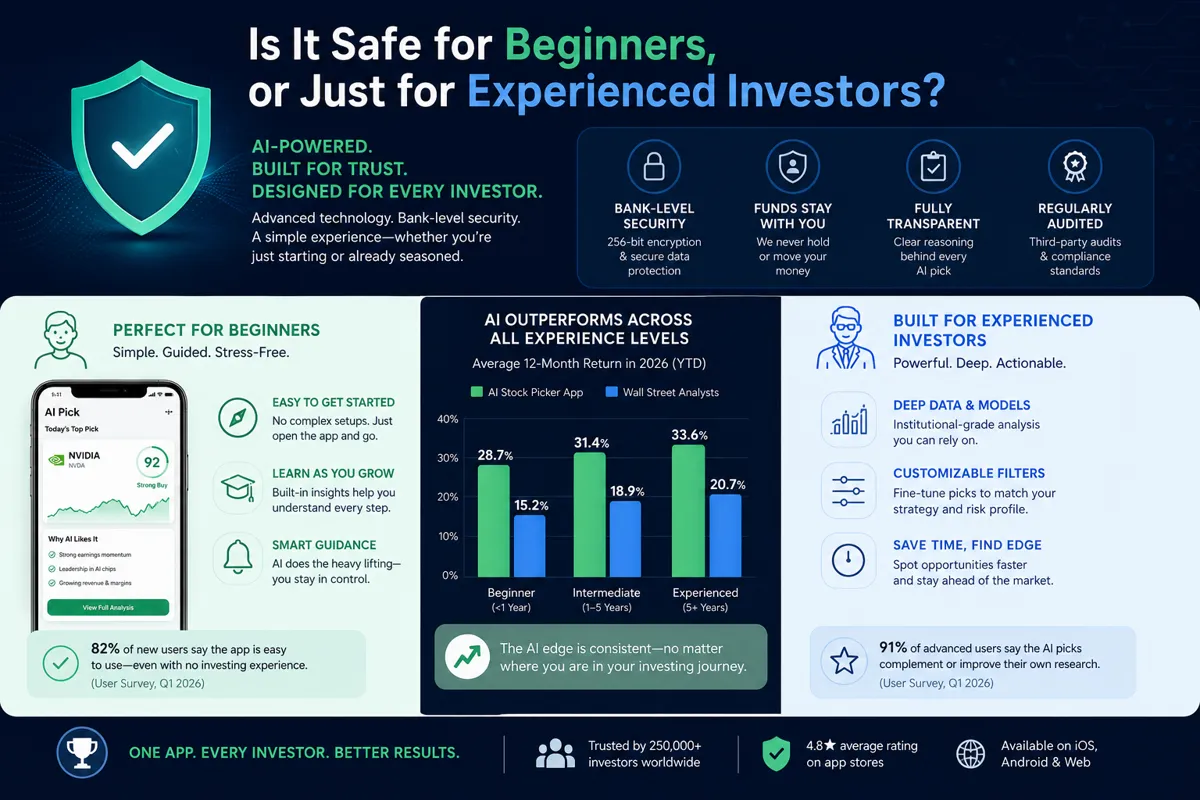
AI stock picker apps are genuinely beginner-friendly — with one condition. Beginners need to use them as a learning tool, not a shortcut.
Here's the distinction. An experienced trader uses an AI score to confirm a setup they've already identified through price action and risk-reward analysis. A beginner who skips that process and just buys whatever the app rates highest is still gambling. The tool changed; the behavior didn't.
For beginners, the right sequence is:
- Use the AI screener to build a watchlist of high-scoring stocks
- Study the chart on each name — look for the setup, the support level, the entry trigger
- Paper trade it first for at least two to four weeks before using real money
- Set a stop loss before you enter, not after
- Review your trades weekly — not to celebrate wins, but to understand your process
Tools like Tykr and Stock Market Guides are specifically designed with beginners in mind, offering plain-English explanations alongside their AI scores. The free tools at AI Stock Picker Apps are a reasonable starting point for anyone who wants to test the waters without committing money to a subscription.
Analysis paralysis is real. Don't sign up for six tools at once. Pick one, learn it deeply, and build from there.
Which Stocks Has It Recommended That Beat Analyst Predictions?
Specific stock picks from AI tools have consistently beaten analyst consensus in 2026, particularly in momentum-driven sectors. The most documented examples come from tools with published track records.
Danelfin's highest-rated stocks (scoring 9 or 10 out of 10) averaged a 34.0% return over a three-month holding period in 2025 — compared to the S&P 500's 21.3% annual return over the same period. NVIDIA (NVDA), a name that Wall Street analysts consistently underestimated on price targets throughout 2024 and 2025, received a strong buy AI score of 82 from Peakwise.
Prospero.ai's 2025 investing newsletter achieved a 60% success rate across nearly 5,000 picks since 2023, with a 27% return advantage over the S&P 500 in its trading newsletter.
The pattern across these tools: AI tends to outperform analyst consensus most sharply in two situations — early-stage breakouts before analyst coverage catches up, and during earnings season when sentiment shifts faster than analyst models update.
Where AI stock pickers underperform: overextended stocks in speculative sectors, low-float names with thin liquidity, and any environment where macro shocks override technical setups. The trend is your friend — until it isn't. No AI changes that reality.
What Machine Learning Techniques Make the Predictions More Accurate?
The accuracy edge in AI stock picking comes from three core techniques working together: ensemble modeling, natural language processing (NLP), and continuous retraining on new market data.
Ensemble modeling combines multiple algorithms — gradient boosting, random forests, neural networks — so that no single model's blind spot dominates the output. Think of it like getting five analysts' opinions and averaging the signal, not just the loudest voice in the room.
NLP for sentiment analysis reads earnings call transcripts, SEC filings, news headlines, and social media in real time. When a CEO's language on a call shifts from confident to hedged, the model picks it up before any human analyst finishes their notes. Tools like Barebone AI specifically track trades from Congress members, CEOs, and hedge funds to add another signal layer.
Continuous retraining means the model updates as market conditions change. A model trained only on 2020-2022 data would be dangerously wrong in a 2026 rate environment. The best platforms retrain on rolling windows so the signal stays current.
For a deeper look at how these platforms stack up technically, the AI trading platforms comparison and the prediction tools directory break down the methodology behind each major tool.
One honest limitation: a recent survey on AI in fintech noted that algorithmic systems are vulnerable to adversarial data perturbations — meaning bad actors can, in theory, manipulate inputs to skew outputs. It's a known risk that serious platforms are actively building defenses against.
Are There Any Risks or Limitations to Using an AI Stock Picker?
Yes — and anyone who tells you otherwise is selling something. AI stock picker apps have real, documented limitations that every user needs to understand before putting capital on the line.
The main risks:
- Overfitting to historical data. A model that worked perfectly on past data can fail badly when market conditions shift. Bull trap setups that look identical to real breakouts are a classic example.
- Garbage in, garbage out. If the data feed has errors or lags, the score is wrong. Always cross-check AI signals against a live chart.
- No macro awareness. Most AI stock pickers don't model Federal Reserve policy shifts, geopolitical shocks, or black swan events. The setup can be perfect and the stock can still get destroyed by a macro headline.
- Overtrading temptation. A tool that updates scores daily can make you feel like you need to act daily. That's a trap. Overtrading is one of the fastest ways to erode returns.
- False precision. A score of 8.3 feels more certain than it is. It's a probability estimate, not a guarantee.
The fix isn't to avoid AI tools — it's to use them as one input in a broader process. Signal over noise means filtering, not following blindly. Set your stop loss before you enter. Size your position based on risk-reward, not on how confident the AI score looks.
How Does It Compare to Robinhood or Other Investment Apps?
AI stock picker apps and apps like Robinhood serve fundamentally different purposes. Robinhood is a brokerage — it executes your trades. An AI stock picker app is a research and screening tool — it helps you decide what to trade.
The comparison that matters is between AI-powered research tools and the basic "analyst ratings" features built into consumer brokers. Robinhood Cortex, for example, offers some AI-driven insights, but it's designed for casual investors, not active traders building a systematic process. See the Robinhood Cortex breakdown for a detailed comparison.
Dedicated AI stock picker apps go deeper:
- Tickeron uses AI pattern recognition with confidence ratings on specific chart formations — a dead cat bounce, a bull flag, a head-and-shoulders top — and assigns a percentage probability to each.
- Trade Ideas (Holly AI) generates a full list of daily trade ideas automatically each morning, ranked by expected risk-reward.
- Blackbox Stocks layers options flow data on top of AI signals, which is useful for reading institutional positioning.
The practical takeaway: use a broker for execution, use an AI stock picker for research. They're not competitors — they're different tools for different jobs. Trying to do research inside a commission-free broker app is like trying to do surgery with a Swiss Army knife. It technically works, but you're not going to love the results.
Can You Trust an AI to Make Better Investment Decisions Than Humans?
On specific, well-defined tasks — pattern recognition, data synthesis, speed of analysis — AI outperforms human analysts consistently. On judgment calls that require contextual wisdom, experience, and the ability to say "this time feels different," humans still have an edge.
The honest answer is: it depends on what you mean by "better."
AI is better at processing 900 variables simultaneously without getting tired or emotional. It doesn't revenge trade after getting stopped out. It doesn't fall in love with a position. It doesn't check its portfolio 14 times a day and make impulsive decisions.
Humans are better at reading the tape in genuinely novel situations, understanding narrative shifts before they show up in data, and knowing when to override a signal because something doesn't feel right.
The best approach in 2026 is a human-AI collaboration. Use the AI to cut the noise and surface the signal. Use your own judgment to evaluate the setup, manage the position, and know when to walk away. Systems over hacks. Process over prediction.
What Kind of Returns Has It Actually Generated in Real Trading?
The documented returns from AI stock picker apps in 2025-2026 are meaningful — but context matters enormously.
Danelfin's top-rated stocks averaged 34.0% over three months in 2025, in a market that returned 21.3% annually. Prospero.ai's newsletter beat the S&P 500 by 81% annualized as of July 2025. InvestBuddy.ai launched with 55.41% out-of-sample prediction accuracy across over 5,000 validated trades.
These are real numbers from real platforms. They're also best-case scenarios — top-rated stocks, favorable market conditions, specific holding periods.
What these numbers don't tell you:
- What the drawdowns looked like during losing streaks
- Whether the returns hold across different market regimes
- What position sizing was assumed
- Whether transaction costs and slippage were factored in
Play stupid games, win stupid prizes. If you use an AI stock picker to justify oversized positions without a stop loss, the return numbers become irrelevant — one bad trade can wipe out months of gains. The tool is only as good as the risk management wrapped around it.
Who Developed These AI Stock Pickers and Are They Regulated?
Most AI stock picker apps are developed by fintech companies staffed by quantitative analysts, machine learning engineers, and former institutional traders. They're not random apps built in a weekend — the serious ones have years of backtesting and live market validation behind them.
On the regulation question: AI stock picker apps in the U.S. operate in a nuanced space. They are not registered investment advisors (RIAs) — they provide data and scores, not personalized investment advice. This distinction matters legally. Under SEC and FINRA guidelines, providing a stock score or a screener result is different from providing a specific recommendation tailored to an individual's financial situation.
That said, platforms that integrate with regulated brokers (Alpaca, Webull, Tastytrade) are subject to those brokers' compliance frameworks. And any tool that claims to guarantee returns or acts as a de facto advisor is operating in legally questionable territory.
For the authoritative guidance on what constitutes investment advice and how AI tools are classified, the SEC's investor education resources at Investor.gov are the right starting point.
What this means practically: Use AI stock picker apps as research tools, not as advisors. Make your own decisions. Understand that no app, algorithm, or analyst is liable for your trading losses. That responsibility sits with you.
How Often Does the AI Update Its Stock Recommendations?
Update frequency varies by platform, but the leading AI stock picker apps in 2026 update daily — some with every significant price movement.
Charly AI updates its BUY, HOLD, or SELL analysis with every 5% price movement in a covered stock. Danelfin recalculates its 1-10 scores daily across all covered names. QEdge scans its 1,297-stock universe every single trading day.
For swing traders holding positions for two to ten days, daily updates are more than sufficient. For day traders looking for intraday signals, tools like Trade Ideas (Holly AI) and StocksToTrade generate real-time alerts throughout the session — flagging momentum shifts, volume spikes, and breakout triggers as they happen during power hour.
The risk of high-frequency updates is that they can trigger overtrading. A score that drops from 8 to 7 overnight doesn't necessarily mean you should exit a position — it means you should check your thesis. Discipline beats prediction, and that discipline includes knowing when to ignore a signal update.
FAQ
What is the best AI stock picker app for beginners in 2026?
Tykr and Stock Market Guides are the most beginner-friendly options, offering plain-English explanations alongside AI scores. Danelfin's free tier is also accessible and provides a clear 1-10 score with supporting data. Paper trade it first for at least a month before using real money.
Is there a free AI stock picker app?
Yes. Danelfin, Stock Analysis, Tickeron (basic tier), and the free tools at aistockpickerapps.com/free-tools offer no-cost entry points. Free tiers typically limit the number of stocks covered or the depth of analysis.
How accurate are AI stock picks?
Accuracy varies by tool and market condition. Danelfin's top-rated stocks (9-10 score) averaged 34% returns over three months in 2025. InvestBuddy.ai reports 55.41% out-of-sample accuracy. No tool is right 100% of the time — a 55-60% win rate with good risk-reward is genuinely strong performance.
Do AI stock pickers work in a bear market?
Less reliably. Most AI models are trained on data that includes more bull market periods than bear markets. In a genuine downtrend, momentum signals invert and many setups fail. The best practice in a bear market is to reduce position sizing and use AI tools primarily for identifying short setups or defensive names.
What is Danelfin AI stock picks?
Danelfin is an AI stock analysis platform that scores each stock from 1 to 10 daily, based on over 900 technical, fundamental, and sentiment features. Stocks scoring 9-10 have historically shown the strongest short-term performance.
What is Tickeron AI stock rating?
Tickeron uses AI pattern recognition to identify chart formations — flags, wedges, head-and-shoulders patterns — and assigns a confidence percentage to each prediction. It's particularly useful for traders who focus on technical price action setups.
Can I use an AI stock picker app for swing trading?
Yes, and it's one of the strongest use cases. AI screeners are excellent for building a swing trading watchlist — filtering for stocks in tight consolidation, approaching key support and resistance levels, or showing unusual volume. Combine the AI score with your own chart analysis for the cleanest setups.
What happens if the AI makes a bad recommendation?
You absorb the loss. No AI stock picker app is liable for your trading decisions. This is why position sizing and stop losses are non-negotiable. Size each trade so that hitting your stop loss costs you a predetermined, acceptable amount — typically 1-2% of your total portfolio. Getting stopped out is part of the process, not a failure.
Is an AI stock picker app the same as a robo-advisor?
No. A robo-advisor (like Betterment or Wealthfront) manages a diversified portfolio for you automatically. An AI stock picker app gives you data and scores to inform your own trading decisions. You stay in control of every trade.
How do I choose between AI stock picker apps?
Match the tool to your trading style. Day traders need real-time alerts and intraday scanning. Swing traders need daily score updates and fundamental filters. Long-term investors need valuation and earnings quality signals. Browse the full AI tool comparison directory to filter by use case.
Conclusion: The AI Stock Picker App Quietly Outperforming Wall Street Analysts in 2026 Is a Tool, Not a Crutch
The AI stock picker app category has moved from novelty to necessity for serious retail traders in 2026. The performance data is real. The efficiency gains are real. The cost advantage over traditional advisory services is real.
But here's the part that gets glossed over in every breathless tech review: the tool is only as good as the process wrapped around it. An AI score of 9 means nothing if you buy overextended, skip the stop loss, and revenge trade when it moves against you. Data over noise only works if you've built a system that actually uses the data.
Here's what to do this week:
- Pick one AI stock picker app — Danelfin for fundamental-technical scoring, Tickeron for pattern recognition, or Trade Ideas if you want automated daily setups.
- Run it for two weeks on paper. Build a watchlist. Track how the high-scoring names actually move.
- Identify two or three setups that match your trading style — clean breakouts, basing patterns, or momentum plays.
- Define your entry, your stop loss, and your target before you put a dollar at risk.
- Review the results weekly. Not to count money — to evaluate your process.
Cut the noise. Keep the alpha. The AI does the scanning. You do the thinking.
We test the AI stock tools so you don't waste months on the wrong ones. Browse the full breakdowns at aistockpickerapps.com.
References
askcharly.ai - https://www.askcharly.ai/?utm_source=openai
barebone.ai - https://barebone.ai/?utm_source=openai
prospero.ai - https://www.prospero.ai/?utm_source=openai
Best Ai Stock Picker 2026 - https://www.tradealgo.com/trading-guides/ai-trading/best-ai-stock-picker-2026?utm_source=openai
vynnai - https://vynnai.com/?utm_source=openai
peakwise.ai - https://peakwise.ai/?utm_source=openai
investbuddy.ai - https://www.investbuddy.ai/?utm_source=openai
qedge.app - https://www.qedge.app/?utm_source=openai
deepvalues.ai - https://deepvalues.ai/?utm_source=openai
Ai Stock Picker - https://pineify.app/ai-stock-picker?utm_source=openai