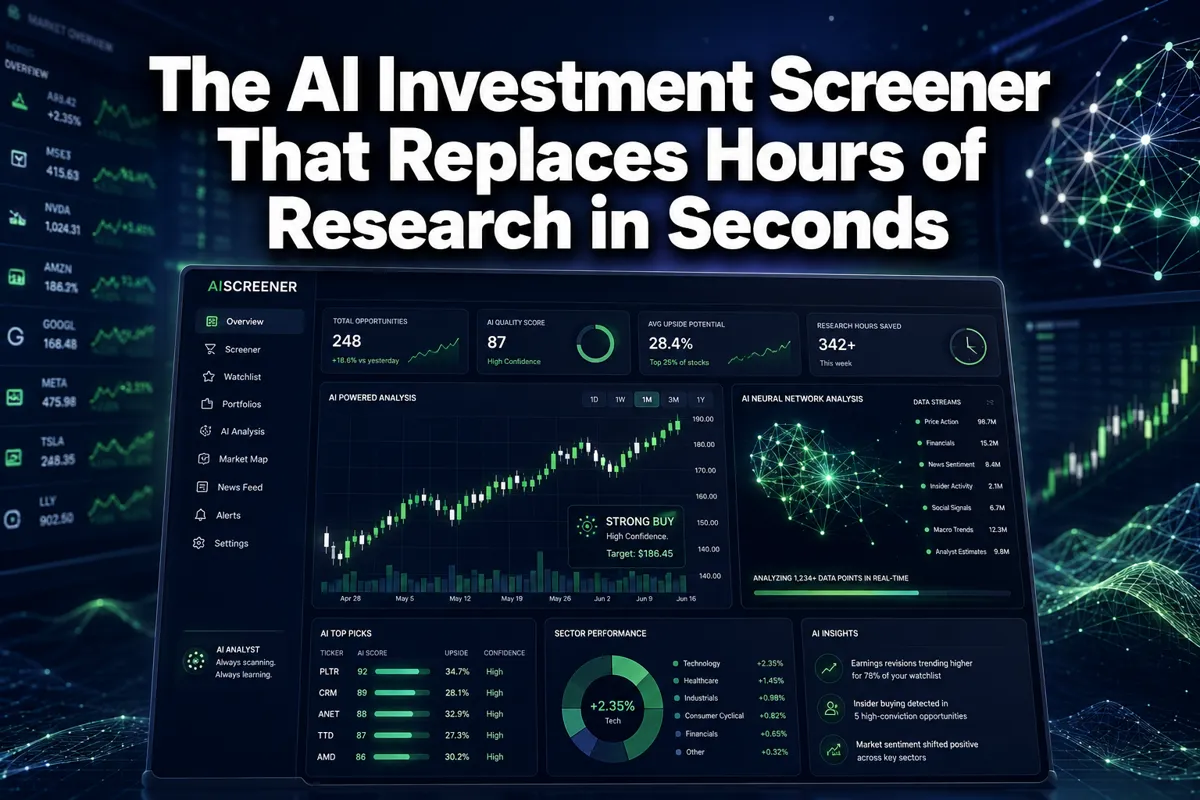
The AI Investment Screener That Replaces Hours of Research in Seconds
Last updated: June 16, 2026
Quick Answer: An AI investment screener is a software tool that uses machine learning and natural language processing to scan thousands of stocks in seconds, filtering them by fundamentals, technicals, sentiment, and valuation — work that would take a human analyst several hours per session. In 2026, the best platforms combine institutional-grade data with plain-English outputs, making serious stock research accessible to retail investors without a Bloomberg terminal or a finance degree.
Key Takeaways
- AI investment screeners cut research time from hours to seconds by automating multi-factor filtering across thousands of securities simultaneously.
- The best tools combine fundamental data (P/E ratios, revenue growth, debt levels) with technical signals (price action, breakouts, volume) and news sentiment in one dashboard.
- Platforms range from free tiers with basic filters to professional tools costing $50-$300/month with institutional-grade data.
- Beginners benefit most from tools with pre-built screeners and plain-English verdicts; experienced traders need customizable multi-factor filters and raw data access.
- AI screeners support multiple strategies: value investing, growth, dividend income, momentum, and swing trading.
- No AI screener replaces human judgment on position sizing, risk management, and stop loss placement — it narrows the field, you make the call.
- Common mistakes include over-filtering (analysis paralysis), ignoring data freshness, and treating AI scores as buy signals rather than starting points.
- Accuracy varies for small-cap and international stocks due to thinner data coverage — always verify independently.
- These tools are legal and compliant; they aggregate public data and do not constitute regulated financial advice.
- You need zero coding skills to use most modern AI screeners — natural language inputs are now standard on leading platforms.
What Exactly Is an AI Investment Screener and How Does It Work?
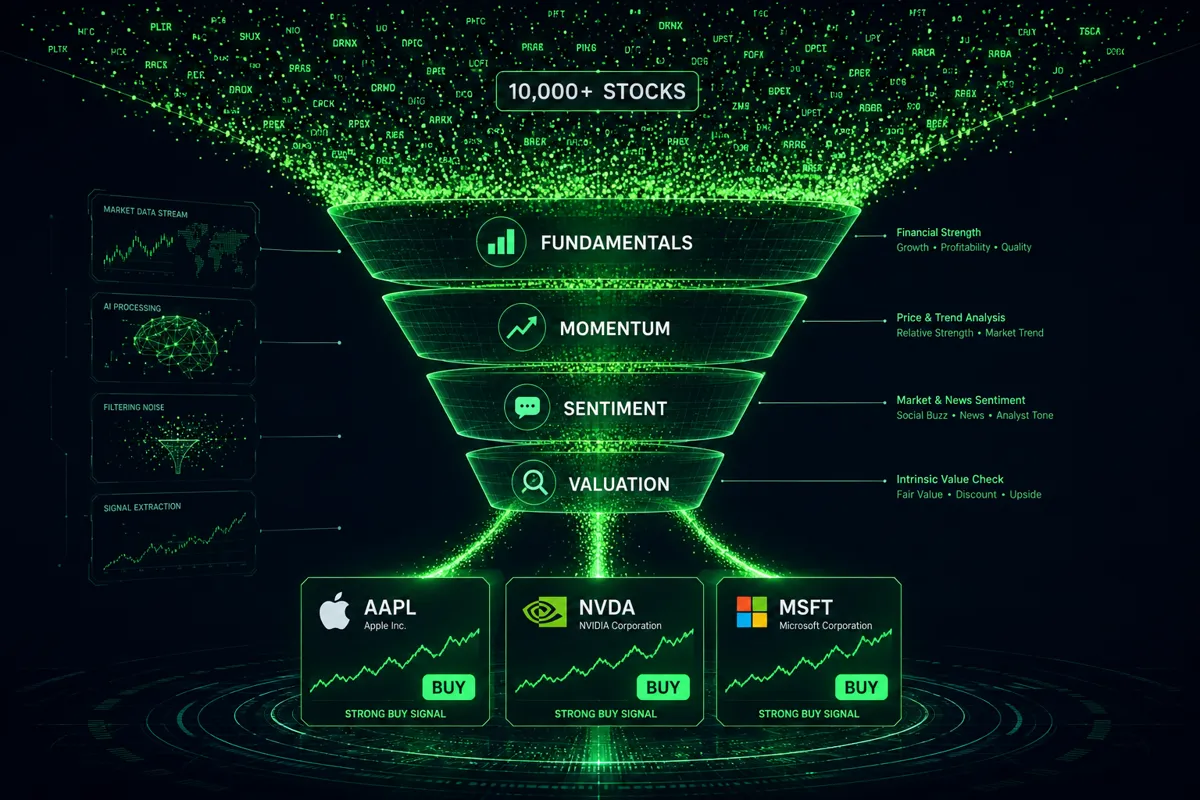
An AI investment screener is a tool that automatically scans a universe of stocks — often 5,000 to 10,000+ securities — and filters them based on criteria you set, using machine learning to weight and rank results faster and more comprehensively than any manual process. Instead of opening 12 browser tabs and cross-referencing spreadsheets, you get a ranked shortlist in seconds.
Here's the basic mechanics:
- Data ingestion: The screener pulls from multiple sources — price feeds, SEC filings, earnings estimates, news wires, and sometimes alternative data like social sentiment or options flow.
- Multi-factor scoring: Machine learning models score each stock across dozens of variables simultaneously. Some tools like Tickeron's AI screener combine technical and fundamental filters in a single pass.
- Ranking and output: Results are ranked by relevance to your strategy, often with a plain-English verdict — buy, hold, avoid, or a numerical score.
- Natural language interfaces: Newer platforms let you type "show me profitable small-caps with low debt and rising earnings" and generate a working screener instantly, no code required.
Think of it like a search engine for stocks. Google doesn't read every webpage when you search — it has already indexed and scored everything. An AI screener works the same way. The filtering happens in the background, constantly. You just set the parameters and collect the output.
The practical takeaway: An AI investment screener doesn't pick stocks for you. It eliminates the 95% of the market that doesn't fit your criteria so you can focus your real analysis on the 5% that does.
The AI Investment Screener That Replaces Hours of Research in Seconds — Why This Actually Matters
Most retail investors don't have a stock-picking problem. They have a time and focus problem.
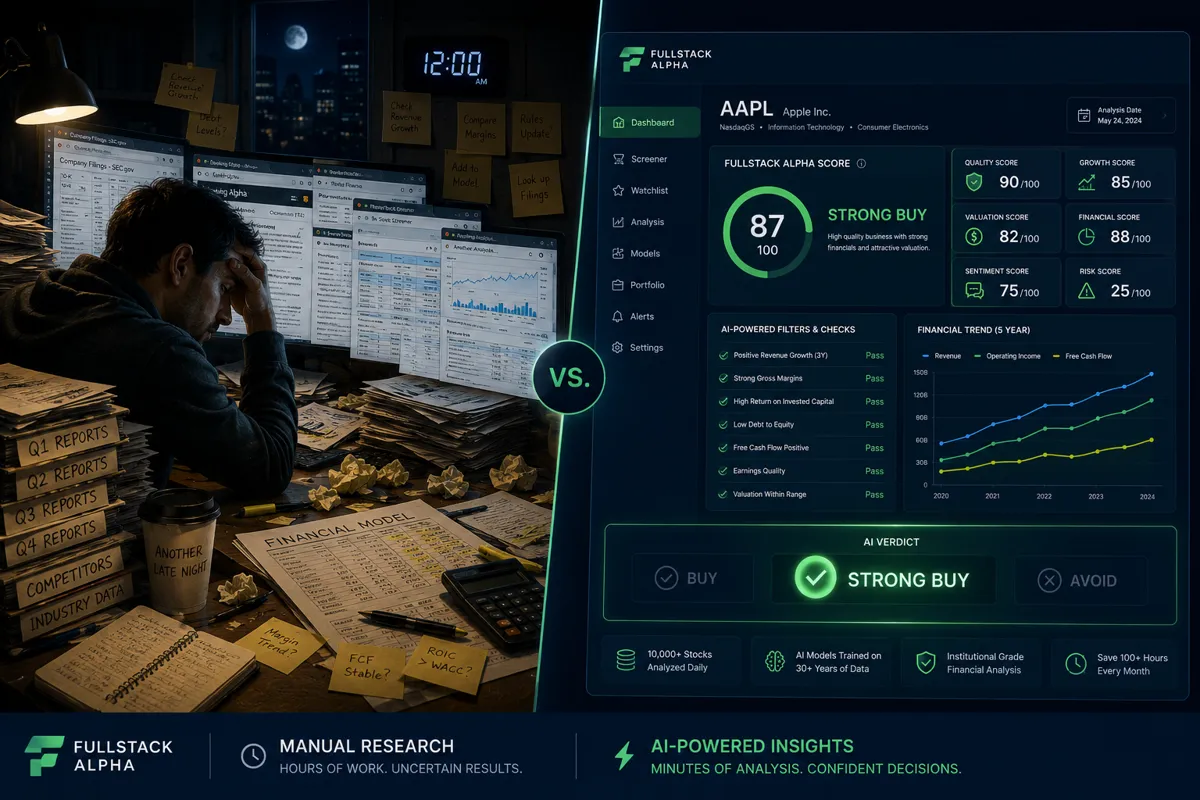
The average self-directed investor juggles a job, a family, and a portfolio. Manually screening for a clean setup — checking price action, pulling five-year revenue charts, reading the last two earnings transcripts, comparing P/E ratios against sector peers — takes two to four hours per stock. If your watchlist has 20 names, that's a part-time job.
The AI investment screener that replaces hours of research in seconds solves this by compressing the grunt work. Platforms like Koyfin offer 500+ fundamental metrics with a generous free tier. Stock Rover goes deep on fundamental screening and research, letting you build multi-factor models without touching a spreadsheet. Danelfin uses AI scores to rank long-term candidates based on probability-weighted technical and fundamental signals.
The time math is stark. A tool like Gainify, which runs on institutional-grade data from S&P Global, gives you forward valuation datasets and smart earnings calendars that would take a professional analyst hours to compile manually. Sirius Investors' free screener filters over 10,000 securities across 30+ criteria in real time. That's not a marginal improvement — it's a category shift.
Signal over noise. The real value isn't speed for its own sake. It's that faster filtering means less time drowning in irrelevant data and more time on the setups that actually fit your system. That's the discipline beats prediction principle in practice.
How Much Faster Is an AI Screener Compared to Traditional Stock Research?
Manual stock research for a single candidate — pulling financials, checking charts, reading news, comparing peers — realistically takes 90 minutes to 3 hours for a thorough job. An AI investment screener compresses that initial filtering phase to under 60 seconds.
That's not an exaggeration. Here's the comparison:
| Task | Manual Process | AI Screener |
|---|---|---|
| Filter 5,000 stocks by P/E + revenue growth | 2-4 hours | Under 10 seconds |
| Add technical filter (breakout + volume) | 30-60 minutes | Simultaneous, same query |
| Pull news sentiment for shortlist | 30-45 minutes | Automated, real-time |
| Generate buy/hold/avoid verdict | Analyst judgment | AI score with reasoning |
| Build earnings calendar for watchlist | 20-30 minutes | Pre-built, auto-updated |
The time savings compound. If you screen weekly, that's potentially 8-12 hours per month returned to your actual life.
The honest caveat: Speed doesn't replace depth. An AI screener gets you to the right 10 stocks fast. The next 30 minutes you spend reading the actual 10-K filing or listening to the earnings call — that's still on you. The screener narrows the field; your judgment closes the trade.
How Much Does an AI Investment Screening Tool Cost?
AI investment screeners range from completely free to enterprise-level pricing. Most serious retail investors land in the $20-$100/month range for a capable tool.
Free tiers worth using:
- Sirius Investors offers a free screener with 30+ filters across 10,000+ securities.
- Tickeron has a free screener tier with basic technical and fundamental filters.
- The free tools section at AI Stock Picker Apps includes a screener recipe builder and stock health scorecard at no cost.
Mid-range ($20-$100/month):
- Most full-featured platforms with real-time data, AI scoring, and portfolio integration sit in this band.
- Tools like TrendSpider and TradingView offer strong screeners with charting integration.
Professional tier ($100-$300+/month):
- Gainify's institutional-grade data from S&P Global, with 1,000+ filters and forward estimates, targets serious active investors.
- AlphaSense and similar enterprise tools serve fund managers and research desks.
Choose based on your actual workflow, not feature lists. A free screener you use daily beats a $200/month platform you open twice and abandon. Paper trade it first with the free tier before committing.
Which AI Investment Screeners Are Best for Beginners vs. Experienced Investors?
Beginners need guardrails and plain-English outputs. Experienced investors need raw flexibility and data depth. These are different products.
Best for beginners:
- Tools with pre-built screener templates (growth, dividend, value) so you're not starting from a blank filter set.
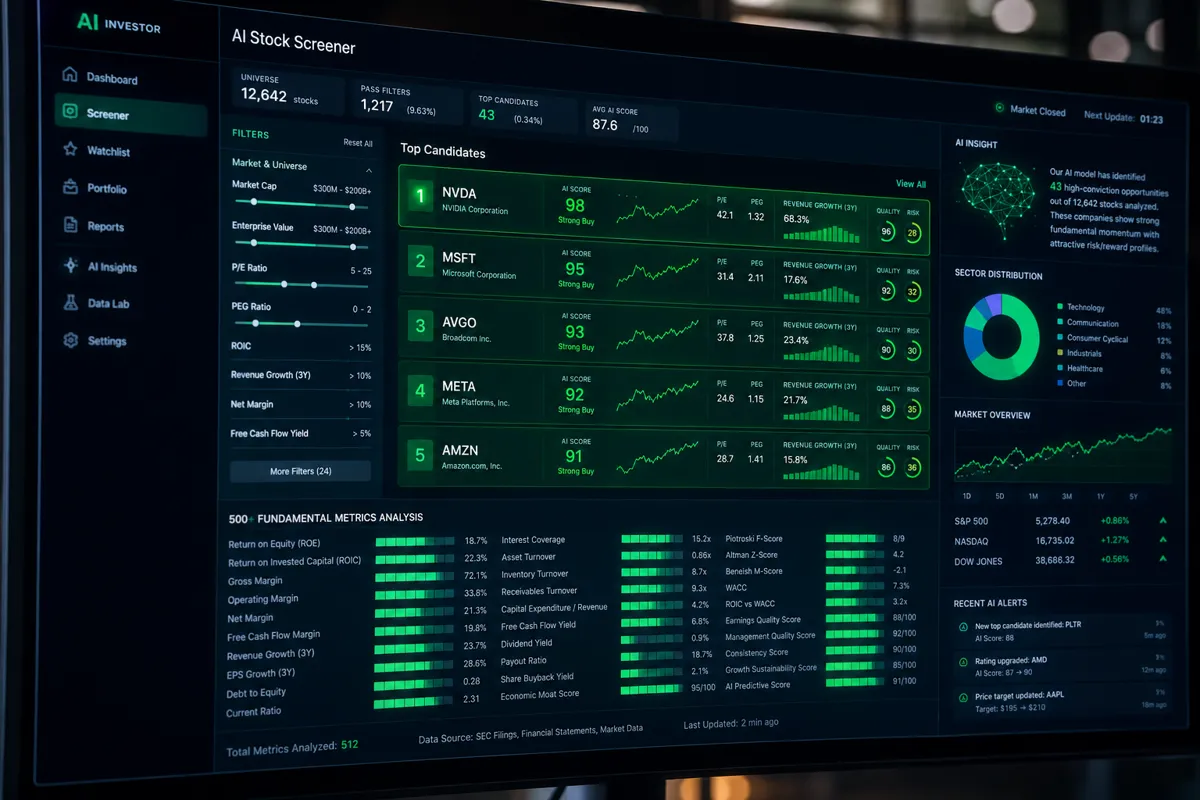
- Plain-English verdicts — buy/hold/avoid scores with brief reasoning, like InvestIQ's AI-generated verdicts with five-year revenue charts and key metrics.
- Visual dashboards over raw data tables.
- Simply Wall St is a strong example: snowflake visualizations that make fundamental analysis readable without a finance background.
Best for experienced traders and active investors:
- Multi-factor customization with 500+ metrics — Koyfin's depth is hard to beat for fundamental screening.
- Real-time scanning with volume spike detection and price action alerts, like StockMover.
- Backtesting capability to validate your screening criteria against historical data.
- Trade Ideas and TC2000 are built for active traders who need real-time scans during power hour.
The honest rule: If you can't explain what a filter does, don't use it. Analysis paralysis from too many filters kills more trades than bad picks. Start with three criteria you understand, master those, then add complexity.
Can AI Stock Screeners Really Replace Human Financial Analysis?
No — and any tool that claims otherwise is selling you something. What AI screeners replace is the mechanical, repetitive data-gathering phase. They do not replace judgment, context, or risk management.
Here's what AI handles well:
- Filtering thousands of stocks by quantitative criteria simultaneously.
- Flagging anomalies — unusual volume, earnings surprises, sentiment shifts.
- Scoring stocks consistently without emotional bias.
- Tracking 25+ sector ETFs for momentum and growth patterns, as Kovered AI does for options screening.
Here's what AI still can't do reliably:
- Assess management quality from an earnings call tone.
- Understand why a stock is basing — whether it's institutional accumulation or just a dead cat bounce.
- Apply your personal risk-reward framework and position sizing rules.
- Know that you already have too much sector concentration in your portfolio.
The market truth: AI screeners are the best research assistant you've ever had. They're not the portfolio manager. You still set the stop loss. You still decide the entry and exit. You still own the outcome.
Play stupid games — like blindly following AI buy signals without understanding the underlying setup — and you win stupid prizes.
What Kinds of Investors Should Use an AI Investment Screening Tool?
AI investment screeners are useful for almost every retail investor type, but they deliver the most value in specific situations.
High-value use cases:
- Active swing traders building a weekly watchlist — AI screeners cut the noise and surface clean setups with tight consolidation and strong risk-reward profiles.
- Long-term investors running an AI value stock screener or AI dividend stock screener to find undervalued names without reading hundreds of annual reports.
- Beginners who need structure — a pre-built AI fundamental screener teaches you what good criteria look like before you start customizing.
- Portfolio builders using an AI screener for portfolio building to ensure diversification across sectors and factor exposures.
Lower-value use cases:
- Pure index fund investors who don't pick individual stocks don't need a screener.
- Crypto-only traders — most screeners focus on equities and ETFs, not crypto assets.
- Investors who don't have time to act on the output. A screener generates candidates; if you're not going to do the follow-up research, the list just creates FOFO (Fear of Finding Out) and decision paralysis.
The practical takeaway: If you actively manage a portfolio of individual stocks or ETFs and spend more than 2 hours a week on research, an AI screener pays for itself in time savings alone.
What Are the Biggest Mistakes People Make When Using AI Investment Screeners?
The tool isn't the problem. How people use it usually is.
Mistake 1: Treating AI scores as buy signals.
A score of 8/10 means the stock fits a model. It doesn't mean the setup is right for you right now. Always check the chart. Is it overextended? Choppy tape? Earnings season risk? The score is a starting point, not a verdict.
Mistake 2: Over-filtering into analysis paralysis.
Adding 15 filters sounds thorough. It usually produces zero results or a list so narrow it misses real opportunities. Start with three to five criteria. Expand only when you understand why each filter matters.
Mistake 3: Ignoring data freshness.
Some screeners run on delayed or weekly-updated data. If you're swing trading, stale fundamentals combined with real-time price action is a mismatch that leads to bad entries. Verify when the data was last updated before acting.
Mistake 4: Revenge trading off screener output.
You got stopped out on a trade. You run the screener again, find something that "looks good," and rush in to recover losses. That's not a process — that's revenge trading with extra steps. The screener didn't cause the bad trade; the lack of discipline did.
Mistake 5: Never backtesting your filter criteria.
If your screener criteria have never been tested against historical data, you don't know if they have any edge. Use platforms with backtesting features, or at minimum, paper trade it first before committing real capital.
Are AI Investment Screeners Accurate for Small-Cap or International Stocks?
Accuracy drops meaningfully for small-caps and international stocks, and every serious user should know this going in.
Small-cap limitations:
- Low float stocks have thinner data coverage — fewer analyst estimates, less earnings history, and more volatile price action that AI models trained on large-caps may misread.
- Volume spikes on small-caps can be manipulation, not institutional buying. An AI screener can flag the spike but can't distinguish between the two.
- Fundamental data for micro-caps (under $300M market cap) is often incomplete or delayed in screener databases.
International stock limitations:
- Currency risk, accounting standard differences (IFRS vs. GAAP), and local regulatory environments are rarely captured well in U.S.-centric screeners.
- Real-time data coverage for non-U.S. exchanges is inconsistent across platforms.
- Sentiment analysis trained on English-language news performs poorly on companies where primary coverage is in another language.
The practical rule: Use AI screeners as a first pass for small-caps and international names, then verify independently. Cross-reference with the company's own filings on SEC.gov for U.S. small-caps, and treat any AI score on an international stock as directional, not definitive.
How Do AI Stock Screening Tools Handle Different Investment Strategies?
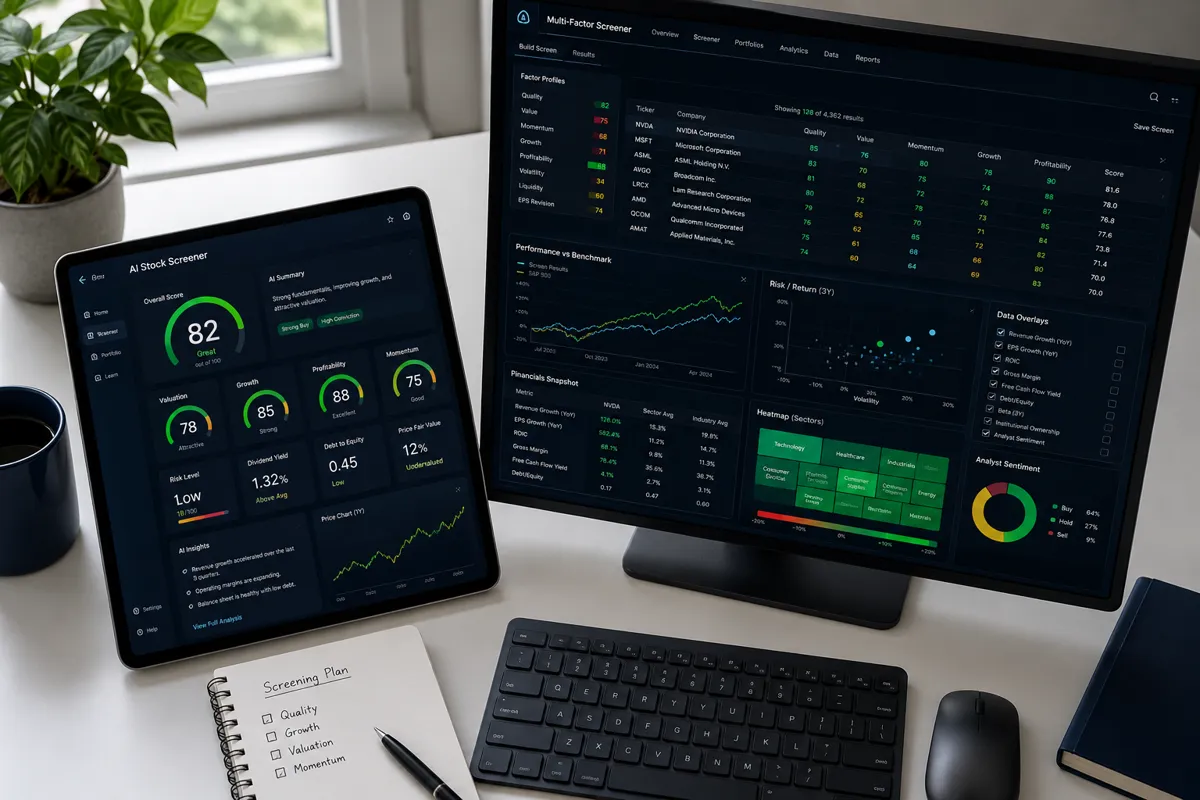
A well-built AI investment screener adapts to your strategy rather than forcing you into one approach. Here's how the main strategies map to screener functionality:
Value investing (AI value stock screener):
Filters for low P/E, low price-to-book, high free cash flow yield, and earnings consistency. Tools like Stock Rover and Validea are built specifically for this — Validea runs stocks through models based on legendary investors' published criteria.
Growth investing:
Filters for revenue growth rate, earnings acceleration, expanding margins, and relative strength. An AI investment research screener like Gainify's platform, with forward estimates from S&P Global data, handles growth screening particularly well.
Dividend income (AI dividend stock screener):
Filters for dividend yield, payout ratio, dividend growth history, and balance sheet strength. Kovered AI extends this to options income strategies, screening 150+ stocks for covered call and cash-secured put opportunities ranked by ROI and downside risk.
Momentum and swing trading:
Filters for price action signals — breakouts from basing patterns, volume confirmation, relative strength versus the index. StockMover's real-time AI scores and volume spike detection are built for this use case.
Multi-strategy (AI screener for portfolio building):
AlphaCrew's multi-agent AI system runs parallel analysis across strategies, offering daily updated rankings and company analyses for investors who blend approaches.
The key insight: Match the screener's strength to your strategy. Using a momentum scanner to find value stocks is like using a hammer to tighten a screw. The AI screeners comparison page breaks down which tools excel at which strategies.
What Data Sources Do AI Investment Screeners Typically Pull From?
Most AI investment screeners pull from a combination of public and licensed data sources. Knowing what's under the hood matters because data quality directly affects output quality.
Common data sources:
- Price and volume feeds: NYSE, NASDAQ, and other exchange data, usually licensed through aggregators.
- Fundamental data: SEC filings (10-K, 10-Q, 8-K), earnings estimates from analyst consensus databases. Gainify specifically uses institutional-grade data from S&P Global.
- News and sentiment: News wire services, financial media, and increasingly social media sentiment analysis. StockMover tracks volume spikes and price action in real time across U.S. stocks.
- Alternative data: Options flow, insider transactions, congressional trading disclosures. Platforms like Quiver Quantitative specialize in this layer.
- Earnings call transcripts: Natural language processing on management commentary for tone and guidance signals.
What this means for accuracy: A screener is only as good as its data pipeline. If the fundamental data is updated quarterly and you're making weekly decisions, you're working with a lag. Always check the data timestamp before acting on a screener output.
Can an AI Screener Help Me Find Undervalued Stocks?
Yes, but "undervalued" is doing a lot of work in that question. An AI value stock screener can identify stocks trading below historical valuation averages or below peer group multiples — that's quantifiable. Whether a stock is genuinely undervalued or cheap for a good reason requires human judgment.
What AI screeners do well for value hunting:
- Screen for low P/E, P/B, EV/EBITDA relative to sector.
- Flag stocks with high free cash flow yield and low debt.
- Identify names with consistent earnings history trading at discounts to intrinsic value estimates.
- Surface stocks that institutional models score highly on value factors, as AlphaCrew's AI rankings do with daily updates.
What to watch out for:
- Value traps — stocks that look cheap because the business is deteriorating. A low P/E on a company losing market share is a catching a falling knife situation, not a bargain.
- The screener can't tell you if management is allocating capital well or if the competitive moat is eroding.
The practical process: Use the AI screener to generate a shortlist of statistically cheap stocks. Then spend your research time asking why each one is cheap. If you can't find a good answer, that's your answer.
Are AI Investment Screening Tools Legal and Compliant With Financial Regulations?
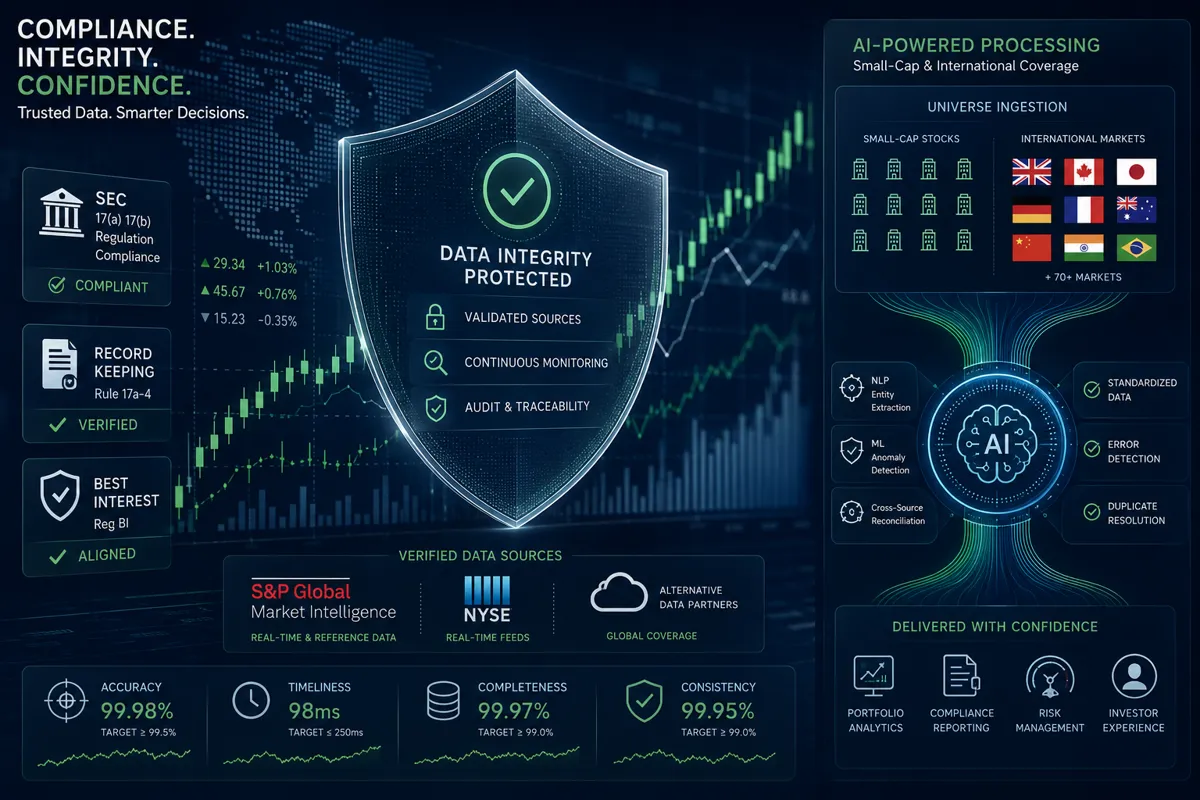
Yes. AI investment screeners are legal tools that aggregate and analyze publicly available market data. They are not regulated financial advisors, and the reputable ones are clear about this distinction.
Key compliance points:
- These platforms do not provide personalized investment advice in the regulatory sense. They provide data analysis and screening outputs.
- The SEC and FINRA regulate investment advisors, broker-dealers, and specific financial products — not data aggregation tools or research software. (See FINRA.org for the regulatory framework on investment tools.)
- Reputable platforms include clear disclaimers that outputs are for informational purposes and do not constitute investment advice.
- Data used by screeners comes from public sources (SEC filings, exchange feeds) and licensed commercial data providers — all within legal boundaries.
What to verify before using any platform:
- Does it have clear terms of service and a privacy policy?
- Does it disclose its data sources?
- Does it avoid making specific return promises? (If a tool claims it "guarantees profits," that's a regulatory red flag and a credibility red flag simultaneously.)
The tools themselves are fine. The risk is in how you use them — specifically, treating AI outputs as guaranteed signals rather than research inputs.
What Technical Skills Do I Need to Use an AI Stock Screening Platform?
Zero coding skills required for most modern AI investment screeners. The industry has moved decisively toward natural language interfaces and visual filter builders.
What you actually need:
- Basic financial literacy — understanding what P/E ratio, revenue growth, and market cap mean. If you're fuzzy on these, Investopedia's plain-English definitions are a good 30-minute fix.
- Ability to read a basic chart — support and resistance levels, volume bars, and trend direction. This isn't optional if you're acting on screener outputs.
- Comfort with web-based dashboards — if you can use Google Docs, you can use most AI screeners.
Natural language screening has become a genuine differentiator. Platforms like screener.sh let you describe your strategy in plain English and generate a working screener automatically — no filter configuration needed.
For more advanced use:
- Excel or Google Sheets familiarity helps if you want to export screener data and build your own models.
- WiseSheets integrates live stock data directly into spreadsheets for users who prefer working in their own models.
- API access for custom integrations is available on professional tiers but requires basic programming knowledge.
The bottom line: The technical barrier to entry for AI investment screeners in 2026 is lower than it's ever been. The bigger requirement is discipline — having a clear strategy before you start filtering, so the tool works for your process rather than creating a new one from scratch.
FAQ
What is the difference between an AI investment screener and a traditional stock screener?
A traditional screener applies static filters you set manually — for example, P/E under 15 and revenue growth over 10%. An AI investment screener uses machine learning to weight multiple factors simultaneously, learn from patterns in historical data, and rank results by relevance to your strategy. The output is faster, more nuanced, and often includes a scoring layer that a traditional screener doesn't provide.
Is there a free AI investment screener worth using?
Yes. Sirius Investors offers a free screener with 30+ filters across 10,000+ securities. Tickeron has a free tier with both technical and fundamental filters. The free tools section at AI Stock Picker Apps includes a screener recipe builder at no cost. Free tiers are genuinely useful for beginners and casual investors.
How often should I run an AI investment screener?
For swing traders, weekly screening before the market open on Monday is a standard practice. For long-term investors, monthly or quarterly screening is sufficient. Running it daily without a clear process just produces more noise — which defeats the purpose.
Can an AI screener predict stock prices?
No. No tool can reliably predict stock prices. AI screeners identify stocks that fit historical patterns associated with certain outcomes — that's probability, not prediction. Discipline beats prediction. A screener gives you better candidates; risk management and position sizing determine your actual results.
What's the best AI investment screener for dividend stocks?
For dividend-focused screening, look for tools that filter by dividend yield, payout ratio, dividend growth streak, and balance sheet health. Kovered AI extends this to options income strategies on dividend stocks. Stock Rover's deep fundamental screening covers dividend metrics comprehensively.
Do I need to connect my brokerage account to use an AI screener?
No. Most AI screeners are standalone research tools — you use them to identify candidates, then execute trades in your brokerage separately. Some platforms like Alpaca offer integrated trading, but it's optional, not required.
How accurate are AI investment screener scores?
Accuracy depends on data quality, model design, and what you're measuring. AI scores are better understood as relative rankings within a universe than as absolute accuracy predictions. A score of 8/10 means the stock ranks highly on the model's criteria — not that it will go up. Always use scores as a starting filter, not a final verdict.
Can I use an AI screener for ETF investing?
Yes. Several platforms screen ETFs alongside individual stocks. Sirius Investors' screener covers ETFs as well as stocks. Kovered AI tracks 25 sector ETFs for growth and momentum analysis. For ETF-focused research, the AI Stock Picker Apps comparison tool lets you filter by asset class coverage.
What's the difference between an AI screener and an AI trading bot?
A screener identifies candidates for you to evaluate and trade manually. A trading bot executes trades automatically based on pre-set rules. Screeners keep you in control of entry and exit decisions; bots automate execution. They serve different purposes and carry different risk profiles.
Is it safe to trust AI-generated investment research for large positions?
Use AI research as one input among several, not the sole basis for large positions. For significant capital allocation, cross-reference AI outputs with your own fundamental analysis, check the company's actual SEC filings, and apply your standard risk management rules — including stop loss placement and position sizing. The AI narrows the field; your process manages the risk.
Conclusion
Here's the honest summary: the AI investment screener that replaces hours of research in seconds is real, it works, and in 2026 there's no good reason not to use one.
The manual research process — six tabs open, three hours gone, still not sure what to buy — is a solved problem. AI screeners compress the filtering phase from hours to seconds, surface clean setups you'd have missed, and let you spend your actual research time where it matters: understanding why a stock is on your list and whether the risk-reward makes sense for your portfolio.
But the tool is only as good as the process behind it. Systems over hacks. A screener without a clear strategy just produces a longer watchlist and more analysis paralysis. Know your strategy first — value, growth, dividend, momentum, or swing trading — then pick the screener that fits it.
Three things to do right now:
- Browse the full AI screener comparison to match tools to your strategy — filter by free tier if you're starting out.
- Run one screening session this week using only three to five criteria. Build the habit before adding complexity.
- Paper trade it first. Take the screener's top five outputs, track them for two weeks without real money, and see how the signals hold up against your own read of the chart.
Cut the noise. Keep the alpha. The research grunt work is done — now build the process that actually uses it.
We test the AI stock tools so you don't waste months on the wrong ones. Browse the full breakdowns at aistockpickerapp.com.
References
InvestIQ - https://investiq.community/?utm_source=openai
Sirius Investors Screener - https://www.siriusinvestors.com/stock/screener?utm_source=openai
Kovered AI - https://kovered.ai/?utm_source=openai
AlphaCrew - https://www.alphacrew.ai/?utm_source=openai
StockMover - https://stockmover.ai/?utm_source=openai
Gainify - https://www.gainify.io/?utm_source=openai
AIFintrix - https://aifintrix.com/?utm_source=openai
Tickeron Screener - https://tickeron.com/screener?utm_source=openai