My AI Built Me a Trading Bot and Neither of Us Knows What We're Doing
My AI Built Me a Trading Bot and Neither of Us Knows What We're Doing...Roast Us
Last updated: June 30, 2026
Quick Answer: If you asked an AI to build you a trading bot and you're not sure whether it's working, losing money, or about to blow up your account — you're not alone, and you're not stupid. The honest truth is that most AI-generated trading bots fail in live markets because the person running them doesn't understand the strategy behind the code. Before you let that bot touch real money, you need to understand what it's actually doing, why it could fail, and how to test it safely.
Key Takeaways
- An AI trading bot built without a clear underlying strategy is essentially a random number generator with extra steps.
- Backtesting results that look extraordinary almost always overfit to historical data — they rarely survive live market conditions.
- Paper trading (simulated trading with no real money) is the only responsible first step before going live.
- Most beginner trading bot failures come down to three things: no stop-loss logic, overleveraging, and skipping the testing phase entirely.
- "My AI built me a trading bot and neither of us knows what we're doing...roast us" is actually a fresh and honest starting point — most people won't admit they don't know what they're doing until after they've lost money.
- AI trading signals accuracy varies wildly depending on market conditions, asset class, and how the strategy was designed.
- You should never start with more than you can afford to lose entirely — a figure most experts suggest keeping under $500 for a completely untested bot.
- Automated trading bot tools built by professionals exist and are worth comparing before you go the DIY route.
My AI Built Me a Trading Bot and Neither of Us Knows What We're Doing...Roast Us
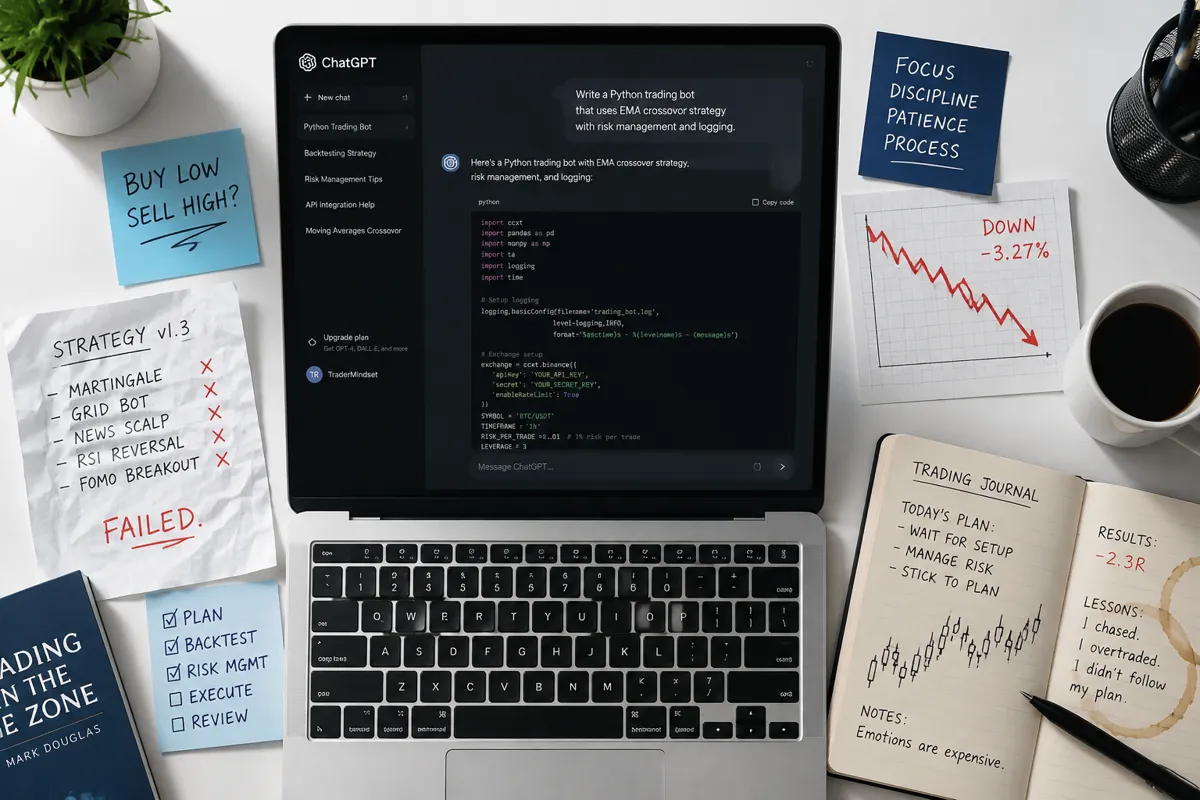
So you fired up ChatGPT, typed something like "build me a Python trading bot that buys the dip and sells the rip," and it actually gave you working code. Extraordinary, right? Then you stared at 200 lines of Python and thought, "Yeah, this looks legit." That's the moment this whole situation became genuinely dangerous.
Here's the roast, delivered with love: the AI didn't build you a trading strategy. It built you a trading bot. Those are two completely different things. A strategy requires a hypothesis about why a market pattern exists, when it stops working, and what conditions invalidate it. A bot is just the execution layer. Asking an AI to write bot code without first having a tested strategy is like asking a contractor to build you a house without an architect's blueprint — the walls might go up, but nobody's inspecting whether the foundation is solid.
The good news? Recognizing this early puts you ahead of the majority of retail traders who run AI-generated code in live accounts without a second thought. So based of you to ask the question before losing real money.
What the AI actually gave you:
- A code structure that executes buy/sell orders based on rules you described
- Logic that may or may not account for trading fees, slippage, or market liquidity
- No risk management unless you specifically asked for it
- Zero guarantee that the rules you described have any statistical edge in real markets
Before anything else, stop the bot if it's running on a live account. Seriously. Let it cook in a paper trading environment before you see results that actually matter.
What Are the Most Common Mistakes Beginners Make With Trading Bots
The most common mistake is skipping the testing phase entirely and going straight to live trading with real money. The second most common mistake is not understanding what the bot is actually doing — which means you can't tell when it's broken.
Here's the full list of beginner trading bot mistakes worth knowing:
- No defined stop-loss: If the bot has no rule for cutting losses, one bad trade can spiral into an account-destroying drawdown.
- Overfitting the backtest: The bot was "optimized" on historical data so perfectly that it only works on that exact historical data. This is called curve fitting, and it's the silent killer of backtested strategies.
- Ignoring trading fees: A bot that generates 0.2% gains per trade looks profitable until you factor in the 0.1% commission each way. Suddenly you're barely breaking even — or losing.
- Using leverage without understanding it: An automated trading bot running on margin can lose more than your initial deposit. This is how accounts get wiped overnight.
- Deploying code you can't read: If you can't explain what each section of the code does, you can't catch errors, bugs, or unintended behavior.
- Treating a bull market backtest as proof: A strategy that worked from 2020 to 2023 may have just been riding a macro tailwind. It's not a strategy — it's a coincidence.
For a broader look at how professional-grade tools handle these issues, comparing 100+ AI trading bots and platforms is a solid starting point before you commit to building your own from scratch.
How Do I Know If My Trading Bot Is Actually Profitable or Just Lucky
A bot that's made money for two weeks in live trading is not proven profitable — it's on a hot streak. Real profitability requires a statistically significant sample of trades across different market conditions.
The metrics that actually matter:
| Metric | What It Tells You | Red Flag |
|---|---|---|
| Win Rate | % of trades that close profitable | Meaningless without avg win/loss size |
| Profit Factor | Gross profit / gross loss | Below 1.3 means the edge is weak |
| Max Drawdown | Largest peak-to-trough loss | Over 20% is dangerous for most retail accounts |
| Sharpe Ratio | Return per unit of risk | Below 1.0 suggests poor risk-adjusted returns |
| Sample Size | Number of completed trades | Under 100 trades is statistically unreliable |
If your bot has taken 12 trades and made money on 9 of them, that's not data — that's noise. You need at minimum 100 trades across varying market conditions (trending, ranging, volatile) before you can draw any real conclusions about whether your AI trading bot has a genuine edge.
Tools like TradersSync are built specifically for tracking and analyzing trade performance so you can see the real numbers, not just your account balance.
What's the Difference Between Backtesting and Live Trading With a Bot
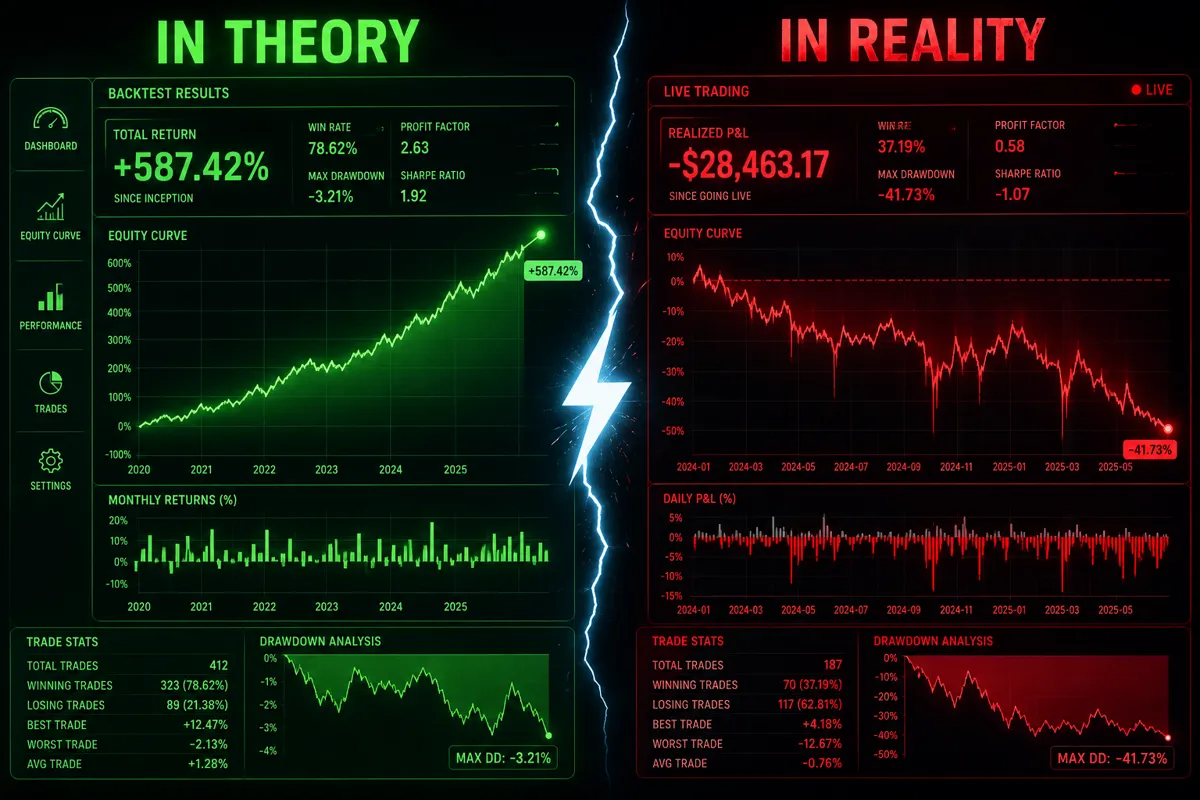
Backtesting runs your bot's rules against historical price data to simulate what would have happened. Live trading executes real orders in real time with real money. The gap between these two environments is where most algorithmic trading AI strategies fall apart.
Why backtests lie (even when they're technically accurate):
- Look-ahead bias: The code accidentally uses future data to make past decisions, which is impossible in real trading.
- Survivorship bias: Backtests often use data from stocks that still exist today, ignoring the ones that went bankrupt.
- Slippage and liquidity: In a backtest, your order fills at exactly the price you wanted. In live markets, you often get a worse price, especially on fast-moving assets.
- Execution latency: Real orders take milliseconds to execute. In volatile markets, that gap matters.
A backtesting ai trading strategy that shows 80% annual returns is almost always a sign of overfitting, not genius. The more parameters you added to "optimize" the strategy, the more likely it only works on the exact historical data you tested it on.
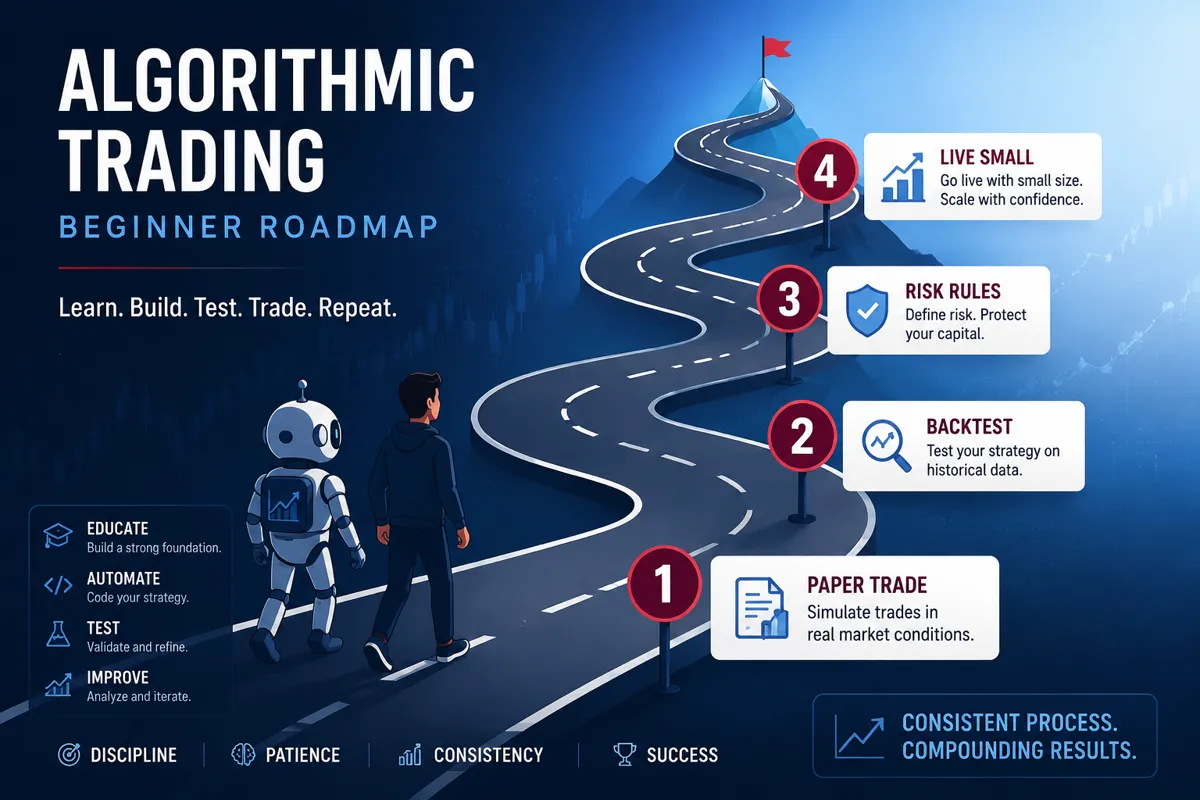
The responsible order of operations:
- Backtest the strategy (with realistic fee assumptions)
- Paper trade it for at least 4-8 weeks in live market conditions
- Run it on a micro account with the smallest possible position sizes
- Only scale up after consistent results across all three phases
Can a Trading Bot Lose All My Money Overnight
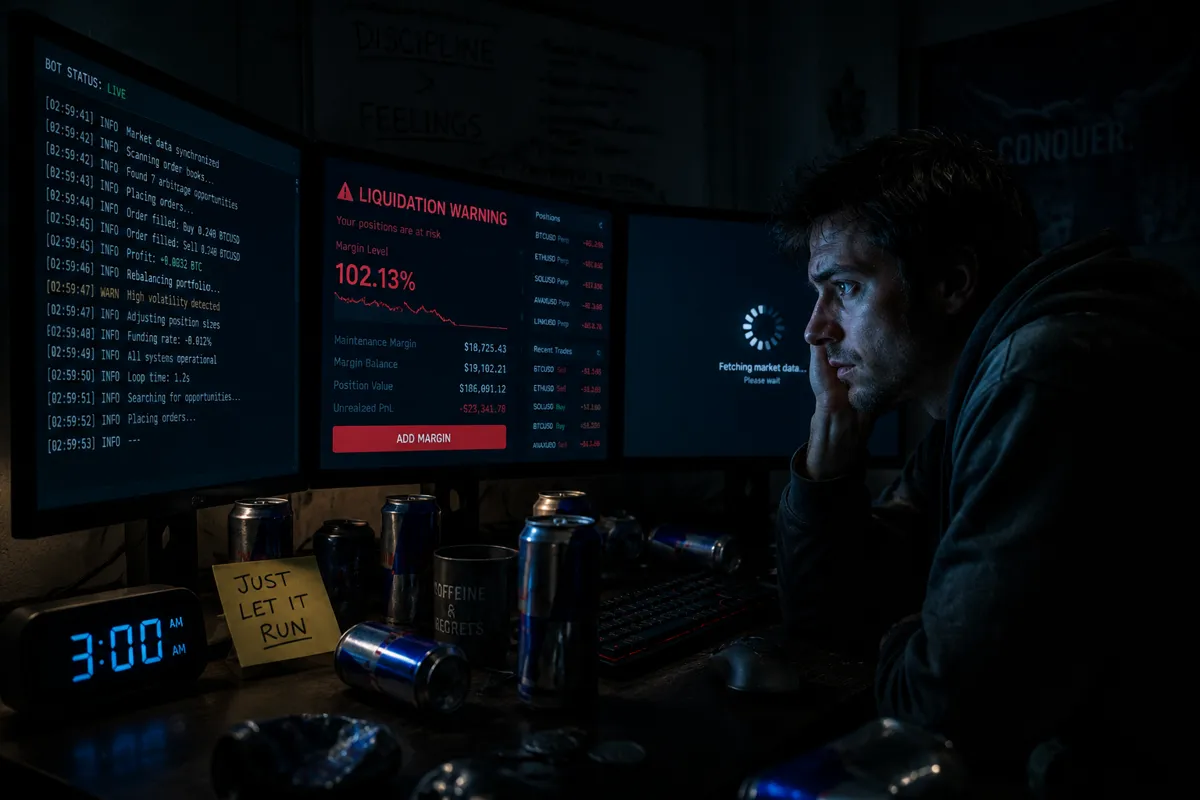
Yes, absolutely. An automated trading bot running without proper risk controls can lose your entire account balance in a single session — and in some cases, leave you with a negative balance if leverage is involved.
This isn't a hypothetical. It happens regularly to retail traders who:
- Deploy bots with no maximum daily loss limit
- Use high leverage on volatile assets (especially crypto)
- Leave bots running during high-impact news events (Fed announcements, earnings, geopolitical events)
- Have no position sizing rules, so the bot bets the entire account on one trade
The non-negotiable risk rules every trading bot needs:
- A maximum daily loss limit (e.g., bot shuts off after losing 3% of account in a day)
- A per-trade risk cap (e.g., no single trade risks more than 1-2% of account)
- A hard stop on leverage (or no leverage at all until the strategy is proven)
- An emergency kill switch you can trigger manually
If your ChatGPT trading bot doesn't have these rules baked in, add them before you go live. This isn't gatekeeping — it's the difference between a learning experience and a financial disaster.
How Much Money Should I Start With When Testing a New Trading Bot
Start with an amount you're completely comfortable losing entirely. For most people testing an unproven ai stock trading bot beginner setup, that number should be $100 to $500 maximum.
The goal of the initial live phase isn't to make money. It's to confirm that the bot executes correctly, that your broker connection works, that fees are what you expected, and that the strategy behaves in live conditions the way it did in testing. None of that requires significant capital.
A practical starting framework:
- Phase 1 (Paper trading): $0 real money, 4-8 weeks minimum
- Phase 2 (Micro live): $100-$500, focus on execution quality not returns
- Phase 3 (Small live): $1,000-$2,500 after at least 100 live trades with acceptable results
- Phase 4 (Scale): Only after consistent performance across multiple market conditions
Anyone telling you to start with $10,000 on an untested bot is not your friend. Let it cook before you see results worth betting real money on.
Why Do Trading Bots Fail and How to Avoid It
Most trading bots fail because the strategy they're built on doesn't have a real edge — it just looked like it did in a backtest. The second biggest reason is that market conditions change, and the bot keeps running the same rules in a market that no longer fits them.
The most common ai trading bot risks that cause failure:
- Strategy decay: A pattern that worked in 2022 may not work in 2026 because other traders have already arbitraged it away.
- No adaptation: Most simple bots run fixed rules. Markets shift between trending and ranging conditions constantly.
- API failures and connectivity issues: Your bot can miss trades, double-execute orders, or freeze entirely if the connection to your broker drops.
- Emotional override: Ironically, the trader starts manually overriding the bot because they "have a feeling" — defeating the entire purpose.
- Ignoring correlation: Running multiple bots that all go long at the same time means you're not diversified — you're just concentrated with extra steps.
The build vs buy trading bot question matters here. A bot you built with AI assistance has zero professional testing behind it. Platforms like 3Commas or WunderTrading come with pre-built strategy templates, risk management tools, and community-tested logic. That's not to say DIY is wrong — but know what you're comparing against.
Should I Use a Trading Bot or Just Trade Manually
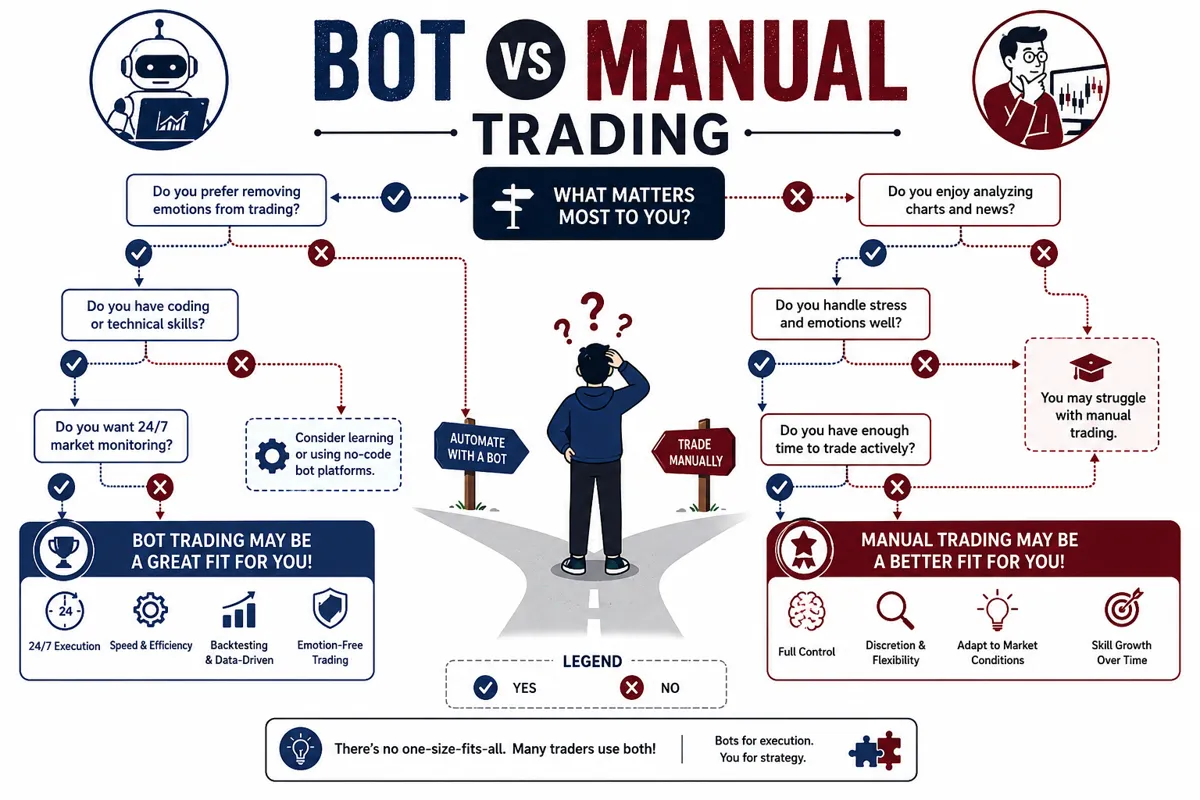
For most retail traders, manual trading with a clear, rules-based approach beats an untested automated trading bot. The exception is when you have a proven strategy that requires speed or consistency you can't provide manually — like executing dozens of trades per day or trading while you sleep.
Use a trading bot if:
- You have a backtested strategy with a documented edge
- The strategy requires execution speed or 24/7 availability
- You've paper traded it successfully for at least a month
- You understand every rule the bot is following
Stick to manual trading if:
- You're still learning how markets work
- You don't understand the code your bot is running
- You haven't defined your risk rules yet
- You're hoping the bot will figure out the strategy for you
For ai bot for day trading specifically, the bar is even higher — day trading requires fast, accurate execution and deep market understanding. If you're new to both trading and bots, exploring AI tools built for day trading will show you what professional-grade automation actually looks like before you try to replicate it with a ChatGPT prompt.
What Does It Mean When My Bot Keeps Getting Liquidated
Liquidation means your position was forcibly closed by your broker or exchange because your losses exceeded your margin. If your bot keeps getting liquidated, it's using leverage it can't handle, has no stop-loss, or is trading a strategy that consistently loses money.
Immediate steps if your bot is getting liquidated repeatedly:
- Turn off the bot immediately
- Check whether it's trading on margin or spot (no leverage)
- Review the position sizing — is it risking too much per trade?
- Check whether stop-loss orders are actually being placed
- Review the entry logic — is the bot entering at the worst possible times?
Repeated liquidations are not a "the market is rigged" problem. They're a risk management problem. No amount of better entry signals fixes a bot that bets too large on every trade.
How Do I Know If My AI-Generated Trading Bot Code Is Actually Safe
"Safe" in this context means two things: financially safe (won't blow up your account) and technically safe (won't expose your API keys or execute unintended orders). Both matter.
Technical safety checklist for AI-generated bot code:
- Never hardcode API keys directly in the script — use environment variables
- Confirm the bot uses read-only API permissions for monitoring and separate keys for execution
- Test with a paper trading account or sandbox environment before connecting real funds
- Check that order quantities are calculated as a percentage of account size, not a fixed dollar amount that could exceed your balance
- Verify there's a maximum order size cap in the code
- Make sure error handling exists — what happens if the API call fails? Does it retry endlessly and accidentally place duplicate orders?
If you can't read the code well enough to check these things, find someone who can before going live. This isn't paranoia — AI-generated code is impeccable at looking correct while containing subtle logic errors that only surface in edge cases.
What Are Red Flags That a Trading Bot Strategy Won't Work in Real Markets
The biggest red flag is a backtest that shows consistent profits with almost no losing periods. Real strategies have drawdowns. If yours doesn't, the backtest is broken.
Other red flags to watch for:
- Win rate above 85% on a backtest (almost certainly overfitted)
- Strategy only tested on one asset or one time period
- No accounting for trading fees in the backtest results
- The "edge" is based on a pattern that has no logical reason to persist
- Backtest uses less than 2 years of data
- Strategy was "optimized" by adjusting parameters until it looked good
A fresh strategy should be able to explain its edge in plain English: "This works because X market participants consistently do Y, which creates Z opportunity." If you can't explain it without referencing the backtest results, you don't have a strategy — you have a curve-fitted coincidence.
For a structured way to evaluate ai trading signals accuracy before committing real capital, AI signal tools with transparent performance data give you a benchmark for what real signal quality looks like.
How Often Should I Check on My Trading Bot
Check your bot at least once per day, every day it's running. "Set it and forget it" is a fantasy for unproven strategies. The bot needs monitoring until you have enough live data to trust its behavior.
A practical monitoring schedule:
- Daily: Check open positions, account balance, and whether any errors occurred
- Weekly: Review trade log, compare live performance to backtest expectations
- Monthly: Evaluate whether market conditions have shifted enough to warrant pausing the strategy
- After major news events: Always check immediately after Fed decisions, major earnings, or geopolitical events
The "can I just leave it running" question has one honest answer: not until you've watched it operate through multiple market conditions without surprises. Even then, daily checks are impeccable practice.
What's the Best Way to Learn Trading Before Letting a Bot Do It for Me
Learn to trade manually first, even if your end goal is full automation. Understanding why prices move, how order flow works, and what makes a strategy fail is knowledge that no bot can substitute for.
A practical learning sequence:
- Study basic technical analysis and market structure (support/resistance, trend identification)
- Paper trade manually for 60-90 days, tracking every decision and outcome
- Learn about position sizing and risk management before anything else
- Study one strategy deeply rather than sampling ten strategies shallowly
- Only then consider automating the rules you've already proven work for you manually
The traders who succeed with algorithmic trading ai are almost always people who traded manually first. The automation came after the strategy was proven — not as a shortcut to avoid learning.
Can You Really Make Money With Automated Trading or Is It All Hype
Yes, automated trading is real and profitable — for a small percentage of traders who have genuine strategies, proper risk management, and the discipline to test thoroughly before going live. For the majority of retail traders who deploy unproven bots, it's an expensive lesson.
The honest breakdown:
- Institutional algorithmic trading accounts for a significant portion of daily market volume — so automation clearly works at scale
- Retail automated trading success rates are much lower, largely because of the testing and strategy gaps described throughout this article
- The tools available in 2026 make it more accessible than ever — platforms that compare AI trading platforms show dozens of options with real performance data
- The hype comes from survivorship bias — the people who made money talk about it; the people who lost money quietly close their accounts
Automated trading is not a get-rich-quick mechanism. It's a systematic approach to executing a proven strategy without emotional interference. If the strategy isn't proven, the automation just executes losses faster and more consistently than you would manually.
Conclusion
Here's the straight answer: "My AI built me a trading bot and neither of us knows what we're doing...roast us" is actually the most honest thing a beginner trader can say in 2026. The problem isn't that you used AI to build the bot. The problem is deploying it without understanding the strategy, the risk rules, or the testing process.
Your actionable next steps, in order:
- Stop the bot if it's running on a live account right now with untested logic.
- Audit the code — specifically check for stop-loss logic, position sizing rules, and API key security.
- Paper trade it for a minimum of 4 weeks before touching real money.
- Define your edge in plain English — if you can't explain why the strategy should work, it probably won't.
- Start micro when you do go live — $100 to $500 maximum until you have 100+ live trades of data.
- Compare professional tools — before building from scratch, explore what professional AI trading tools actually offer so you know what you're measuring against.
The traders who win with automation are the ones who treated it like a business, not a lottery ticket. Be so based about your approach that you actually do the work before you risk the money. The market will still be there when you're ready.
Frequently Asked Questions
Q: Is it legal to use an AI-generated trading bot for stock trading?
A: Yes, using automated trading software for personal investing is legal in the U.S. You must comply with your broker's terms of service regarding API usage and automated order placement.
Q: Can ChatGPT build a profitable trading bot?
A: ChatGPT can write functional trading bot code, but it cannot create a profitable strategy. Profitability depends on the underlying trading logic, which requires backtesting, validation, and real-world testing — not just code generation.
Q: What's the safest way to test a new trading bot?
A: Paper trading on a simulated account is the safest first step. After that, deploy with the smallest possible real-money position sizes (under $500) until you have statistically meaningful live trade data.
Q: Do I need to know how to code to use a trading bot?
A: No. Many platforms offer no-code or low-code bot builders with pre-built strategy templates. If you're using AI-generated code, you should at minimum understand what each section does, even if you didn't write it yourself.
Q: How long should I paper trade before going live?
A: A minimum of 4-8 weeks, or until you have at least 50-100 completed trades in paper trading. The goal is to see how the bot behaves across different market conditions, not just a short favorable period.
Q: What's the difference between a trading bot and a robo-advisor?
A: A robo-advisor manages a diversified portfolio based on your risk profile and long-term goals. A trading bot executes active buy/sell strategies based on technical signals. They serve very different purposes and carry very different risk profiles.
Q: Can a trading bot work for crypto as well as stocks?
A: Yes, but crypto markets are more volatile and operate 24/7, which increases both the opportunity and the risk. Leverage is also more commonly used in crypto, which amplifies losses.
Q: What happens if my bot places a trade while I'm asleep and the market crashes?
A: Without a daily loss limit or automatic shutdown rule, the bot will keep trading. This is why a maximum daily loss cap is non-negotiable before leaving any bot running overnight.
Q: Is backtesting enough to know if a strategy will work?
A: No. Backtesting is a necessary first step, not a final answer. It tells you whether the strategy would have worked historically, not whether it will work going forward. Paper trading and micro live testing are required before drawing real conclusions.
Q: Should I use a pre-built trading bot platform or build my own?
A: For beginners, a pre-built platform with tested logic and risk management tools is almost always the better starting point. Build your own only after you understand trading strategy fundamentals well enough to evaluate whether your code is doing what you intend.