Lucid Prop Firm | Review of Rules, Pricing and Bot Policy
The Lucid prop firm (Lucid Trading) is a futures prop firm that sells one-time-fee evaluations, then pays traders a 90/10 split on simulated funded accounts and promotes its best performers to live accounts. Its help center says automated trading systems and trade copiers are permitted, while high-frequency trading, microscalping and cross-account hedging are banned. The rule that decides most payouts is consistency: LucidPro funded accounts cap your best day at 40% of the profit in each payout cycle. There is no monthly subscription and no activation fee on the core plans, so a failed attempt costs you the purchase price or a reset, never a recurring bill.
Key insights
- Bots are allowed, with guardrails. Lucid's "Other Trading Activities" page permits automated systems and trade copiers, and makes the trader responsible for any software error.
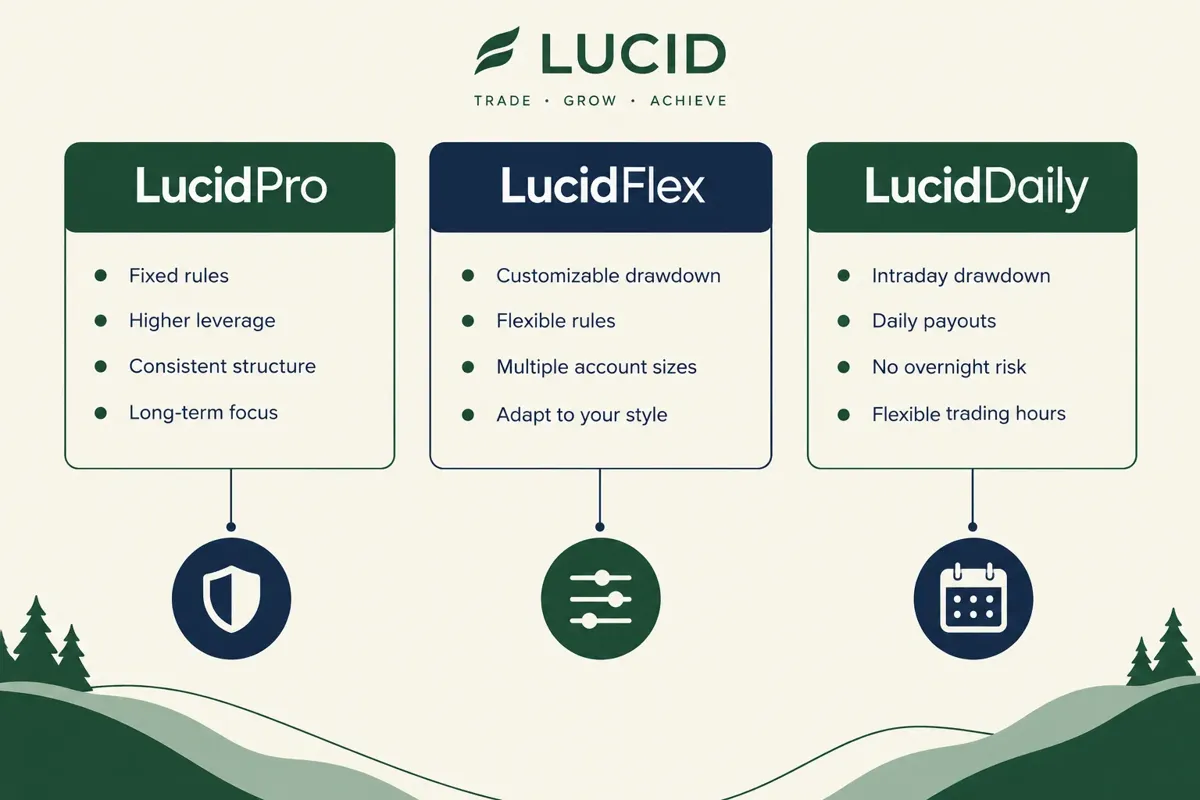
- Four public plans, four rulebooks. LucidPro, LucidFlex, LucidDaily and LucidDirect each handle drawdown, consistency and payouts differently. LucidMaxx is invite-only.
- LucidPro numbers that matter: $3,000 profit target and $2,000 end-of-day drawdown on the $50K, $500 minimum profit goal per cycle, $500 minimum payout, first payout capped at $2,000.
- Live accounts start at $0 with end-of-day drawdown, daily payouts, no daily loss limit and no consistency rule.
- Prices and promo codes move. The homepage pushes code VAULT "for the best deal," but checkout is the only place the final price shows. Re-check it the day you buy.
By FullStack Alpha Editorial Team | Reviewed by Jay Rocco, Chief Editor
Everything below comes from Lucid's own help center and website, read in 2026. Where Lucid does not publish something, this review says so instead of guessing. Every number is tied to the official page it came from.
What Is the Lucid Prop Firm?
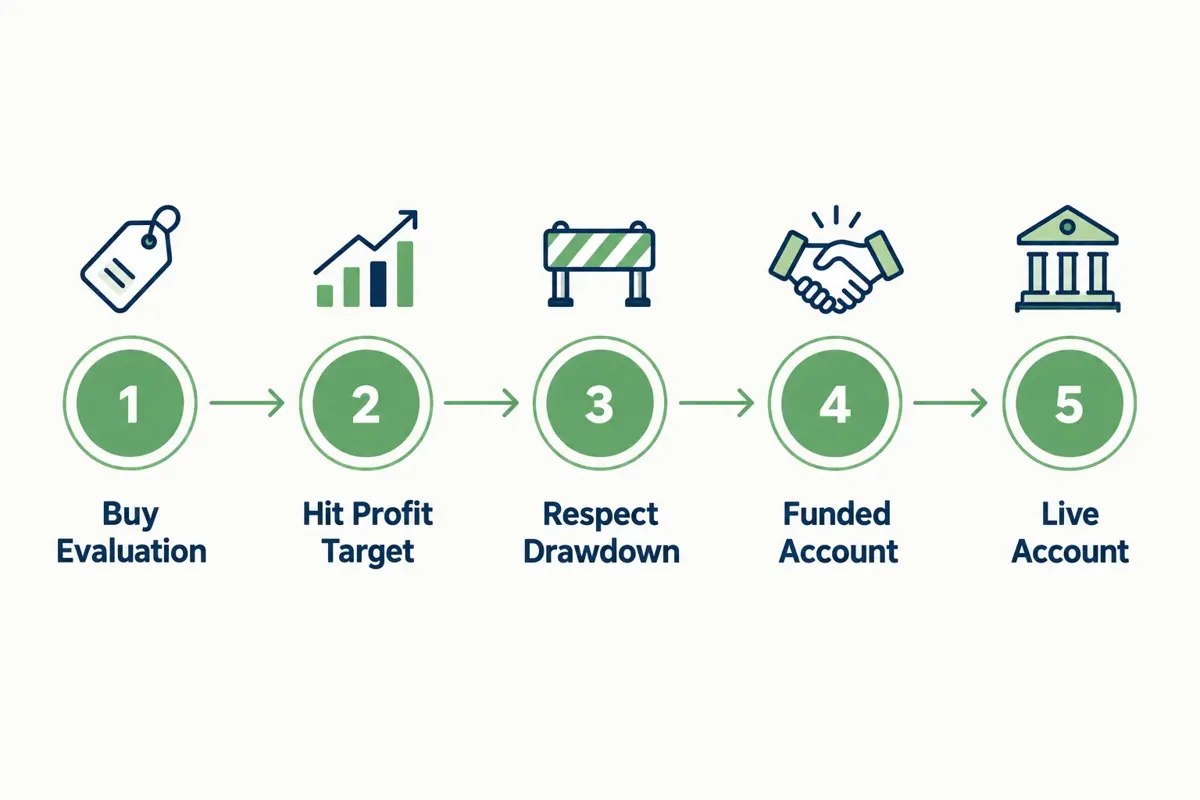
Lucid Trading is a futures funding company. You buy an evaluation, trade a simulated account under fixed rules, and if you hit the profit target without touching the Max Loss Limit, you move to a simulated funded account that pays real money when you withdraw. Lucid's FAQ describes the end state as a live brokerage account "funded with our capital."
The legal entity named in the refund policy is Lucid Trading Group LLC, and the site footer lists 3500 S Dupont Hwy, Dover, DE. The homepage claims "$700M+ earned by traders" and "500K+ traders." Those are company figures, not audited ones. Treat them as marketing until a third party confirms them.
Founder names and leadership bios were not published on the pages we checked (2026). If ownership matters to your decision, ask support in writing before you buy.
The lineup in plain English
- LucidPro: the flagship evaluation. No consistency rule in the evaluation, so you can pass in one trading day. The funded account adds a 40% consistency rule and a buffer.
- LucidFlex: a 40% consistency rule in the evaluation (50% with a paid add-on), then no consistency rule and no buffer once funded. Payouts need five profitable days.
- LucidDaily: daily payouts and no funded consistency rule, but the funded account always uses intraday drawdown and red-folder USD news is a hard breach.
- LucidDirect: straight to funded, no evaluation, with a stricter 20% consistency rule.
- LucidMaxx: an invite-only evaluation-to-live track for traders Lucid's risk team selects.
The practical takeaway: the Lucid prop firm sells options on rules, so the Lucid prop firm plan you pick matters more than the account size. Options help when you know your own trading style. They cost you money when you don't.
How Do Lucid Prop Firm Evaluations and Pricing Work?
Every core Lucid plan is a one-time purchase. The "Simulated Account Fees" article says LucidPro evaluations and LucidDirect accounts carry no subscription and no automatic rebilling, and there is no activation fee to move from a LucidPro evaluation to a LucidPro funded account. If you fail, you buy a reset from the dashboard. Resets are not automatic and not free.
Here is the catch on price. Plan prices on lucidtrading.com load at checkout and change with the options you pick (daily loss limit on or off, consistency add-on, drawdown type). Dollar prices were not published on the pages we checked (2026). The homepage banner reads "For the best deal use code: VAULT." Codes rotate, so confirm the final number in your cart.
LucidPro evaluation rules (official)
| Account size | Profit target | Max Loss Limit (EOD) | Daily loss limit | Max size |
|---|---|---|---|---|
| $25K | $1,250 | $1,000 | None | 2 minis or 20 micros |
| $50K | $3,000 | $2,000 | $1,200 | 4 minis or 40 micros |
| $100K | $6,000 | $3,000 | $1,800 | 6 minis or 60 micros |
| $150K | $9,000 | $4,500 | $2,700 | 10 minis or 100 micros |
Lucid says a passed LucidPro evaluation upgrades to funded in real time, within 5 to 30 minutes of hitting the target. The daily loss limit is a soft breach: hit it and you are locked out until the next session, but the account survives as long as the Max Loss Limit holds.
Pricing and payout structure by plan
Lucid did not publish dollar prices on the help pages or homepage we checked (2026). The table keeps the structure that decides your real cost: drawdown and payout mechanics, side by side for LucidPro and LucidFlex.
| Account size | LucidPro price | LucidFlex price | Drawdown (both plans) | Payout mechanics |
|---|---|---|---|---|
| $25K | Shown at checkout | Shown at checkout | EOD, $1,000 Max Loss Limit | Pro: $250 min profit goal, first payout max $1,000. Flex: 5 days of $100+, max 50% of profit up to $1,000 |
| $50K | Shown at checkout | Shown at checkout | EOD, $2,000 Max Loss Limit | Pro: $500 goal, first payout max $2,000. Flex: 5 days of $150+, up to $2,000 |
| $100K | Shown at checkout | Shown at checkout | EOD, $3,000 Max Loss Limit | Pro: $750 goal, first payout max $2,500. Flex: 5 days of $200+, up to $2,500 |
| $150K | Shown at checkout | Shown at checkout | EOD, $4,500 Max Loss Limit | Pro: $1,000 goal, first payout max $3,000. Flex: 5 days of $250+, up to $3,000 |
Both plans have a $500 minimum payout request and a 90/10 split. Daily loss limit on or off changes the checkout price, so price the exact configuration you will trade.
How the drawdown works
LucidPro, LucidFlex and LucidDirect use an end-of-day (EOD) drawdown. At each session close the system records your highest closing balance, and the Max Loss Limit trails up behind it. Once your balance passes the Initial Trail Balance ($52,100 on a $50K LucidPro), the limit locks at the starting balance plus $100 ($50,100) and stops moving.
LucidDaily is different. You pick EOD or intraday drawdown for the evaluation at checkout, but every LucidDaily funded account uses intraday drawdown. Intraday means the floor rises with open profit in real time. Run a trade up $1,200 unrealized, give it back, and your room is already smaller.
Decision rule
Choose EOD drawdown if you let winners breathe and accept giving back open profit. Choose intraday only if you take profit mechanically. Not sure? Pull your last 50 trades and compare maximum favorable excursion with where you exited. That gap picks the setting, not a sales page.
Before you spend money finding out your strategy can't survive a trailing floor, run it through a backtest reality check. It is free and takes ten minutes.
Does the Lucid Prop Firm Allow Trading Bots?
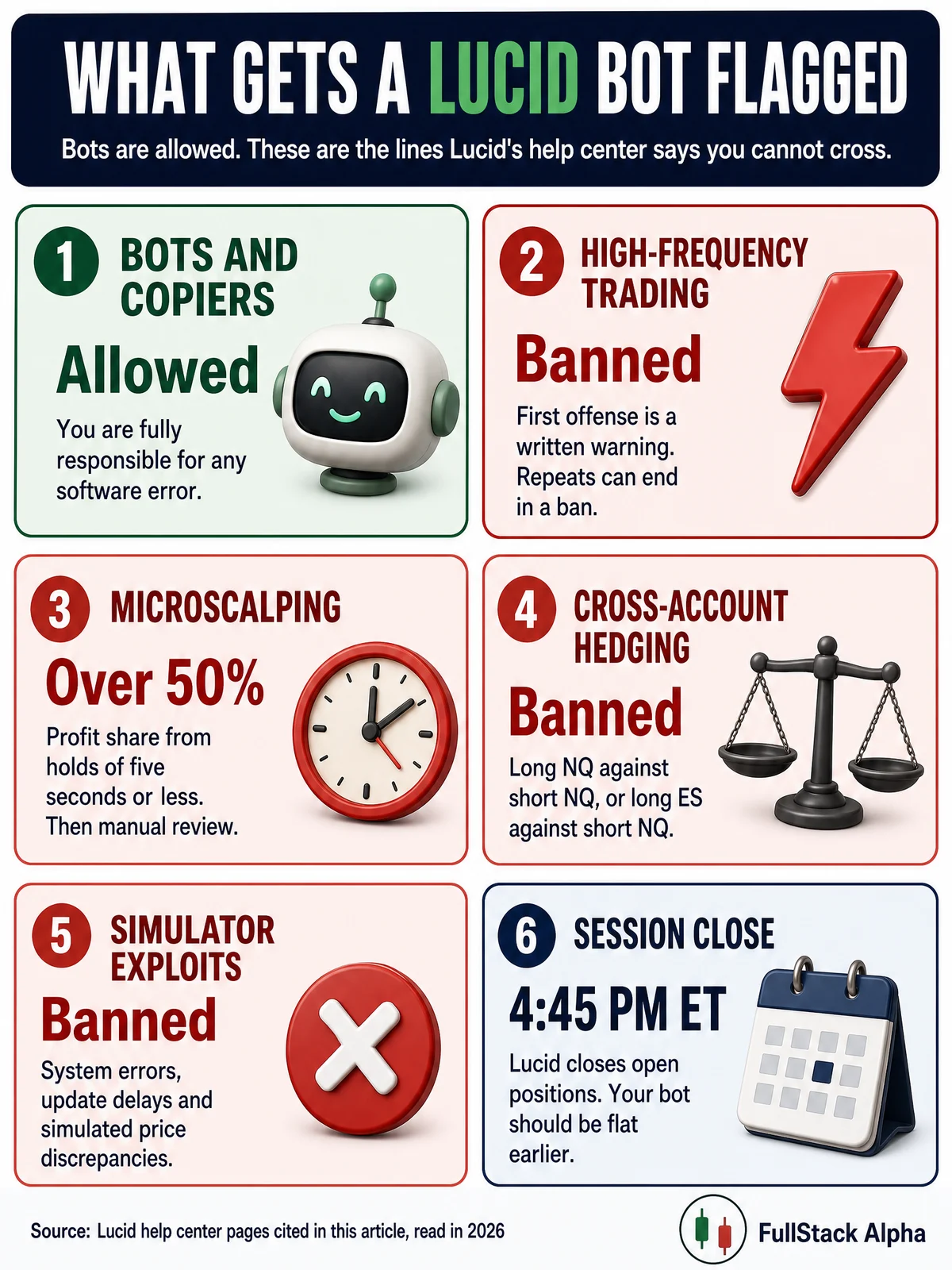
Yes. The Lucid prop firm states it in plain words on its Other Trading Activities page: "Automated trading systems and trade copiers are permitted. All automated activity must comply with Lucid Trading rules. Traders are fully responsible for any software errors, malfunctions, or unintended outcomes."

That is more permissive than several big competitors. Take Profit Trader's Universal Trading Policies ban bots and algos on every account type. Apex Trader Funding's prohibited-activities page says "No Automation or Algorithm Usage allowed." So if your process is systematic, Lucid is one of the firms where the code itself is not the problem.
What gets a bot flagged at Lucid
- High-frequency trading. Lucid defines HFT as a high volume of trades in seconds or milliseconds. First offense is a written warning. Repeat offenses remove the HFT profits, close the accounts and can end with a permanent ban.
- Microscalping. You are flagged if more than 50% of your profits come from trades held five seconds or less. Lucid then runs a manual review before acting.
- Hedging across accounts. Long NQ in one account and short NQ in another is banned, and so is long ES in one account against short NQ in another, because the assets are correlated. Flagged accounts get reset to the prior day's balance without restoring drawdown.
- Exploiting the simulator. The "Trade With Integrity" page bans taking advantage of system errors, update delays or discrepancies in simulated prices.
Copy trading your own accounts
Trade copiers are permitted, which matters because Lucid allows up to five funded accounts per household. The hedging rule is the trap. A copier that mirrors one direction across your accounts is allowed. A setup where one account runs long and another runs short on correlated products is the fastest way to a reset.
Before you point a bot at it
- Test the exact config on an evaluation first. The rules are identical, and a failed evaluation costs less than a closed funded account.
- Log trade duration. If your average hold is under a few seconds, run the 50% microscalping math yourself before Lucid does.
- Hard-code the session close. Lucid auto-closes positions at 4:45 PM ET on Pro, Flex and Direct. Your bot should be flat earlier.
- Keep written confirmation. Email support with your platform, strategy type and account count, and save the reply.
For a broader look at which automation tools hold up, our AI trading bots guide scores the category on the same five pillars we use for every review.
What Are the Lucid Prop Firm Trading Rules and Restrictions?
Scalping and day trading are allowed at the Lucid prop firm. The rules that actually end accounts are drawdown type, consistency, news restrictions on LucidDaily and the session close.
- Genuine scalping: allowed, as long as it is not microscalping that games simulated fills.
- News trading: allowed on Flex, Pro and Direct. On LucidDaily funded accounts you must be flat from one minute before to one minute after high-impact USD news, or the account is breached.
- Scaling in (DCA): allowed. Lucid "strongly discourages" martingaling, adding to losers in hope of a reversal.
- Flipping: allowed. Quick in-and-out trades to meet trading-day minimums are not restricted.
- Trading hours: positions must be closed by 4:45 PM ET Monday to Friday, and trading resumes at 6:00 PM ET Sunday through Thursday. Holding past 4:45 PM is not a failure; Lucid simply closes the position for you.
- Inactivity: an account that produces less than $1 of net profit or loss in 30 calendar days is treated as abandoned and deleted.
- Account limits: up to 10 evaluation accounts per household, 5 funded accounts per household and 5 live accounts.
The consistency rule, in plain numbers
LucidPro funded accounts require your largest single-day profit to be no more than 40% of total profit in the payout cycle. Lucid's own example: a $1,000 best day on $4,000 of profit is 25%, so you qualify. A $2,000 best day on the same $4,000 is 50%, so you keep trading until normal days dilute it.
Accounts bought or reset before November 28, 2025 at 3:00 PM ET still use the older 35% figure. LucidDirect is stricter at 20%. LucidFlex and LucidDaily funded accounts have no consistency rule at all, which is the single biggest reason a one-big-day trader might pick them.
What that means for your style: one monster session is a liability on LucidPro. A trader who grinds $200 a day for five days clears review. A trader who makes $900 on Tuesday and $100 the rest of the week waits.
Common edge case: you hit the minimum profit goal in one session and stop trading to protect it. That is exactly the pattern the rule punishes. Keep trading normal size on normal setups until the distribution flattens.
How Fast Are Lucid Prop Firm Payouts, and Who Qualifies?
Lucid's payout pages say there is no fixed payout window. Once you meet the objectives you can request any day, funds leave the account within minutes of approval, and the money reaches your payment method within two business days. The homepage advertises "15ish min from request to bank," which is a marketing figure, not the policy text.

LucidPro payout objectives (official)
Source: the LucidPro payouts article, read in 2026.
| Account size | Min profit goal per cycle | Buffer balance | First payout max | Payout 2+ max |
|---|---|---|---|---|
| $25K | $250 | $26,100 | $1,000 | $1,500 |
| $50K | $500 | $52,100 | $2,000 | $2,500 |
| $100K | $750 | $103,100 | $2,500 | $3,000 |
| $150K | $1,000 | $154,600 | $3,000 | $3,500 |
The minimum request is $500 and the split is 90/10. Accounts bought or reset before November 28, 2025 at 3:00 PM ET can still receive 100% of the first $10,000. Payout requests are final once submitted.
Worked example: a $50K LucidPro account needs $52,600 to take the minimum $500 payout ($52,100 buffer plus $500), and $54,100 to take the full $2,000 first payout. At a 90/10 split, a $2,000 request puts $1,800 in your pocket.
The buffer trap: if you keep trading after you submit and your balance drops into the buffer, Lucid can deny the request. Trade as if the payout has already left the account.
LucidFlex and LucidDaily payouts
LucidFlex needs five days in the cycle that each clear a minimum profit ($100, $150, $200 or $250 by size) plus positive net profit for the cycle. You can request 50% of profit, capped at $1,000 to $3,000 by size, with no buffer. After five Flex payouts the account moves live.
LucidDaily lets you request daily once profit clears the buffer, with a $500 minimum. Instead of per-request caps it sets a Maximum Daily Profit ($6,000 to $12,000 by size). Hit it and you are moved live automatically. With the daily loss limit on, LucidDaily allows several payout requests in one session if each one meets the rules.
How Lucid pays you
- Plaid: instant bank transfers for U.S. traders.
- WorkMarket by ADP: U.S. and international, by bank transfer or PayPal, typically as early as the next business day.
- Crypto for international traders: BTC, ETH, LTC, USDT and USDC.
Who qualifies
Anyone who passes KYC and is not a citizen or resident of a restricted country. Lucid's list is long and includes Tajikistan, Turkey, Ukraine, the Philippines, Nigeria, South Africa and Vietnam among others. Check the official restricted-countries page the day you buy, because passing from a restricted country means you cannot be paid.
What Happens When You Move Live at Lucid?
Lucid's New Live Structure article explains the step most prop reviews skip. Traders enter a live review pool after the fifth payout on Flex, Pro or Direct, after large lifetime payouts, after hitting LucidDaily's maximum daily profit, or for exceptional sim performance. Every move is at the risk team's discretion.
Each eligible funded account becomes one live account, and each one must have received at least one payout. Live accounts start at a $0 balance with daily payouts, EOD drawdown and no daily loss limit. Starting live drawdown is $1,000, $2,000, $3,000 or $4,500 by account size, and consistency rules no longer apply.
The cashout option: if you don't want live capital yet, Lucid offers a cashout equal to 50% of your live starting balance at a 90/10 split. Ignore the email for 24 hours and your accounts move live automatically.
The live bonus: reach the live profit target ($2,000, $4,000, $6,000 or $9,000 by size) and complete 20 trading days, and Lucid lists a repeatable bonus of $1,000, $2,000, $3,000 or $4,500, also split 90/10.
LucidDaily twist: sim profits above the buffer can be paid out on the move to live, but only up to $15,000 total, no matter how many accounts you hold.
Is the Lucid Prop Firm Legitimate and Regulated?
Lucid Trading operates as a real business with a public help center, dated rule changes and a written payout policy. It is not a regulated broker, and nothing in its materials claims otherwise. Your evaluation and funded accounts are simulated, so there is no customer money in custody and no SIPC-style protection beyond the fee you paid.
Trust signals in Lucid's favor:
- Rules are published in exact numbers, including buffer balances and payout caps.
- Rule changes are dated, such as the November 28, 2025 consistency change, rather than slipped in quietly.
- One-time fees remove the subscription-churn incentive that monthly models create.
- A documented path from sim funded to live, with stated starting drawdown and contract limits.
Things that deserve skepticism:
- Refunds are close to nonexistent. The refund and liability policy says there are no refunds on any account that has been traded, regardless of results or technical issues. Untraded accounts may be considered at Lucid's discretion.
- Liability is capped. The same policy limits Lucid's liability to the greater of $100 or what you paid in the prior month, and says Lucid owes nothing for failures of trade copiers or automated systems.
- Chargebacks are a ban. Filing an improper dispute gets you permanently banned.
- Rules change often. Legacy articles for LucidBlack, LucidFlex and LucidDirect show how frequently terms have been rewritten in 2025 and 2026.
A prop firm is legitimate when it pays people who follow the rules, and transparent when the rules are readable before you pay. Lucid clears both bars today. "Today" is doing real work in that sentence.
How Do You Pass the Lucid Prop Firm Challenge?
You pass by trading small enough that the drawdown never gets a vote. The profit target is rarely what stops people. Risk per trade is.
- Size for the drawdown, not the target. Risk no more than 10% of your drawdown on one trade. On a $2,000 drawdown, that is $200, which gives you ten straight losers before you are out.
- Cap your day. Two losing trades and you stop. Revenge trading after a stop-out fails more evaluations than bad strategy.
- Trade one setup. One instrument, one time frame, one pattern. Variety is for after you are funded.
- Spread profit on purpose. On LucidPro funded or LucidFlex evaluations, aim for 15% to 20% of your goal per good day so the consistency math stays clean.
- Count commissions. Lucid charges $1.75 per side on ES and NQ and $0.50 per side on MES and MNQ. A scalper doing 20 round trips a day in ES pays $70 in commissions.
- Journal the rule, not just the trade. Note which rule you followed or broke. Our best trading journal roundup covers tools that make this painless.
Common mistake: buying the $150K because the payout caps look bigger. The drawdown is larger in dollars, but each tick feels bigger too. Most traders should prove the process at $25K or $50K first.
How Does the Lucid Prop Firm Compare to Other Futures Prop Firms?
Lucid competes on one-time fees, configurable rules and an explicit permission for automation. Here is how it lines up against two firms we also reviewed, using each firm's own pages.
| Firm | Fee model | Bots and automation | Funded drawdown | Split |
|---|---|---|---|---|
| Lucid Trading | One-time fee, no activation fee on core plans | Allowed, plus trade copiers; no HFT or microscalping | EOD on Pro, Flex, Direct; intraday on Daily | 90/10 |
| Topstep | Monthly Trading Combine, $49 to $199 Standard, plus $149 activation | Allowed with conditions; no VPS for order flow | Trailing MLL that locks at $0 | 90/10 |
| Take Profit Trader | Monthly Test subscription, $130 PRO activation | Not allowed on any account | Intraday trailing on PRO | 80/20 on PRO |
For a deeper read on each, see our Topstep review, Take Profit Trader review and the full best prop firm comparison.
Decision rule: if you cannot describe your average winning day as a share of your average week, you are not ready for a 40% consistency rule. Pick LucidFlex or LucidDaily, whose funded accounts have none, or keep paper trading.
Where the Lucid prop firm genuinely wins: low payout thresholds. A $250 minimum profit goal on a $25K LucidPro means a competent week can reach a withdrawal. Getting paid once changes how you trade.
Who Should Skip the Lucid Prop Firm?
Skip it if your edge depends on rare outsized days on LucidPro, if your bot runs at HFT speed, or if you need a refund safety net.
- The one-big-day trader on LucidPro or LucidDirect. A 40% or 20% cap will hold your payouts. Consider LucidFlex instead.
- The microsecond bot. If most of your profit comes from holds under five seconds, Lucid's detection will find it.
- The news gambler on LucidDaily. Holding through red-folder USD news is a hard breach on Daily funded accounts.
- The equities trader. Lucid is futures only. For stock and options platforms, start with our reviews library.
- Anyone in a restricted country. You can pass and still not be paid.
- The undercapitalized trader. If the fee is money you need, the pressure will make you size badly.
The honest version: prop evaluations are a filter, and the filter works. Most people fail because they had no process before they paid, not because the rules were unfair.
How Much Could the Lucid Prop Firm Evaluation Really Cost You?
The sticker price is the smallest number in this decision. What matters is how many attempts you will likely need and how long funded profit takes to pay that back. Run your own numbers below before you buy any Lucid prop firm evaluation.
FullStack Alpha
What passing really costs you
The sticker price is one attempt. This works out what passing actually costs you at your own pass rate, and how long funded profit takes to pay it back.
Expected attempts is 1 divided by your pass rate, so a 25% rate means four tries on average. Re-check the current evaluation price and payout split on the firm's own page. The profit figure is your own estimate and nothing here forecasts it. Most funded accounts are lost before they pay out.
Frequently Asked Questions
Does the Lucid prop firm allow trading bots?
Yes. The Lucid prop firm's help center says automated trading systems and trade copiers are permitted, as long as they follow Lucid's rules. High-frequency trading, microscalping and hedging across accounts are banned. You are responsible for any software error your bot makes.
How much does a Lucid prop firm evaluation cost?
Lucid sells one-time evaluations with no monthly rebilling and no activation fee on its core plans. The dollar price shows only at checkout and changes with the options you pick, such as a daily loss limit. The homepage promotes code VAULT, so check the final cart price on the day you buy.
What is the Lucid consistency rule?
On LucidPro funded accounts, your largest single-day profit must be no more than 40% of the profit in that payout cycle. LucidDirect uses 20%, and accounts bought before November 28, 2025 keep 35%. LucidFlex and LucidDaily funded accounts have no consistency rule.
How fast does Lucid Trading pay out?
Lucid says there is no fixed payout window, so you can request any day once you meet the objectives. Funds leave the account within minutes of approval and reach your payment method within two business days. The minimum request is $500 and the split is 90/10.
Is Lucid Trading legit?
Lucid Trading operates as a real business with a public help center, dated rule changes and written payout terms. It is not a regulated broker, and funded accounts are simulated. Its refund policy refuses refunds on any account that has been traded, so read the rules before you pay.
Is Topstep or Lucid better?
It depends on your style. Lucid charges one-time fees and explicitly allows automation and trade copiers, while Topstep bills monthly for its Combine and bans VPS-based order flow. Topstep has the longer operating history, dating to Topstep Trader's 2012 launch.
Does the Lucid prop firm allow scalping?
Yes, genuine scalping is allowed. Lucid flags microscalping when more than 50% of your profits come from trades held five seconds or less, then reviews the account manually. Trim winners mechanically if you trade an intraday drawdown plan.
Our Take
For bot traders, the Lucid prop firm is one of the friendlier rulebooks in futures: automation and trade copiers are explicitly allowed, fees are one-time, and the live structure is written down in numbers. The guardrails are HFT, microscalping and cross-account hedging, and Lucid enforces them with automated detection, so test your exact configuration on an evaluation first.
The one rule to read before you pay is consistency. On LucidPro your best day cannot exceed 40% of the cycle's profit, and on LucidDirect it is 20%. If your style makes money in bursts, choose LucidFlex or LucidDaily, whose funded accounts drop the rule entirely. Check the price and the VAULT code at checkout on the day you buy, because both change.
Want the full scorecard on the tools that run on top of your futures account? Browse every review at FullStack Alpha
Stay alpha.