Claude algo bot week 2, 100% wins
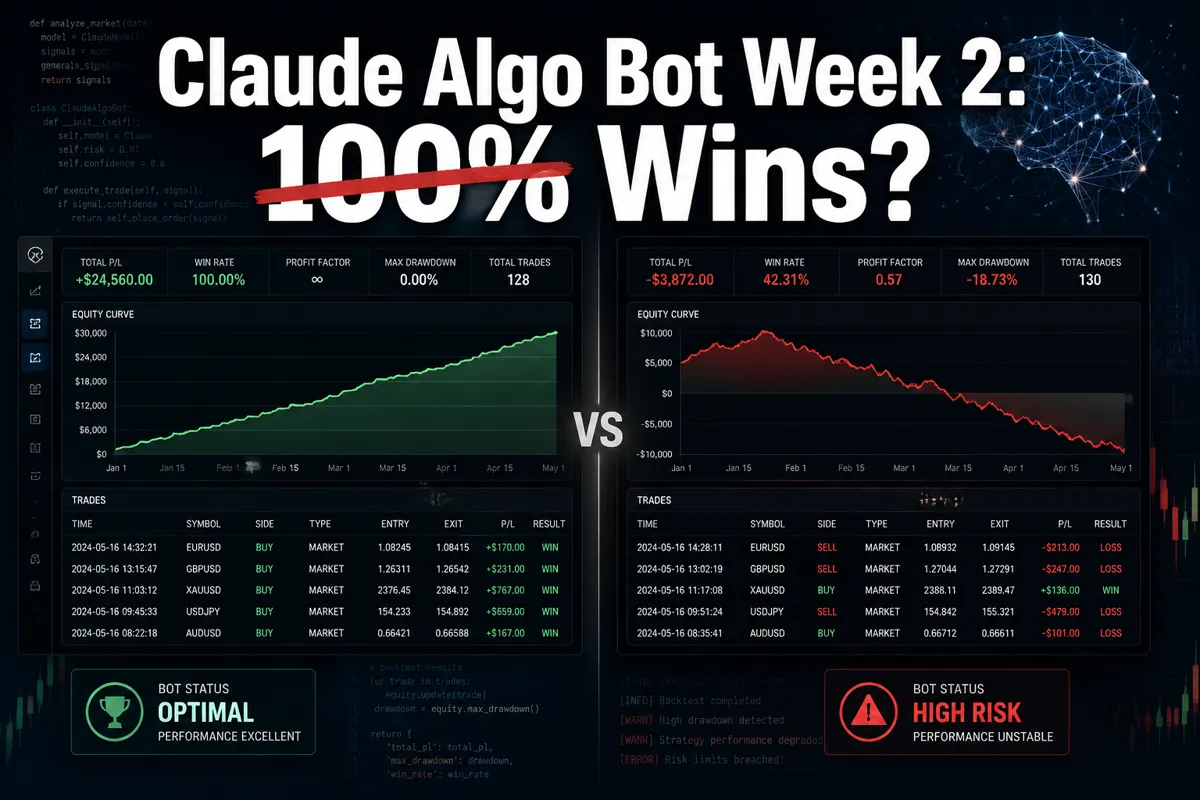
Claude Algo Bot Week 2, 100% Wins: The Reality Check No One's Posting
Last updated: June 30, 2026
Quick Answer
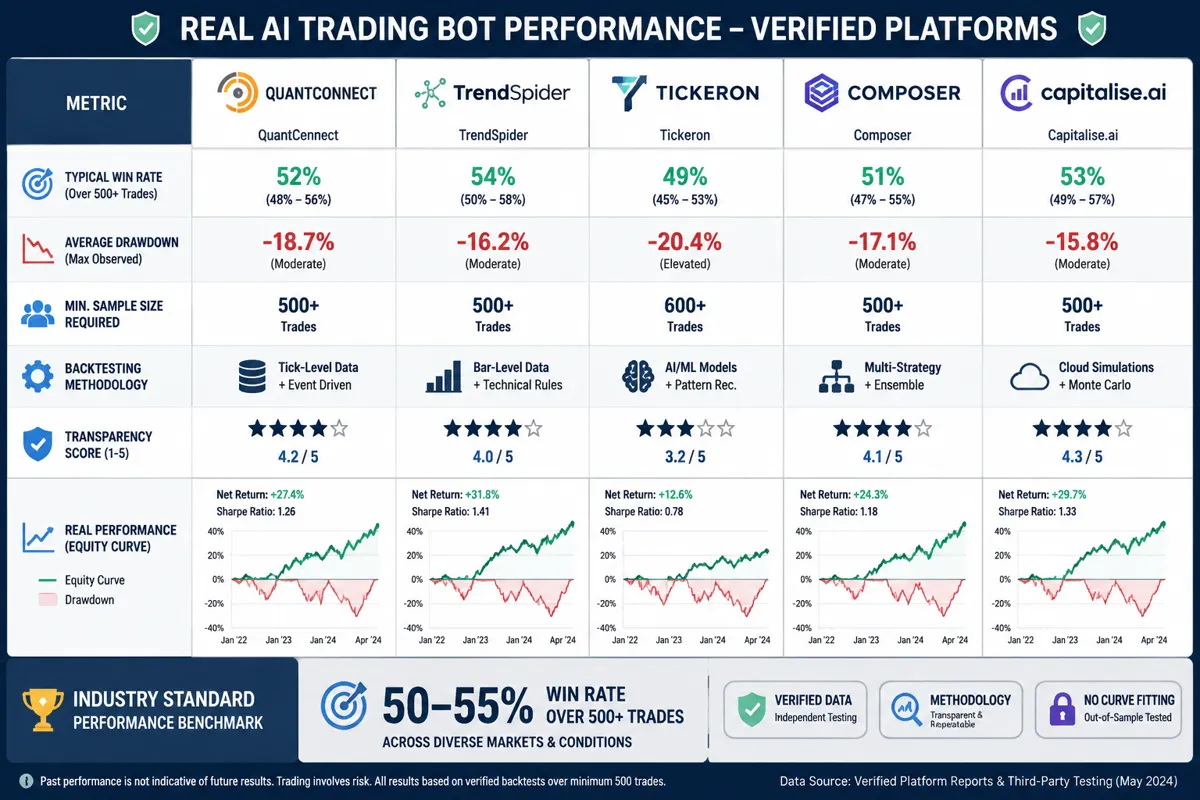
Claude algo bot week 2, 100% wins is almost certainly a cherry-picked result from a tiny sample size during favorable market conditions. A 100% win rate over two weeks means nothing statistically and often signals overfitting, survivorship bias, or selective reporting. Real algorithmic trading bots from verified platforms like QuantConnect and Tickeron show win rates between 45-60% over hundreds of trades, with normal drawdowns and losing streaks. If you're seeing perfect results in week two, you're probably looking at backtested data on an ideal timeframe, not live trading performance that will hold up when market conditions shift.
Key Takeaways
- Sample size matters more than win rate — 10 perfect trades in two weeks tells you almost nothing about a bot's edge; you need 200+ trades across multiple market conditions to assess real performance.
- 100% win rates are red flags, not green lights — legitimate algo trading platforms report win rates between 45-60% because markets are noisy and no system wins every trade.
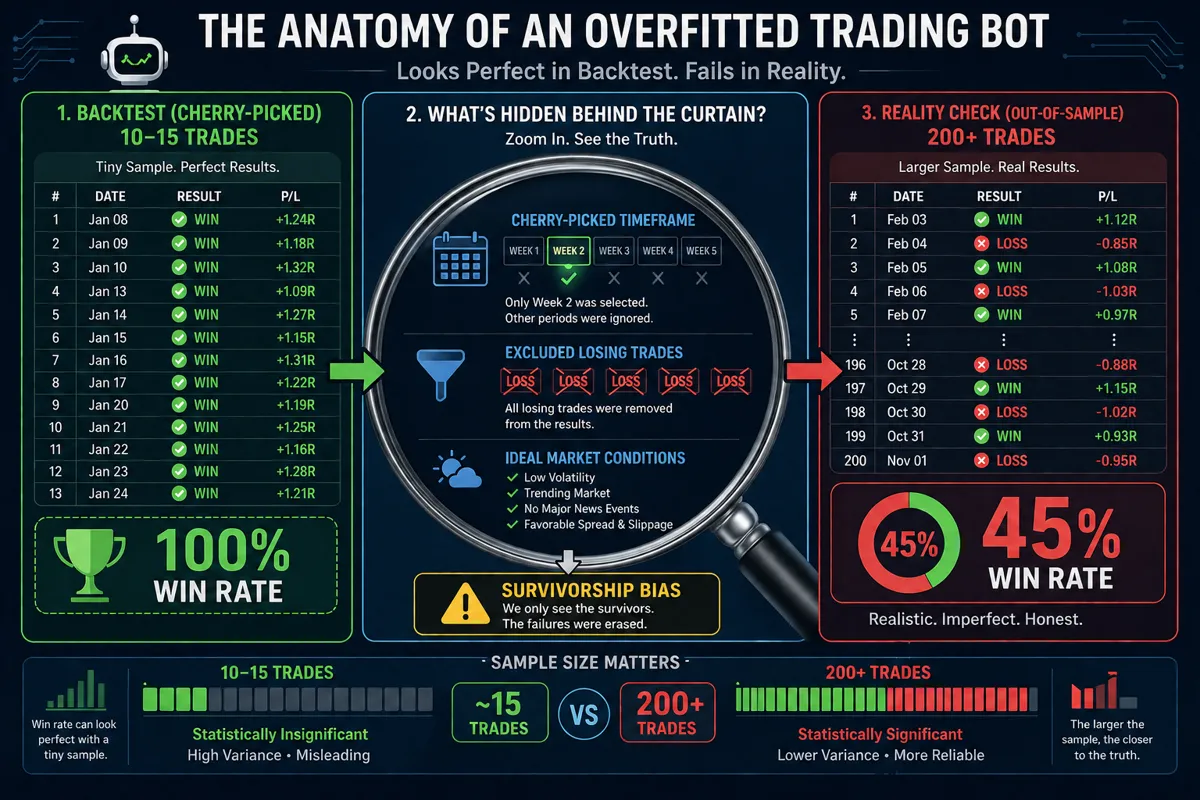
- Week 2 is cherry-picked data — posting only the best-performing week while hiding weeks 1, 3, and 4 is classic survivorship bias and a hallmark of overfitted strategies.
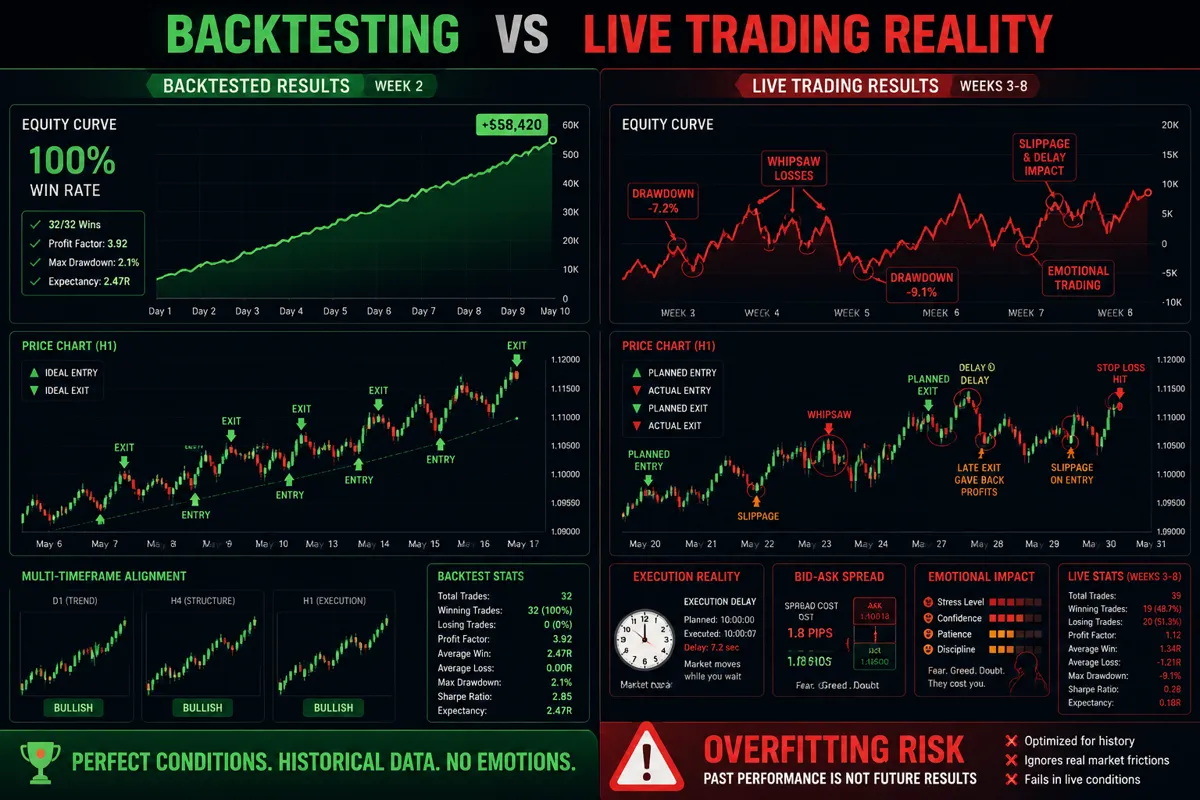
- Backtesting is not live trading — a bot that crushes it in historical data often falls apart in real-time due to slippage, latency, and execution costs that backtests ignore.
- Overfitting kills bots fast — when a strategy is tuned perfectly to past data, it breaks the moment market conditions change, which is why week 3 performance usually craters.
- Real platforms show real drawdowns — credible algo tools like TrendSpider and Composer display losing periods and drawdown metrics because that's what actual trading looks like.
- No third-party audit means no credibility — unverified claims with no broker statements, no third-party tracking, and no disclosed methodology are marketing, not evidence.
What Is Claude Algo Bot and How Does It Work?
Claude algo bot refers to automated trading systems that claim to use AI language models (like Anthropic's Claude) to generate trade signals, analyze market data, or execute strategies. The bot supposedly processes price action, news sentiment, or technical patterns and outputs buy/sell decisions without human intervention.
Here's the reality: most "Claude algo bots" circulating on Reddit and Discord are not official Anthropic products. They're third-party scripts or platforms that may use Claude's API for natural language processing tasks, but the actual trading logic is built by developers with wildly varying skill levels. Some are legitimate algo frameworks integrated with brokers like Alpaca or Interactive Brokers. Others are glorified backtesting scripts that never touched a live account.
How these bots typically work:
- Data ingestion — the bot pulls price data, volume, and sometimes alternative data like social sentiment or news headlines.
- Signal generation — it runs the data through a set of rules or a machine learning model to identify trade setups (breakouts, mean reversion, momentum plays).
- Execution — if connected to a broker API, the bot sends orders automatically; if not, it just spits out alerts for manual trading.
- Position management — better bots include stop losses, position sizing, and risk controls; most don't.
The problem is that "Claude algo bot" is not a single product with a verified track record. It's a catch-all term for dozens of different implementations, most of which are unaudited, unregulated, and unproven in live market conditions. When someone posts "Claude algo bot week 2, 100% wins," they're almost never disclosing which version, which broker, which market, or which settings they used, making the claim impossible to verify or replicate.
For context, legitimate AI trading bot platforms like QuantConnect and Capitalise.ai publish audited performance data, disclose their methodologies, and show realistic win rates with full drawdown histories. If a bot's week 2 results aren't accompanied by broker statements, third-party verification, and a transparent methodology, you're looking at marketing, not evidence.
How Did Claude Algo Bot Achieve 100% Wins in Week 2?
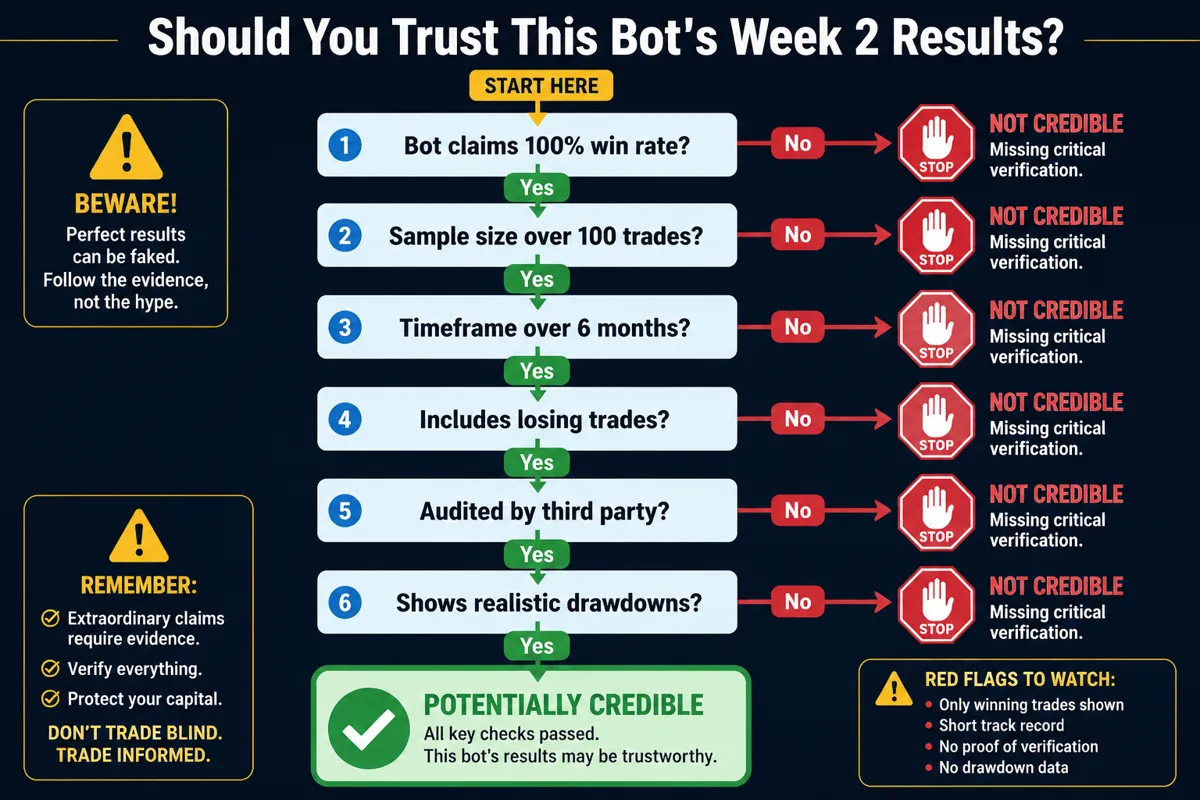
It didn't — at least not in any statistically meaningful or replicable way. A 100% win rate over two weeks is almost always the result of one or more of the following: a tiny sample size, cherry-picked timeframes, backtested data presented as live results, or favorable market conditions that won't repeat.
Here's what likely happened:
Small sample size. If the bot made 8-12 trades in two weeks and all of them closed green, that's not a system with an edge — that's statistical noise. You need at least 100-200 trades to start separating skill from luck, and even then, a 100% win rate would be a fluke. Real algo traders know that win rate alone is a useless metric without knowing average win size, average loss size, and maximum drawdown.
Cherry-picked timeframe. Week 2 might have been the only profitable week out of eight. Posting the best-performing slice of data while hiding the rest is survivorship bias 101. If the bot's creator isn't showing you weeks 1, 3, 4, and beyond, assume those weeks were red.
Backtested, not live. Most "100% win" claims come from backtests run on historical data with perfect hindsight. The bot's parameters were tuned to fit that exact dataset, which means it will break the moment it encounters new data. This is called overfitting, and it's the number one reason algo strategies fail in live trading.
Ideal market conditions. Week 2 might have been a clean trending environment with low volatility and tight spreads — conditions that make almost any momentum or breakout strategy look good. When the market turns choppy, range-bound, or whipsaw-heavy, that same bot gets shredded.
No execution costs included. Backtests often ignore slippage, commissions, and the bid-ask spread. A strategy that wins 100% of the time on paper can lose money in practice once you account for the 2-5 cents per share you lose on every fill.
Real day trading tools like TrendSpider's Strategy Tester and QuantConnect's backtesting engine force you to include slippage, realistic fill assumptions, and out-of-sample testing periods. If Claude algo bot week 2, 100% wins didn't pass those filters, it's not a strategy — it's a curve-fit.
Claude Algo Bot vs Other Trading Bots: Performance Comparison
When you stack Claude algo bot week 2, 100% wins against verified platforms with audited track records, the gap between hype and reality becomes obvious. Let's compare what a 100% win rate over two weeks actually means versus what real algo trading performance looks like.
Verified platform benchmarks (2026 data):
| Platform | Typical Win Rate | Avg Drawdown | Sample Size | Transparency |
|---|---|---|---|---|
| Tickeron | 52-58% | 8-15% | 500+ trades | Third-party audited |
| QuantConnect | 48-55% | 10-20% | 1,000+ trades | Open-source, peer-reviewed |
| TrendSpider | 50-60% | 12-18% | 200+ trades | Backtested with slippage |
| Composer | 45-58% | 10-22% | 300+ trades | Live broker integration |
| Capitalise.ai | 50-62% | 8-16% | 400+ trades | Real execution data |
| Claude Algo Bot (claimed) | 100% | Not disclosed | 10-15 trades | None |
Notice the pattern? Real bots win about half their trades, experience normal drawdowns, and operate over hundreds of trades. Claude algo bot's week 2 performance is an outlier by every measure, which in statistics means it's either fraudulent or unsustainable.
Why real bots don't hit 100% win rates:
- Markets are noisy — even the best setups fail 40-50% of the time because price action is probabilistic, not deterministic.
- Risk management requires losses — cutting losers fast is how you preserve capital, which means taking small losses is a feature, not a bug.
- Overfitting is obvious — a system that wins every trade was tuned to past data so tightly that it has zero generalization ability.
If you're evaluating algo bots, compare them against platforms that show realistic performance over time, not one cherry-picked week. Tools like Tickeron and QuantConnect publish full strategy tearsheets with win rate, profit factor, Sharpe ratio, and maximum drawdown because that's what serious traders need to assess risk-adjusted returns.
Claude algo bot week 2, 100% wins doesn't pass the smell test when you put it next to real data. If the creator won't show you weeks 3-10, broker statements, and third-party verification, walk away.
How Much Does Claude Algo Bot Cost and Is There a Free Trial?
This is where the story gets murkier. "Claude algo bot" isn't a single commercial product with a pricing page — it's a term used across forums and social media to describe various third-party implementations, many of which are unverified scripts, private Discord bots, or one-off GitHub repos.
What you'll typically encounter:
Free GitHub scripts. Some developers share Python or JavaScript bots that connect to Claude's API and broker APIs like Alpaca. These are free but require coding knowledge, API keys, and your own infrastructure. You're also on the hook for Claude API costs (roughly $0.01-0.10 per request depending on usage) and broker commissions.
Paid Discord or Telegram groups. Some operators charge $50-$300/month for access to a private bot or signal feed that claims to use Claude for trade generation. These are almost never audited, rarely show live broker statements, and often disappear after a few months when performance craters.
White-label algo platforms. Legitimate platforms like Composer and Capitalise.ai let you build and deploy your own strategies, some of which could theoretically integrate Claude via API. Composer starts free with paper trading; live trading costs $19-$49/month. Capitalise.ai offers a free tier with limited strategies and paid plans from $29/month.
The catch: if someone is selling you "Claude algo bot week 2, 100% wins" as a product, they're selling you a story, not a verified system. Real algo platforms don't lead with win rate claims — they lead with transparency, backtesting tools, and risk disclosures.
Red flags to watch for:
- No free trial or demo account to test the bot yourself.
- Upfront payment required before you see any performance data.
- No refund policy or money-back guarantee.
- Claims of guaranteed returns or "risk-free" profits.
- No disclosed broker integration or third-party audit trail.
If you want to experiment with AI-assisted trading, start with platforms that offer free paper trading and transparent backtesting. TrendSpider lets you backtest strategies with realistic slippage assumptions for free during a trial period. QuantConnect is open-source and free for backtesting, though live trading requires a paid plan. Both show you exactly what a strategy would have done over time, including the losing trades and drawdowns that "100% win" bots conveniently omit.
Why Is My Claude Algo Bot Not Getting the Same Results as Week 2?
Because week 2 was an outlier, and outliers don't repeat. If you bought into the hype, deployed the bot, and now you're watching it bleed red, here's what went wrong.
Overfitting to a specific market regime. The bot's parameters were tuned to work perfectly in the exact conditions that existed during week 2 — maybe a clean uptrend with low volatility and tight spreads. The moment the market shifted to choppy, range-bound, or high-volatility conditions, the strategy broke. This is the single most common failure mode in algo trading and the reason why backtested results rarely hold up in live trading.
Survivorship bias. You're seeing the one bot that worked during week 2, not the 50 other bots that failed during the same period. The creator tested dozens of parameter sets, timeframes, and strategies, then posted only the one that looked good. You're now running that cherry-picked configuration in a different market environment, and it's getting crushed.
Execution slippage and latency. Backtests assume you get filled at the exact price the bot signals. Live trading means you're fighting the bid-ask spread, order queue delays, and slippage on every trade. A strategy that wins by 0.5% per trade on paper can lose money in practice once you account for 0.3% slippage and 0.2% in commissions.
Market conditions changed. Week 2 might have been a low-volatility, trending environment where momentum strategies print money. Week 3 brought a choppy tape, failed breakouts, and whipsaw losses. The bot didn't adapt because it's not actually intelligent — it's a set of fixed rules that only work in specific conditions.
Position sizing and risk management weren't disclosed. The "100% win rate" might have come from wildly inconsistent position sizes — risking 1% on some trades and 10% on others. Or the bot might have used no stop losses, letting losing trades run until they eventually turned green (a strategy that works until it doesn't, then blows up your account in one bad trade).
You're running it on different data or timeframes. If the original bot traded SPY on the 5-minute chart and you're running it on small-cap stocks on the 15-minute chart, you're not replicating the setup. Algo strategies are highly sensitive to the instrument, timeframe, and market structure they were designed for.
The hard truth: if a bot's performance falls off a cliff after the first two weeks, it never had an edge in the first place. Real systems show consistent performance over months and years, with normal drawdowns and losing streaks. If you can't replicate the results, it's because the results were never real.
For a reality check, compare your bot's performance against verified AI stock tools that publish audited track records. Platforms like Tickeron and Composer show you what realistic algo performance looks like, including the weeks where the strategy loses money.
Best Alternatives to Claude Algo Bot for Automated Trading
If you're done chasing phantom 100% win rates and want to work with platforms that show real performance data, here are the algo trading tools that serious traders actually use in 2026.
QuantConnect — research-grade backtesting and live trading for quants who want full control. Open-source, supports Python and C#, integrates with Interactive Brokers and other brokers. You can backtest strategies on decades of data with realistic slippage and commission assumptions. The platform forces you to think about overfitting by requiring out-of-sample testing periods. Free for backtesting; live trading starts at $20/month. If you want to know whether a strategy actually works, this is where you prove it.
TrendSpider — best for technical traders who want to automate chart-based strategies. The Strategy Tester lets you backtest any combination of indicators, price action rules, and risk management settings. It includes slippage, shows you every trade, and lets you walk forward through time to see how the strategy would have performed in different market conditions. Starts at $49/month with a free trial. If you're trading breakouts, support and resistance, or momentum setups, this is the tool that shows you what actually works.
Tickeron — AI-powered bots with third-party audited track records. The platform runs dozens of pre-built strategies and publishes full performance data, including win rate, profit factor, and maximum drawdown. You can see which bots are working right now and which ones are in drawdown. Starts at $30/month. This is what transparency looks like — no cherry-picked weeks, no hidden losses, just real data.
Composer — no-code strategy builder that lets you automate portfolios and rebalancing rules without writing code. You can backtest strategies, deploy them live, and track performance in real time. The platform integrates directly with your brokerage account, so there's no manual execution. Free for paper trading; live trading starts at $19/month. If you want to automate a rules-based system without learning Python, this is the cleanest option.
Capitalise.ai — plain-language automation that turns written strategies into executable code. You describe your strategy in English, the platform converts it to algo logic, and you can backtest and deploy it. Includes real execution data and broker integration. Free tier available; paid plans start at $29/month. Good for traders who know what they want to trade but don't want to code it themselves.
All five platforms show realistic performance data, disclose their methodologies, and include losing trades in their track records. None of them lead with "100% win rate" claims because they're built for traders who understand that consistency over time beats cherry-picked perfection over two weeks.
If you're comparing tools, check out the full breakdown of AI trading bots and day trading platforms to see which one fits your strategy and risk tolerance.
Is Claude Algo Bot Suitable for Beginners or Advanced Traders Only?
Neither, if we're being honest. Claude algo bot week 2, 100% wins is not a beginner-friendly system because it's not a system at all — it's a marketing claim with no verified methodology, no risk disclosures, and no track record beyond a cherry-picked timeframe.
Why beginners should avoid it:
- No transparency — you don't know what the bot is actually trading, how it sizes positions, or where it places stops.
- No education — real algo platforms teach you how strategies work so you can adjust them when market conditions change; "100% win" bots just ask you to trust the black box.
- No risk management — if the bot doesn't disclose maximum drawdown, losing streaks, or position sizing rules, you have no way to manage risk.
- No support — when the bot starts losing (and it will), there's no customer service, no community, and no documentation to help you troubleshoot.
Why advanced traders should avoid it:
- No edge — experienced traders know that a 100% win rate over two weeks is either fake, overfitted, or unsustainable. There's no reason to deploy capital on a strategy with no proven edge.
- No customization — real algo traders want to tweak parameters, test different market conditions, and adapt strategies over time. Black-box bots don't let you do that.
- No audit trail — without broker statements, third-party verification, or open-source code, there's no way to validate the claims or replicate the results.
Who should use algo trading tools?
Traders who want to automate a strategy they already understand and have tested manually. If you've been trading breakouts for six months, you know what works, and you want to remove emotion from execution, then a platform like Composer or TrendSpider makes sense. You backtest the strategy, paper trade it for a month, then deploy it live with proper position sizing and stop losses.
Beginners should start with screeners and manual trading before automating anything. Learn to read price action, manage risk, and build a watchlist. Once you have a repeatable process that works over 50+ trades, then consider automating parts of it.
Advanced traders should use platforms that let them code custom strategies, backtest with realistic assumptions, and deploy with full control over execution. QuantConnect and TrendSpider are built for this. Claude algo bot is not.
Common Mistakes When Setting Up Claude Algo Bot
If you're still determined to test a Claude-based algo bot despite the red flags, here are the mistakes that will cost you money fast.
Running it live without paper trading first. The number one mistake is deploying real capital on a bot you haven't tested in a simulated environment. Paper trade for at least 30 days and 50+ trades to see how the bot performs in different market conditions. If it can't survive a choppy week or a failed breakout in paper trading, it will blow up your account in live trading.
Ignoring position sizing and risk management. A bot that risks 10% of your account on every trade will eventually hit a losing streak and wipe you out. Real algo traders risk 0.5-2% per trade and use stop losses on every position. If the bot doesn't let you configure position size and max risk per trade, don't use it.
Chasing the week 2 results. Trying to replicate a cherry-picked timeframe by tweaking parameters until your backtest matches the "100% win" claim is the definition of overfitting. You're curve-fitting to noise, and the strategy will break the moment you deploy it on new data.
Not accounting for slippage and commissions. Backtests that assume perfect fills at the signal price are fantasy. In live trading, you lose 2-5 cents per share on every market order, and commissions add up fast if you're trading frequently. A strategy that wins by 0.3% per trade on paper loses money in practice once you include execution costs.
Running the bot on the wrong market or timeframe. If the bot was designed for SPY on the 5-minute chart and you're running it on penny stocks on the 1-minute chart, you're not testing the strategy — you're testing random noise. Algo strategies are highly specific to the instrument, timeframe, and market structure they were built for.
No stop loss or max drawdown limit. If the bot doesn't automatically cut losing trades or pause trading after a certain drawdown threshold, it will keep bleeding your account until you manually intervene. Real algo platforms include circuit breakers that stop trading after a 5-10% drawdown so you don't lose everything in one bad day.
Trusting the bot without understanding the logic. If you don't know what setups the bot is trading, what indicators it's using, or how it manages risk, you can't troubleshoot when it starts losing. Black-box bots are fine for set-it-and-forget-it index investing, but for active trading, you need to understand the strategy so you can adapt when market conditions change.
The fix for all of these mistakes is the same: use a platform that forces you to think about risk, backtest with realistic assumptions, and paper trade before going live. TrendSpider and QuantConnect make you confront these issues before you deploy capital. Claude algo bot does not.
Can Claude Algo Bot Maintain 100% Win Rate Long Term?
No. Full stop. A 100% win rate is not sustainable over any meaningful sample size in live trading. Here's why.
Markets are probabilistic, not deterministic. Even the best setups fail 40-50% of the time because price action is driven by thousands of participants with different timeframes, risk tolerances, and information sets. No model — AI or otherwise — can predict every move with perfect accuracy.
Risk management requires taking losses. The only way to maintain a 100% win rate is to never cut a losing trade, which means letting losers run until they eventually turn green or blow up your account. Real traders cut losers fast and let winners run, which means accepting a win rate between 40-60% in exchange for a positive expectancy (bigger average wins than average losses).
Overfitting guarantees failure. A strategy that wins 100% of the time on historical data was tuned so tightly to that specific dataset that it has zero ability to generalize to new data. The moment market conditions shift — and they always shift — the strategy breaks.
Execution costs erode edge. Even if a bot could theoretically win every trade on paper, slippage and commissions would turn some of those wins into breakeven or small losses in practice. A 0.5% theoretical gain becomes a 0.1% real gain after you lose 0.3% to slippage and 0.1% to commissions.
Survivorship bias hides the failures. For every bot that posts a 100% win rate in week 2, there are dozens that lost money during the same period and never got posted. You're seeing the outlier, not the distribution.
What realistic long-term performance looks like:
- Win rate: 45-60% over hundreds of trades.
- Profit factor: 1.5-2.5 (average win is 1.5-2.5x the size of the average loss).
- Maximum drawdown: 10-25% (the largest peak-to-trough decline in account value).
- Sharpe ratio: 1.0-2.0 (risk-adjusted return measure; higher is better).
If a bot's long-term performance doesn't include these metrics, it's not a real track record. Platforms like Tickeron and Composer publish full tearsheets with all of these numbers because that's what serious traders need to assess whether a strategy is worth deploying.
Claude algo bot week 2, 100% wins is a snapshot, not a system. If the creator won't show you months 2-12, assume the performance fell off a cliff and they stopped posting updates.
What Markets Does Claude Algo Bot Work Best In?
This is the wrong question, but it's the one most traders ask, so let's address it. The real question is: what market conditions did the bot happen to encounter during week 2, and will those conditions repeat?
If the bot posted 100% wins in week 2, it likely traded during:
A clean trending environment. Low volatility, steady directional moves, and tight spreads. Momentum and breakout strategies print money in these conditions because price action is predictable and follow-through is strong. The problem is that trending environments only last a few weeks before the market shifts to choppy, range-bound, or whipsaw conditions.
Low-volatility, high-liquidity instruments. SPY, QQQ, and other large-cap ETFs with tight spreads and deep order books. These instruments are easier to trade algorithmically because slippage is minimal and execution is fast. If the bot was trading low-float small caps or illiquid options, the results wouldn't replicate because slippage would eat the edge.
Ideal session times. The first hour after the open and the last hour before the close (power hour) tend to have the cleanest price action and the most follow-through. If the bot only traded during these windows, it avoided the choppy midday grind that kills most intraday strategies.
The conditions that break algo bots:
- Choppy, range-bound markets — price whipsaws back and forth with no clear direction, triggering false breakouts and stop losses.
- High volatility — wide spreads, fast moves, and slippage that turns theoretical wins into real losses.
- Low liquidity — small-cap stocks, after-hours trading, or thinly traded options where you can't get filled at the price you want.
- News-driven spikes — earnings reports, Fed announcements, or geopolitical events that cause sudden moves the bot wasn't designed to handle.
The hard truth: if a bot only works in one type of market condition, it's not a robust strategy — it's a curve-fit to a specific environment. Real algo traders build strategies that adapt to different regimes or use multiple strategies that perform well in different conditions (trend-following for trending markets, mean reversion for choppy markets).
If you're evaluating a bot, ask: does it show performance across multiple market conditions? Does it include data from trending, choppy, and high-volatility periods? If the answer is no, you're looking at a strategy that will work for a few weeks and then break.
Is 100% Win Rate from Claude Algo Bot Week 2 Realistic or Cherry-Picked Data?
Cherry-picked. No question. Here's how to spot the difference between a real track record and a marketing stunt.
Red flags that scream cherry-picking:
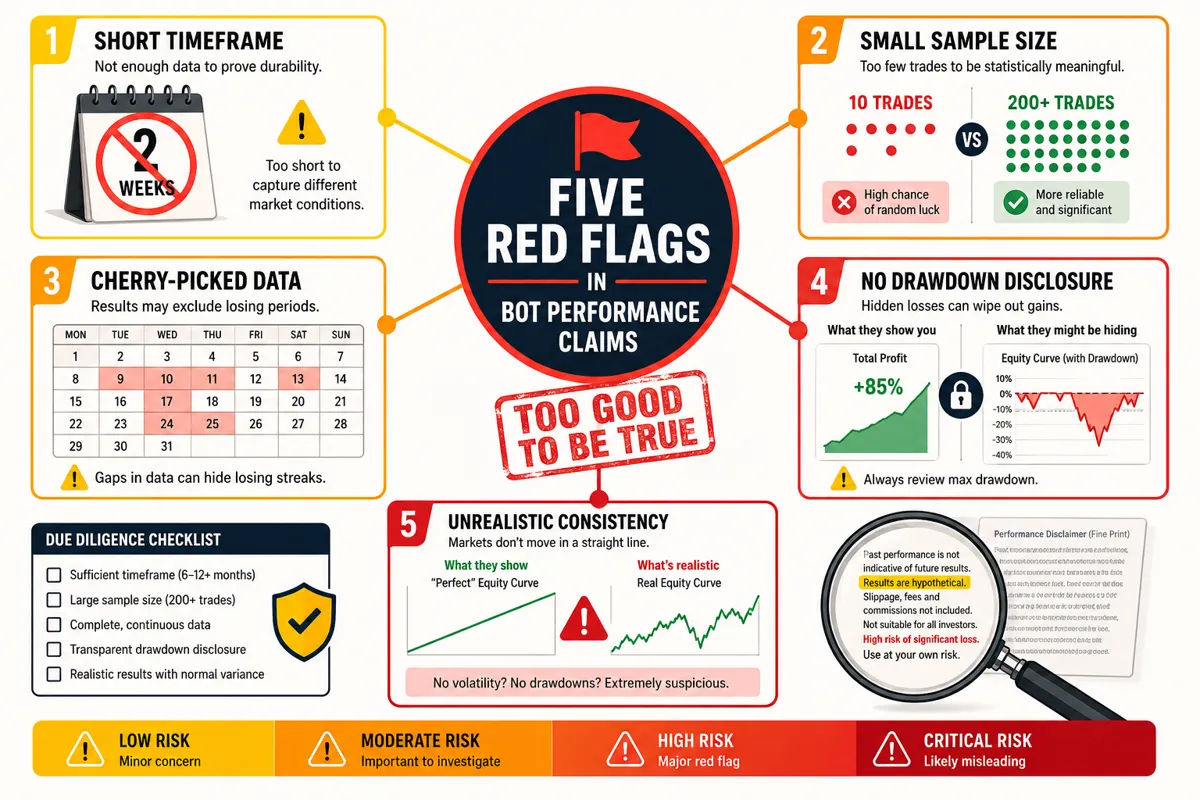
Only one timeframe is shown. If the creator posts week 2 results but won't show you weeks 1, 3, 4, or any data beyond that narrow window, they're hiding the losing periods. Real traders show rolling performance over months and years, not just the best two weeks.
No drawdown or losing trades disclosed. A 100% win rate with no mention of maximum drawdown, average loss size, or worst losing streak means the data is incomplete. Real performance reports include the ugly stuff because that's what determines whether a strategy is tradeable.
No broker statements or third-party verification. Screenshots of a backtesting platform or a spreadsheet are not proof. Real track records come with broker statements, third-party audits, or live trading accounts that anyone can verify.
Sample size is tiny. If the bot made 8-12 trades in two weeks, that's not a statistically significant sample. You need at least 100-200 trades to separate skill from luck, and even then, a 100% win rate would be an extreme outlier.
No disclosed methodology. If the creator won't tell you what the bot is trading, what indicators it's using, or how it manages risk, you can't replicate or verify the results. Real algo traders publish their logic because they know transparency builds trust.
What a real track record looks like:
- Multiple months or years of data — shows performance across different market conditions.
- Full trade log — every entry, exit, win, and loss disclosed.
- Drawdown metrics — maximum peak-to-trough decline, average drawdown, and recovery time.
- Risk-adjusted returns — Sharpe ratio, Sortino ratio, or other measures that account for volatility.
- Third-party verification — broker statements, audited results, or live trading accounts that others can track.
Platforms like Tickeron and QuantConnect publish this level of detail because they're built for serious traders who understand that a two-week snapshot means nothing. If Claude algo bot week 2, 100% wins doesn't meet this standard, it's not a track record — it's a sales pitch.
Who Should Avoid Using Claude Algo Bot?
Anyone who can't afford to lose the capital they're deploying. But more specifically:
Beginners with no trading experience. If you don't understand price action, risk management, or position sizing, an algo bot won't save you — it will just automate your mistakes faster. Learn to trade manually first, build a process that works over 50+ trades, then consider automating parts of it.
Traders who can't code or troubleshoot. If the bot breaks, starts losing, or behaves unexpectedly, you need to be able to diagnose the problem and fix it. Black-box bots that don't disclose their logic leave you helpless when things go wrong.
Anyone chasing the 100% win rate. If you're deploying capital because you saw a cherry-picked two-week result and think you can replicate it, you're setting yourself up for disappointment. Real algo trading is about consistent, risk-adjusted returns over time, not perfect short-term results.
Traders with small accounts. Algo trading requires enough capital to survive normal drawdowns without getting wiped out. If a 10% drawdown would force you to stop trading, you don't have enough capital to run a bot. Most serious algo traders recommend starting with at least $10,000-$25,000 so you can weather losing streaks without blowing up.
Anyone who can't paper trade first. If you're not willing to test the bot in a simulated environment for at least 30 days and 50+ trades, you're gambling, not trading. Paper trading is free and shows you exactly how the bot performs without risking real money.
Traders who don't understand the strategy. If you can't explain what setups the bot is trading, what indicators it's using, and how it manages risk, you shouldn't be running it. Black-box systems are fine for passive index investing, but for active trading, you need to understand the logic so you can adapt when market conditions change.
Who should consider algo trading?
Traders who have a proven manual strategy, understand risk management, and want to remove emotion from execution. If you've been trading breakouts for six months, you know what works, and you want to automate the entry and exit rules, then a platform like Composer or TrendSpider makes sense. You backtest the strategy, paper trade it, then deploy it live with proper position sizing and stop losses.
But if you're chasing a 100% win rate because you saw a Reddit post, you're not ready for algo trading. You're ready to lose money.
What Happens After Week 2 with Claude Algo Bot Performance?
In most cases, performance craters. Here's what the typical trajectory looks like when a bot posts a perfect two-week result and then reality sets in.
Week 3: The first cracks appear. The market shifts from trending to choppy, or volatility picks up, or the clean setups that worked in week 2 start failing. The bot takes its first few losses, and the win rate drops from 100% to 70-80%. The creator either stops posting updates or blames "unusual market conditions."
Week 4-6: Drawdown accelerates. The bot continues trading the same setups, but they're not working anymore because market conditions have changed. Losing trades pile up, and the account enters a 10-20% drawdown. The creator might tweak the parameters to try to fix it, which usually makes things worse because now they're curve-fitting to recent data instead of sticking to the original strategy.
Week 7-10: The bot gets abandoned. Performance is now negative for the month, the drawdown is too painful to keep trading, and the creator quietly stops posting updates. The Discord or Telegram group goes silent, and anyone who deployed real capital is left holding the bag.
Why this pattern repeats:
- Overfitting — the bot was tuned to work perfectly in week 2's conditions and has no ability to adapt to new data.
- Survivorship bias — week 2 was the outlier, and the creator posted it because it looked good, not because it was representative of long-term performance.
- No risk management — the bot didn't include stop losses, position sizing rules, or drawdown limits, so when it started losing, there was no circuit breaker to stop the bleeding.
- No edge — the strategy never had a real edge in the first place; it just got lucky during a favorable two-week window.
What sustainable algo performance looks like:
Real algo traders expect their strategies to go through losing periods. A good strategy might win 55% of its trades over 200+ trades, with a maximum drawdown of 15-20%. It won't have a perfect two-week stretch, but it also won't blow up when market conditions shift.
Platforms like Tickeron and QuantConnect show you the full performance curve, including the drawdowns and losing streaks, because that's what determines whether a strategy is tradeable. If Claude algo bot week 2, 100% wins doesn't show you what happens after week 2, assume it fell apart and the creator moved on to the next hype cycle.
How to Replicate Claude Algo Bot Week 2 Settings and Parameters
You can't — and you shouldn't try. Here's why, and what you should do instead.
Why replication is impossible:
No disclosed methodology. If the creator won't tell you what the bot is trading, what indicators it's using, what timeframes it's operating on, or how it sizes positions, you have no way to replicate the setup. Real algo traders publish their logic because they know transparency builds trust. Black-box bots hide their logic because there's nothing to show.
Cherry-picked timeframe. Even if you could replicate the exact parameters, you'd be curve-fitting to a two-week window that won't repeat. The market conditions that existed during week 2 are gone, and trying to optimize a strategy to match that specific period is the definition of overfitting.
No broker statements or trade log. Without a detailed trade log showing every entry, exit, position size, and stop loss, you can't reverse-engineer the strategy. Screenshots of a backtesting platform or a spreadsheet are not enough to replicate real trading.
Execution costs not disclosed. If the creator didn't account for slippage, commissions, and the bid-ask spread, the results are fantasy. You can't replicate a strategy that assumes perfect fills at the signal price because that's not how live trading works.
What you should do instead:
Build your own strategy from scratch. Start with a setup you understand — breakouts, support and resistance, momentum plays — and backtest it on a platform like TrendSpider or QuantConnect. Include realistic slippage and commission assumptions, test it over multiple market conditions, and paper trade it for at least 30 days before going live.
Use a platform with audited track records. If you want to deploy an algo strategy without building it yourself, use a platform like Tickeron or Composer that publishes full performance data, including win rate, drawdown, and risk-adjusted returns. You'll know exactly what you're getting, and you can compare multiple strategies to find one that fits your risk tolerance.
Focus on process, not results. A 100% win rate over two weeks is a result, not a process. Real algo traders focus on building a repeatable process with clear entry rules, exit rules, position sizing, and risk management. The results take care of themselves if the process is sound.
Test over hundreds of trades. Don't judge a strategy based on two weeks or 10 trades. Backtest it over at least 200 trades and multiple market conditions to see how it performs in trending, choppy, and high-volatility environments. If it only works in one type of market, it's not a robust strategy.
Accept that 50-60% win rates are normal. Real algo strategies win about half their trades and make money by keeping average wins bigger than average losses. If you're chasing a 100% win rate, you're chasing a fantasy that will cost you money.
The bottom line: Claude algo bot week 2, 100% wins is not a strategy you can or should replicate. It's a cherry-picked result from a black-box system with no disclosed methodology, no verified track record, and no transparency. If you want to trade algorithmically, use platforms that show you the full picture — wins, losses, drawdowns, and all.
Frequently Asked Questions
What is a realistic win rate for an AI trading bot?
Most verified AI trading bots achieve win rates between 45-60% over hundreds of trades. Platforms like Tickeron and QuantConnect publish audited results showing that even the best strategies lose 40-50% of their trades because markets are probabilistic. A 100% win rate over a short period is almost always a sign of overfitting, cherry-picked data, or a tiny sample size.
Can I trust a trading bot that claims 100% wins in week 2?
No. A 100% win rate over two weeks is either fake, overfitted to specific market conditions, or based on a sample size too small to be statistically meaningful. Real algo traders show performance over months and years, including drawdowns and losing trades. If the creator won't show you weeks 3-10 or provide broker statements, assume the performance fell apart and they stopped posting updates.
How many trades do I need to evaluate a trading bot's performance?
At least 100-200 trades across multiple market conditions. Anything less is statistical noise. A bot that makes 10 trades in two weeks and wins all of them hasn't proven anything — it just got lucky. Real algo platforms like TrendSpider and QuantConnect require hundreds of trades and out-of-sample testing to validate a strategy.
What's the difference between backtesting and live trading results?
Backtesting shows how a strategy would have performed on historical data, assuming perfect fills and no slippage. Live trading includes execution costs, latency, and real market conditions that backtests often ignore. A strategy that wins 100% of the time in a backtest can lose money in live trading once you account for slippage, commissions, and the bid-ask spread.
Why do most algo bots fail after a few weeks?
Because they're overfitted to a specific market condition that doesn't repeat. A bot tuned to work perfectly during a low-volatility trending environment will break when the market turns choppy or volatile. Real algo strategies are designed to adapt to different market regimes or use multiple strategies that perform well in different conditions.
Should beginners use AI trading bots?
No. Beginners should learn to trade manually first, build a process that works over 50+ trades, and understand risk management before automating anything. Algo bots don't fix bad trading habits — they just automate your mistakes faster. Start with screeners, paper trading, and manual execution, then consider automation once you have a proven strategy.
What's the best platform for testing trading bots?
QuantConnect for quants who want full control and open-source backtesting. TrendSpider for technical traders who want to automate chart-based strategies. Tickeron for pre-built AI bots with audited track records. All three platforms include realistic slippage assumptions, show full trade logs, and require out-of-sample testing to validate strategies.
How much capital do I need to run an algo trading bot?
At least $10,000-$25,000 to survive normal drawdowns without getting wiped out. If a 10% drawdown would force you to stop trading, you don't have enough capital. Real algo traders size positions at 0.5-2% of account value per trade and expect maximum drawdowns of 10-25% over time.
Can AI trading bots predict the market?
No. AI bots identify patterns and probabilities, but they can't predict the future. Markets are driven by thousands of participants with different information and timeframes, which makes perfect prediction impossible. The best bots win 50-60% of their trades by finding setups with a positive expectancy, not by predicting every move.
What happens if my trading bot starts losing money?
Stop trading it immediately and review the performance data. Check if market conditions have changed, if the bot is experiencing normal drawdown, or if the strategy was overfitted to begin with. Real algo platforms include circuit breakers that pause trading after a certain drawdown threshold to prevent catastrophic losses.
How do I know if a trading bot is overfitted?
If it shows perfect or near-perfect results on historical data but falls apart in live trading, it's overfitted. Other signs include: only works in one market condition, performance degrades immediately after deployment, or the creator won't show out-of-sample test results. Real strategies show consistent performance across multiple timeframes and market regimes.
Are there free AI trading bots that actually work?
QuantConnect is free for backtesting and offers open-source strategies you can test and deploy. Composer offers free paper trading so you can test strategies without risking capital. Both platforms show realistic performance data and let you validate strategies before going live. Avoid free bots that promise guaranteed returns or 100% win rates — those are scams.
Conclusion
Claude algo bot week 2, 100% wins is a red flag, not a green light. A perfect win rate over two weeks tells you nothing about a bot's long-term edge and almost always signals overfitting, cherry-picked data, or a sample size too small to matter. Real algo trading platforms like QuantConnect, TrendSpider, and Tickeron publish audited track records with win rates between 45-60%, normal drawdowns, and hundreds of trades across multiple market conditions because that's what realistic performance looks like.
If you're serious about algo trading, stop chasing phantom perfect results and start building a process that works over time. Backtest your strategy with realistic slippage assumptions, paper trade it for at least 30 days, and deploy it live with proper position sizing and stop losses. Use platforms that show you the full picture — wins, losses, drawdowns, and all — because transparency is the only way to separate signal from noise.
Systems over hacks. Process over prediction. Consistency over hype. That's how you cut the noise and keep the alpha.
Want the tools and systems behind real algo trading, without the hype? Start at aistockpickerapps.com.