Apex Trader Funding Review: Rules, Payouts, Bot Policy
By FullStack Alpha Editorial Team | Reviewed by Jay Rocco, Chief Editor
This apex trader funding review covers a futures prop firm that sells simulated evaluations: you pay a monthly fee, hit a profit target inside a trailing drawdown limit, and get a funded (still simulated) account where a cut of the profits is paid out to you. Automated trading is flat-out banned under Apex's user agreement, which prohibits any script, macro, bot, or preconfigured strategy that submits or modifies orders without your personal real-time approval, with termination and forfeiture of unpaid rewards as the stated penalty. Payouts are real and published on Apex's own ledger, but the firm is currently facing multiple federal lawsuits in 2026 alleging withheld profits, and none of those allegations have been proven. Check the official Apex site for current pricing, targets, and drawdown figures before you buy anything, since promo pricing changes constantly.
What You Should Know
- Bots are banned. Apex's user agreement prohibits tools, scripts, macros, or systems that pre-program, batch-submit, pre-load, auto-execute, or modify orders, even partially.
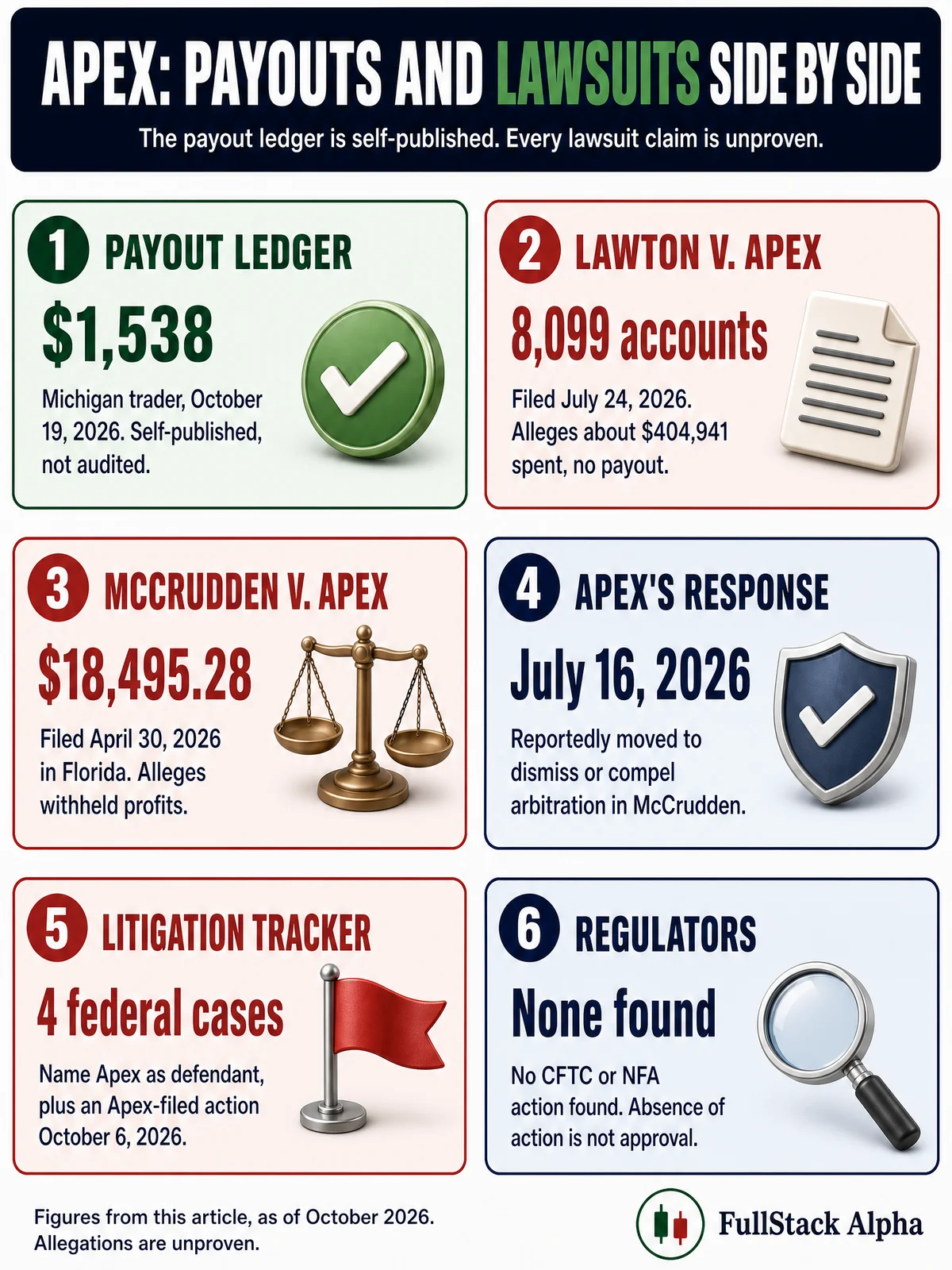
- Lawton v. Apex Trader Funding Inc., case 1:26-cv-02078, was filed in the Western District of Texas on July 24, 2026, alleging the plaintiff bought 8,099 accounts and spent roughly $404,941 with no payout. Allegations are unproven.
- A second case, McCrudden v. Apex Trader Funding, was filed in Florida on April 30, 2026, alleging $18,495.28 in withheld profits. Apex reportedly moved to dismiss or compel arbitration on July 16, 2026. Also unproven.
- Apex publishes a rolling payout ledger. One entry on October 19, 2026 listed a Michigan-based trader receiving $1,538. That's self-published, not independently audited.
- No CFTC enforcement action or NFA disciplinary action against Apex turned up in searches through October 2026. Absence of action is not approval.
What Is Apex Trader Funding and How Does It Work?
Apex Trader Funding is a futures prop firm that sells evaluation accounts. You pay a recurring fee, trade a simulated futures account against a profit target, and if you stay inside the drawdown rules, you move to a "funded" account where you keep an agreed share of simulated profits paid out as compensation.
Notice the word simulated. That's the part most people skim past.
You are not getting handed a brokerage account with real capital in it. Independent industry commentary consistently describes retail futures evaluation programs as simulated products that sit outside the ordinary brokerage-registration model. Apex is in that bucket. Your trades route to a sim environment. Whether the firm hedges any of that flow in live markets is between Apex and its internal books.
So what are you actually buying? A structured test with a payout attached if you pass it, and a monthly subscription if you don't.
The mechanics, in order
- Pick an account size. Apex lists several, from small accounts up to six-figure notional sizes. Check the official pricing page for the current lineup, since Apex rotates plans.
- Pay the evaluation fee. Monthly, usually heavily discounted off the list price.
- Hit the profit target without breaching the trailing threshold drawdown. A trailing drawdown is a loss limit that follows your highest account balance upward, so a big unrealized gain you give back can kill you even if you're still green on the day.
- Pass, then convert to a funded account with an activation or ongoing fee.
- Trade the funded account under the same rules, then request a payout once you meet the minimum trading days and safety-net balance.
Who it suits
Discretionary intraday futures traders who click their own buttons, trade E-mini or micro contracts, close flat before the session cutoff, and want leverage they can't afford to fund personally. That's the honest fit.
Who it doesn't suit shows up later in this apex trader funding review, and it's a longer list than the marketing suggests.
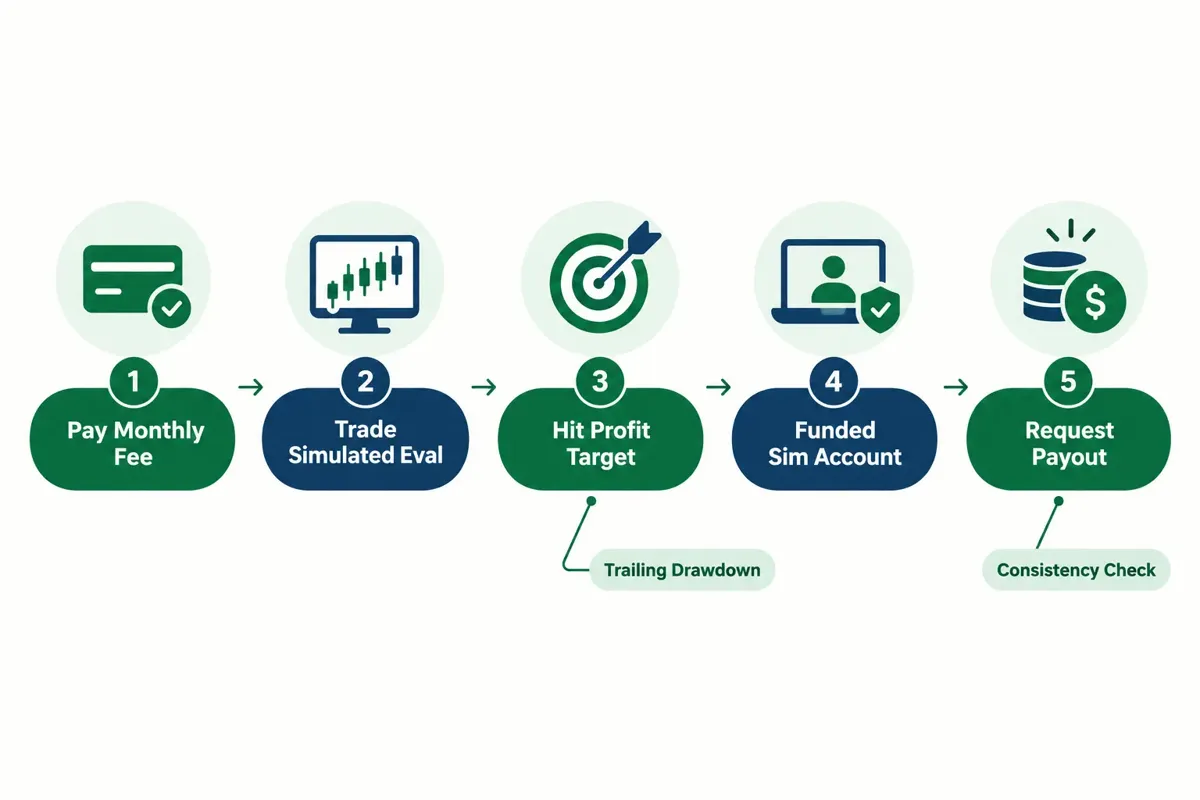
Market truth: The product isn't capital. The product is a rule set with a subscription fee attached, and the firm makes money whether you pass or not.
What Do Apex Rules and Pricing Look Like Now?
Apex's exact fees, targets, and drawdown figures change often, and the firm runs near-constant promotional pricing, so any number printed in an article has a shelf life measured in weeks. Confirm every figure on the official Apex Trader Funding pricing page before buying.
Here's the structure, with placeholders where the number genuinely needs to come from the source rather than a guess:
| Account size | Monthly fee | Profit target | Trailing drawdown | Notes |
|---|---|---|---|---|
| Small (micro-focused) | Check the official page | Check the official page | Trailing threshold, follows balance highs | Lowest cost entry, fewest contracts |
| Mid-tier | Check the official page | Check the official page | Trailing threshold | Most common tier bought |
| Large / six-figure notional | Check the official page | Check the official page | Trailing threshold | Highest contract allowance, highest fee |
| Static drawdown variant | Check the official page | Check the official page | Fixed, does not trail | Different risk math entirely |
Structure as described on Apex's public site and independent rule summaries, checked October 2026. Figures intentionally not stated because promo pricing was active and would be stale by publication.
The rules that actually end accounts
Session cutoff. Apex generally requires positions closed and pending orders cancelled before 4:59 p.m. Eastern Time. The public site describes a trading session that opens at 6:00 p.m. ET and ends the following afternoon. Plan-specific documentation controls if it differs from the general page. Holding past the cutoff is one of the easiest ways to fail, and it's entirely self-inflicted.
Trailing threshold drawdown. This is the rule that catches people who've only traded with a fixed stop-out. If your balance peaks at a high-water mark intraday, your floor moves up with it. Give back a big open profit and you can breach while still showing a winning week.
News trading. Not categorically banned. Apex reportedly prohibits strategies built specifically to exploit scheduled news releases for windfall profits, including certain pre-news directional or multidirectional entries. Straddling a Fed announcement with brackets on both sides is the classic version. Play stupid games.
Copy trading. Independent rule summaries report that copying trades between your own Apex accounts is permitted. Copying from another trader, using a third-party copier, or letting someone else trade your account can get you terminated.
Consistency. Apex has used consistency-style requirements on payouts at various points. Confirm the current rule on the official payout page, because this one has changed more than once.
Common mistake
Buying five accounts on day one because the promo made them cheap. You now have five subscriptions, five drawdowns, and one attention span. Position sizing applies to your account purchases too.
Does Apex Allow Algo Trading and Bots?
No. Apex Trader Funding prohibits automated and algorithmic order execution. The user agreement, as published and checked on October 23, 2026, bars any tool, script, macro, or system that pre-programs, batch-submits, pre-loads, auto-executes, modifies, or otherwise automates order entry or modification, even partially.
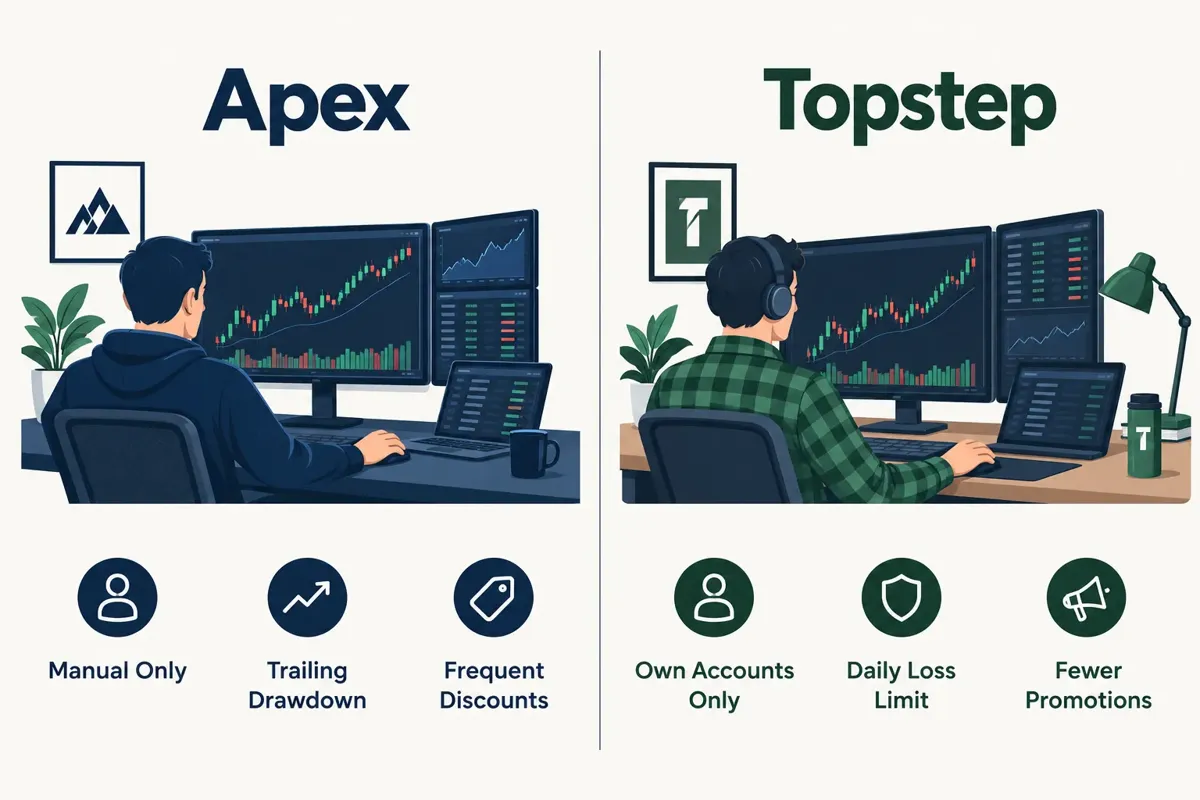
That phrase "even partially" is doing a lot of work. Read it again.
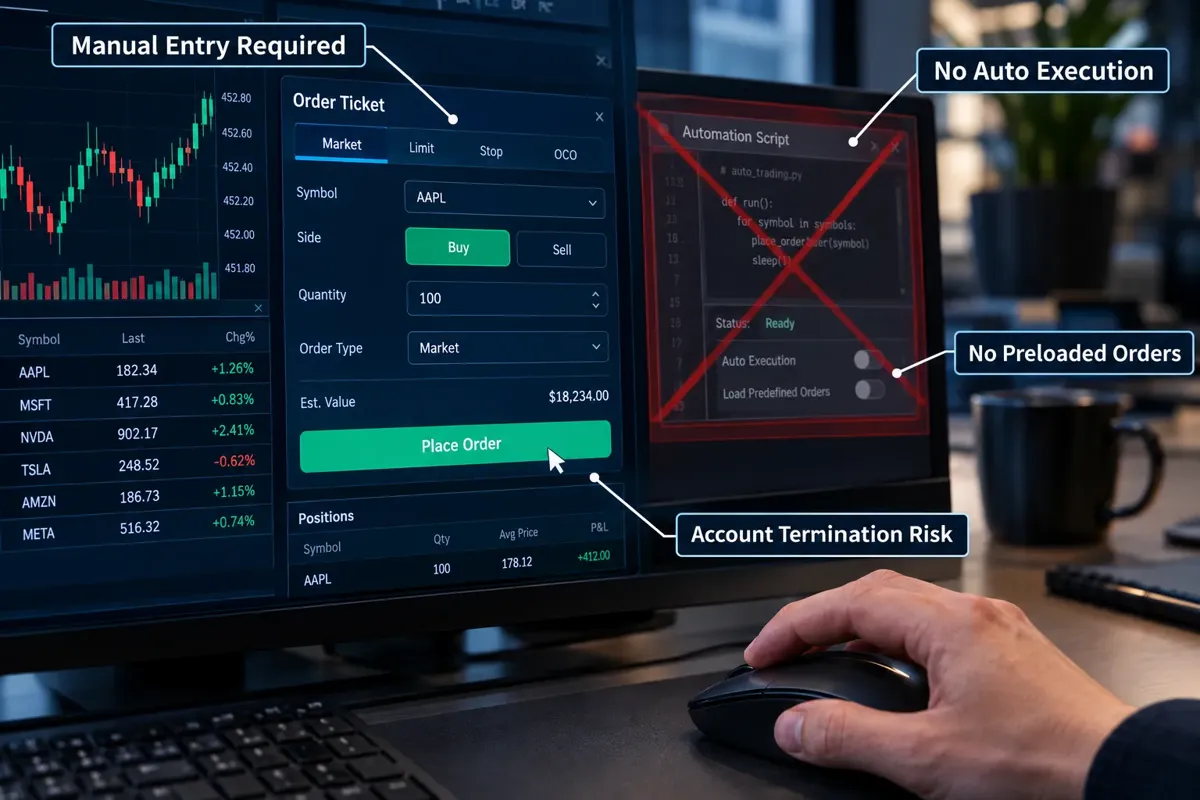
What the prohibition covers
The agreement reportedly goes further than banning a fully autonomous robot. It also bars:
- Preconfigured bots or strategies that place, modify, or cancel orders based on preset conditions, signals, or market events.
- Order submission without your personal, real-time review and approval. Meaning a human has to look at it and say yes, each time.
- Partial automation. Semi-auto setups, signal-to-execution bridges, and one-click macros that fire a sequence all land in the grey-to-red zone.
Apex may monitor trading activity. The agreement states a violation can result in immediate account termination and forfeiture of pending or unpaid rewards, at the company's discretion. "At the company's discretion" is the part you should price in before you test the boundary.
Decision rule
Choose Apex only if you trade manually. If you run Expert Advisors, API execution, trade automation, machine-generated order logic, or any HFT-flavoured system, Apex is the wrong venue even though NinjaTrader, Tradovate, and Rithmic-connected platforms technically support those functions. Platform capability is not permission.
If automation is your whole edge, you're better off in an environment built for it. Our coverage of AI trading bots by broker walks through which execution venues allow it, and whether AI trading is legit is worth reading before you buy anyone's algorithm.
Edge case: trailing stops and brackets
Bracket orders and platform-native trailing stops attached to a trade you placed yourself are a different animal from a bot that generates entries. Apex has historically allowed standard order types. The firm's own support documentation is the only safe authority here, because the agreement language is broad enough to read either way. Ask in writing, keep the reply.
Takeaway: If a machine decides when to enter, you're offside. If you decide and the platform manages the exit you attached, you're probably fine. Get it confirmed in writing anyway.
Does Apex Trader Funding Pay Out?
Apex publishes individual payout entries on a rolling public ledger, and the firm has processed a large volume of them. On October 19, 2026, that page listed a Michigan-based trader with a payout of $1,538. That's real evidence payouts happen. It is not an independently audited payout report, and it's published by the company whose payouts are being verified.
Separate the two categories cleanly, because they do not say the same thing.
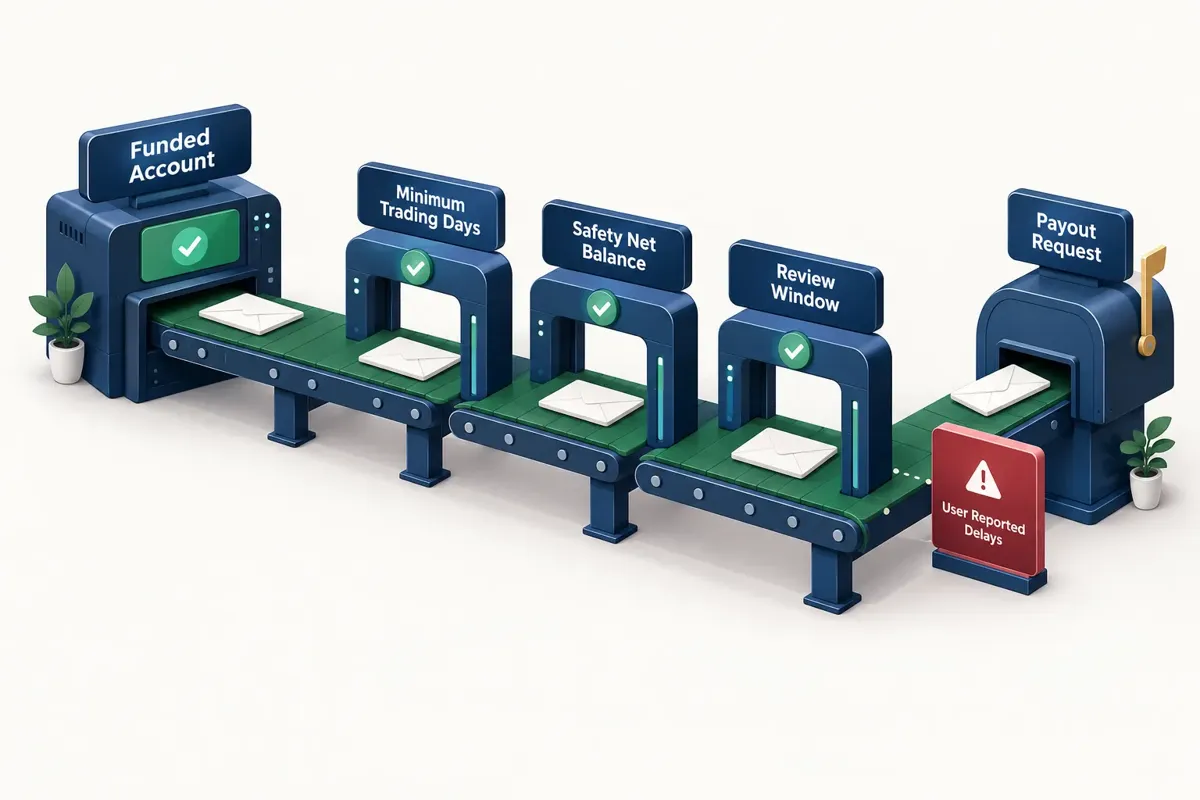
What Apex officially requires
To request a payout from a funded account, traders generally need to clear a few gates. Current specifics live on Apex's payout page, and they've been revised:
- A minimum number of qualifying trading days before the first request.
- A safety-net balance above the starting balance, not just a profit.
- Consistency-style requirements on how profits were distributed across days.
- No rule breaches, including the automation prohibition.
What users report
Payout timelines reported by traders in public forums vary widely, from a few business days to multi-week waits during busy periods. Treat forum timelines as anecdotes, not a service-level agreement. Apex's own stated processing window is the only figure worth quoting, and it's on the official page.
What the lawsuits allege
Two filings matter for anyone weighing this apex trader funding review against the marketing.
Lawton v. Apex Trader Funding Inc., case 1:26-cv-02078, filed in the Western District of Texas on July 24, 2026. The complaint reportedly alleges the plaintiff purchased 8,099 accounts, spent or lost approximately $404,941, and received no payout, asserting a Commodity Exchange Act-related claim. No merits judgment had been entered as of the latest available docket reporting.
McCrudden v. Apex Trader Funding, filed in Florida on April 30, 2026. The plaintiff alleges Apex withheld $18,495.28 in trading profits and that more than $50,000 was paid in fees and related charges. Apex reportedly moved on July 16, 2026 to dismiss or compel arbitration.
A litigation tracker updated in October 2026 reported four federal cases naming Apex as a defendant, plus a new Apex-filed action dated October 6, 2026. The tracker itself cautions that some complaints were not yet available and that allegations should not be read as adjudicated misconduct.
Allegations are allegations. Buying 8,099 accounts is also, independently, a decision worth examining. Both things can be true.
Is Apex Legit and What Do Reddit Users Say?
Apex Trader Funding is a real operating company with a long trading history, a published payout ledger, and a large user base. Is Apex legit in the sense of being a functioning business that pays some traders? Yes. Is it a regulated brokerage holding your capital? No, and no one should treat it as one.
The trust signals that hold up
- Years of continuous operation in the futures evaluation space, which is longer than most competitors have lasted.
- A public, rolling payout ledger with named individual entries.
- Clear, written, findable rules, including the bot prohibition. Vague firms are worse than strict ones.
- No CFTC enforcement action or NFA disciplinary action identified in searches through October 2026.
The signals that should slow you down
- Four federal cases naming Apex as a defendant per the October 2026 litigation tracker, with 2026 filings among them.
- Arbitration clauses. Apex reportedly moved to compel arbitration in the McCrudden matter, which, if granted, means disputes resolve privately rather than in open court.
- The simulated-product structure itself. A September 17, 2026 CFTC staff letter was reported as providing limited no-action-style relief for qualifying passive software providers connecting users to registered FCMs, introducing brokers, or designated contract markets. Nothing in that reporting indicates Apex's simulated evaluation program became a registered brokerage product.
On Reddit
Public discussion across r/FuturesTrading, r/Daytrading, and prop-firm-specific subs is heavy, polarised, and mostly unverifiable at the individual level. This review will not quote a comment it cannot link with a verified permalink, because screenshot-sourced "Reddit says" is how half the prop firm review industry manufactures credibility.
What is fair to say: the discussion skews toward rule complaints and payout timing, which is normal for Reddit, where people post when they're annoyed. Solicited review-site scores skew the other way. The gap between the two is the finding, not either number on its own.
If you're evaluating any trading product, our checklist of AI trading bot red flags applies to prop firms almost line for line.
How Many Days Does It Take to Pass the Apex Eval?
The honest answer is that the rules set a minimum, not an average. Apex requires a minimum number of qualifying trading days before a funded account becomes payout-eligible, and the evaluation itself can technically be completed as soon as you hit the profit target inside the drawdown. Check the official page for the current minimum day count, since it's been revised.
No one can give you a credible average, and anyone who quotes one is making it up.
What determines your timeline
- Your position sizing. Trade bigger and you hit the target faster, and you breach the trailing drawdown faster too. Same lever, both directions.
- The trailing threshold. A fast start raises your floor. Many traders pass the target and then fail on the giveback.
- Your consistency. If the current rules include a per-day profit cap relative to total profit, one monster day can delay eligibility rather than accelerate it.
- The tape. Grinding a choppy tape in a low-volatility stretch takes longer than a trending one. That's not a skill issue, that's conditions.
The mistake that costs the most
Sizing up to compress the timeline. The eval fee is a monthly cost, so people rush to stop paying it, and the rush is what fails them. Paying one extra month of fees is cheaper than blowing the account and paying a reset.
If your process depends on speed, you don't have a process. You have a deadline.
Topstep vs Apex for Bot Traders
For automated traders, neither firm is a good home, and the topstep vs apex question mostly comes down to which restrictions annoy you less. Both prohibit third-party copy trading and require the trader to be the one making decisions. Verify each firm's current rule page before committing, because both update terms.
| Factor | Apex Trader Funding | Topstep |
|---|---|---|
| Automated bots / EAs | Prohibited. Scripts, macros, pre-loaded or auto-executing orders barred, even partially | Restricted. Confirm current automation language on Topstep's official rules page |
| Copy trading | Permitted between your own Apex accounts. Third-party copiers and other-trader copying can trigger termination | Generally limited to your own accounts. Check official page |
| Drawdown style | Trailing threshold on most plans, static variant available | Trailing, with a separate daily loss limit on evaluation |
| Daily loss limit | Not the primary mechanism on standard plans | Yes, a core part of the ruleset |
| Session cutoff | Positions flat before 4:59 p.m. ET; session opens 6:00 p.m. ET | Firm-specific close requirement, check official page |
| News trading | Allowed, but strategies built to exploit scheduled news for windfalls are prohibited | Firm-specific restrictions apply |
| Promotional pricing | Frequent, heavy discounting | Less aggressive discounting historically |
| Public litigation profile (Oct 2026) | Four federal cases naming Apex as defendant per litigation tracker | No equivalent cluster identified in these searches |
Compiled from each firm's public rule documentation and independent rule summaries as of October 2026. Both firms revise terms; the official pages control.
Decision rule for the apex vs topstep call
- Choose Apex if you trade manually, want multiple cheap accounts during a promo, and prefer a trailing-threshold-only framework with no separate daily loss limit to babysit.
- Choose Topstep if a hard daily loss limit helps your discipline, and you'd rather have a firm with a quieter legal docket.
- Choose neither if your edge is automated. Point your capital at a live brokerage account that permits API execution and stop renting rules that forbid your entire strategy.
Running a bot on a platform that bans bots isn't an edge. It's a termination clause with a delay built in.
Who Should Skip Apex?
Skip Apex if any of the following describe you. These aren't edge cases, they're the most common mismatches.
- Algo and bot traders. The prohibition covers partial automation. There's no clever workaround that survives monitoring.
- Crypto traders. Apex is a futures evaluation firm. Any crypto exposure is limited to listed crypto futures products available on the supported exchanges and platform, and spot cryptocurrency trading is not part of the offering. Confirm the current product list on the official platform page.
- Swing traders. Positions must be flat before the daily cutoff. Holding overnight isn't a strategy here, it's a violation.
- Anyone who can't absorb the fee. Monthly evaluation costs, activation fees, and resets compound. If the subscription is a strain, the pressure will wreck your decisions.
- Traders who've never used a trailing drawdown. Paper trade it first on a sim account with the same mechanic before you pay for one.
- Anyone expecting a regulated brokerage relationship. It's a simulated evaluation product. Price that into your expectations.
What Disqualifies You From Apex Trader Funding?
Account termination or evaluation failure typically comes from a specific, written breach. The ones that end most accounts:
- Breaching the trailing threshold drawdown. Hard fail.
- Holding past the 4:59 p.m. ET flat requirement or leaving pending orders live into the close.
- Using any automation. Bots, scripts, macros, API execution, batch-submitted or pre-loaded orders.
- Copy trading from another person, using a third-party copier, or letting someone else trade your account.
- News-exploitation strategies built specifically to capture windfalls around scheduled releases.
- Exceeding contract limits for your account tier.
- Account sharing or identity issues on the agreement and KYC side.
Violations can trigger immediate termination and forfeiture of pending or unpaid rewards, at the firm's discretion. Read the current user agreement yourself. It's the single highest-return hour in this whole process.
How Long Does It Take to Get Approved, and What Does the Signup Cost?
Signing up for an Apex evaluation is close to instant. You pick a plan, pay the fee, and receive platform credentials, typically the same day. There's no application review, no capital verification, and no credit check, because you're buying a subscription, not opening a brokerage account.
That speed is a feature and a warning. A product that takes your money in ninety seconds has no interest in whether you're ready.
Payout approval is the slower gate. That requires minimum trading days, a safety-net balance, rule compliance, and identity verification. Budget weeks, not hours, and confirm the stated processing window on the official payout page rather than a forum thread.
Minimum account size
The entry point is whatever Apex's smallest plan costs that month, not a capital deposit. There's no $25,000 requirement, no PDT-style gate, and no funding minimum, because you never deposit trading capital. Check the official pricing page for the current smallest tier and its contract limit.
Which Apex Account Size Fits Your Risk Budget?
The right account size isn't the biggest one you can afford during a promo. It's the one where your typical stop loss, measured in ticks and multiplied by your contract count, leaves you room to be wrong several times in a row without touching the trailing drawdown.
Run your own numbers below rather than guessing from the marketing page.
FullStack Alpha
What passing really costs you
The sticker price is one attempt. This works out what passing actually costs you at your own pass rate, and how long funded profit takes to pay it back.
Expected attempts is 1 divided by your pass rate, so a 25% rate means four tries on average. Promotional pricing moves often, so re-check the current price and split on the firm's own page. The profit figure is your own estimate and nothing here forecasts it. Most funded accounts are lost before they pay out.
Common Mistakes Traders Make With Apex
The failure modes repeat with depressing regularity. None of them are exotic.
- Buying too many accounts during a promo. Cheap is not free. Five accounts means five sets of rules and five monthly charges.
- Treating the trailing drawdown like a static one. The floor moves up. Plan for giveback, not just for loss.
- Revenge trading after a reset. The reset fee already stung. Doubling size to earn it back is how the second account dies.
- Trading right into the 4:59 p.m. ET cutoff and getting flattened by an auto-liquidation you could have avoided by closing at 4:30.
- Assuming platform capability equals permission. NinjaTrader supports automation. Apex forbids it. Those two facts coexist.
- Skipping the user agreement, then arguing about a rule after the forfeiture email.
- Sizing for the target instead of the drawdown. Survive first. The target takes care of itself if you're still trading in week six.
If you want a cleaner read on whether your process is good enough before you rent someone else's rules, journaling tools like TradeZella make the pattern obvious faster than another month of evaluations will. And if your strategy needs backtesting before it meets a drawdown rule, QuantConnect is the serious option, with the obvious caveat that whatever you build there can't execute automatically inside Apex.
Apex Trader Funding Alternatives and Competitors
The futures evaluation space has several established players, and they differ mainly on drawdown mechanics, daily loss limits, and automation policy. Verify each firm's current rules directly, because this category rewrites terms often.
- Topstep. The best-known alternative. Uses a daily loss limit alongside its drawdown, which some traders find more protective and others find constraining.
- Take Profit Trader, Elite Trader Funding, MyFundedFutures, Bulenox. Comparable structures with varying targets, drawdown styles, and payout schedules. Compare rule pages, not promo banners.
- A live retail futures account. If you can fund a few thousand dollars and trade micros, you own the account, you keep 100% of the gains, and no one can forfeit your balance for a rule interpretation. Lower leverage, far fewer rules.
- Equity and options tooling instead. If what you want is a better read on setups rather than more leverage, a scanner does more for you than a funding challenge. The TrendSpider pattern scanner and Blackboxstocks both sit in that category.
Decision rule: If you'd be unprofitable on a $3,000 live micro account, a $150,000 simulated one won't fix it. It'll just make the mistakes louder.
Frequently Asked Questions
How many days does it take to pass the Apex eval?
There's no official or verifiable average, only a minimum number of qualifying trading days before payout eligibility. Check Apex's current rules page for that figure. Your actual timeline depends on position sizing, the trailing drawdown, and market conditions. Traders who rush the target by sizing up usually breach the drawdown before they reach it.
Is being a funded trader worth it?
It's worth it only if you're already consistently profitable on a smaller live or sim account. A funding program multiplies an existing edge, it doesn't create one. Factor in monthly fees, activation costs, reset fees, and the profit split, then compare that total against simply trading micro futures in your own account where nobody can void your balance.
Does Apex Trader Funding actually pay out?
Yes, Apex publishes a rolling payout ledger with named entries, including one on October 19, 2026 listing a trader "Shawn" in Michigan receiving $1,538. That ledger is self-published, not independently audited. Separately, multiple 2026 federal lawsuits allege withheld profits, including a Florida case claiming $18,495.28 was withheld. Those allegations remain unproven.
How much does it cost to trade with Apex?
Costs include a recurring evaluation fee, an activation or ongoing funded-account fee, optional reset fees, and platform or data fees depending on your setup. Exact amounts change with frequent promotions, so check the official Apex pricing page. One plaintiff in a 2026 Florida filing alleged paying more than $50,000 in fees and related charges overall.
Is there an Apex discount code?
Apex runs promotional pricing frequently, but this review won't confirm any specific apex discount code, because codes expire and listing a dead one helps nobody. Check the official Apex site's own promotions banner, which is where current offers are published. Treat third-party coupon sites as affiliate funnels, not as a source of truth.
Can you trade cryptocurrencies with Apex Trader Funding?
Not spot crypto. Apex is a futures evaluation firm, so any crypto exposure would be limited to listed crypto futures contracts available on the supported exchanges and platform. Confirm the current tradable product list on the official platform page, since available contracts change with exchange listings.
Does Apex allow copy trading?
Copying trades between your own Apex accounts is permitted according to independent rule summaries. Copying from another trader, using a third-party copy-trading service, or letting another person trade your account can result in termination. The distinction is whether the decisions originate from you.
Our Take
For bot traders, the verdict in this apex trader funding review is simple: skip it. The automation prohibition isn't a grey area you can creatively interpret. It covers scripts, macros, pre-loaded orders, and partial automation, and the stated penalty is termination plus forfeiture of unpaid rewards at the firm's discretion. Running an algorithm there is a countdown, not a strategy.
For disciplined manual intraday futures traders, Apex is a functioning, long-operating option with published payouts and clearly written rules. The four federal cases naming the firm as of October 2026 are unproven allegations, but they belong in your decision alongside the promo price. Read the user agreement, size for the drawdown instead of the target, and never buy more accounts than you can trade.
Systems over hacks. Discipline beats the discount code.
Weighing Apex against firms that allow automation? See how we score prop firms and tools before you pay for an evaluation.
Stay alpha.